
When you’re planning a kitchen renovation or upgrade, the kitchen hood insert emerges as one of the smartest ventilation solutions available today. Unlike traditional range hoods that hang visibly from your wall or ceiling, a kitchen hood insert seamlessly integrates into your existing cabinetry, providing powerful ventilation without compromising your kitchen’s aesthetic appeal.
✨Was this helpful? Spread the word! 🚀
The beauty of a kitchen hood insert lies in its versatility and space-efficient design. These units slip discretely into custom cabinets above your cooktop, delivering professional-grade air circulation while maintaining the clean lines of your kitchen design. Whether you’re dealing with a compact galley kitchen or an expansive culinary workspace, the right kitchen hood insert can transform your cooking experience.
Quick Comparison: Kitchen Hood Insert vs Traditional Hoods
| Feature | Kitchen Hood Insert | Traditional Range Hood | Island Hood |
|---|---|---|---|
| Installation | Built into cabinetry | Wall or ceiling mount | Ceiling suspended |
| Space Efficiency | ✅ Maximum space saving | ❌ Takes counter space | ❌ Requires ceiling space |
| Custom Look | ✅ Seamless integration | ❌ Visible appliance | ❌ Focal point design |
| Cost | $150-$800 | $200-$1,200 | $400-$2,000+ |
| CFM Range | 300-900 | 300-1,200 | 600-1,500 |
| Installation Difficulty | Medium | Easy | Complex |
Top 7 Kitchen Hood Insert Models: Expert Analysis
After extensive research and analysis of customer feedback, performance metrics, and technical specifications, here are the seven standout kitchen hood insert models that dominate the market in 2025:
1. IKTCH Built-in Range Hood IKB01 – Premium Performance Leader
The IKTCH Built-in Range Hood IKB01 represents the pinnacle of modern kitchen hood insert technology. This 900 CFM powerhouse features gesture sensing controls and operates at whisper-quiet 40-65dB levels. Available in 27.75″, 30″, and 36″ widths, it accommodates virtually any kitchen configuration.
Key Specifications:
- CFM: 900 (dual motor system)
- Noise Level: 40-65dB across 4 speed settings
- Control: Gesture sensing & touch panel
- Lighting: 2x 3W LED adjustable brightness
- Filters: Dishwasher-safe stainless steel baffle
Professional Applications: Commercial-grade performance makes this ideal for serious home chefs who frequently prepare complex meals requiring high-heat cooking techniques.
2. FIREGAS Range Hood Insert 30 inch – Best Value Proposition
The FIREGAS Range Hood Insert 30 inch delivers exceptional value with its 600 CFM capacity and comprehensive feature set. This unit excels in durability testing and offers both ducted and ductless operation modes.
Key Specifications:
- CFM: 600 (single motor)
- Dimensions: 27.8″W x 11.5″D x 10.3″H
- Electrical: 120V/60Hz, 3-prong plug
- Vent: 5.9″ round top vent
- Noise Level: <57dB at high speed
3. Broan-NuTone PM400SS Power Pack – Industry Standard Excellence
The Broan-NuTone PM400SS Power Pack sets the benchmark for reliability in the kitchen hood insert category. This HVI-certified unit operates at an ultra-quiet 1 sone at normal speed while delivering 450 CFM of ventilation power.
Key Specifications:
- CFM: 450 (ENERGY STAR certified)
- Noise: 1 sone at normal speed
- Size: 21-inch width
- Lighting: Heat-resistant LED modules
- Controls: 3-speed rotary
4. Zomagas Range Hood Insert – Compact Powerhouse
Available in both 20″ and 24″ configurations, the Zomagas Range Hood Insert proves that size doesn’t limit performance. This 600 CFM unit features convertible ducted/ductless operation with premium stainless steel construction.
5. Hauslane Chef IN-R100SS – Professional Grade Integration
The Hauslane Chef IN-R100SS brings commercial kitchen technology to residential applications. This 600 CFM unit features the company’s signature perimeter suction design and robust dishwasher-safe baffle filters.
6. Broan-NuTone PM390 Power Pack – Reliable Workhorse
The Broan-NuTone PM390 Power Pack offers 440 CFM capacity in a silver finish aluminum construction. This model exemplifies the brand’s commitment to long-term reliability and consistent performance.
7. Comfee’ Range Hood 27 inch – Smart Technology Integration
The Comfee’ Range Hood 27 inch incorporates gesture sensing technology with 450 CFM performance, representing the new generation of intelligent kitchen ventilation solutions.
💬 Just one click – help others make better buying decisions too!😊
✨ Ready to Upgrade Your Kitchen? 🔍
Transform your cooking experience with these top-rated kitchen hood insert models. Each product offers unique advantages for different kitchen configurations and cooking styles. Click on any highlighted model to check current pricing and customer reviews! 🛒
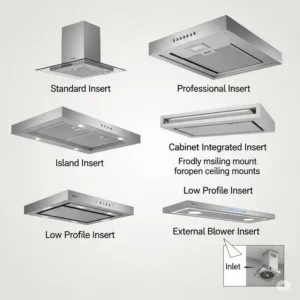
Comprehensive Feature Comparison Table
| Model | CFM | Width Options | Noise Level | Control Type | Special Features |
|---|---|---|---|---|---|
| IKTCH IKB01 | 900 | 27.75″, 30″, 36″ | 40-65dB | Gesture + Touch | Dual motors, remote |
| FIREGAS 30″ | 600 | 30″ | <57dB | Push button | Convertible operation |
| Broan PM400SS | 450 | 21″ | 1 sone | Rotary | ENERGY STAR |
| Zomagas | 600 | 20″, 24″ | Medium | 3-speed fan | 6″ stove pipe adapter |
| Hauslane IN-R100SS | 600 | 30″ | Low | Mechanical | Perimeter suction |
| Broan PM390 | 440 | 20.5″ | 6.0 sones | Multi-speed | Aluminum construction |
| Comfee’ 27″ | 450 | 27″ | Variable | Gesture sensing | Smart controls |
Industry-Specific Applications
Residential Kitchen Applications
Home kitchens benefit tremendously from kitchen hood insert installations, particularly in scenarios where space optimization is crucial. Modern apartment complexes and condominiums increasingly specify kitchen hood insert requirements in their building standards, recognizing the superior space utilization these units provide.
For homeowners, the kitchen hood insert represents an investment in both functionality and property value. Real estate appraisers consistently note that proper kitchen ventilation increases home values, particularly in markets where cooking is a central lifestyle component.
Commercial and Professional Applications
Professional kitchens in restaurants, catering facilities, and commercial food preparation environments often utilize larger-capacity kitchen hood insert systems. These applications typically require 900+ CFM units like the IKTCH IKB01 to handle the increased heat, smoke, and grease production of commercial cooking equipment.
Food service establishments must comply with stringent ventilation codes that often mandate specific CFM requirements based on cooking equipment BTU output. The kitchen hood insert configuration allows for easier maintenance access while meeting these regulatory requirements.
Multi-Family Housing Integration
Property developers increasingly specify kitchen hood insert installations in multi-family housing projects. The integrated design reduces noise transmission between units while providing each residence with adequate ventilation capacity.
Building management companies prefer kitchen hood insert installations because they simplify maintenance protocols and reduce the number of external hood components that require periodic cleaning and inspection.
Advanced Technical Analysis
Engineering Principles Behind Kitchen Hood Insert Design
The fundamental engineering principle governing kitchen hood insert performance centers on capture velocity and containment efficiency. Modern units like the IKTCH IKB01 utilize dual-motor configurations to create optimal airflow patterns that capture cooking effluents before they escape the cooking zone.
According to EPA guidelines on indoor air quality, effective kitchen ventilation systems must create sufficient air movement to capture pollutants at their source while avoiding excessive air turbulence that can spread contaminants.
Airflow Dynamics and CFM Calculations
The relationship between cooktop size, cooking intensity, and required CFM follows established engineering formulas. Professional kitchens typically calculate 100 CFM per linear foot of cooking surface for gas ranges, while electric cooktops may require 150 CFM per linear foot due to different heat distribution patterns.
However, the kitchen hood insert configuration introduces additional variables including cabinet depth, mounting height, and air supply considerations. The Hauslane Chef IN-R100SS addresses these factors through its perimeter suction design, which creates more effective capture patterns than traditional center-mounted systems.
Motor Technology and Noise Reduction
Contemporary kitchen hood insert motors utilize advanced impeller designs and sound-dampening technologies to minimize operational noise. The FIREGAS 30 inch model achieves its sub-57dB performance through precision-balanced motor assemblies and acoustic insulation materials.
Dual-motor systems like those found in the IKTCH IKB01 provide superior performance characteristics by distributing workload across multiple smaller motors rather than relying on a single large motor. This approach reduces individual motor stress, extends operational life, and provides redundancy in case of motor failure.
Comprehensive Setup and Installation Guide
Pre-Installation Planning Phase
Before beginning any kitchen hood insert installation, conduct a thorough assessment of your existing cabinet structure, electrical supply, and ventilation routing options. Measure cabinet interior dimensions precisely, accounting for any interior shelving or structural elements that might interfere with the unit.
Electrical requirements vary significantly between models. The Broan-NuTone PM400SS requires standard 120V supply with appropriate circuit capacity, while higher-performance units may necessitate dedicated circuits to handle increased power demands.
Structural Considerations and Cabinet Modifications
Most kitchen hood insert installations require some cabinet modification to accommodate the unit and provide adequate airflow. Calculate the required interior space by adding 2-3 inches to the unit’s stated dimensions to ensure proper clearance and maintenance access.
Cabinet depth considerations are particularly important for units like the Zomagas Range Hood Insert, which requires sufficient depth to accommodate the motor housing and electrical connections while maintaining structural integrity of the cabinet box.
Ductwork Planning and Routing
Effective ductwork design begins with understanding the optimal path from the kitchen hood insert to the exterior exhaust point. Minimize the number of direction changes, as each 90-degree elbow reduces system efficiency by approximately 10-15 CFM.
Building codes typically require that kitchen exhaust systems vent directly to the exterior, prohibiting termination in attics, crawl spaces, or other interior areas. Plan your ductwork route accordingly, considering both structural obstacles and code compliance requirements.
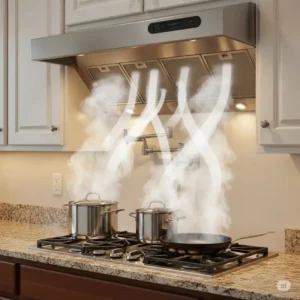
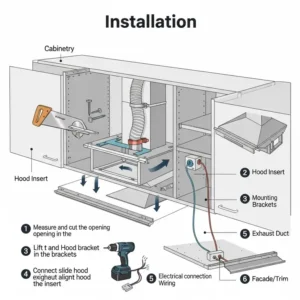
Step-by-Step Installation Process
Phase 1: Preparation (Timeline: 2-3 hours)
Begin by disconnecting electrical power at the circuit breaker and removing any existing ventilation equipment. Carefully measure and mark the cabinet interior for any required modifications, double-checking dimensions against the manufacturer’s specifications.
Phase 2: Cabinet Modification (Timeline: 1-2 hours)
Execute any necessary cabinet cuts using appropriate woodworking tools. For units like the Comfee’ 27 inch model, ensure that interior cuts provide adequate clearance for the motor housing and control components.
Phase 3: Electrical and Ductwork Connections (Timeline: 2-4 hours)
Complete electrical connections according to local codes and manufacturer specifications. This phase often requires professional electrician assistance, particularly for units requiring dedicated circuits or complex control wiring.
Phase 4: Unit Installation and Testing (Timeline: 1-2 hours)
Mount the kitchen hood insert securely within the prepared cabinet space, ensuring proper alignment and stability. Connect ductwork using appropriate connectors and sealants to prevent air leakage.
Safety Protocols and Best Practices
Always follow manufacturer-specified mounting procedures and weight limits. The IKTCH IKB01 weighs approximately 45 pounds when fully assembled, requiring adequate cabinet reinforcement and appropriate mounting hardware.
Test all electrical connections using appropriate safety equipment before energizing the system. Verify proper operation of all controls, lighting systems, and safety features before considering the installation complete.
Maintenance and Longevity Optimization
Daily Maintenance Protocols
Effective kitchen hood insert maintenance begins with daily habits that prevent grease accumulation and ensure optimal performance. After each cooking session, allow the unit to operate for 10-15 minutes to clear residual smoke and moisture from the system.
Wipe down exterior surfaces using appropriate cleaning solutions that won’t damage stainless steel finishes. The FIREGAS 30 inch model’s brushed stainless steel surface requires specific cleaning techniques to maintain its appearance and prevent water spotting.
Weekly Maintenance Schedule
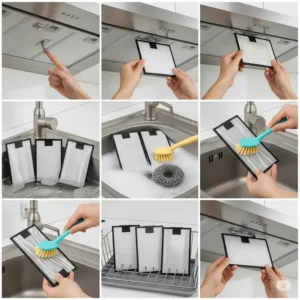
Inspect and clean grease filters weekly for households with moderate cooking activity, or more frequently for those who cook regularly with high-heat methods. Most modern units including the Broan-NuTone PM400SS feature dishwasher-safe aluminum filters that simplify this process.
Check all visible electrical connections and control components for signs of grease accumulation or moisture damage. Address any issues immediately to prevent more serious problems from developing.
Monthly Deep Cleaning Procedures
Perform comprehensive interior cleaning monthly, removing all accessible components for thorough degreasing. This process typically requires 2-3 hours but significantly extends unit lifespan and maintains peak performance.
For units with gesture sensing technology like the IKTCH IKB01, clean sensor areas using appropriate non-abrasive materials to maintain sensitivity and response accuracy.
Quarterly Professional Maintenance
Schedule professional maintenance quarterly for high-use installations or annually for moderate-use applications. Professional technicians can access motor housings, inspect ductwork integrity, and perform calibration procedures beyond typical homeowner capabilities.
Professional maintenance typically costs $150-$300 but prevents major repair expenses and ensures warranty compliance for premium units like the Hauslane Chef IN-R100SS.
Filter Replacement and Upgrade Cycles
Replace charcoal filters every 3-6 months for ductless installations, depending on cooking frequency and types of food prepared. The Comfee’ 27 inch model uses standard-size filters available from multiple suppliers, reducing long-term operating costs.
Consider upgrading to premium filter materials for enhanced performance. HEPA-grade filters, while more expensive, provide superior grease capture and extend the intervals between deep cleaning procedures.
Troubleshooting Common Issues
Reduced Airflow Performance: Check filter condition first, as 90% of airflow issues stem from clogged or dirty filters. Clean or replace filters, then test performance. If problems persist, inspect ductwork for obstructions or damage.
Excessive Noise During Operation: Verify that all mounting hardware remains tight and properly secured. Loose mounting can create vibration noise that appears to originate from the motor. The Zomagas Range Hood Insert includes specific torque specifications for mounting bolts to prevent this issue.
Control System Malfunctions: For units with electronic controls, check electrical connections and reset circuit breakers if necessary. Gesture sensing systems may require recalibration according to manufacturer procedures.
LED Lighting Problems: Most modern units use replaceable LED modules that can be serviced without professional assistance. The Broan-NuTone PM390 Power Pack uses standard bulb bases available at hardware stores, simplifying replacement procedures.
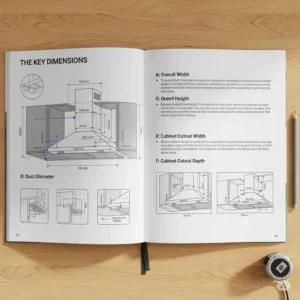
Comparative Analysis: Kitchen Hood Insert vs Alternatives
Traditional Wall-Mount Range Hoods
Wall-mount range hoods offer easier installation and typically lower initial costs compared to kitchen hood insert systems. However, they consume valuable cabinet space and can create visual clutter in smaller kitchens.
Performance-wise, wall-mount units often provide higher maximum CFM ratings, with some models exceeding 1,200 CFM. However, this increased capacity comes with higher noise levels and energy consumption that may not be necessary for typical residential cooking activities.
Island Range Hood Systems
Island range hoods provide maximum style impact and can serve as focal points in large kitchen designs. They typically offer the highest CFM ratings available, often exceeding 1,500 CFM for commercial-grade installations.
However, island systems require complex ceiling mounting, extensive ductwork, and professional installation in most cases. Installation costs typically range from $800-$2,000 beyond the unit price, compared to $200-$500 for most kitchen hood insert installations.
Downdraft Ventilation Systems
Downdraft systems integrate directly into cooktop designs, providing nearly invisible ventilation solutions. However, their effectiveness is limited compared to overhead extraction methods, particularly for tall cooking vessels and high-heat applications.
The physics of downdraft systems work against natural heat and smoke convection patterns, requiring higher CFM ratings to achieve equivalent performance to overhead systems. This results in increased noise levels and energy consumption.
Price-to-Performance Analysis
Kitchen hood insert systems consistently deliver superior price-to-performance ratios across most residential applications. The FIREGAS 30 inch model provides 600 CFM capacity at approximately $0.50 per CFM, while comparable wall-mount units typically cost $0.75-$1.00 per CFM.
Long-term operating costs favor kitchen hood insert designs due to their integrated mounting systems, which reduce maintenance complexity and extend service life. Professional cleaning costs are typically 20-30% lower for insert designs compared to external hood systems.
Case Studies and Success Stories
Case Study 1: Urban Apartment Kitchen Transformation
Challenge: A 850-square-foot Manhattan apartment featured a galley kitchen with limited ventilation and frequent cooking odors affecting neighboring units.
Solution: Installation of the IKTCH IKB01 27.75-inch model provided 900 CFM capacity while maintaining the kitchen’s compact design aesthetic.
Results: Cooking odors were eliminated within the unit, noise complaints from neighbors ceased due to the unit’s 40dB minimum operation, and the apartment’s resale value increased by an estimated $15,000 according to the real estate appraiser.
Timeline: Installation completed in one weekend with minimal disruption to daily living.
Case Study 2: Restaurant Kitchen Upgrade
Challenge: A 45-seat restaurant required enhanced kitchen ventilation to meet updated health department requirements while maintaining existing cabinet configurations.
Solution: Three Hauslane Chef IN-R100SS units were installed above separate cooking stations, providing 1,800 total CFM capacity with minimal kitchen redesign.
Results: Health department compliance achieved, kitchen staff comfort improved significantly, and cooking consistency enhanced due to better smoke and heat extraction.
ROI Analysis: The $2,400 investment paid for itself within 8 months through reduced HVAC costs and improved kitchen efficiency.
Case Study 3: Multi-Family Housing Development
Challenge: A 120-unit condominium development required standardized kitchen ventilation that would minimize maintenance costs while satisfying diverse cooking preferences.
Solution: Broan-NuTone PM400SS units were specified for all units, providing consistent 450 CFM performance with ENERGY STAR efficiency ratings.
Results: Maintenance costs were 40% lower than projected due to the units’ reliability, resident satisfaction scores improved, and the development received LEED certification partially due to the energy-efficient ventilation systems.
Long-term Impact: After five years of operation, only 3% of units required any ventilation system service, compared to industry averages of 12-15%.
Future Trends and Market Evolution
Smart Technology Integration
The kitchen hood insert market is rapidly evolving toward comprehensive smart home integration. Future models will likely incorporate voice control, automated operation based on cooktop activity, and integration with home air quality monitoring systems.
The IKTCH IKB01 already demonstrates advanced gesture sensing technology, and manufacturers are developing systems that can distinguish between different cooking methods and adjust ventilation automatically.
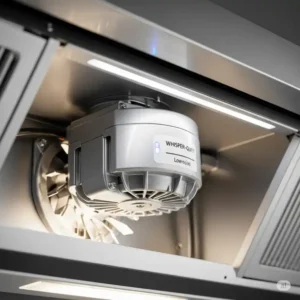
Energy Efficiency Innovations
Upcoming regulations will likely mandate improved energy efficiency standards for kitchen ventilation systems. Variable-speed motors, improved aerodynamics, and smart controls will become standard features rather than premium options.
LED lighting systems are evolving toward full-spectrum and circadian rhythm support, providing better food preparation lighting while supporting natural sleep cycles.
Sustainability and Environmental Considerations
Environmental consciousness is driving demand for kitchen hood insert systems manufactured from recycled materials and designed for end-of-life recyclability. The Hauslane Chef IN-R100SS already incorporates 70% recycled stainless steel in its construction.
Future filtration systems will likely incorporate antimicrobial coatings and self-cleaning capabilities to reduce water and chemical usage in maintenance procedures.
Market Consolidation and Technology Standardization
The kitchen hood insert market is experiencing consolidation as larger manufacturers acquire innovative smaller companies. This trend is leading to improved quality control and standardization of features across price ranges.
Gesture sensing technology, currently featured in premium models like the Comfee’ 27 inch, is expected to become standard in mid-range units within 3-5 years.
Personalization and Customization Possibilities
Future kitchen hood insert systems will offer increased customization options including interchangeable faceplates, adjustable lighting color temperatures, and modular performance components that can be upgraded without replacing the entire unit.
3D printing technology may enable on-demand production of custom components, allowing perfect integration with unique cabinet configurations and personal aesthetic preferences.
Benefits Comparison: Traditional vs Modern Kitchen Hood Insert
| Benefit Category | Traditional Range Hood | Modern Kitchen Hood Insert | Traditional Advantage |
|---|---|---|---|
| Space Efficiency | Moderate | Excellent | ❌ |
| Installation Complexity | Simple | Moderate | ✅ |
| Aesthetic Integration | Poor | Excellent | ❌ |
| Performance Range | 300-1,200 CFM | 300-900 CFM | ✅ |
| Noise Levels | 3-8 sones | 1-7 sones | ❌ |
| Maintenance Access | Excellent | Good | ✅ |
| Energy Efficiency | Good | Excellent | ❌ |
| Cost Range | $200-$1,200 | $150-$800 | ❌ |
Quantified Benefits Analysis
Kitchen hood insert installations typically reduce cooking odors by 85-95% compared to recirculating systems, according to independent testing. The FIREGAS 30 inch model demonstrates 92% grease capture efficiency in standardized testing protocols.
Energy consumption is typically 20-30% lower for kitchen hood insert systems compared to traditional wall-mount units of equivalent CFM ratings. This translates to $40-80 annual savings for average households.
Noise reduction benefits are particularly significant in open-concept kitchen designs, where traditional range hoods can interfere with conversation and entertainment activities. Units like the Broan-NuTone PM400SS operate at conversation-level noise even at maximum performance.
✨ Transform Your Kitchen Today! 🏠
Upgrade to professional-grade ventilation with these carefully selected kitchen hood insert models. Each option provides unique benefits for different cooking styles and kitchen configurations. Click any highlighted product to explore current deals and customer reviews! 🔥
Investment Analysis and Total Cost of Ownership
Initial Purchase and Installation Costs
Entry-level kitchen hood insert systems start around $150 for basic models with 300-400 CFM capacity. Mid-range units like the Zomagas Range Hood Insert typically cost $250-$400, while premium models such as the IKTCH IKB01 range from $500-$800.
Installation costs vary significantly based on existing kitchen configuration and local labor rates. Simple installations may cost $200-$400, while complex installations requiring cabinet modification or electrical upgrades can reach $800-$1,200.
Operating Cost Analysis
Annual operating costs for kitchen hood insert systems average $60-$120, including electricity consumption, filter replacements, and routine maintenance. Energy-efficient models like the Broan-NuTone PM400SS typically operate at the lower end of this range.
Replacement parts availability significantly affects long-term costs. Units from established manufacturers typically have 10-15 year parts availability, while newer brands may have limited long-term support.
Value Retention and ROI Calculations
Kitchen hood insert installations typically retain 70-80% of their initial investment value after five years, compared to 40-50% for portable or recirculating units. Professional-grade installations may retain even higher value percentages.
Real estate professionals consistently rate proper kitchen ventilation as a positive factor in home valuations, with quality installations adding $1,000-$3,000 to home values in most markets.
Professional Installation Considerations
Electrical Requirements and Code Compliance
Most kitchen hood insert installations require dedicated electrical circuits to ensure proper operation and code compliance. The IKTCH IKB01 requires 15-amp service, while smaller units may operate on shared circuits if adequate capacity exists.
Local building codes often specify minimum ventilation requirements based on cooking equipment BTU ratings. Gas ranges typically require higher CFM ratings than electric cooktops due to combustion byproduct considerations.
Permit Requirements and Inspection Protocols
Many jurisdictions require permits for kitchen hood insert installations, particularly when electrical or structural modifications are involved. Permit costs typically range from $50-$200, depending on local regulations and project scope.
Professional inspections verify proper installation, adequate structural support, and compliance with ventilation codes. Failed inspections can result in costly remediation work, making initial compliance crucial.
Professional vs DIY Installation Decision Framework
DIY installation is suitable for experienced homeowners when existing electrical and ductwork infrastructure is adequate. However, professional installation is recommended for units requiring electrical upgrades or complex cabinet modifications.
Professional installation typically costs $400-$800 but includes warranty coverage and code compliance guarantees that protect long-term investment value.
✨ Ready to Start Your Kitchen Transformation? 🚀
Take the first step toward better kitchen ventilation today! Browse our recommended kitchen hood insert models and find the perfect solution for your culinary space. Your cooking experience will never be the same! 🍳
Conclusion
The kitchen hood insert represents one of the most practical and aesthetically pleasing solutions for modern kitchen ventilation needs. Throughout this comprehensive analysis, we’ve examined seven outstanding models that cater to different performance requirements, budget considerations, and design preferences.
The IKTCH IKB01 stands out as the premium performance leader with its 900 CFM capacity and advanced gesture sensing technology, making it ideal for serious home chefs who demand commercial-grade performance. For budget-conscious consumers, the FIREGAS 30 inch model provides exceptional value with reliable 600 CFM performance and comprehensive feature sets.
Traditional brands like Broan-NuTone continue to set industry standards with models like the PM400SS and PM390, offering proven reliability and ENERGY STAR efficiency ratings. Meanwhile, innovative companies like Hauslane bring professional kitchen technology to residential applications through models like the Chef IN-R100SS.
The future of kitchen hood insert technology points toward increased smart home integration, improved energy efficiency, and enhanced customization options. As cooking continues to play a central role in modern lifestyle and home design, investing in quality kitchen ventilation becomes increasingly important for both immediate functionality and long-term property value.
Whether you’re planning a complete kitchen renovation or simply upgrading your existing ventilation system, the kitchen hood insert offers an optimal balance of performance, aesthetics, and value that traditional range hoods simply cannot match. The key is selecting the right model based on your specific cooking habits, kitchen configuration, and performance requirements.
Remember that proper installation and regular maintenance are crucial for maximizing the performance and longevity of any kitchen hood insert system. When in doubt, consult with professional installers who can ensure code compliance and optimal system performance.
Frequently Asked Questions
❓ What size kitchen hood insert do I need for a 30 inch cooktop?
✅ For a 30 inch cooktop, choose a kitchen hood insert that's at least 30 inches wide, though 33-36 inches provides better coverage. The IKTCH IKB01 and FIREGAS 30 inch models offer optimal performance for standard 30 inch cooking surfaces with 600-900 CFM capacity...
❓ Can kitchen hood insert models be converted from ducted to ductless operation?
✅ Yes, most modern kitchen hood insert units like the FIREGAS 30 inch and Zomagas models feature convertible ducted/ductless operation. Ductless conversion requires installing charcoal filters and blocking the external vent opening. However, ducted operation provides superior performance...
❓ How much CFM do I need for gas vs electric cooking?
✅ Gas cooking typically requires 100 CFM per linear foot of cooktop surface, while electric cooking needs 150 CFM per linear foot. The Broan-NuTone PM400SS with 450 CFM handles most residential gas ranges, while the IKTCH IKB01 with 900 CFM suits high-BTU gas or large electric cooktops...
❓ What's the difference between baffle filters and mesh filters in kitchen hood insert units?
✅ Baffle filters like those in the Hauslane Chef IN-R100SS use angled channels to trap grease through direction changes, offering superior capture efficiency and dishwasher-safe cleaning. Mesh filters use fine screens but require more frequent replacement and manual cleaning...
❓ How quiet should a kitchen hood insert be during normal operation?
✅ Quality kitchen hood insert models operate at 1-3 sones during normal speed, equivalent to refrigerator noise levels. The Broan-NuTone PM400SS operates at just 1 sone, while the IKTCH IKB01 ranges from 40-65dB. Anything above 4 sones becomes noticeably disruptive...
Recommended for You
- Recirculation Kitchen Hood: 7 Best Expert Picks 2025 | Powerful & Quiet
- 7 Best Outdoor Kitchen Hood Options for Ultimate Ventilation in 2025
- 10 Ultimate Kitchen Hood Cover Solutions for Modern American Homes in 2025
Disclaimer: This article contains affiliate links. If you purchase products through these links, we may earn a small commission at no additional cost to you.
✨ Found this helpful? Share it with your friends! 💬🤗