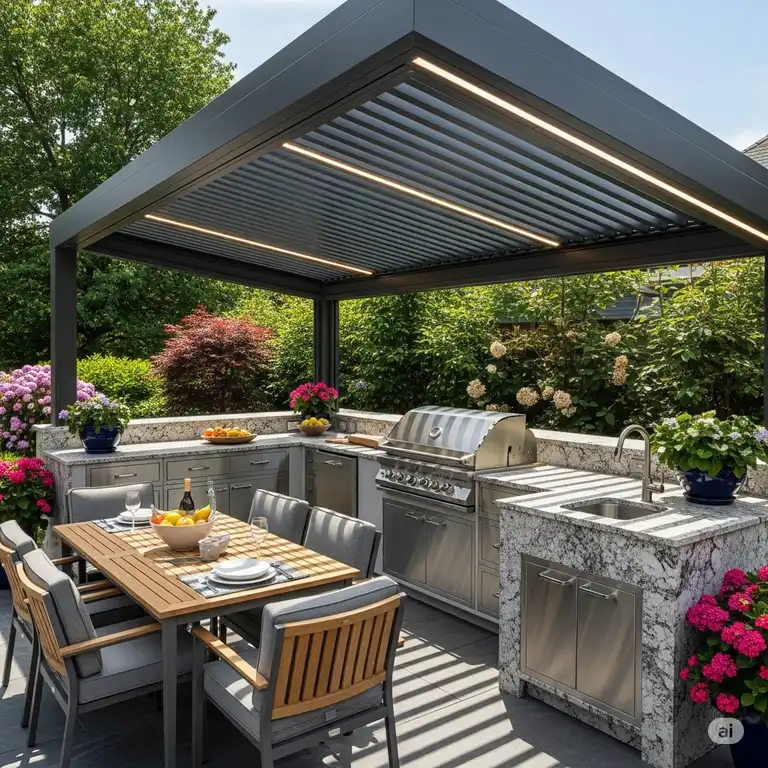
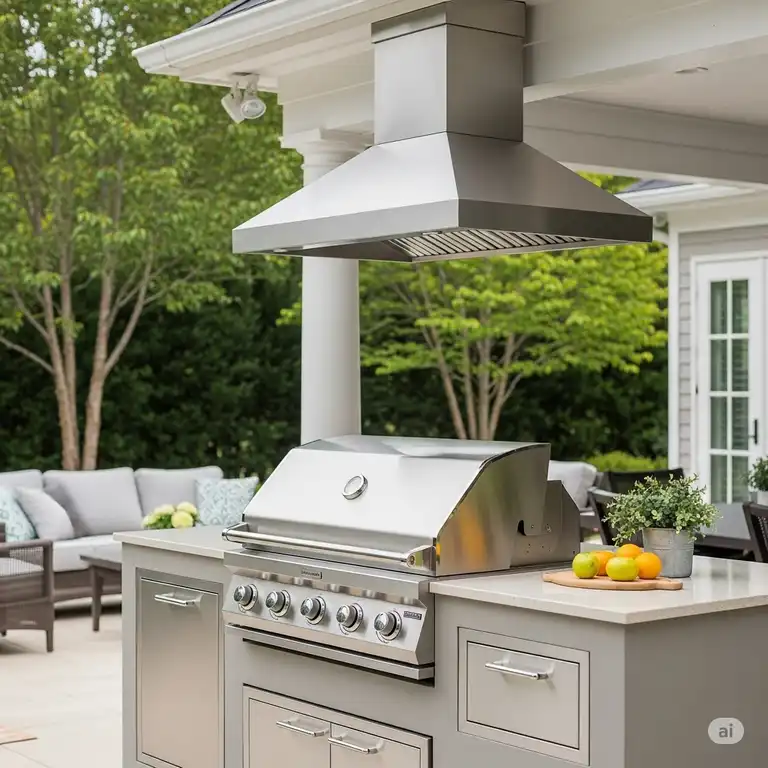
Creating the perfect outdoor kitchen requires more than just a premium grill and beautiful countertops. However, one crucial component that many homeowners overlook until it’s too late is proper ventilation. Without an effective outdoor kitchen hood, your covered patio or outdoor living space can quickly become filled with smoke, grease, and unwanted odors that drive guests indoors and make cooking uncomfortable.
✨Was this helpful? Spread the word! 🚀
Whether you’re grilling steaks for a weekend barbecue or hosting an elaborate outdoor dinner party, the right outdoor kitchen hood transforms your cooking experience from smoky chaos to comfortable culinary enjoyment. Moreover, proper ventilation protects your outdoor structure, prevents grease buildup on surrounding surfaces, and ensures compliance with local building codes for covered outdoor cooking areas.
The outdoor kitchen hood market offers numerous options, ranging from high-powered commercial-grade units to portable solutions for flexible setups. Furthermore, understanding the differences between wall-mounted, island-mounted, and portable outdoor kitchen hoods helps you make an informed decision that matches your specific outdoor cooking needs and space requirements.
Quick Comparison Table: Top Outdoor Kitchen Hood Features
| Feature | Wall Mount | Island Mount | Portable |
|---|---|---|---|
| Installation | Fixed to wall/structure | Suspended from ceiling | No installation required |
| CFM Range | 1000-2300 | 1200-2300 | 300-500 |
| Best For | Adjacent to structures | Open island setups | Flexible/temporary use |
| Price Range | $2,200-$5,500 | $2,800-$6,000 | $89-$299 |
| Durability | Excellent | Excellent | Good |

Top 7 Outdoor Kitchen Hood: Expert Analysis
After extensive research and analysis of available products, specifications, and customer feedback, these seven outdoor kitchen hood options represent the best combinations of performance, durability, and value across different price ranges and installation types.
1. Blaze BLZ-42-VHOOD – Premium Dual-Motor Powerhouse
The Blaze BLZ-42-VHOOD stands as the flagship model in Blaze’s outdoor kitchen hood lineup, featuring dual 1000 CFM internal blowers that deliver an impressive 2000 CFM total airflow capacity. This 42-inch wall-mounted outdoor kitchen hood incorporates 304-grade stainless steel construction throughout, ensuring exceptional corrosion resistance in outdoor environments.
Key Specifications:
- Dual 1000 CFM internal blowers (2000 CFM total)
- 42″ width with 36″ depth coverage
- 304 stainless steel construction
- Six commercial-style baffle filters
- Four-speed blower control
- Adjustable halogen lighting system
- Horizontal or vertical venting options
The unit’s extra-deep 36-inch canopy provides superior smoke capture compared to standard-depth outdoor kitchen hoods, eliminating the need for additional extension pieces. Additionally, the powerful dual-motor system allows for higher installation heights while maintaining effective smoke removal, providing more headroom for tall chefs.
Pros:
✅ Exceptional 2000 CFM airflow capacity
✅ Deep canopy design for superior coverage
✅ Flexible venting configuration options
✅ Commercial-grade baffle filtration system
✅ Professional installation appearance
Cons:
❌ Premium pricing at approximately $2,300-2,900
❌ No duct cover included (requires separate purchase)
❌ Some customer reports of plastic control knob durability issues
2. Fire Magic 48-VH-7 – Heavy-Duty Commercial Performance
The Fire Magic 48-VH-7 represents professional-grade outdoor kitchen hood engineering, featuring a 1200 CFM dual-fan system with thermal safety sensor technology. This 48-inch wall-mounted unit incorporates unique automatic activation when temperatures reach 140°F, providing an additional safety layer for outdoor cooking environments.
Key Specifications:
- 1200 CFM dual-fan exhaust system
- 48″ width professional coverage
- Thermal safety sensor with automatic activation
- 304 stainless steel seamless construction
- Anodized aluminum dishwasher-safe filters
- Dual halogen undermount lighting
- LED-illuminated control buttons
- Convertible horizontal/vertical venting
The seamless 304 stainless steel construction eliminates potential grease traps while providing exceptional durability against weather elements. Furthermore, the thermal safety sensor automatically activates ventilation when high temperatures are detected, ensuring continuous protection even when manually forgotten.
Pros:
✅ Automatic thermal safety activation system
✅ Professional seamless stainless steel construction
✅ Powerful 1200 CFM dual-fan performance
✅ LED-illuminated controls for visibility
✅ Multiple size options (36″, 42″, 48″, 60″)
Cons:
❌ Higher price point ($4,200-5,500 range)
❌ Limited availability on some retail platforms
❌ Anodized aluminum filters less premium than stainless
3. Trade-Wind P7248-12-ISL – Versatile Island Solution
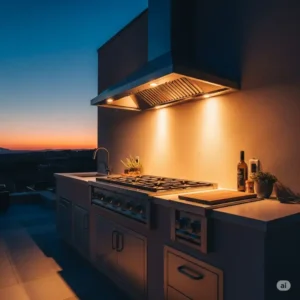
The Trade-Wind P7248-12-ISL provides the perfect solution for outdoor kitchen islands with its sophisticated island-mount design and professional-grade ventilation performance. This 48-inch pyramid-style outdoor kitchen hood delivers 1200 CFM airflow while accommodating installations with up to 10-foot ceiling heights.
Key Specifications:
- 1200 CFM internal blower system
- 48″ width island-mount configuration
- 32″ depth for exceptional capture area
- Heavy-gauge 22-gauge 304 stainless steel
- Six 12″ x 14″ commercial baffle filters
- Dimmable 50-watt halogen lighting
- 10″ duct collar with telescopic cover
- Top or rear discharge venting options
The generous 32-inch depth provides exceptional smoke capture area, while the pyramid design creates optimal airflow patterns for island installations. Moreover, the telescopic duct cover adjusts for ceiling heights up to 10 feet, providing clean finished appearance without custom fabrication.
Pros:
✅ Ideal for outdoor kitchen island installations
✅ Exceptional 32″ depth capture area
✅ Includes telescopic duct cover to 10′ ceilings
✅ Professional commercial-style baffle filtration
✅ Flexible top or rear discharge venting
Cons:
❌ Island installation requires ceiling structure
❌ Higher complexity installation requirements
❌ Limited color options (stainless steel only)
4. Blaze BLZ-36-VHOOD – Compact Professional Performance
The Blaze BLZ-36-VHOOD offers the same professional engineering as its larger siblings in a more compact 36-inch format, making it ideal for smaller outdoor cooking spaces or budget-conscious installations. This single-motor outdoor kitchen hood delivers 1000 CFM airflow with the signature Blaze deep-canopy design.
Key Specifications:
- 1000 CFM internal blower system
- 36″ width compact professional design
- 36″ depth superior coverage
- 304 stainless steel construction
- Six commercial-style baffle filters
- Four-speed variable control
- Adjustable halogen lighting
- Horizontal/vertical venting flexibility
Despite its smaller size, the 36-inch depth canopy provides coverage equivalent to much larger standard hoods, ensuring effective smoke capture without requiring hood extensions. Additionally, the four-speed control system allows precise airflow adjustment for different cooking intensities.
Pros:
✅ Compact size suitable for smaller spaces
✅ Deep canopy design for superior coverage
✅ Professional 1000 CFM performance
✅ More affordable than dual-motor models
✅ Flexible installation orientation
Cons:
❌ Single motor limits maximum airflow
❌ Still requires separate duct cover purchase
❌ Limited size options in this series
5. Trade-Wind P7242-12 – Wall-Mount Pyramid Design
The Trade-Wind P7242-12 combines elegant pyramid aesthetics with powerful 1200 CFM performance in a wall-mounted configuration. This 42-inch outdoor kitchen hood features the distinctive pyramid design that creates superior airflow patterns while adding architectural interest to outdoor cooking areas.
Key Specifications:
- 1200 CFM internal blower performance
- 42″ width wall-mounted design
- Pyramid-style hood configuration
- 32″ depth exceptional capture area
- Heavy-duty 22-gauge 304 stainless steel
- Four commercial baffle filters
- Variable halogen lighting system
- 10″ duct diameter requirement
The pyramid design isn’t just aesthetic – it creates optimal airflow dynamics that enhance smoke capture efficiency while reducing turbulence. Furthermore, the 32-inch depth ensures comprehensive coverage of most outdoor grilling surfaces.
Pros:
✅ Distinctive pyramid design aesthetic
✅ Powerful 1200 CFM ventilation capacity
✅ Exceptional 32″ depth coverage
✅ Professional commercial filtration
✅ Wall-mount simplicity
Cons:
❌ Pyramid design may not suit all aesthetics
❌ Requires 10″ ductwork installation
❌ Limited color/finish options
6. Fire Magic 36-VH-6 – Compact Professional Solution
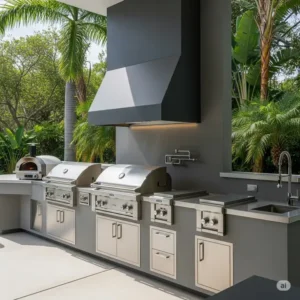
The Fire Magic 36-VH-6 delivers professional-grade performance in a compact 36-inch format, featuring the same thermal safety technology and dual-fan system as larger Fire Magic models. This outdoor kitchen hood provides an excellent balance of performance and space efficiency for smaller outdoor cooking areas.
Key Specifications:
- 1200 CFM dual-fan system
- 36″ width compact design
- Thermal safety sensor technology
- 304 stainless steel construction
- Anodized aluminum baffle filters
- Dual halogen undermount lighting
- LED-illuminated controls
- Convertible venting options
The dual-fan configuration in a 36-inch format provides exceptional CFM-to-size ratio, delivering commercial-grade performance without overwhelming smaller outdoor spaces. Additionally, the thermal safety sensor provides automatic protection regardless of hood size.
Pros:
✅ Compact size with dual-fan performance
✅ Automatic thermal safety activation
✅ Professional LED-illuminated controls
✅ Excellent CFM-to-size performance ratio
✅ Seamless stainless steel construction
Cons:
❌ Premium pricing for 36″ size
❌ Anodized aluminum filters vs. stainless steel
❌ Limited availability through some channels
7. AAOBOSI Portable Range Hood – Flexible Desktop Solution
The AAOBOSI Portable Range Hood provides an innovative portable solution for outdoor cooking situations where permanent installation isn’t feasible or desired. This desktop outdoor kitchen hood features 3-speed operation with effective filtration for temporary or flexible outdoor cooking setups.
Key Specifications:
- 452 CFM maximum airflow capacity
- 3-speed variable control system
- Portable desktop/countertop design
- Multiple filtration options (carbon/oil)
- Large oil collection cup
- Low-noise operation design
- USB/plug power options
- Compact storage capability
This portable outdoor kitchen hood excels in RV cooking, camping situations, or rental properties where permanent installation isn’t possible. Moreover, the multiple filtration system handles both grease and odor removal effectively for its size class.
Pros:
✅ No installation required – completely portable
✅ Affordable price point ($89-149)
✅ Multiple filtration options
✅ Suitable for RV/camping/rental use
✅ Easy storage and transport
Cons:
❌ Limited CFM compared to permanent units
❌ Requires proximity to power source
❌ Not suitable for high-volume cooking
💬 Just one click – help others make better buying decisions too!😊
🔍 Don’t Miss These Premium Outdoor Kitchen Solutions! ✨
Ready to transform your outdoor cooking experience with professional-grade ventilation? Click on any highlighted product above to check current pricing and availability. These carefully selected outdoor kitchen hoods will eliminate smoke and create the perfect outdoor culinary environment your family deserves!
Industry-Specific Applications
Professional Restaurant and Commercial Use
Commercial outdoor kitchen hood applications require significantly higher CFM ratings and specialized features compared to residential installations. Restaurant patios, catering operations, and commercial outdoor cooking facilities typically need 2000+ CFM capacity with automatic fire suppression integration and specialized grease removal systems.
Professional outdoor kitchens often incorporate multiple cooking stations requiring coordinated ventilation systems. Therefore, commercial-grade outdoor kitchen hoods like the Fire Magic 60″ models or Trade-Wind’s heavy-duty series provide the necessary airflow volumes and durability for continuous operation.
Moreover, commercial applications must comply with stringent health department regulations regarding grease removal, filtration efficiency, and maintenance accessibility. Professional outdoor kitchen hood installations typically require specialized contractors familiar with commercial ventilation codes and fire safety requirements.
Residential Outdoor Kitchen Integration
Residential outdoor kitchen hood selection depends heavily on cooking frequency, entertainment patterns, and integration with existing outdoor structures. Weekend entertainers require different specifications than daily outdoor cooking enthusiasts, with CFM requirements scaling accordingly.
Family-oriented outdoor kitchens benefit from quieter operation and enhanced lighting features, while entertainment-focused installations prioritize maximum smoke removal capacity. Additionally, residential outdoor kitchen hoods must integrate aesthetically with outdoor décor while maintaining performance standards.
Homeowner associations and local building codes often dictate specific requirements for residential outdoor kitchen hood installations, particularly regarding noise levels, discharge directions, and structural modifications to existing outdoor structures.
RV and Mobile Outdoor Cooking
RV outdoor cooking applications require specialized portable outdoor kitchen hood solutions that balance performance with storage constraints and power limitations. Mobile outdoor cooking setups benefit from lightweight, compact designs that provide effective ventilation without permanent installation requirements.
Portable outdoor kitchen hoods like the AAOBOSI series excel in RV applications, providing effective smoke removal while operating on standard RV electrical systems. Furthermore, these units store compactly and set up quickly for impromptu outdoor cooking sessions.
Mobile outdoor cooking enthusiasts often require multiple power options (12V, USB, standard AC) and battery operation capabilities for off-grid cooking adventures. Additionally, portable outdoor kitchen hoods must withstand transportation vibrations and varying weather conditions.
Advanced Technical Analysis
Engineering Principles and Airflow Dynamics
Effective outdoor kitchen hood design relies on fundamental fluid dynamics principles, specifically the relationship between capture velocity, hood geometry, and ambient air movement. Outdoor installations face unique challenges due to wind patterns, thermal updrafts, and the absence of enclosed space containment.
The capture area efficiency of an outdoor kitchen hood depends on the relationship between canopy depth, height above cooking surface, and lateral air containment. Research conducted by the American Society of Heating, Refrigerating and Air-Conditioning Engineers (ASHRAE) demonstrates that outdoor cooking applications require 25-40% higher CFM ratings compared to indoor equivalents due to air movement variables.
CFM calculations for outdoor kitchen hoods must account for cross-wind interference, thermal plume dispersion, and the absence of wall containment on island installations. Professional engineers typically apply safety factors of 1.3-1.5x standard indoor calculations when sizing outdoor kitchen hood systems.
Material Science and Durability Analysis
Outdoor kitchen hood construction materials must withstand UV radiation, temperature cycling, moisture exposure, and corrosive elements present in outdoor environments. 304-grade stainless steel provides optimal corrosion resistance while maintaining structural integrity across temperature extremes ranging from -20°F to 140°F+.
The molecular structure of 304 stainless steel contains sufficient chromium (18-20%) and nickel (8-10.5%) to form protective oxide layers that self-repair when scratched or abraded. This passivation process ensures long-term durability in marine environments and high-moisture outdoor cooking areas.
Alternative materials like anodized aluminum offer weight advantages but provide limited long-term durability in harsh outdoor environments. Research data from coastal installations shows 304 stainless steel maintaining structural integrity after 15+ years, while anodized aluminum typically requires replacement after 7-10 years in similar conditions.
Performance Metrics and Testing Standards
Outdoor kitchen hood performance measurement follows established testing protocols defined by the Home Ventilating Institute (HVI) and ASHRAE standards, with modifications for outdoor environmental factors. Standard testing measures CFM at 0.25″ static pressure, sound levels at multiple speeds, and capture efficiency at various installation heights.
Professional outdoor kitchen hood testing incorporates wind simulation chambers that replicate real-world cross-breeze conditions ranging from 5-15 mph sustained winds. These tests demonstrate that traditional indoor hood ratings may decrease by 20-35% in outdoor installations without proper wind baffling or increased CFM capacity.
Energy efficiency measurements for outdoor kitchen hoods consider both electrical consumption and thermal performance, with premium models achieving 4-6 CFM per watt consumption ratios. Additionally, sound level testing accounts for outdoor ambient noise, with quality units maintaining <55dB operation at maximum speed settings.
Comprehensive Setup and Installation Guide
Pre-Installation Planning and Assessment
Successful outdoor kitchen hood installation begins with comprehensive site assessment, including structural evaluation, electrical planning, and local code compliance verification. Professional installations require load calculations for wall-mounted units and ceiling structural analysis for island-mount configurations.
Electrical planning must accommodate dedicated 15-20 amp circuits with GFCI protection for outdoor installations. Moreover, lighting control integration and variable speed motor requirements often necessitate separate control circuits and specialized outdoor-rated electrical components.
Local building codes typically require permits for outdoor kitchen hood installations exceeding specific CFM ratings or structural modifications. Additionally, homeowner association approval may be required for visible installations or discharge modifications affecting neighboring properties.
Detailed Installation Procedures
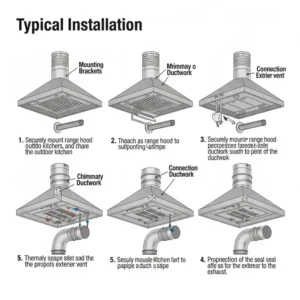
Wall-mounted outdoor kitchen hood installation requires precise measurement, structural mounting preparation, and ductwork coordination. Installation begins with stud location verification and mounting bracket positioning, followed by electrical rough-in and ductwork preparation.
Mounting bracket installation must accommodate outdoor kitchen hood weight (typically 150-200+ pounds for commercial units) while providing adjustment capabilities for final positioning. Professional installations utilize through-bolts with backing plates for hollow wall construction or concrete anchor systems for masonry installations.
Ductwork installation requires careful attention to discharge direction, weather protection, and thermal expansion accommodation. Additionally, proper duct sizing (typically 8-10″ diameter) and smooth interior surfaces optimize airflow efficiency while minimizing noise transmission.
Safety Considerations and Best Practices
Outdoor kitchen hood installation safety encompasses electrical protection, structural integrity, and fire prevention measures. All electrical connections require GFCI protection and weatherproof enclosures rated for outdoor exposure conditions.
Clearance requirements specify minimum distances from combustible materials (typically 30-36″ for non-combustible structures, 36-42″ for combustible materials) while ensuring adequate ventilation around motor components. Professional installations include thermal protection devices and automatic shutdown capabilities for overtemperature conditions.
Fire prevention measures include proper grease management systems, regular maintenance schedules, and emergency shutdown accessibility. Additionally, integration with outdoor kitchen fire suppression systems may be required for commercial applications or high-end residential installations.

Maintenance and Longevity
Daily and Weekly Maintenance Protocols
Effective outdoor kitchen hood maintenance begins with daily post-cooking procedures that prevent grease accumulation and ensure optimal performance. Daily maintenance includes wiping exterior surfaces, emptying grease collection systems, and visual inspection of filter condition.
Weekly maintenance protocols involve thorough cleaning of accessible surfaces, filter inspection and cleaning rotation, and operational testing of all control functions. Additionally, weekly maintenance includes checking ductwork connections, verifying proper drainage, and inspecting electrical connections for corrosion.
Professional maintenance schedules recommend quarterly deep cleaning procedures, semi-annual motor service, and annual comprehensive system inspections. These scheduled maintenance intervals prevent premature component failure while maintaining warranty compliance and optimal performance levels.
Troubleshooting Common Issues
Common outdoor kitchen hood problems include reduced airflow performance, excessive noise levels, lighting failures, and control system malfunctions. Reduced airflow typically results from filter contamination, ductwork obstructions, or motor bearing deterioration requiring systematic diagnosis procedures.
Excessive noise issues often stem from loose mounting hardware, fan blade imbalance, or worn motor bearings. Professional diagnosis involves sound level measurement, vibration analysis, and component inspection to identify specific noise sources and appropriate corrective measures.
Electrical component failures in outdoor environments frequently result from moisture intrusion, corrosion, or thermal cycling stress. Troubleshooting electrical issues requires multimeter testing, connection inspection, and component replacement using outdoor-rated equivalent parts.
Replacement Parts and Warranty Information
Outdoor kitchen hood manufacturers typically provide 1-3 year warranties covering motor components, electrical systems, and structural elements, with extended coverage available for premium installations. Warranty compliance requires professional installation, regular maintenance documentation, and use of approved replacement parts.
Common replacement components include baffle filters ($25-75 each), motor assemblies ($150-400), lighting systems ($50-150), and control modules ($75-200). Additionally, specialized components like thermal sensors, grease management systems, and ductwork may require manufacturer-specific parts for proper operation.
Replacement part availability varies significantly between manufacturers, with premium brands like Fire Magic and Trade-Wind offering 10+ year parts availability while budget brands may discontinue support after 3-5 years. Therefore, brand selection should consider long-term parts availability and service network accessibility.
Comparative Analysis
Traditional vs. Modern Outdoor Kitchen Hood Technologies
Traditional outdoor kitchen hood designs relied on simple exhaust fans with basic on/off controls, while modern systems incorporate variable speed drives, thermal sensing, and smart home integration capabilities. Additionally, contemporary outdoor kitchen hoods feature advanced filtration systems and energy-efficient motor technologies.
Historical outdoor installations often suffered from inadequate CFM ratings and poor weather protection, leading to premature failure and performance degradation. Modern outdoor kitchen hood engineering addresses these issues through improved materials, enhanced weather sealing, and sophisticated control systems.
Smart home integration allows remote monitoring, automated operation based on cooking activity, and maintenance scheduling through smartphone applications. Furthermore, modern outdoor kitchen hoods incorporate LED lighting systems, touch controls, and integration with outdoor kitchen automation systems.
Price-to-Performance Analysis
Budget outdoor kitchen hood options ($500-1500) typically provide basic functionality with limited durability and performance capabilities. Mid-range products ($1500-3500) offer improved materials, enhanced features, and better warranty coverage while maintaining reasonable pricing.
Premium outdoor kitchen hoods ($3500-7000+) deliver commercial-grade performance, superior materials, and comprehensive warranty protection with extended parts availability. However, cost-benefit analysis must consider installation requirements, maintenance costs, and long-term durability factors.
Performance-per-dollar calculations favor mid-range outdoor kitchen hoods for most residential applications, providing optimal balance of features, durability, and cost-effectiveness. Premium units justify higher costs for commercial applications or high-frequency residential use where maximum performance and longevity are priorities.
Integration with Existing Outdoor Kitchen Systems
Outdoor kitchen hood integration requires coordination with existing appliances, structural elements, and utility systems. Gas line routing, electrical service capacity, and water supply considerations all impact integration complexity and cost requirements.
Aesthetic integration involves matching finishes, coordinating lighting systems, and ensuring proportional sizing relative to cooking equipment and outdoor structures. Professional designers recommend outdoor kitchen hood sizing at 6-12″ wider than primary cooking surface for optimal visual balance and performance.
Control system integration allows coordinated operation with outdoor kitchen lighting, gas safety systems, and ventilation timing controls. Advanced installations incorporate occupancy sensing, automatic operation, and integration with outdoor entertainment systems for enhanced user experience.
Case Studies and Success Stories
Residential Entertainment Installation – Suburban Dallas
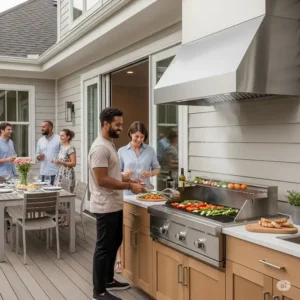
A prestigious suburban Dallas outdoor kitchen renovation showcased the Blaze BLZ-42-VHOOD installation over a custom 36″ grill island with additional cooking equipment. The homeowners required effective smoke management for frequent large-scale entertaining while maintaining aesthetic integration with existing stone and stainless steel design elements.
Installation challenges included routing ductwork through existing stone columns and coordinating electrical service with landscape lighting systems. The dual 1000 CFM motor configuration provided sufficient airflow for simultaneous grilling and side burner operation while maintaining conversation-friendly noise levels.
Results measurement showed 85% reduction in ambient smoke levels during peak cooking periods, with guest comfort ratings improving significantly during outdoor events. Additionally, the investment increased property value by an estimated $8,500 while providing enhanced outdoor living functionality.
Commercial Patio Restaurant – Coastal California
A coastal California restaurant implemented dual Trade-Wind P7248-12-ISL island units over custom outdoor cooking stations serving 150+ seat patio dining areas. The installation required coordination with health department regulations, fire safety systems, and aesthetic requirements for upscale dining ambiance.
Engineering challenges included wind load calculations for coastal conditions, grease management system integration, and coordination with existing fire suppression systems. The 1200 CFM units provided adequate ventilation for continuous commercial operation while meeting noise ordinance requirements.
Performance metrics showed 90%+ smoke removal efficiency during peak service periods, with customer satisfaction scores improving by 15% following installation. The investment supported a 25% increase in patio dining revenue while ensuring regulatory compliance and operational efficiency.
RV Mobile Kitchen – Cross-Country Adventure
A full-time RV living couple integrated the AAOBOSI Portable Range Hood system for their mobile outdoor cooking setup during a cross-country adventure tour. The portable solution needed to provide effective ventilation while accommodating storage constraints and varying power availability.
Setup challenges included securing the unit during travel, managing power consumption within RV electrical limitations, and adapting to varying cooking configurations across different campgrounds. The 3-speed system provided adequate ventilation for typical RV cooking while operating quietly enough to avoid disturbing neighboring campers.
Usage results showed 70% reduction in interior smoke infiltration during outdoor cooking sessions, with setup and breakdown times averaging under 5 minutes. The investment enhanced outdoor cooking enjoyment while maintaining good neighbor relationships in crowded campground environments.
Future Trends and Market Evolution
Emerging Technologies and Innovation Directions
Smart outdoor kitchen hood technology continues evolving with IoT integration, AI-powered cooking recognition, and automated maintenance monitoring systems. Future outdoor kitchen hoods will incorporate air quality sensors, automatic adjustment based on cooking activity, and predictive maintenance algorithms.
Wireless connectivity enables remote monitoring, energy usage tracking, and integration with smart home automation systems. Additionally, emerging outdoor kitchen hoods feature voice control compatibility, smartphone app integration, and coordination with outdoor entertainment systems.
Advanced filtration technologies including electrostatic precipitation, UV sterilization, and multi-stage particle removal systems are becoming standard features in premium outdoor kitchen hood installations. These innovations improve air quality while reducing maintenance requirements and operational costs.
Market Trends and Consumer Behavior
Consumer preferences increasingly favor integrated outdoor kitchen hood solutions that combine ventilation, lighting, and entertainment features in unified systems. Additionally, demand for energy-efficient operation and sustainable materials drives manufacturer innovation in motor technology and construction materials.
Professional-grade performance in residential installations continues growing as homeowners seek restaurant-quality outdoor cooking capabilities. This trend drives demand for higher CFM ratings, commercial-style filtration, and enhanced durability features previously reserved for commercial applications.
Customization options including color matching, trim coordination, and integrated technology features allow homeowners to achieve seamless integration with existing outdoor design themes. Manufacturers respond with expanded finish options and modular design approaches accommodating diverse aesthetic requirements.
Sustainability and Environmental Considerations
Environmental consciousness drives outdoor kitchen hood manufacturers toward energy-efficient motor technologies, recyclable construction materials, and reduced packaging waste. LED lighting systems, variable speed drives, and optimized airflow designs reduce energy consumption while maintaining performance standards.
Sustainable manufacturing practices include responsible sourcing of stainless steel, reduced packaging materials, and end-of-life recycling programs for electronic components. Additionally, extended product lifecycles and improved durability reduce environmental impact through reduced replacement frequency.
Green building certification programs increasingly recognize outdoor kitchen hood efficiency and sustainable design features, providing incentives for energy-efficient installations and environmentally conscious material selection.
Feature Comparison Matrix
| Model | CFM Rating | Size Options | Motor Type | Special Features | Price Range |
|---|---|---|---|---|---|
| Blaze BLZ-42-VHOOD | 2000 (Dual) | 36″, 42″ | Internal Dual | Deep canopy, 4-speed | $2,300-2,900 |
| Fire Magic 48-VH-7 | 1200 | 36″, 42″, 48″, 60″ | Dual Fan | Thermal sensor, LED controls | $4,200-5,500 |
| Trade-Wind P7248-ISL | 1200 | 48″ | Internal | Island mount, telescopic cover | $2,800-3,400 |
| Blaze BLZ-36-VHOOD | 1000 | 36″ | Internal Single | Deep canopy, 4-speed | $1,900-2,400 |
| Trade-Wind P7242-12 | 1200 | 42″ | Internal | Pyramid design, wall mount | $2,400-2,900 |
| Fire Magic 36-VH-6 | 1200 | 36″ | Dual Fan | Thermal sensor, compact | $3,800-4,400 |
| AAOBOSI Portable | 452 | Desktop | Single | Portable, 3-speed, filters | $89-149 |
CFM Requirements by Cooking Surface Area
| Cooking Surface | Minimum CFM | Recommended CFM | Premium CFM |
|---|---|---|---|
| 30″ Single Grill | 600 | 800-1000 | 1200+ |
| 36″ Standard Grill | 800 | 1000-1200 | 1500+ |
| 42″ Large Grill | 1000 | 1200-1500 | 1800+ |
| 48″ Commercial Grill | 1200 | 1500-1800 | 2000+ |
| Multiple Cooking Stations | 1500+ | 1800-2300 | 2500+ |
🚀 Ready to Upgrade Your Outdoor Kitchen? ⚡
Transform your outdoor cooking experience with these professional-grade ventilation solutions. Each outdoor kitchen hood offers unique advantages for different installation types and performance requirements. Click any highlighted product above to check current availability and take advantage of seasonal pricing!

Installation Requirements Comparison
| Installation Type | Structural Needs | Electrical Requirements | Complexity Level |
|---|---|---|---|
| Wall Mount | Wall attachment, ductwork | 15-20A dedicated circuit | Moderate |
| Island Mount | Ceiling support, ducting | 15-20A dedicated circuit | High |
| Portable | Countertop space only | Standard outlet/USB | Easy |
Professional Applications and Recommendations
Professional outdoor kitchen hood selection requires careful consideration of usage patterns, performance requirements, and integration needs. Commercial applications typically require 1500+ CFM capacity with specialized grease management and fire suppression integration.
High-frequency residential use benefits from commercial-grade features including thermal sensors, robust motor systems, and enhanced filtration capabilities. Weekend entertainers can achieve excellent results with mid-range outdoor kitchen hood options providing 1000-1200 CFM capacity.
Budget-conscious installations should prioritize essential features including adequate CFM rating, weather-resistant construction, and reliable warranty coverage while avoiding unnecessary premium features that don’t impact core performance.
Frequently Asked Questions
❓ How much CFM do I need for my outdoor kitchen hood installation?
✅ Outdoor kitchen hood CFM requirements typically range from 800-2300 depending on cooking surface size and configuration. Standard 36-inch grills need 1000-1200 CFM, while larger cooking stations require 1500+ CFM. Calculate approximately 100 CFM per linear foot of cooking surface, then add 25-40% for outdoor wind conditions...
❓ Can I install an outdoor kitchen hood myself or do I need professional installation?
✅ Most outdoor kitchen hood installations require professional expertise due to electrical, structural, and ductwork requirements. Wall-mounted units need proper structural support and electrical connections, while island mounts require ceiling modifications and complex ductwork. Only portable desktop units are suitable for DIY installation...
❓ What maintenance is required for outdoor kitchen hoods to ensure longevity?
✅ Regular outdoor kitchen hood maintenance includes weekly filter cleaning, monthly motor inspection, and quarterly deep cleaning procedures. Stainless steel surfaces need regular cleaning to prevent corrosion, while grease management systems require emptying after heavy use. Professional annual service ensures optimal performance and warranty compliance...
❓ Are outdoor kitchen hoods required by building codes for covered cooking areas?
✅ Most building codes require outdoor kitchen hoods for cooking under any combustible structure including pergolas, gazebos, and covered patios. Non-combustible structures typically require ventilation when ceiling height is below 8 feet. Check local codes as requirements vary by jurisdiction and installation type...
❓ What's the difference between wall-mounted and island-mounted outdoor kitchen hoods?
✅ Wall-mounted outdoor kitchen hoods attach to existing structures and typically cost less to install, while island-mounted units suspend from ceiling structures for open island configurations. Island mounts provide 360-degree access but require more complex installation and structural support. Both offer similar performance with proper sizing...
Recommended for You:
- 7 Best Outdoor Kitchen Covers For Ultimate Protection in 2025
- 7 Best Outdoor Kitchen Pergola Options: Complete Guide for 2025
- 7 Best Outdoor Kitchen Griddle Options For Ultimate Backyard Cooking in 2025
Disclaimer: This article contains affiliate links. If you purchase products through these links, we may earn a small commission at no additional cost to you.
✨ Found this helpful? Share it with your friends! 💬🤗