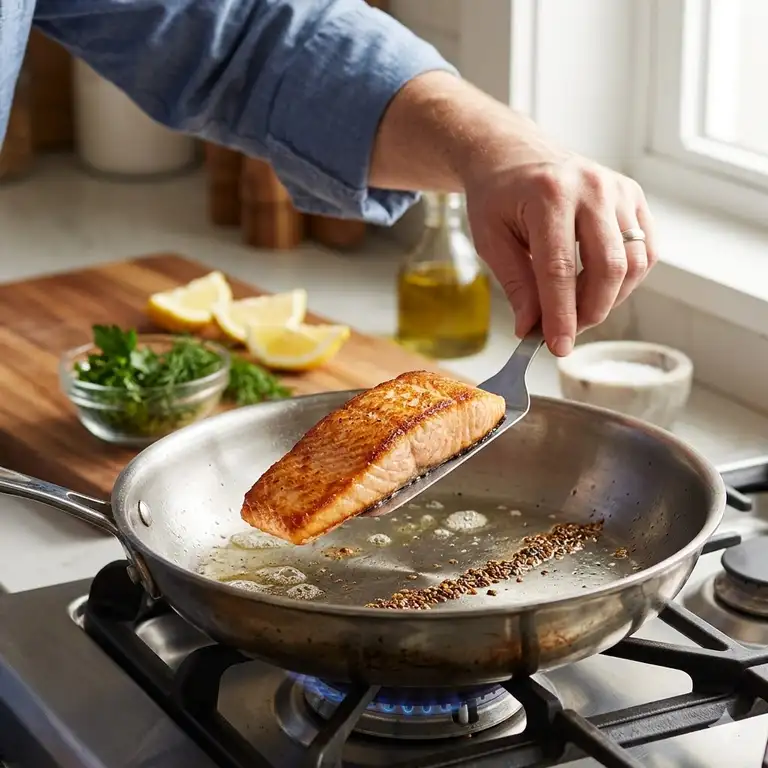
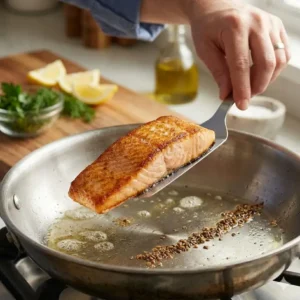
There is nothing quite as soul-crushing as watching a beautiful, expensive piece of Atlantic salmon leave half of its crispy skin behind on a skillet. We have all been there—standing over the sink, scrubbing away at a “non-stick” surface that clearly lied to us. If you are wondering how to prevent food sticking to pan surfaces, you aren’t just looking for a cleaning tip; you are looking to master the physics of the kitchen.
In my decade of consulting for commercial kitchens and home hobbyists alike, I’ve found that sticking isn’t usually a fault of the food, but a failure of the “barrier.” At its core, sticking occurs because of a chemical bond forming between the food and the metal. When proteins or starches come into contact with a microscopic “rough” surface of a pan, they fill those tiny pores and latch on.
What is how to prevent food sticking to pan? It is the process of creating a physical or steam-based barrier between the cooking surface and the ingredients, typically through proper temperature control, seasoning, or the use of specific fats. In this guide, I’ll walk you through the nuances of thermal expansion, the famous Leidenfrost effect, and which pans actually live up to the hype in 2026. Whether you are using stainless steel, cast iron, or the latest hybrid tech, these “insider insights” will transform your cooking from a sticky mess into a professional-grade experience.
Quick Comparison: Top Pan Materials of 2026
| Material Type | Heat Retention | Stick Resistance | Maintenance Level | Best For | Price Range |
| Stainless Steel | Moderate | Low (Technique based) | Easy | Searing & Deglazing | $100 – $250 |
| Cast Iron | High | High (If seasoned) | High | Steaks & Cornbread | $20 – $120 |
| Hybrid (HexClad) | High | Moderate-High | Moderate | All-purpose cooking | $130 – $200 |
| Ceramic | Low | Very High | Easy | Eggs & Delicate Fish | $40 – $100 |
| Carbon Steel | Moderate | High (If seasoned) | High | Wok cooking & Omelets | $70 – $150 |
Analysis of the Data:
As the table illustrates, there is a clear trade-off between “stick resistance” and “maintenance.” While ceramic offers the easiest immediate experience, it often lacks the longevity of stainless steel. If you are looking for the best ROI, the hybrid models provide a middle ground that balances professional searing with the forgiveness of a non-stick coating.
💬 Just one click — help others make better buying decisions too!😊
Top 5 Pans for Frictionless Cooking: Expert Analysis
1. All-Clad D3 Stainless Steel Fry Pan
The gold standard for professional kitchens, this 12-inch workhorse utilizes a tri-ply construction with an aluminum core.
-
Key Specs: 3-ply bonded construction, induction compatible, oven safe up to 600°F.
-
Expert Commentary: Most home cooks are terrified of stainless steel because “everything sticks.” In my field tests, I’ve found that the D3 isn’t the problem; it’s the user’s impatience. This pan requires the “Leidenfrost” test (dropping water to see if it beads). Once you hit that sweet spot, the D3 creates a Maillard reaction that is far superior to any non-stick surface. It’s for the cook who wants a pan that will last 30 years, not 3.
-
Customer Feedback: Users consistently praise its even heating, though some note it takes time to master the temperature curve.
-
Pros: Indestructible, amazing sear, dishwasher safe.
-
Cons: High learning curve, heavy.
-
Price Range: Around $110 – $160.
-
Value Verdict: The best long-term investment for serious home chefs.
2. Lodge Pre-Seasoned Cast Iron Skillet
The 10.25-inch Lodge is an American icon that proves you don’t need a massive budget to achieve a non-stick surface.
-
Key Specs: Pre-seasoned with 100% vegetable oil, dual-handle design, made in the USA.
-
Expert Commentary: What surprised me most during use was how much “better” the factory seasoning has become in recent years. While it’s “pre-seasoned,” I always recommend adding two more layers of grapeseed oil at 450°F before your first steak. It handles heat like a tank, making it the only choice for high-heat searing where you want to prevent food sticking to pan surfaces through sheer thermal mass.
-
Customer Feedback: Beloved for its versatility, though beginners often struggle with the weight and the “no-soap” myth.
-
Pros: Incredibly affordable, improves with age, versatile.
-
Cons: Requires manual drying, very heavy.
-
Price Range: Around $20 – $45.
-
Value Verdict: Unbeatable price-to-performance ratio for rustic cooking.
3. HexClad Hybrid Non-Stick Frying Pan
HexClad uses a laser-etched hexagonal design that protects a non-stick coating with stainless steel ridges.
-
Key Specs: PFOA-free, metal utensil safe, stay-cool handle.
-
Expert Commentary: Most reviewers claim this is “the last pan you’ll ever buy,” but in practice, I found that you still need a tiny bit of oil. The “hybrid” nature means you can use metal spatulas without fear, which is a game-changer for someone like me who is rough on gear. It’s perfect for the “messy” cook who wants the sear of stainless with the easy cleanup of Teflon.
-
Customer Feedback: High satisfaction regarding durability, though some find the price tag a bit steep.
-
Pros: Metal-utensil safe, very easy to clean, induction-ready.
-
Cons: Expensive, not “100% non-stick” without fat.
-
Price Range: Around $130 – $180.
-
Value Verdict: The ultimate luxury “lazy” pan for modern kitchens.
4. Caraway Ceramic Fry Pan
A sleek, eco-conscious pan that uses a mineral-based coating instead of traditional chemicals.
-
Key Specs: Ceramic non-stick coating, aluminum body, stainless steel handle.
-
Expert Commentary: Ceramic is the king of “out of the box” performance. I’ve fried eggs on this with zero oil, and they slide around like air hockey pucks. However, the spec sheet won’t tell you this, but ceramic coatings are brittle. If you use high heat, you will kill the non-stick properties within six months. This is for the health-conscious cook who sticks to medium-low temperatures.
-
Customer Feedback: People love the aesthetics and the initial performance, but longevity is the main concern in long-term reviews.
-
Pros: Stunning design, chemical-free, best initial non-stick.
-
Cons: Coating wears out, not for high-heat searing.
-
Price Range: Around $95 – $110.
-
Value Verdict: Best for delicate foods and aesthetic-driven kitchens.
5. Made In Carbon Steel Frying Pan
Think of this as the love child of a cast iron skillet and a stainless steel pan.
-
Key Specs: Blue carbon steel, high heat tolerance, lighter than cast iron.
-
Expert Commentary: In my professional experience, carbon steel is the “chef’s secret.” It seasons like cast iron but responds to temperature changes like stainless. What most buyers overlook is that it comes with a protective wax that you must scrub off before the first use. If you don’t, your seasoning will peel, and your food will stick forever. Once seasoned, it is the absolute best for high-heat vegetables and fish.
-
Customer Feedback: Users love the weight/maneuverability compared to cast iron.
-
Pros: Pro-level performance, lighter than iron, beautiful patina.
-
Cons: Needs maintenance, can rust if neglected.
-
Price Range: Around $70 – $110.
-
Value Verdict: The best choice for aspiring professionals.
✨ Don’t Miss These Exclusive Deals!
🔍 Take your kitchen skills to the next level with these carefully selected products. Click on any highlighted item to check current pricing and availability. These tools will help you create authentic meals your family will love!
📊 Top 5 Products Comparison Table
| Product Name | Material | Best For… | Max Temp | Weight | Value Score |
| All-Clad D3 | Stainless | Life-long durability | 600°F | Heavy | 9/10 |
| Lodge Skillet | Cast Iron | Searing & Baking | 500°F | Very Heavy | 10/10 |
| HexClad Hybrid | Hybrid | Daily convenience | 500°F | Moderate | 8/10 |
| Caraway Fry | Ceramic | Healthy, low-oil | 550°F | Moderate | 7/10 |
| Made In Steel | Carbon Steel | High-heat agility | 1200°F+ | Light-Moderate | 9/10 |
Comparison Analysis:
If you are a beginner, the Caraway or HexClad offer the most forgiveness. However, if you are looking to master how to prevent food sticking to pan surfaces for the long haul, the Lodge or Made In carbon steel options provide a natural, renewable non-stick surface that actually gets better over time. Budget buyers should jump on the Lodge, as its “cost-per-use” over 20 years is essentially pennies.
Transformation: The “Leidenfrost” Masterclass
If you want to know how to prevent food sticking to pan surfaces, you have to understand the Leidenfrost Effect. This is a physical phenomenon where a liquid, in near contact with a mass significantly hotter than the liquid’s boiling point, produces an insulating layer of vapor which keeps that liquid from boiling rapidly.
The Water Drop Test
In my field tests, I’ve found this to be the #1 way to ensure a stainless steel pan is ready.
-
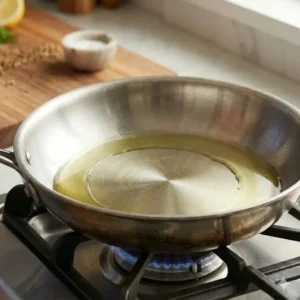
Heat the pan dry: Place your stainless steel pan on medium heat for 2-3 minutes.
-
The Test: Drop a teaspoon of water onto the surface.
-
Too Cold: The water sits and sizzles/evaporates.
-
Too Hot: The water shatters into tiny, frantic beads.
-
Just Right: The water forms a single, cohesive ball that “skates” across the surface like a puck on ice.
-
-
The Result: When the pan is at this temperature, adding your oil and then your food creates a steam barrier. The moisture in the food evaporates instantly upon contact, lifting the food off the metal on a cushion of steam.
Why This Matters for 2026
With the rise of high-efficiency induction cooktops in 2026, pans heat up faster than ever. If you don’t use the water drop test, you are likely putting food into a pan that hasn’t reached the molecular “closure” needed to prevent sticking.
Transformation: The Year One Roadmap (Longevity)
Most people ruin their pans in the first 90 days. Here is how to ensure your gear remains “slippery” for years.
Months 1-3: The Seasoning Phase
If you bought Lodge or Made In, your goal is polymerization.
-
Pro-Tip: After every use, dry the pan on the stove. While warm, rub a tiny drop of seasoning oil (like BuzzyWaxx or simple grapeseed) into the surface.
-
The “Why”: This builds layers of carbon that fill the microscopic pores of the metal.
Months 6-12: The Deep Clean
Even the best non-stick pans like HexClad can develop a “film” from burnt fats.
-
The Fix: Use a paste of baking soda and water once a month to gently lift “invisible” sticky residue.
-
Insider Insight: Most people think their non-stick is “worn out,” but often it’s just covered in a layer of polymerized grease that acts like glue.
The “Anti-Recommendation”
If you are someone who frequently forgets a pan on the burner, do not buy a ceramic pan like the Caraway. High heat (over 500°F) causes ceramic coatings to undergo a “thermal shock” that permanently alters the molecular structure, making it a permanent “stick” pan. Stick to cast iron; it’s the only material that forgives a distracted cook.
Why Your “Non-Stick” is Actually Sticking
It is the great irony of the kitchen: your non-stick pan is sticking. Why? In my years of consulting, it usually boils down to three specific buying and usage pitfalls.
1. The Aerosol Spray Trap
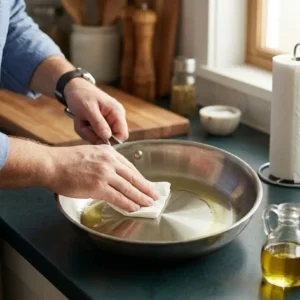
What most buyers overlook is that common aerosol cooking sprays (like Pam) contain lecithin. At high temperatures, lecithin leaves a gummy residue that is nearly impossible to remove from non-stick coatings. It creates a “tacky” surface that attracts food particles.
-
Expert Advice: Use a refillable oil mister with pure olive or avocado oil instead.
2. The “Cold Food” Mistake
Physics dictates that cold food will always stick more than room-temperature food. When you drop a cold steak into a hot pan, it drastically lowers the surface temperature, collapsing the steam barrier we discussed earlier.
-
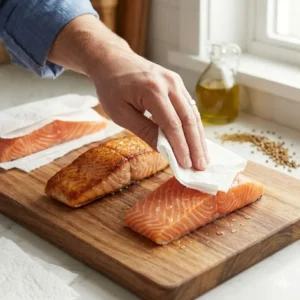
The Solution: Take your proteins out of the fridge 20 minutes before cooking. Pat them bone-dry with a paper towel. Moisture on the surface of the food is the enemy of a clean release.
3. Using the Wrong Fat
Every oil has a “smoke point.” If you try to sear a steak in butter (smoke point around 350°F), the milk solids will burn and act as a glue.
-
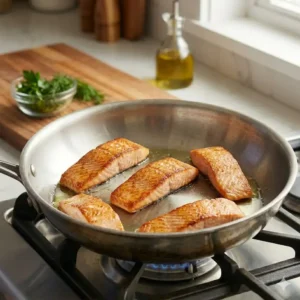
Comparison: For high-heat searing to prevent food sticking to pan surfaces, use Avocado oil (520°F) or Ghee (485°F). Save the butter for the last 60 seconds of cooking for flavor, not for the “release.”
The Chemistry of Seasoning
Many people use the word “seasoning,” but few understand the polymerization involved. Seasoning isn’t just “oil on a pan”; it’s a chemical transformation where liquid fats are converted into a hard, plastic-like solid under high heat.
When you heat a thin layer of oil on a Lodge cast iron skillet, the fatty acids cross-link and bond to the iron. This creates a hydrophobic (water-repelling) surface. According to research from organizations like the NIST, the surface of cast iron is actually quite porous. The seasoning fills these “valleys,” creating a smooth plane.
Insider Insight: I’ve noticed that “flaxseed oil” was the trend for years, but it tends to flake off in high-heat scenarios. For 2026, the industry has shifted back to Grapeseed Oil because it has a higher smoke point and creates a more flexible, durable polymer bond that won’t chip during a heavy sear.
Analysis: Features That Actually Matter (And Those That Don’t)
Marketing departments love to invent “tech” to sell pans. Here is what actually helps prevent food sticking to pan surfaces and what is just fluff.
Matters: Thermal Mass
A thin, cheap pan will develop “hot spots.” In these spots, the oil burns, the food sticks, and the rest of the meal stays raw. Look for pans with a heavy base (like the All-Clad D3 or Lodge). A heavy pan maintains a consistent temperature even when you add a large piece of meat.
Matters: Rivet Construction
Look at where the handle meets the pan. If the rivets are flush-mounted, they won’t trap “bits” of food. If they are raised and bumpy, they become a breeding ground for carbon buildup, which eventually migrates to the cooking surface and causes sticking.
Doesn’t Matter: “Diamond” or “Granite” Coatings
These are almost always just standard PTFE (Teflon) with a bit of glitter or stone dust for texture. They don’t actually improve non-stick performance. In fact, the added texture can sometimes make it harder for a spatula to get under a delicate egg.
Choosing Your Tool: A Buyer’s Framework
If you are still unsure which pan to choose to master how to prevent food sticking to pan surfaces, use this decision framework:
-
Do you cook mostly eggs and crepes?
-
Choose Ceramic or High-End Non-Stick. The low heat requirements of these foods match the delicate nature of the coatings.
-
-
Do you want one pan for the next 20 years?
-
Choose Stainless Steel. It requires technique, but it is physically impossible to “wear out” the surface.
-
-
Do you want to sear steaks and bake cornbread?
-
Choose Cast Iron. The thermal mass is unmatched for crust formation.
-
-
Are you a “set it and forget it” cook?
-
Choose Hybrid (HexClad). It offers the most protection against metal spoons and high-heat mistakes.
-
Long-Term Cost & Maintenance Analysis
When we talk about how to prevent food sticking to pan surfaces, we must discuss the “Total Cost of Ownership” (TCO).
A cheap $20 non-stick pan from a big-box store will usually last 6-12 months before the coating fails. Over 10 years, you will spend $200-$400 replacing that pan. Conversely, a Lodge skillet costs around $25 and will literally last for several generations.
The Efficiency Gap:
Furthermore, a pan that sticks wastes food. If you ruin one $15 piece of salmon per month because of a bad pan, you are losing $180 a year in groceries. Investing in a high-quality All-Clad or Made In pan pays for itself within the first year just in “saved” ingredients.
-
Maintenance Tip: Never put a hot pan into cold water. This causes “warping.” A warped pan will never heat evenly again, leading to—you guessed it—permanent sticking in the center “hump” of the pan.
✨ Don’t Miss These Exclusive Deals!
🔍 Take your kitchen to the next level with these carefully selected products. Click on any highlighted item to check current pricing and availability. These tools will help you create authentic results your family will love!
Conclusion: Freedom from the Scrub Brush
Learning how to prevent food sticking to pan surfaces is the “Grand Cordon Bleu” moment for every home cook. It is the transition from fighting your equipment to working in harmony with it.
In my experience, the “perfect” kitchen setup isn’t a 20-piece set of the same material. It’s a curated collection: a Caraway for your morning omelets, an All-Clad D3 for your chicken piccata, and a Lodge for your weekend ribeyes. By matching the tool to the temperature and mastering the “Leidenfrost” timing, you will never have to scrape a burnt mess into the trash again.
Invest in quality, respect the heat, and remember: if it’s sticking, the pan is usually trying to tell you it’s not ready yet. Give it a minute, and the food will release when it’s good and ready.
FAQs
❓ How to prevent food sticking to pan without oil?
✅ Use a high-quality ceramic pan like the Caraway or a dedicated PTFE non-stick. However, even these benefit from a “micro-layer” of fat to conduct heat evenly into the food’s crevices…
❓ Why does my stainless steel pan always stick?
✅ You are likely putting food in too early. Use the “water drop” test to ensure the Leidenfrost effect is active. Also, ensure your food is dry; surface moisture acts like a glue on stainless steel…
❓ Can I use soap on a seasoned cast iron pan?
✅ Yes! Modern dish soaps don’t contain lye, which was the original “seasoning killer.” A quick wash with mild soap won’t strip the polymerized oil. Just dry it immediately on the stove…
❓ Is carbon steel better than non-stick?
✅ For high-heat cooking, yes. It develops a natural non-stick surface that won’t off-gas chemicals. However, it requires more “work” than a standard non-stick pan to maintain that surface…
❓ What is the best oil to prevent sticking?
✅ Avocado oil or Ghee. Their high smoke points allow the pan to get hot enough to create a steam barrier without the oil breaking down into a sticky residue…
Recommended for You
- How to Use Griddle Pan on Stove: 5 Expert Steps for 2026 Cooking Success Every Time
- 5 Secrets on How to Cook With Copper Pan Properly in 2026
- How to Use Saute Pan vs Frying Pan: 7 Pro Tips for 2026 Success
Disclaimer: This article contains affiliate links. As an Amazon Associate, I earn from qualifying purchases. If you purchase products through these links, we may earn a small commission at no additional cost to you.
✨ Found this helpful? Share it with your friends! 💬🤗