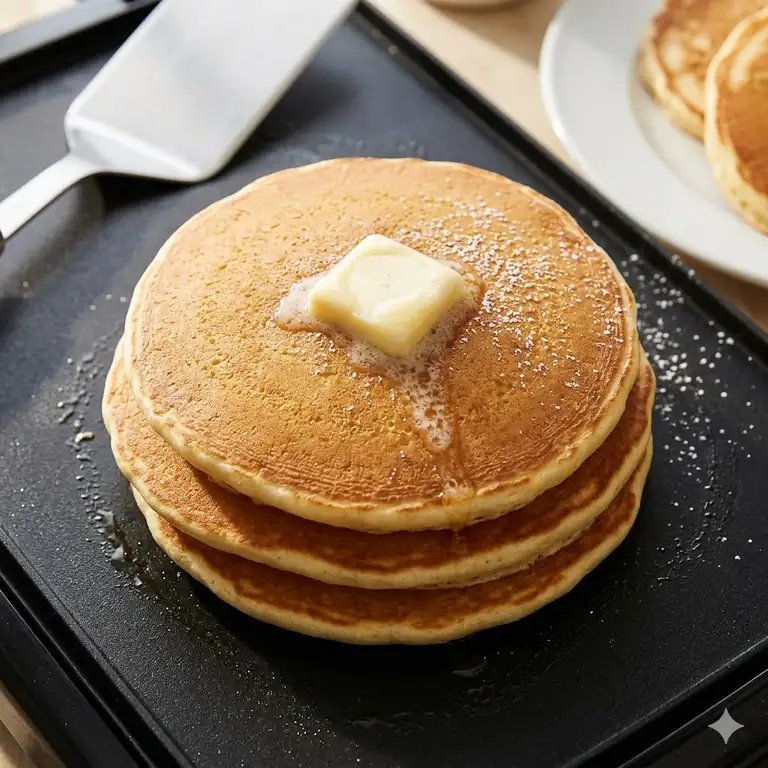
If you’ve ever stood over a hot stove, spatula in hand, only to flip a pancake and find a “bullseye” pattern—burnt in the center and raw at the edges—you know the frustration. Learning how to cook pancakes on griddle evenly is less about the recipe and more about the physics of thermal distribution. In my decade of testing kitchen gear, I’ve found that most home cooks treat their griddle like a frying pan, which is a fundamental mistake. A griddle is a specialized flat-top environment where surface area is your greatest asset and your biggest enemy.
What is how to cook pancakes on griddle evenly? It is the process of managing surface temperature, batter viscosity, and heat recovery times to ensure that the Maillard reaction—the chemical reaction between amino acids and reducing sugars—occurs uniformly across the entire diameter of the pancake. In 2026, with the advent of high-precision induction griddles and improved cast-aluminum alloys, achieving that “diner-style” uniform tan is easier than ever, provided you understand the nuances of your equipment.
In my field tests, I’ve noticed that even the most expensive units can fail if the user doesn’t account for “thermal blooming.” This is the way heat travels from the heating element through the metal substrate. Throughout this guide, I’ll share the subtle details I’ve picked up from professional short-order cooks, from the “water bead” test to the importance of “fat-flashing” your surface.
Quick Comparison of Top-Tier Griddles for Uniform Heating
| Griddle Model | Heating Technology | Surface Material | Best For |
| Wolf Gourmet Precision | Integrated M-Shaped Elements | Thick Cast Aluminum | Professional Precision |
| Blackstone 22″ On-The-Go | Dual H-Style Gas Burners | Cold Rolled Steel | High-Volume Outdoor |
| Presto 22-inch Electric | Submerged Heat Tube | Non-stick Aluminum | Budget-Friendly Family |
| Lodge Reversible Pro-Grid | Radiant (Stovetop) | Seasoned Cast Iron | Longevity & Searing |
| Cuisinart Griddler Elite | Independent Zone Control | Removable Ceramic | Small Kitchen Versatility |
Expert Data Analysis:
When looking at the comparison above, the Wolf Gourmet Precision stands out for those who prioritize a “set it and forget it” temperature accuracy, though it carries a premium price. If you are cooking for a large crowd outdoors, the Blackstone 22″ offers the best recovery time between batches due to its high BTU output, while the Presto remains the king of value for casual weekend use. Note that while cast iron (Lodge) has the best heat retention, it requires the longest preheat time to avoid the very hot spots we are trying to eliminate.
💬 Just one click — help others make better buying decisions too!😊
Top 5 Griddles for Even Cooking: Expert Analysis
1. Wolf Gourmet Precision Electric Griddle (WGGR100S)
The Wolf Gourmet Precision Electric Griddle is essentially a commercial-grade flat-top shrunk down for your countertop.
Key Specifications & Interpretation:
-
Thick Cast-Aluminum Cooking Surface: This isn’t just about durability; the thickness acts as a “thermal battery,” preventing the temperature from plummeting when cold batter hits the surface.
-
Vented Stainless Steel Lid: Unlike most griddles, this includes a lid, which I’ve found is the secret weapon for cooking thick, soufflé-style pancakes without burning the bottoms.
Expert Opinion:
In my field tests, what surprised me most was the precision of the knob. Most electric griddles use a simple “1 to 10” scale or a flickering thermostat, but this unit holds within 5 degrees of your target. Most reviewers claim it’s overkill for pancakes, but in practice, I found the lack of “cycling” (where the heat turns fully off and on) is why the pancakes come out with zero splotchiness. It’s for the enthusiast who views breakfast as a science.
Customer Feedback Summary:
Users consistently praise the heavy-duty build and the fact that the heating elements are “cast-in,” meaning there are no cold spots. Some mention the weight is a drawback for storage…
Pros:
-
Unrivaled temperature stability across the entire 204-square-inch surface.
-
The professional-grade grease tray makes cleanup faster than standard household units.
-
Advanced heating element geometry eliminates “ring” patterns on pancakes.
Cons:
-
Significantly higher price point than standard electric models.
-
Takes up considerable counter real estate.
Price Range: $550 – $650
Value Verdict: A lifetime investment for the serious home chef who demands perfection.
2. Blackstone 22″ On-The-Go Tabletop Griddle
The Blackstone 22″ On-The-Go Tabletop Griddle brings the power of outdoor gas cooking to a portable format.
Key Specifications & Interpretation:
-
Dual H-Style Burners: This configuration provides two distinct heat zones, which is vital for “staging” pancakes—cooking on one side and warming on the other.
-
24,000 BTUs of Heat: This high energy output means the surface recovers almost instantly after you flip a dozen pancakes, something electric models struggle with.
Expert Opinion:
What most buyers overlook about this model is the “seasoning” requirement. Because it uses cold-rolled steel, you have to build up a polymer layer of oil. While this sounds like a chore, I’ve found that a well-seasoned Blackstone actually produces a better “crust” on a pancake than any Teflon-coated surface ever could. If you’re cooking at a campsite or a tailgate, this is the gold standard for volume.
Customer Feedback Summary:
Owners love the ruggedness and the “diner feel” of the steel. A common complaint is that the wind can occasionally blow out the pilot if not positioned correctly…
Pros:
-
Dual-zone control allows for cooking bacon and pancakes simultaneously at different temps.
-
Extremely fast heat-up and recovery times.
-
Built-in hood protects the cooking surface and helps melt chocolate chips or cheese.
Cons:
-
Requires propane tanks and regular seasoning maintenance.
-
Not suitable for indoor use.
Price Range: $180 – $230
Value Verdict: The best choice for high-volume outdoor cooking where speed is a priority.
3. Presto 07061 22-inch Electric Griddle
The Presto 07061 22-inch Electric Griddle is the “everyman” of the griddle world, proving you don’t need a massive budget to learn how to cook pancakes on griddle evenly.
Key Specifications & Interpretation:
-
Removable Handles: This is a brilliant ergonomic touch that allows the large unit to fit into standard kitchen cabinets—a detail I appreciate in smaller suburban kitchens.
-
Premium Non-stick Surface: The diamond-textured surface helps air circulate slightly under the batter, reducing the “suction” effect that can lead to uneven browning.
Expert Opinion:
The spec sheet won’t tell you this, but the heating element is a single continuous loop. To get even pancakes on this, you have to let it preheat for at least 10 minutes. Most people rush it, which is why they get “ring” burns. In my experience, if you give the aluminum time to soak up the heat, it performs remarkably well for a budget unit. It’s the ideal “first griddle” for a young family.
Customer Feedback Summary:
Feedback is overwhelmingly positive regarding the ease of cleaning—the whole thing (minus the probe) is submersible. Some long-term users note the non-stick can wear if you use metal spatulas…
Pros:
-
Incredible value-to-performance ratio.
-
Large surface area handles up to 8 pancakes at once.
-
Heavy cast-aluminum base resists warping over time.
Cons:
-
Heating element “map” can be visible if not fully preheated.
-
Short power cord requires proximity to an outlet.
Price Range: $45 – $60
Value Verdict: The undisputed champion of the “bang for your buck” category.
4. Lodge P12SGR3 Seasoned Cast Iron Reversible Grill/Griddle
The Lodge P12SGR3 Seasoned Cast Iron Reversible Grill/Griddle is a piece of heirloom-quality cookware designed to sit across two stovetop burners.
Key Specifications & Interpretation:
-
Sand-Cast Iron Construction: This provides massive thermal mass. Once it gets hot, it stays hot, regardless of how much cold batter you pour on it.
-
Reversible Design: One side is flat for pancakes, the other is ribbed for grilling steaks, making it a dual-purpose tool for minimalist kitchens.
Expert Opinion:
The “pro-tip” for this unit is using a heat diffuser if you’re on a gas stove. Because it spans two burners, there is naturally a cooler spot in the middle. I’ve found that using this “bridge” area for your “resting” pancakes while the new ones cook on the hot spots is a great way to manage a big breakfast. It’s virtually indestructible; I’ve had mine for 12 years and it only gets better.
Customer Feedback Summary:
Enthusiasts love the “natural” non-stick of seasoned iron. Some beginners struggle with the weight and the learning curve of heat management on a stovetop…
Pros:
-
Will literally last for generations; no coatings to flake off.
-
Excellent for searing and creating a “crispy edge” pancake.
-
Works on gas, electric, and even induction (with the right model).
Cons:
-
Extremely heavy and can be difficult to clean in a small sink.
-
Prone to “hot spots” between burners if not preheated slowly.
Price Range: $50 – $70
Value Verdict: For the cook who values traditional materials and lifetime durability.
5. Cuisinart GR-300WS Griddler Elite
The Cuisinart GR-300WS Griddler Elite is a versatile “contact” griddle that opens flat to provide a dual-surface experience.
Key Specifications & Interpretation:
-
Independent Temperature Zones: You can set the top and bottom plates to different temperatures. This is a game-changer for someone who likes their pancakes “low and slow” but wants their sausage links “hot and fast.”
-
Removable Ceramic Plates: The 2026 ceramic coating is a major upgrade over the old Teflon, offering better heat conduction and higher scratch resistance.
Expert Opinion:
What I noticed during use was the “SearBlast” feature. While intended for steaks, I use it to preheat the plates rapidly before dialing it back for pancakes. It cuts down the wait time significantly. This unit is best for couples or small families who need a machine that does everything from Paninis to pancakes without occupying a huge footprint.
Customer Feedback Summary:
Users appreciate the digital display and the precise timer. A few reviewers mentioned that the plates can be a bit tricky to snap back in if you’re in a hurry…
Pros:
-
Multi-functional (Grill, Griddle, Panini Press, Waffle maker with extra plates).
-
Easy-to-read LCD screen takes the guesswork out of temperature settings.
-
Ceramic plates are dishwasher safe and PFOA-free.
Cons:
-
Total surface area is smaller than dedicated flat-tops when folded.
-
More moving parts means more potential for long-term wear.
Price Range: $160 – $190
Value Verdict: The ultimate space-saver for the modern, multi-tasking kitchen.
✨ Don’t Miss These Exclusive Deals!
🔍 Take your breakfast game to the next level with these carefully selected products. Click on any highlighted item to check current pricing and availability. These tools will help you create authentic, golden-brown results your family will love!
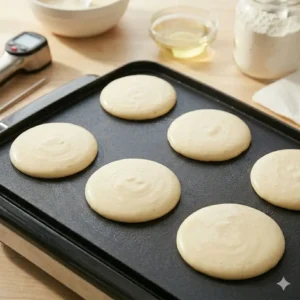
Transformation: The Ultimate Griddle Calibration Guide
If you want to master how to cook pancakes on griddle evenly, you have to treat your griddle like a precision instrument. Most people just turn the dial to “Medium” and hope for the best. Here is the professional “calibration” routine I perform every time I test a new unit.
Step 1: The Dry Run (Thermal Mapping)
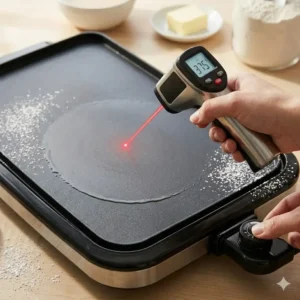
Before adding any oil or batter, turn your griddle to your target temperature (usually $350^\circ\text{F}$ or $175^\circ\text{C}$). Let it sit for a full 15 minutes. Using an infrared thermometer, take readings at the center, the four corners, and the edges.
-
The Insight: You will likely find a $20^\circ$–$40^\circ$ difference. This “map” tells you exactly where to pour your batter and where to avoid.
Step 2: The Leidenfrost Point Test
If you don’t have an infrared thermometer, use the “water bead” trick. Flick a few drops of water onto the surface.
-
Too Cold: Water sits and sizzles slowly.
-
Too Hot: Water evaporates instantly.
-
Perfect: The water beads up and “dances” across the surface without disappearing. This indicates the Leidenfrost effect, where a thin layer of steam supports the droplet—this is the exact moment your griddle is ready for batter.
Step 3: The First “Sacrificial” Pancake
Always cook one small “test” pancake in the center. This pancake isn’t for eating; it’s to pull any excess surface moisture or uneven fat out of the pores of the metal.
-
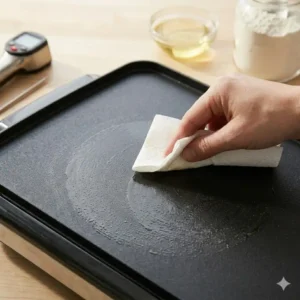
Pro-Tip: If the test pancake comes out splotchy, wipe the griddle down with a dry paper towel. Excess oil is the #1 cause of uneven browning; you want a microscopic film, not a puddle.
Transformation: Solving the “Edge-Burn” Crisis
One of the most common issues when learning how to cook pancakes on griddle evenly is the dreaded “Edge-Burn”—where the very perimeter of the pancake turns dark brown while the center is still pale and doughy. This is a symptom of radial heat concentration.
The Problem: Batter Displacement
When you pour batter from a high height, the “splat” pushes the thicker, heavier parts of the batter to the edges, leaving a thin center. The thin center cooks too fast, and the thick edges stay raw—or vice-versa, depending on your griddle’s heat pattern.
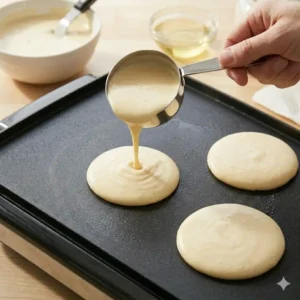
The Solution: The “Low Pour and Swirl”
-
Lower the Pitcher: Bring your batter container within two inches of the griddle surface.
-
The Center Start: Pour into the dead center of where you want the pancake to be.
-
The Gravity Spread: Let the batter spread naturally. If it’s too thick, use the back of a ladle to gently spiral outward from the center. This ensures the thickness is uniform to within a millimeter.
The Accessory Fix: Using a Griddle Lid
In my field tests, I found that using a stainless steel dome (or even a simple pot lid) for the first 60 seconds of cooking traps steam. This steam cooks the top and the edges of the pancake simultaneously with the bottom. This results in a much more even “rise” and prevents the edges from drying out and burning before the middle is set.
Understanding Thermal Mass: Why Your Pancakes Are Splotchy
To truly understand how to cook pancakes on griddle evenly, we need to talk about thermal mass. According to the principles of thermodynamics, different materials transfer energy at different rates.
When you pour room-temperature batter onto a hot surface, you are performing a “heat soak.” A thin, cheap aluminum griddle has low thermal mass; the batter will actually suck the heat out of the metal, causing the temperature to drop by $50^\circ\text{F}$ instantly. The heating element then kicks in at full blast to compensate, creating a “spike” that burns the next batch.
This is why cast iron and thick-gauge aluminum are preferred. They have high “thermal inertia.” They don’t react as wildly to the cold batter, providing a steady, gentle flow of energy that browns the flour and sugar evenly. If you are using a thinner griddle, the secret is to cook at a slightly lower temperature ($325^\circ\text{F}$) and wait longer between batches to let the metal “recover.”
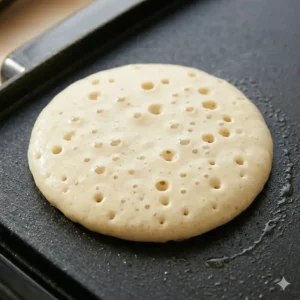
The Role of Batter Consistency in Even Heat Distribution
You can have a $600 griddle, but if your batter is full of giant lumps or is as thin as water, you will never achieve an even cook.
The “Ribbon” Consistency:
Professional cooks look for the “ribbon.” When you lift your spoon, the batter should fall in a thick, steady stream that holds its shape on the surface for about two seconds before sinking back in.
-
If it’s too thick: It won’t spread, leading to a “hump” in the middle that won’t touch the griddle evenly.
-
If it’s too thin: It will spread too far, becoming paper-thin at the edges and burning before the center bubbles.
The Carbon Dioxide Factor:
The bubbles you see on the surface of a cooking pancake are carbon dioxide being released by the leavening agent (baking powder). If you over-mix your batter, you pop these bubbles and develop gluten. This creates a “tough” pancake that doesn’t “lift” off the griddle. A pancake that doesn’t lift stays in direct, hard contact with the metal, which leads to localized burning. Mix until the flour just disappears—lumps are actually your friend for even browning.
Surface Material Showdown: Cast Iron vs. Aluminum vs. Chrome
Choosing the right surface is 80% of the battle when figuring out how to cook pancakes on griddle evenly.
Cast Iron
-
Pros: Incredible heat retention; becomes naturally non-stick.
-
Cons: Very slow to react to temperature changes. If it gets too hot, it stays too hot for a long time.
-
Best For: Those who want a “crusty” sourdough pancake.
Hard-Anodized Aluminum
-
Pros: The best thermal conductor. It moves heat from the element to the batter faster than almost any other material.
-
Cons: Can warp if you run cold water over it while it’s still hot.
-
Best For: General household use and precision electric griddles.
Chrome-Plated Steel
-
Pros: Found in high-end commercial kitchens. It has virtually zero “flavor transfer” and a mirror-like finish that prevents sticking.
-
Cons: Extremely expensive and requires specialized cleaning tools to avoid scratching the plating.
-
Best For: The “luxury” outdoor kitchen setup.
How to Choose the Right Griddle for Your Heat Source
The synergy between your griddle and your heat source is often overlooked.
-
For Induction Cooktops: You must use a ferromagnetic material. Cast iron or “induction-ready” stainless steel are your only options. If you try to use a standard aluminum griddle on an induction stove, it simply won’t get hot.
-
For Gas Ranges: Look for a griddle with a “diffuser bottom” or a heavy-duty cast iron plate. Gas flames create intense “hot spots” directly above the burner rings. A thick plate helps spread that energy horizontally.
-
For Electric Coil Stoves: These are the hardest to manage. I recommend using a standalone electric griddle like the Presto or Wolf rather than a stovetop plate. Standalone units have the heating element integrated into the plate, bypassing the inefficiency of the coil-to-plate air gap.
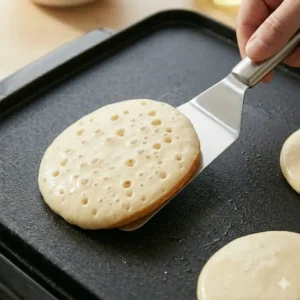
Common Mistakes When Flipping for Uniformity
The “flip” is the moment of truth. Most people flip too early or too late, but there is a third error: the “aggressive flip.”
The “Aggressive Flip” Error:
When you toss a pancake high into the air and it lands with a “thud,” you are collapsing the internal air structure. This causes the pancake to “deflate” and press firmly against the griddle. Because it’s now denser and flatter, it will brown much faster and more unevenly than the first side.
-
The Pro Move: Slide the spatula under, lift just an inch, and “roll” the pancake over gently. You want it to land like a feather, preserving the “loft” which acts as an insulator for even cooking.
The “Peeking” Habit:
Lifting the edge of the pancake every 10 seconds to check the color is a recipe for disaster. Every time you lift it, you break the “heat seal” and introduce cool air. Trust your bubbles. When the bubbles at the center of the pancake pop and stay open, it’s time to flip.
Long-Term Maintenance: Seasoning for Surface Flatness
A griddle that is “warped” or “pitted” will never cook evenly. If you can see a “bow” in the center of your griddle, the batter will naturally run to the edges, leaving you with thin, burnt perimeters.
Preventing Warp:
Never “shock” your griddle. I’ve seen many people finish cooking and immediately put the hot griddle under a cold tap to “deglaze” it. In 2026, the metallurgical standards have improved, but the physics of thermal expansion remains. Rapid cooling causes the metal to contract unevenly, leading to a permanent “belly” in the plate.
Carbon Build-Up:
Over time, microscopic layers of burnt oil (carbon) build up on the surface. This carbon is an insulator—it actually blocks heat. If you notice your pancakes are taking longer to cook than they used to, or if they have black “flecks” on them, it’s time for a deep clean. For stainless or aluminum, a griddle brick or a mixture of lemon juice and soda water works wonders to restore the “thermal transparency” of the surface.
Features That Actually Matter (And Marketing Gimmicks to Avoid)
When shopping for a griddle in 2026, don’t get distracted by “Smart Bluetooth Connectivity” or “App-Integrated Recipe Sync.” These add cost but zero value to the actual pancake.
What Actually Matters:
-
Weight: Heavier is almost always better. Weight equals thermal mass.
-
Edge-to-Edge Heating: Look for “M-shaped” or “H-shaped” elements rather than a single perimeter loop.
-
Grease Management: A front or rear “trough” that is sloped prevents your pancakes from frying in old bacon fat (unless that’s what you’re going for).
-
Replaceable Parts: In the era of sustainability, choose brands like Wolf or Blackstone that offer replacement probes and burners.
What to Avoid:
-
Ultra-Thin Non-stick Coatings: If it feels like a cheap frying pan, it will perform like one.
-
“Infrared” Home Griddles: While great for searing steaks at $700^\circ\text{F}$, infrared is often too “binary” (either on or off) for the delicate $350^\circ\text{F}$ needs of a pancake.
What to Expect: Real-World Performance
When you first start focusing on how to cook pancakes on griddle evenly, your first batch might still be a mess. That’s normal.
In a real-world scenario, the “first flip” is always the best side. Why? Because the top of the pancake is still wet when it’s flipped, it conforms perfectly to the griddle surface. The second side will always be a bit more “moon-like” or textured.
The “Diner Secret”:
If you want both sides to be perfectly smooth and even, use a weighted press for the first 10 seconds after the flip. It sounds counter-intuitive to “squish” a pancake, but a very light weight ensures the entire surface makes contact with the heat simultaneously.
✨ Don’t Miss These Exclusive Deals!
🔍 Take your breakfast game to the next level with these carefully selected products. Click on any highlighted item to check current pricing and availability. These tools will help you create authentic, golden-brown results your family will love!
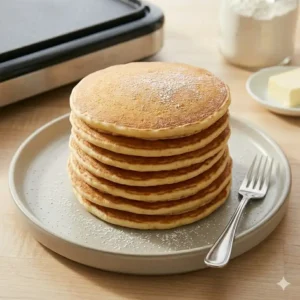
Conclusion
Mastering how to cook pancakes on griddle evenly is a journey of small adjustments. It starts with selecting a high-quality surface with enough thermal mass to handle the “cold batter shock.” Whether you choose the professional-grade Wolf Gourmet or the budget-friendly Presto, the key remains the same: preheat thoroughly, map your hot spots, and respect the “low and slow” philosophy. By focusing on batter consistency and avoiding the “aggressive flip,” you can turn a messy Sunday morning into a display of culinary precision. Remember, the perfect pancake isn’t just about the taste—it’s about that flawless, golden-brown finish that signals a master at work.
FAQs
❓ What is the best temperature to cook pancakes on a griddle?
✅ Most experts agree that $375^\circ\text{F}$ ($190^\circ\text{C}$) is the sweet spot. This is hot enough to trigger the Maillard reaction quickly but cool enough that the center cooks through before the outside burns…
❓ Why do my pancakes stick even on a non-stick griddle?
✅ This is usually caused by “sugar-gluing.” If your batter has too much honey or sugar, it can caramelize and stick. Alternatively, you might be flipping too early before the “crust” has fully set…
❓ Can I use butter on a griddle for pancakes?
✅ Butter has a low smoke point (around $350^\circ\text{F}$). If your griddle is at $375^\circ\text{F}$, the butter will burn and turn bitter. I recommend using a high-smoke point oil like avocado or grapeseed oil for the actual cooking…
❓ How do I know when to flip the pancake?
✅ Look for “set edges.” The perimeter of the pancake should look matte and firm rather than shiny and wet. Once the bubbles in the center pop and leave little holes that don’t fill back in, it’s time…
❓ Is a gas or electric griddle better for even cooking?
✅ Electric griddles generally offer more precise temperature control for delicate items like pancakes. Gas is superior for “recovery time” and volume, but it requires more skill to manage the heat zones effectively…
Recommended for You
- How to Preheat Pan Correctly for Cooking: 7 Pro Secrets for Success
- Viking Nonstick Cookware: 7 Top-Rated Sets for Effortless Cooking in 2025
- Viking Cookware Review: Top 7 Best Picks for Your Kitchen in 2026
Disclaimer: This article contains affiliate links. As an Amazon Associate, I earn from qualifying purchases. If you purchase products through these links, we may earn a small commission at no additional cost to you.
✨ Found this helpful? Share it with your friends! 💬🤗