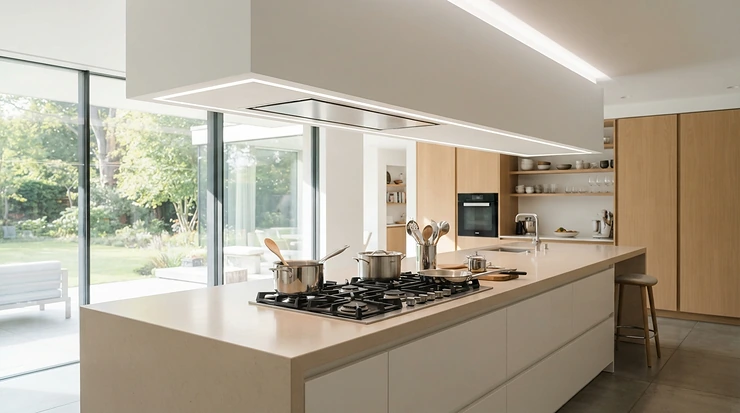
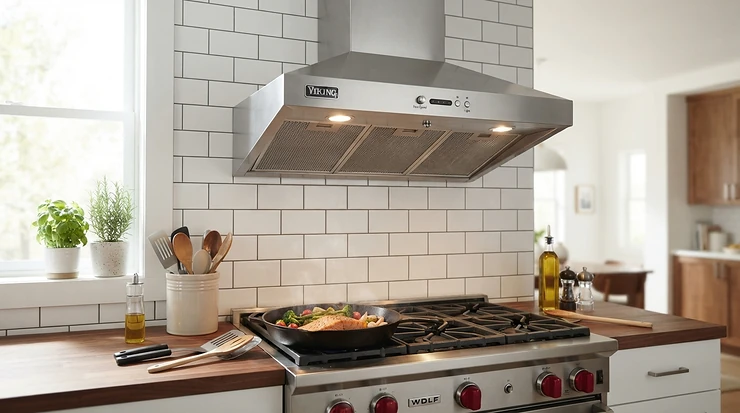
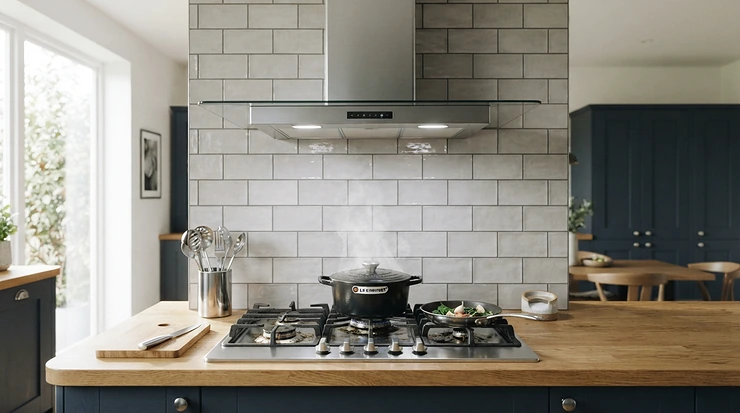
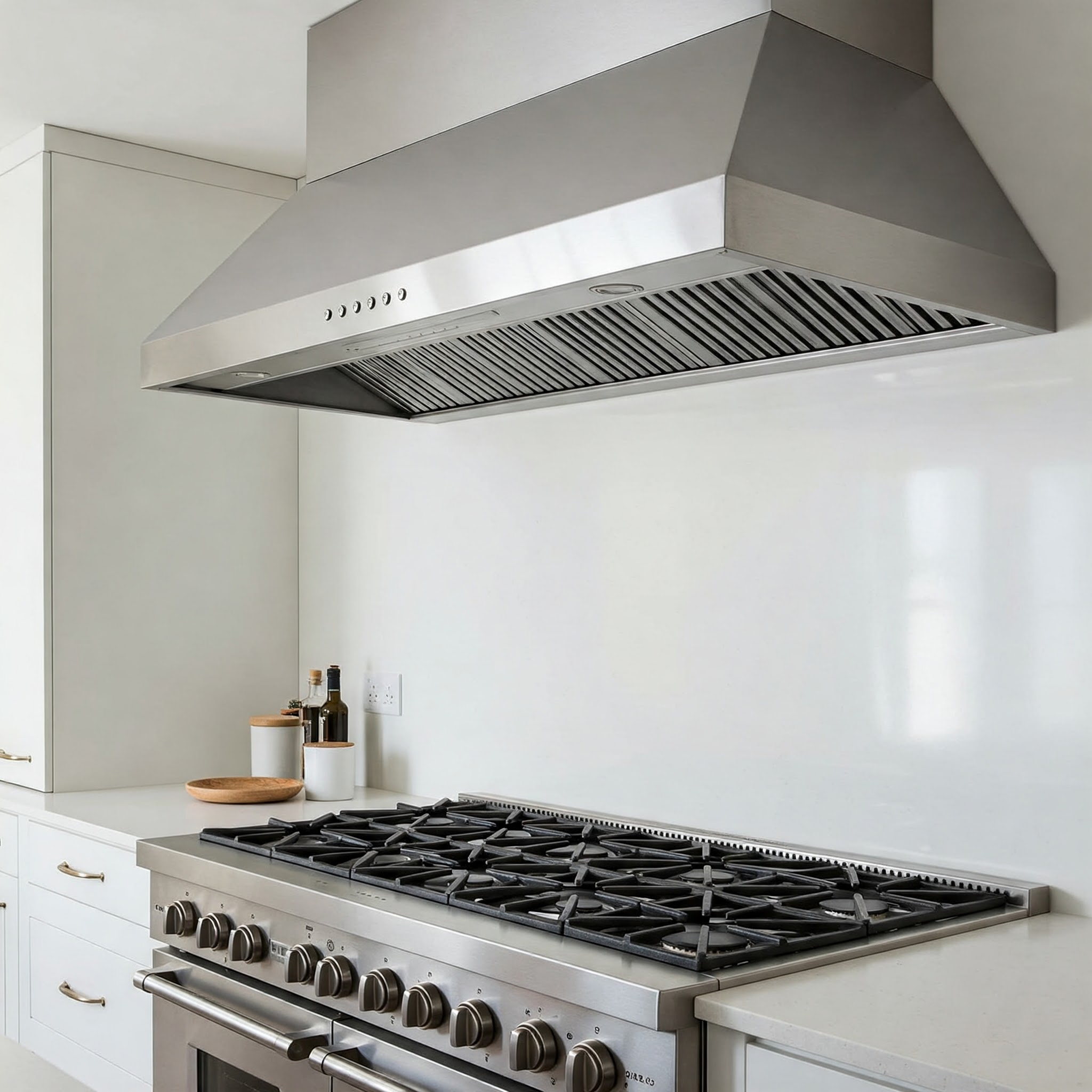
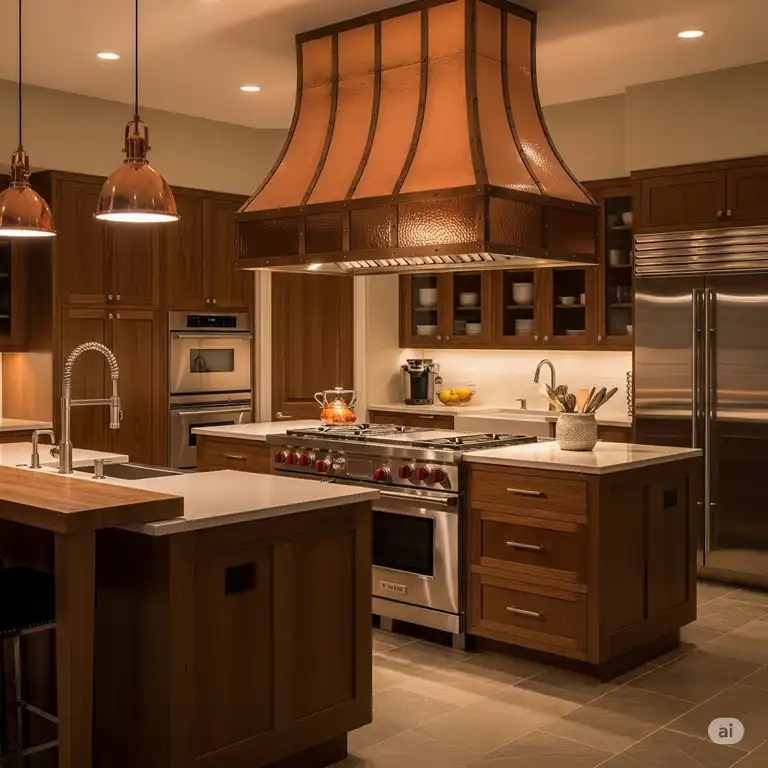
Shoppers who search for a plaster range hood often assume they’re buying a hood made of plaster. They aren’t. The plaster is a skin troweled over a framed box, and the part that actually pulls grease out of your air is a metal insert that disappears once the last coat dries.
That changes what’s worth buying in 2027. Choose the wrong insert and the framing is wrong; fix the framing afterward and you’re patching plaster. So the five picks below start inside the hood, with four inserts sized for custom enclosures, and finish on the surface with a Venetian plaster from a maker whose products appear in published homeowner hood builds. Each one ties to a decision you have to make before the first coat goes on.
I haven’t built a hood or handled any of these products. What follows comes from Amazon listings, retailer spec sheets, manufacturer guidance and the build write-ups of people who plastered their own, and I point out where those sources disagree.
A plaster hood is a box, an insert and a finish
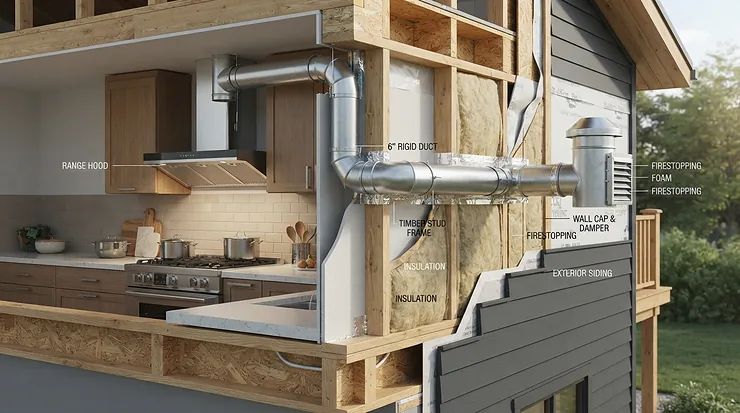
Every plaster hood kitchen project I read about follows the same stack. A wood frame holds the insert, drywall or a similar board covers the frame, and the plaster goes on last. Vent-A-Hood’s product copy, as reproduced by one retailer, describes its liner inserts as the part that mounts inside decorative hoods of wood, plaster, tile or metal.
There are two routes into that stack, and they change what you buy. You can order a hood shell raw or primed and plaster it after it’s mounted, which Hoodsly says many of its buyers and designers do, or you can frame the box yourself, as the Plank & Pillow author did with a drywall crew and his own plaster work. A shell usually arrives with its dimensions fixed, so you choose an insert that fits it. A homemade frame flips that order: the insert comes first and the frame follows.
Three rules shaped these picks. Width comes first: ZLINE’s guide says the insert should match or exceed the width of your cooktop, and Proline says its inserts fit hoods about two inches wider than the insert, so a 28-inch insert suits a 30-inch hood. Depth comes second, because it decides how shallow or sculpted the finished front can be. Venting comes third. The Home Ventilating Institute (HVI) says range hoods should vent outdoors, that ductless filters send heat, humidity, smoke and odors back into the room, and that high-BTU gas cooktops should always be ducted.
Every pick has an Amazon listing plus at least one second source: a retailer spec sheet, a manufacturer guide or a homeowner’s build log. Price ranges appear only where a page I opened supports them.
Pick
Job
Size as listed (W × D)
Airflow as listed
Venting
ZLINE 698-28
Deep, mid-width insert
28 × 18 in
120–400 CFM
Ducted
Broan-NuTone PM300SS
Slim power pack
21.4 × 11.4 in
300 max CFM
Ducted; convertible to non-ducted
IKTCH IKB01-30
Shallow insert
27.75 × 11.77 in
900 CFM
Ducted or ductless
Hauslane IN-R200
Deep, convertible insert
27.75 × 18.5 in
500 lab / 860 equivalent
Ducted or ductless
FirmoLux Marmorino Berlina
The plaster
n/a
n/a
n/a
Read the table as a map of trade-offs rather than a ranking. At roughly 18 inches front to back, the ZLINE 698-28 and Hauslane IN-R200 leave room for a curved or heavily sculpted front, while the IKTCH IKB01-30 and Broan-NuTone PM300SS suit slimmer builds. The airflow column can’t be compared line by line, a point the Hauslane entry explains.
Five picks, from the vent inside to the plaster outside
1. ZLINE 698-28 — deep body for chunkier plaster hoods
Depth is what this insert has that the slimmer ones lack. The ZLINE 698-28 is a 28-inch ducted insert that runs about 18 inches front to back and 14.2 inches tall according to a retailer listing; Amazon’s own dimension line swaps width and depth, so go by the retailer’s numbers and the installation sheet. That depth matters because a plaster hood gets built around the insert, not the other way around. The author of the Plank & Pillow build framed his hood around a ZLINE insert and advises choosing the insert before finalizing the framing, since inserts aren’t interchangeable.
Airflow is where the sources disagree. The Amazon bullet list gives four fan speeds topping out at 400 CFM, while a block of manufacturer text lower on the same page still shows 900 CFM and halogen lights, which looks like older copy. Retailers and ZLINE’s guide line up behind 400, so I’d treat 400 as the figure. Duct size has its own conflict: Amazon lists a 6-inch transition, and two retailer pages list 8 inches. Confirm which before you buy duct.
The rest is straightforward. The listing describes 430-grade stainless steel, dishwasher-safe baffle filters, a dedicated 120-volt, 15-amp circuit, a 3-year parts warranty and a lifetime motor warranty. A retailer spec lists an ideal distance of 30 to 36 inches from the stove. Retail listings put it at around $700 to $800; check the current price on Amazon.com.
Pros:
✅ Dishwasher-safe baffle filters that slide out, handy for keeping grease off the plaster
✅ Lifetime motor warranty plus 3-year parts coverage, per the listing
Cons:
❌ Ducted only; ZLINE says all of its inserts are designed for ducted installation
❌ Conflicting airflow and duct-size text across listings
Spotted a fit for your framing? The Amazon.com listing has the full spec panel.
Not every plaster hood has to be a chimney. For a slimmer build, a 21-inch power pack takes far less room than a full-depth insert. The Broan-NuTone PM300SS measures about 21.4 inches wide, 11.4 deep and 2.8 tall, with a 7-inch round duct connection, a two-speed rocker control, two LED modules and a dishwasher-safe aluminum filter. Retailers list it as UL listed and HVI certified, with a one-year warranty.
Broan’s spec sheet notes that the maximum CFM figure describes the blower in open air. A framed box, a filter and a duct run all add resistance, so 300 is a ceiling rather than a delivery number. The sound rating is 3 sones. HVI’s FAQ explains the scale: one sone is roughly a quiet refrigerator, and a 3-sone fan sounds half as loud as a 6-sone one.
The unit converts to non-ducted use, but a retailer listing shows no ductless filter or kit in the box. Broan also sells optional stainless liners for 30- and 36-inch cabinet installs. Retailers sell it at around $250 to $320.
One shopping warning from the Amazon results themselves: several third-party listings reuse the PM300SS name for lookalike inserts under other brand names. Buy the one sold under the Broan-NuTone brand.
Look elsewhere if your range is a high-output gas model; 300 CFM measured in open air is a thin margin for that job.
Shallow is the point here, and also the limit. The IKTCH IKB01-30 is listed at 27.75 inches wide, 11.77 deep and 11.4 tall, which suits a hood front that doesn’t project far into the room. Amazon lists 900 CFM, four speeds, remote, touch and gesture controls, two stainless baffle filters and ETL certification. The brand promises a 10-year motor replacement and 5 years on the switch and lights. A buying-guide roundup confirms the 900 CFM label, the 40 to 65 dB noise range and the 10-year motor coverage.
Two details on the listing don’t match. One field says 60 dB and the bullet text says 40 dB at low speed and 65 at maximum. The voltage shows as 127 in one field and 120 elsewhere. I found no laboratory airflow number for this model, so I’d read 900 as the label’s ceiling rather than a promise, for the reason the Hauslane entry lays out below.
It’s convertible, but HVI’s guidance on ductless filters applies: vent outside if you can. Some manufacturers build airflow limits into their 860-CFM models for local code reasons, as Hauslane describes for its IN-R110, so ask your building department whether a 900-CFM hood triggers make-up air rules where you live. Check the current price on Amazon.com.
Pros:
✅ 11.77-inch depth works for a shallow plaster front
✅ Remote, touch and gesture controls for hands covered in flour or oil
Cons:
❌ No lab airflow figure; the 900 is a headline number
❌ Inconsistent noise and voltage fields on the listing
Two airflow numbers follow this model around, and the gap between them is the most useful thing on the page. A retailer lists 860 CFM as equivalent airflow and 500 CFM as laboratory airflow. Home Depot’s title says 500, Amazon’s title says 500 to 860, and Amazon’s detail panel says 800. I read 500 as the planning number and 860 as the ceiling; that’s my reasoning, and Hauslane’s own pages would settle it. Noise runs from 1.5 to 7 sones across the speed range, per the retailer.
The body is 27.75 inches wide, 18.5 deep and 13.25 tall, so it shares the ZLINE 698-28‘s depth while adding a ductless option. Amazon’s listing describes three speeds, a 6-inch round duct connection, two dishwasher-safe baffle filters in the 30-inch size, a grease tray and replaceable GU10 LED bulbs. Charcoal filters for recirculating mode are sold separately. The retailer lists electrical draw at 1.2 amps and 144 watts. The same family also comes in 36- and 42-inch widths, and one retailer lists the 30-inch model at around $500 to $600; check the current price on Amazon.com.
I opened no Hauslane page of its own, so the CFM question is worth asking the company directly.
It makes sense if you want the ZLINE’s depth with an option to recirculate later.
Everything above ends up behind this one, the part visitors actually see. Amazon lists FirmoLux Marmorino Berlina as an Italian-made lime and marble Venetian plaster for interior use, sold in sizes from a quart up to 5 gallons and in a large color range. The listing’s coverage line calls for 5 kg per 100 square feet for one coat and 9 kg for two. Plank & Pillow’s framing was about 51½ by 23 by 49 inches; by my arithmetic, its front and two sides total roughly 33 square feet, or about 3 kg for two coats. One gallon, which the listing codes as 5 kg, would cover that with margin.
Here’s what the evidence does and doesn’t show. The hood Plank & Pillow documents used FirmoLux’s matte Marmorino Piatto, applied over FirmoLux Anchor Primer on finished drywall: a thin base coat, a texture coat, burnishing with a clean joint knife and a natural beeswax finish. The Chris Loves Julia hood used Novacolor’s Marmorino KS instead. Neither used Berlina, and neither source tests plaster against cooktop heat. Berlina’s listings also mix “polished” and “matte” labels, so confirm the finish in the variation you pick.
Technique matters more than the can. Hoodsly’s designer network says to test the texture on sample boards before committing and suggests hiring a specialty painter, because getting the texture right is often harder than the application. A quart won’t cover a hood; trust the coverage line, not the can size.
Where a plastered hood gets into trouble: grease, weight and access
Grease and heat
Venting decides most of the grease problem. HVI says to vent outdoors, and Proline’s guidance for custom hoods is that a ducted insert is the better way to keep the hood itself clean. A designer quoted by Hoodsly says they’ve had no trouble because the hood sits far enough from the range, though the article gives no distance.
Distances differ by source. HVI says to follow the manufacturer’s height and notes that the installation instructions it reviewed show a typical range of 20 to 30 inches; ZLINE’s retailer spec says 30 to 36 inches. Your manual wins. As for heat, none of the build write-ups I read gives a heat rating for the plaster. Plank & Pillow’s post doesn’t address heat or fire safety at all, so ask both the plaster maker and the insert maker about clearance, and check with your building department.
Picking a plaster finish for range hood use
Smooth, burnished and sealed is the common thread. Chris Loves Julia credits burnishing to a slight sheen for grease not sticking and says that after about three years she rarely cleans the hood. The Plank & Pillow author reports no visible grease or dirt, though he notes that heavy deep-frying or a very low mount might change that. House Digest describes a polished finish as plaster sanded between coats and burnished before sealing.
A coarse, earthy texture has more surface for grease to settle into, which is my reasoning rather than a tested claim. A Houzz discussion raises the same worry about grease-stained plaster and recommends sizing the hood for what you cook, plus switching it on before the pan heats up.
Weight and the access question
Hoodsly says plaster and Roman clay add weight, so use a few extra screws when mounting the hood to the wall, add iron strapping inside regardless of width, and reinforce during installation rather than afterward. Plank & Pillow set the insert’s brackets on wood cross-pieces and used flexible duct, which allows repairs without removing the insert, though its author doubts the insert can be dropped back out. HVI prefers smooth metal duct over flexible because the ridges cut airflow and wants runs short and straight, so you may be weighing serviceability against airflow.
Access is the question the Chris Loves Julia post leaves unanswered; a reader asked how to reach the metal insert and the post doesn’t say. ZLINE’s guide lists filter cleaning or replacement, interior wipe-downs and keeping grease off the blower as routine upkeep. Leave yourself a way to reach all three before anything gets plastered.
Plaster hood designs, and the insert each one asks for
A curved front is the shape most often documented. Plank & Pillow framed one from pine with seven MDF strips across the front, over a 46-inch ZLINE insert. That depth suggests the ZLINE 698-28 or Hauslane IN-R200 class of insert for a sculpted front. Chris Loves Julia’s hood has a slight vault in the middle and storage nooks at the sides.
Other plaster hood designs lean on trim and scale. Mostess shows an adobe-style hood with cedar trim, and House Digest calls a plaster hood with a range shelf a popular pairing. The Range Hood Store recommends consulting a professional before attempting a tall plaster hood alone. Taller means heavier, which brings back Hoodsly’s strapping advice.
Finish choice follows the same logic. The LUDC design blog describes plaster hoods that run from coarse and earthy to burnished like polished stone, and suggests either matching the surrounding walls or contrasting them. For slim fronts, the IKTCH IKB01-30 (11.77 inches deep) and Broan-NuTone PM300SS (11.4 inches deep) leave more room. ZLINE’s custom range hood guide walks through measuring the insert and the cooktop-to-hood distance before you size the enclosure.
Three questions about plaster vent hoods
Can you plaster a range hood?
Yes. Hoodsly says many buyers order a hood raw or primed and plaster it themselves after installation, and Vent-A-Hood’s liner copy names plaster hoods as a use. Heat tolerance is the open question, so ask both makers about clearance.
What goes inside a plaster hood?
A liner or insert: a metal blower-and-filter unit that slides into a framed box and ducts outside. Proline says most residential inserts run 28 to 60 inches wide and fit hoods about two inches wider, such as a 28-inch insert in a 30-inch hood.
How do you clean a plaster vent hood?
Gently. Hoodsly says to dust occasionally and clean lightly when needed. Chris Loves Julia wipes only the lower area where fingerprints collect and credits the burnished finish for the rest. Check the plaster maker’s care instructions before using any cleaner.
Choosing your plaster range hood setup
Start with the insert, not the plaster. Measure the depth your design allows and the width your cooktop needs, then match the vent. For a curved or deep front, the ZLINE 698-28 and Hauslane IN-R200 are the two with the room. For a slimmer build, the IKTCH IKB01-30 carries the bigger airflow label, and the Broan-NuTone PM300SS suits lighter cooking. Duct it outdoors if at all possible, and confirm the airflow number you’re actually buying.
A plaster range hood is a finish decision made last and a venting decision made first. Once the box is framed, FirmoLux Marmorino Berlina is one option for the surface, to be tested on sample boards before it touches the hood. Whatever you pick, leave a way back into the insert.
Found a pick that fits your framing? Take a closer look at its Amazon.com listing.
Disclaimer: This post contains affiliate links. As an Amazon Associate, I earn from qualifying purchases made through these links, at no additional cost to you.
Planning a plaster hood of your own? Share this with whoever is holding the trowel. 🧱
At SmartCookLab, we are passionate about cooking and helping you find the best kitchen appliances and tools. Our team provides expert reviews, buying guides, and practical tips to enhance your cooking experience.
Home » Plaster range hood: 5 Picks Worth Your Money (2027) Shoppers who search for a plaster range hood often assume they’re buying a hood made of plaster. They aren’t.
Home » Plaster range hood: 5 Picks Worth Your Money (2027) Shoppers who search for a plaster range hood often assume they’re buying a hood made of plaster. They aren’t.
Home » Plaster range hood: 5 Picks Worth Your Money (2027) Shoppers who search for a plaster range hood often assume they’re buying a hood made of plaster. They aren’t.