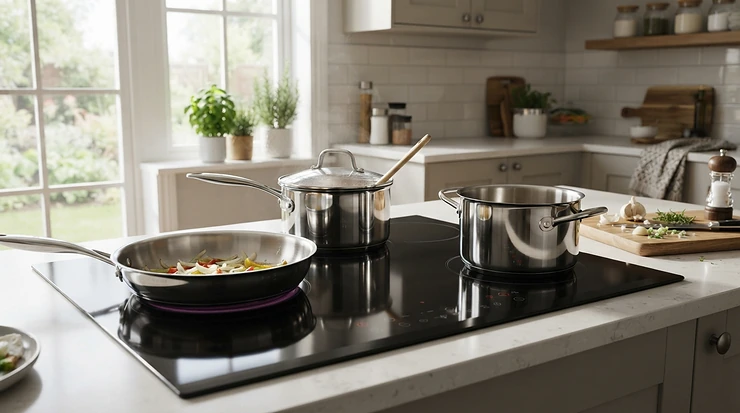
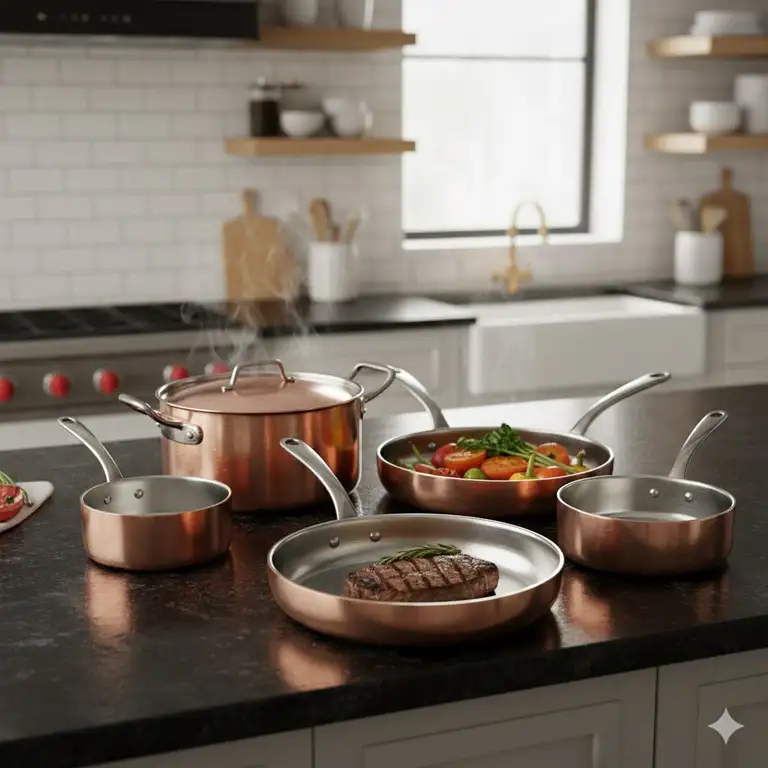
A copper saucepan bought for the wrong cooktop is an expensive mistake, because classic copper is not magnetic and an induction burner simply ignores it. Price compounds the risk: America’s Test Kitchen says a single piece of copper cookware can run past $500. Before anything else, then, shoppers weighing copper saucepans in 2027 need to settle three things: the wall thickness they want, the lining inside, and the stove underneath.
Specs, weights and care rules below come from the makers’ own pages, while the long-running owner findings come from eGullet threads, retailer review pages and America’s Test Kitchen’s explainer; where those sources disagree, the disagreement is stated, and prices stay in ranges.
The short version: gas, electric and radiant cooktops reward the heavier French builds, such as the Mauviel M’Heritage M’250C Copper Saucepan with Lid, 2.6-Quart, while induction cooks get a working copper pan from the Hestan CopperBond Induction Copper Saucepan with Lid, 2-Quart or the Mauviel M’6 S Induction Copper Saucepan with Lid, 3.2-Quart.
Who should buy solid copper, and who should buy clad instead
Copper’s appeal is speed. America’s Test Kitchen’s (ATK) explainer on copper pans describes a metal that reacts to the burner almost at once and sheds heat just as quickly when the flame drops, so food is less likely to overcook or burn. Aluminum is more responsive than stainless steel, the same page adds, yet still slower than copper.
The drawbacks are just as concrete. Copper is expensive, and unlined copper isn’t safe for cooking, so every pan on the market carries a lining. Some nonstick pans sold as “copper” contain none, according to ATK’s expert, who describes them as ordinary nonstick pans in a copper color.
Whether the trade is worth making is the open question, and an eGullet thread comparing copper with stainless-clad cookware shows how split owners are. Members agree that heavy copper outperforms other materials, but several doubt it pays off for everyday cooking. One calls the gain a nicety rather than a necessity and would buy only a piece or two, such as a saucepan for sauces; another argues copper earns its place in long reductions and unattended simmering, where it resists scorching.
That makes the saucepan the sensible first copper purchase, since gentle liquids are what copper does best. Buyers who cook mostly on induction, or who don’t want to polish anything, can look at copper-core clad instead: ATK says pans with a hidden copper layer cost about half as much as solid copper.
Gauge, lining, stove: the filters behind this shortlist
Thickness is the first filter. Borough Kitchen’s guide to choosing a copper saucepan puts Mauviel’s M’150 range at 1.5 mm and the M’200 at 2 mm, each about 90% copper over a thin stainless layer, with the thicker one heating faster but weighing more. Heavier is where forum members place the payoff: an eGullet member who owns several pieces says the advantage comes from stainless-lined copper around 2.5 mm and sees little gain in 1.6 mm pans. Mauviel itself labels its 1.5 mm line as standard use, so the maker and that member read the same gauge differently.
Lining is the second. Copper is reactive and can give acidic foods a metallic taste, so a non-reactive lining is needed. ATK calls tin the traditional choice and finds it acceptable in saucepans, where liquid keeps the surface cooler, but notes that tin starts to melt above roughly 450°F, while stainless is now the most common lining on new pans and lasts longer. Borough Kitchen adds that tin wears down and needs re-tinning every 10 to 20 years depending on use, and it advises against metal utensils on tin. Mauviel’s own care notes cap tin-lined pieces in the oven somewhere between 440°F and 460°F, depending on which of its pages you read. All six pans below are stainless-lined or stainless-clad, so none of that upkeep applies.
Handles and stove come last. Cast iron and bronze handles hold heat and get hot, while stainless handles stay cooler, per Borough Kitchen; five of the six picks list stainless handles, and the maker’s page for the sixth doesn’t say. Stove compatibility is the hard filter, and it gets its own section further down.
Best copper saucepans for 2027: build, lid and stove compared
None of these is a ranking, because each pan answers a different kitchen.
Model
Build
Induction
Lid
Price range
Mauviel M’Heritage M’250C Copper Saucepan with Lid, 2.6-Quart
2.5 mm, 90% copper and 10% stainless
Not stated by the maker; classic Mauviel copper needs an interface disc
Included
Around $400 to $500
Mauviel M’Heritage M’150 S Copper Saucepan, 1.8-Quart
1.5 mm, 90% copper and 10% stainless
Only with an interface disc
Not stated
Around $300
Mauviel M’6 S Induction Copper Saucepan with Lid, 3.2-Quart
Six layers, 2.6 mm overall
Yes
Copper lid on a retailer’s listing
Around $350 to $490
Hestan CopperBond Induction Copper Saucepan with Lid, 2-Quart
Five layers, 1 mm copper core
Yes
Stainless, included
Around $350
All-Clad Copper Core 5-Ply Saucepan with Lid, 2-Quart
Five-ply, copper center
Yes, per the maker
Included
Around $270
de Buyer Prima Matera Copper Saucepan with Lid, 16 cm
90% copper outside, 10% stainless inside
Yes, magnetic base
Included
Check the current price on Amazon.com
The build column shows the split: the two M’Heritage pans and the de Buyer are mostly copper, while the Hestan and the All-Clad hide a thin copper layer inside steel. Induction support runs the other way, because the layered pans were designed around the magnet. The lid column deserves a second look, since the maker’s page for the M’150 S leaves lid details thin.
Copper saucepans reviews, one pan at a time: six models and their jobs
Availability is the first question with this pan, ahead of performance. Mauviel’s own page for the 2.6-quart lists 2.5 mm of copper (90% copper, 10% 18/10 stainless), a 7.6-inch diameter, a 4.2-inch height and a lid, at around $400 to $500 after a markdown, but the unit shown is described as new with a small cosmetic scratch. Vintage French Copper’s 2021 write-up reports that Mauviel was phasing the M’250 out in favor of the 2 mm M’200, so stock of this gauge may come and go.
Gauge is the reason to hunt for it. The eGullet members who argue for heavy copper keep returning to roughly 2.5 mm, and this is that thickness in a size suited to sauces and grains. Mauviel’s care notes are the usual copper rules: hand wash, no steel wool, scouring pads, bleach or oven cleaner, no empty pan on a hot burner, and a lifetime warranty that misuse voids. Induction goes unmentioned on the maker’s page, and Mauviel says elsewhere that classic copper needs an interface disc for induction.
Pros:
✅ 2.5 mm gauge, the thickness forum members favor for sauce work
✅ Stainless interior, so no re-tinning
✅ Lid included
Cons:
❌ Not induction-ready without a separate disc
❌ The line is reportedly being phased out, so sizes and stock vary
Compare the exact model number before buying, since the M’200 and M’150 are thinner pans at 2 mm and 1.5 mm.
Whether 1.5 mm is enough copper is the argument that follows this pan around. One eGullet member who owns heavy pieces says 1.6 mm versions offer no real advantage, while Mauviel sells the 1.5 mm M’150 range as standard use, and Vintage French Copper notes that Mauviel graded 1.6 to 2 mm copper as table-service ware until 2007. The trade is plain: less copper and less weight for a lower price, and Borough Kitchen’s listing describes the M’150 S as having a lighter body.
Mauviel’s page lists four sizes from 0.9 to 3.4 quarts at roughly $200 to $450, with the 1.8-quart near $300, a stay-cool cast stainless handle and a stainless interior. Borough Kitchen’s guide singles out the 16 cm (1.8-liter) size as the most versatile for two-person servings. On induction the pan works only with Mauviel’s interface disc, sold separately, and the page advises running it at about 60% of burner power. Anyone hunting for a copper saucepan with lid should know the page does not say whether one is included, and Mauviel sells copper lids for the line as separate items. All four sizes showed as sold out there, so stock elsewhere varies.
Mauviel’s own blog names this line as the exception to its rule that most copper lines need an induction adapter, which makes the M’6 S the French answer for induction cooks. The maker’s page lists six layers of stainless steel, aluminum, magnetic stainless steel and copper, 2.6 mm overall, a 7.9-inch diameter, a 4.3-inch height and a cast stainless handle, and says the pan runs on gas, electric, halogen and induction and goes under the broiler.
Read “2.6 mm” carefully: it is the thickness of the whole stack, and the maker’s page does not say how much of it is copper, so this pan should heat more like a premium clad pan than like the solid M’250C. That is an inference from the layer list, not a test result. One retailer’s listing for the 3.4-quart adds a copper lid with a cast stainless handle, a flared rim for drip-free pouring and an oven limit of 680°F, at around $350 to $490 depending on the sale; capacity appears as 3.2 and 3.4 quarts on different pages.
Pros:
✅ Works on induction without an adapter
✅ Copper lid on the retailer’s listing
✅ Oven and broiler safe
Cons:
❌ The copper share of the 2.6 mm stack isn’t stated
❌ Hand wash only, and the maker advises about 60% of burner power
Before ordering, confirm the capacity and whether the lid is in the box.
Around $350 buys the 2-quart on Hestan’s own page, and the four saucepan sizes run from about $300 to $430. That puts it at the pricier end of the clad picks, and the construction explains part of the gap: a five-layer stack with an 18/10 stainless interior, aluminum, a 1 mm copper core according to Hestan’s FAQ, more aluminum and a stainless exterior, wrapped in a stainless base made for induction. ATK ranked Hestan among its four best copper skillets, though that review covers skillets, not saucepans.
The numbers that matter at the stove: 7.63 inches across, 3 inches tall, 3.39 pounds with the stainless lid, and a 6.25-inch induction contact area, which is worth checking against a small burner ring. It is oven and broiler safe to 600°F, metal-utensil safe, hand wash only, and covered by a lifetime warranty plus a 45-day money-back window. Some eGullet members dismiss copper layered inside steel as marketing copper, so a 1 mm core will not satisfy buyers who want the heavy French feel; it suits those who want responsive heat on an induction-ready base.
Induction trouble is what owners on BBQGuys’ review page report for this size, so that comes before the praise. One owner wrote in 2023 that the 2-quart pan would not heat on their induction stove even though their other Copper Core pieces did, adding that a magnet would not stick to it. A second reported the pan was too small to sit on any of the five burners of their induction cooktop. Both are single reports against a maker listing that says the pan works on any stovetop, induction included, so treat them as a reason to test a magnet and measure your burner ring.
The rest of the page’s owner feedback is friendlier: two reviewers call the pan heavy but praise its heat conduction, and others say it cleans easily. All-Clad’s page lists a five-ply bonded build with aluminum, stainless and a copper center, a long vented double-riveted handle, oven and broiler safety to 600°F, hand-wash care and a limited lifetime warranty, at around $270. It is assembled in Pennsylvania from global components, and ATK counted All-Clad among its top four copper skillets.
Pros:
✅ Lid included, at one of the lower prices in this group
✅ Oven and broiler safe to 600°F
Cons:
❌ Two owners report induction problems (single reports)
De Buyer’s pitch sits closer to Mauviel’s than to Hestan’s: a mostly copper pan, 90% copper outside and 10% AISI 304 stainless inside, with a special base that lets it heat on induction. The maker’s page for the 16 cm size gives a 1.8-liter usable volume (about 1.9 quarts), 12 cm total height, a 15.5 cm induction base, two riveted cast stainless handles, a lid and a weight of 1.29 kg.
The page lists no wall thickness, so compare gauge against the Mauviel pans before assuming parity. Borough Kitchen, a UK retailer, calls the range the closest thing to a traditional French copper pan that still works on induction and lists a two-year guarantee against manufacturing defects, though warranty terms for US buyers may differ. Care follows the copper norm: polishing paste for the copper, hand washing for the stainless parts. Check the current price on Amazon.com.
Confirm the size and lid on the listing before you commit.
French copper saucepans or American clad: what the Mauviel gauge changes mean
The French-versus-clad decision comes down to what the copper is doing. In Mauviel and de Buyer pans it is the body of the pan; in Hestan and All-Clad it is one layer in a bonded stack. Vintage French Copper’s 2021 breakdown of Mauviel’s lineup shows why the French side needs careful reading: until 2007 Mauviel sold 1.6 to 2 mm copper as table-service grade, the M’150 now carries a standard-use label, and the 2 mm M’200 replaced the 2.5 mm M’250 as the stainless-lined flagship, with roughly 1.8 mm of copper against about 2.3 mm.
The same write-up lists the tin-lined M’Tradition at 2.6 mm and points buyers who want new 2.5 mm stainless-lined pans toward Falk and Matfer Bourgeat. Falk is the Belgian maker whose skillet also made ATK’s top four, but neither brand’s saucepan appears among the six because no US listing for either was verified. The blog dates from 2021, so lineups may have moved since.
Clad copper-core pans trade some of that feel for convenience. An eGullet member who prefers heavy copper notes that fully clad pans rarely match the copper thickness that gives the best heat behavior, while ATK’s pricing point cuts the other way, with hidden-copper pans costing roughly half as much. For induction cooks the layered build is the whole appeal, because the magnet is already designed in.
Copper saucepans for induction hobs: adapter disc, built-in base or copper core
Induction heats magnetic metal, and copper is not magnetic. Mauviel’s own page on its value says classic copper won’t run on induction and suggests the M’6 S line, its stainless lines or an interface disc, while an eGullet member calls heavy copper largely unsuitable for induction.
Three routes work. An interface disc such as Mauviel’s M’plus, sold separately, lets a classic pan like the Mauviel M’Heritage M’150 S Copper Saucepan, 1.8-Quart sit on an induction burner, though Manufactum, which sells Falk’s copper cookware, says a cast-iron plate adapter compromises the conductivity that makes copper worth buying. A magnetic layer or base built into the pan, as on the Mauviel M’6 S Induction Copper Saucepan with Lid, 3.2-Quart and the de Buyer Prima Matera Copper Saucepan with Lid, 16 cm, keeps more of the pan as copper. A copper core inside magnetic stainless, as on the Hestan CopperBond Induction Copper Saucepan with Lid, 2-Quart and the All-Clad Copper Core 5-Ply Saucepan with Lid, 2-Quart, is the design most clearly built around the magnet.
Size matters as much as metal. Hestan lists a 6.25-inch induction contact diameter for its 2-quart pan, de Buyer gives a 15.5 cm base for its 16 cm pan, and the All-Clad owner whose 2-quart pan fit none of five burners shows how a small base can fall short. Measure the smallest ring on your cooktop before choosing a small saucepan.
How to clean copper saucepans without hurting the lining
Let the pan cool, then wash it by hand with warm water, mild soap and a soft sponge. Mauviel, Hestan and All-Clad all list their pans as hand wash only.
Treat the interior gently. Soak stuck food in hot, soapy water for 10 to 15 minutes before wiping, a tip from Homes & Gardens, and keep steel wool, scouring pads, oven cleaner and bleach away from it; Mauviel says bleach erodes the stainless.
Polish the outside only when you want it bright. Mauviel’s marketing director told Homes & Gardens that half a lemon dipped in salt or baking soda lifts tarnish, while Hestan and ATK’s expert both point to Wright’s Copper Cream, and Hestan suggests powdered Barkeeper’s Friend for the stainless sections.
Rinse, then dry the exterior thoroughly, because moisture promotes tarnish.
Cook on medium heat, since Mauviel’s pages suggest about 60% of burner power, and never leave an empty pan on a hot burner.
Polishing is optional. Homes & Gardens says patina adds character, and Mauviel’s warranty page treats water spots and patina as cosmetic, so a darker pan is not a damaged one. Tin-lined pieces, which none of these six are, follow stricter rules: no metal utensils and no metal scourers.
Copper saucepan lining, induction and upkeep: short answers
❓ Is it safe to cook in a copper saucepan?
✅ Yes, when the cooking surface is lined. America's Test Kitchen says unlined copper isn't safe for cooking, and Borough Kitchen notes copper can give acidic foods a metallic taste. Stainless or tin linings keep food off the copper, so check the lining stays intact.
❓ Does copper work on an induction cooktop?
✅ Classic copper is not magnetic, so it won't heat on induction by itself. Induction-ready versions add a magnetic layer or base, as clad copper-core pans and a few French lines do, while most classic Mauviel lines need a separate interface disc.
❓ Should a copper saucepan be tin-lined or stainless-lined?
✅ Stainless is the easier choice. America's Test Kitchen finds tin acceptable in saucepans, but it wears and needs re-tinning, which Borough Kitchen puts at every 10 to 20 years depending on use. Stainless never needs re-tinning and tolerates metal utensils.
❓ Is a copper saucepan worth the money?
✅ One eGullet member calls the gain a nicety, not a necessity, and would buy only a piece or two, such as a saucepan for sauces. America's Test Kitchen notes a single piece can exceed $500, while copper-layer clad costs about half as much.
❓ Can a copper saucepan go in the dishwasher?
✅ No. Mauviel, Hestan and All-Clad all list their copper pans as hand wash only, and Mauviel warns that bleach erodes the stainless interior. Wash by hand with a soft sponge, dry right away, and polish only if you want the bright finish.
Which copper saucepan to buy, stove first
Pick the stove first and the gauge second. On gas, electric or radiant cooktops, the Mauviel M’Heritage M’250C Copper Saucepan with Lid, 2.6-Quart is the heavy-gauge choice, with the Mauviel M’Heritage M’150 S Copper Saucepan, 1.8-Quart as the lighter, cheaper way in. On induction, the Hestan CopperBond Induction Copper Saucepan with Lid, 2-Quart and the Mauviel M’6 S Induction Copper Saucepan with Lid, 3.2-Quart are built for it, the All-Clad Copper Core 5-Ply Saucepan with Lid, 2-Quart is the lower-priced clad option once you’ve measured your burner ring, and the de Buyer Prima Matera Copper Saucepan with Lid, 16 cm suits solid-copper purists. If copper saucepans are new to you, start with one 2-quart pan for sauces, the job copper does best. Check the lining and the stove type on the listing before you order.
Disclaimer: This post contains affiliate links. As an Amazon Associate, I earn from qualifying purchases made through these links, at no additional cost to you.
A copper saucepan is a long purchase, so match it to your stove before you fall for the shine. 🍳
At SmartCookLab, we are passionate about cooking and helping you find the best kitchen appliances and tools. Our team provides expert reviews, buying guides, and practical tips to enhance your cooking experience.