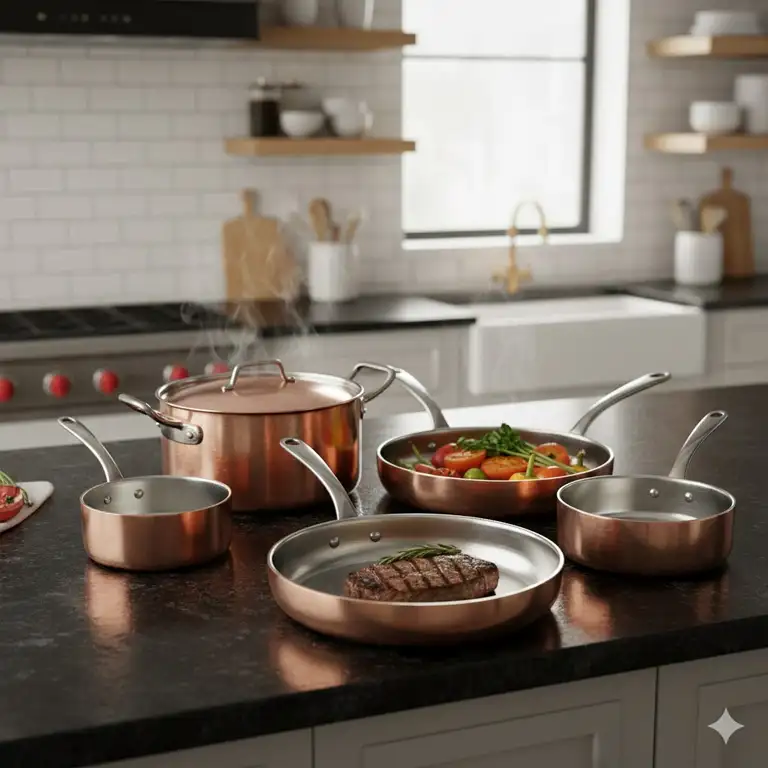
If you have ever stepped into a professional kitchen or watched a high-end cooking show, you have likely seen those shimmering, reddish-gold vessels hanging from the racks. There is a reason for that. I have spent years obsessing over kitchen gear, and I can tell you that nothing quite compares to the performance of solid copper pans. They are the Ferraris of the culinary world—expensive, beautiful, and capable of high-performance maneuvers that other pans simply cannot handle.
✨Was this helpful? Spread the word! 🚀
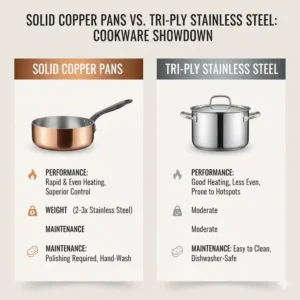
In the world of professional cooking, heat control is everything. Copper is legendary because it responds to temperature changes almost instantly. When you turn the flame down, the pan cools down immediately. This level of precision is why chefs insist on using a pure copper pot for delicate tasks like melting chocolate or making complex sauces. If you are serious about your craft, or even if you just want to feel like a Michelin-starred chef in your own home, investing in solid copper pan sets is a total game-changer.
Before we dive into the deep end of metallurgy and French culinary history, let’s look at how copper stacks up against the usual suspects in your kitchen cabinet.
Comparison: Copper vs. Traditional Cookware Materials
| Feature | Solid Copper | Stainless Steel | Cast Iron | Aluminum |
| Heat Conductivity | Exceptional (Top Tier) | Poor (Requires core) | Moderate (Slow) | High |
| Responsiveness | Instant | Slow | Very Slow | Fast |
| Durability | High (Lined) | Extremely High | Lifetime | Moderate |
| Maintenance | High (Needs Polishing) | Low | Moderate (Seasoning) | Low |
| Ideal For | Sauces, Sautéing | Searing, Boiling | Frying, Baking | General Use |
As you can see, solid copper pans offer a level of responsiveness that stainless steel or cast iron simply can’t match. While aluminum is a good conductor, it lacks the thermal mass and “prestige” performance found in heavy-gauge copper. This article will guide you through the absolute best options available in 2026, from classic French heritage brands to modern induction-compatible innovations.
Quick Comparison: Top 7 Solid Copper Pans at a Glance
| Product Name | Best For | Material Thickness | Lining Type |
| Mauviel M’Heritage M250C | Professional Use | 2.5mm | Stainless Steel |
| Matfer Bourgeat Copper Saucepan | Serious Home Chefs | 2.5mm | Stainless Steel |
| Hestan CopperBond | Induction Cooking | Multi-ply Copper | Stainless Steel |
| Ruffoni Historia | Tableside Presentation | Hammered Copper | Hand-Applied Tin |
| Falk Culinair Classical | Daily Reliability | 2.5mm (Bimetal) | Stainless Steel |
| Sertodo Copper Alicante | Specialty Dishes | Heavy Gauge | Hand-Applied Tin |
| De Buyer Prima Matera | Modern Versatility | 2mm | Stainless Steel |
Top 7 Solid Copper Pans: Expert Analysis 🍳
Choosing the right solid copper pans isn’t just about picking the shiniest one. You have to consider the thickness, the lining, and the handle material. Here is my breakdown of the top seven options currently dominating the market in 2026.
1. Mauviel M’Heritage M250C 2.5mm Copper Fry Pan
Mauviel is a name that is synonymous with French culinary excellence. Founded in 1830, they have been crafting pans in Villedieu-les-Poêles for nearly two centuries. The Mauviel M’Heritage M250C is their flagship model, featuring a thick 2.5mm exterior.
-
Technical Specifications: 90% copper, 10% 18/10 stainless steel lining. Cast iron handle with stainless steel rivets. Made in France.
-
Customer Review Analysis: Users consistently praise the “weighty feel” and “unbelievable heat distribution.” Many mention that while it is heavy, the balance is perfect for flipping omelets or searing scallops.
-
Professional Application: This pan is a workhorse in high-end restaurants for searing proteins and finishing pan sauces.
-
Pros:
-
Extra-thick copper for maximum thermal mass.
-
Beautiful polished finish.
-
Lifetime warranty against manufacturing defects.
-
-
Cons:
-
Not compatible with induction stovetops without an interface disk.
-
Heavy for some users.
-
2. Matfer Bourgeat 2.5mm Copper Saucepan
If Mauviel is the fancy choice, Matfer Bourgeat is the “chef’s choice.” This Matfer Bourgeat Copper Saucepan is designed for durability and performance without any unnecessary frills. It is a staple in the world’s most prestigious culinary schools.
-
Technical Specifications: 2.5mm pure copper body, lined with a thin layer of stainless steel. Cast iron handle. Model Number: 150614.
-
Customer Review Analysis: Customers love the “no-nonsense” design. It is frequently cited as the most durable option because the stainless lining is slightly thicker than competitors, making it resistant to scratches.
-
Professional Application: Ideal for reducing stock or creating delicate emulsions like Hollandaise.
-
Pros:
-
Unrivaled temperature control.
-
Reinforced drip-proof rim.
-
Extremely long-lasting stainless lining.
-
-
Cons:
-
Industrial look might not appeal to everyone.
-
Handles can get very hot during long cooking sessions.
-

3. Hestan CopperBond Induction Copper 10-Piece Set
Hestan has revolutionized the market by making copper pans solid and functional on induction burners. The Hestan CopperBond series features a unique five-layer construction that puts copper at the heart of the pan.
-
Technical Specifications: 100% copper core, wrap-around copper exterior, 18/10 stainless steel interior. Induction-capable base.
-
Customer Review Analysis: Reviewers are obsessed with the fact they can finally use copper on their induction ranges. “The best of both worlds,” one user noted.
-
Professional Application: Used in modern kitchens where induction is preferred for safety and efficiency.
-
Pros:
-
Induction compatible.
-
Dishwasher safe (though hand washing is recommended).
-
Flush rivets for easy cleaning.
-
-
Cons:
-
Exterior copper is a thinner layer compared to 2.5mm solid options.
-
Expensive for a multi-ply set.
-
4. Ruffoni Historia Hammered Copper Stockpot
For those who view cooking as an art form, the Ruffoni Historia is a masterpiece. Each piece is hand-hammered by artisans in Italy. If you are looking for a pure copper pot that can go from the stove to the center of a dinner party, this is it.
-
Technical Specifications: Hand-hammered copper, hand-applied tin lining. Acorn-shaped brass handles. Model: 99B-24.
-
Customer Review Analysis: Owners often describe these as “heirlooms.” The hand-applied tin is naturally non-stick, though it does require eventual re-tinning.
-
Professional Application: Mostly used for tableside service or slow-simmering soups where appearance is vital.
-
Pros:
-
Incredible aesthetic appeal.
-
Tin lining is more non-stick than stainless steel.
-
Unique, one-of-a-kind craftsmanship.
-
-
Cons:
-
Tin lining can melt if the pan is heated dry over 450°F.
-
Requires more delicate care.
-
5. Falk Culinair Classical Copper Sauté Pan
Falk Culinair is a Belgian company that patented the “bimetal” process—bonding copper directly to stainless steel under immense pressure. The Falk Culinair Classical sauté pan is famous for its brushed finish, which hides scratches and fingerprints better than polished copper.
-
Technical Specifications: 2.3mm copper, 0.2mm stainless steel lining. Cast iron handles.
-
Customer Review Analysis: Many “serious amateurs” prefer Falk because of the low-maintenance brushed exterior. “I don’t have to polish it every week to keep it looking decent,” says one reviewer.
-
Professional Application: Perfect for “one-pan” meals like chicken piccata where you need both a sear and a sauce reduction.
-
Pros:
-
Excellent value-to-performance ratio.
-
Ergonomic handle design.
-
Very durable bimetal bond.
-
-
Cons:
-
Brushed finish isn’t as “shiny” as traditional copper.
-
Harder to find in retail stores; usually sold direct.
-
6. Sertodo Copper Alicante Paella Pan
Sertodo Copper brings a rugged, American-made (via Mexican artisans) feel to the category. The Sertodo Copper Alicante is a heavy-duty pan designed for high-heat tasks and massive family meals.
-
Technical Specifications: 100% recycled copper, hand-hammered, hot-tinned interior. Stainless steel handles.
-
Customer Review Analysis: Users highlight the “massive heat capacity.” It is a favorite for outdoor cooking and large-scale entertaining.
-
Professional Application: Ideal for paella, obviously, but also great as a large roasting pan for meats.
-
Pros:
-
Sustainable, recycled materials.
-
Extremely thick and durable.
-
Unique artisanal look.
-
-
Cons:
-
Tin lining requires careful temperature management.
-
Handles are functional but not “elegant.”
-
7. De Buyer Prima Matera Copper Stewpan
De Buyer is another French powerhouse. Their De Buyer Prima Matera line is unique because it is composed of 90% copper but features a special magnetic bottom, making it the only “traditionally thick” copper pan that works on induction.
-
Technical Specifications: 2mm thickness, stainless steel lining, ferro-magnetic base. Stainless steel handles.
-
Customer Review Analysis: Fans love the sleek, modern handles that stay cooler than cast iron. The induction performance is rated “A+” by tech-savvy home cooks.
-
Professional Application: Versatile for stewing, braising, and stovetop-to-oven transitions.
-
Pros:
-
Induction compatible without sacrificing copper thickness.
-
Modern, ergonomic handles.
-
Easy-pour rims.
-
-
Cons:
-
Slightly thinner (2mm) than the 2.5mm Mauviel or Matfer.
-
Very high price point.
-
✨ Don’t Miss These Exclusive Deals! 🔍
Take your kitchen to the next level with these carefully selected products. Click on any highlighted item to check current pricing and availability. These tools will help you master the art of temperature control and create restaurant-quality dishes! 🛒✨
💬 Just one click – help others make better buying decisions too!😊
Comparison: Feature Matrix for Top 7 Picks
| Product | Induction Ready? | Lining Material | Handle Material | Style |
| Mauviel M250C | No | Stainless Steel | Cast Iron | Polished |
| Matfer Bourgeat | No | Stainless Steel | Cast Iron | Industrial |
| Hestan CopperBond | Yes | Stainless Steel | Stainless | Modern |
| Ruffoni Historia | No | Tin | Brass | Hammered |
| Falk Classical | No | Stainless Steel | Cast Iron | Brushed |
| Sertodo Alicante | No | Tin | Stainless | Hammered |
| De Buyer Prima Matera | Yes | Stainless Steel | Stainless | Polished |
Why Every Chef Needs a Pure Copper Pot
When people talk about a pure copper pot, they are usually referring to a vessel used for specific tasks like sugar work or jam making. In its most literal sense, a “pure” pot would be unlined copper. Unlined copper is reactive, which is actually a benefit when you are whisking egg whites or boiling sugar. The copper ions interact with the proteins in the egg whites to create a more stable foam—it’s pure kitchen chemistry!
However, for most of us, a pure copper pot will be lined with either tin or stainless steel. This lining is essential because copper can react with acidic foods (like tomatoes or lemon juice), which can lead to a metallic taste or even toxicity in high amounts.
The Benefits of Heavy-Gauge Construction
When shopping for solid copper pans, the thickness is the most important metric. You will see measurements like 1.5mm or 2.5mm.
-
1.5mm Thickness: Often found in “table service” pans. They look great and heat up fast, but they don’t have enough mass to hold heat evenly across the whole surface.
-
2.5mm Thickness: This is the “gold standard.” It provides enough copper to ensure there are absolutely no hot spots. Whether you are using a gas flame or an electric coil, the heat spreads out perfectly.
Comparison: Performance Metrics by Thickness
| Thickness | Heat Spread | Weight | Speed to Boil | Durability |
| 1.0mm – 1.5mm | Good | Light | Very Fast | Moderate |
| 2.0mm – 2.5mm | Excellent | Heavy | Fast | High |
| 3.0mm+ | Overkill | Very Heavy | Moderate | Extremely High |
The Versatility of Copper Saucepans
If you only buy one piece of copper, make it one of the many available copper saucepans. Why? Because the saucepan is where the most delicate cooking happens. Think about making a Caramel sauce. In a thin stainless steel pan, the sugar might burn in the corners while the middle is still liquid. In solid copper pans, the heat is so uniform that the sugar melts and browns with total consistency.
Key Features to Look For in Copper Saucepans
-
Pouring Rims: Some high-end brands like De Buyer include a flared rim. This makes a huge difference when you are pouring out a silky béarnaise sauce and don’t want it dripping down the side of your expensive pan.
-
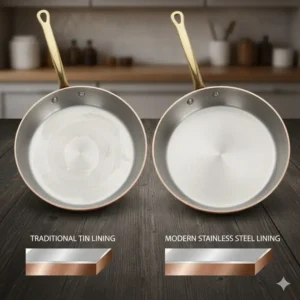
Lining Material: As I mentioned before, you have two main choices. Tin is more traditional and naturally non-stick, but it wears out every few years. Stainless steel is permanent and allows you to use metal whisks without worry.
-
Handle Length: A long handle provides better leverage, especially since solid copper pans are quite heavy.
Comparison: Tin Lining vs. Stainless Steel Lining
| Feature | Tin Lining | Stainless Steel Lining |
| Non-stick Properties | Excellent | Moderate |
| Temperature Limit | Low (450°F) | High (600°F) |
| Longevity | 5-10 years (needs re-tinning) | Lifetime |
| Maintenance | Delicate | Rugged |
| Traditional Feel | High | Modern |
Understanding the Science of Solid Copper Pans
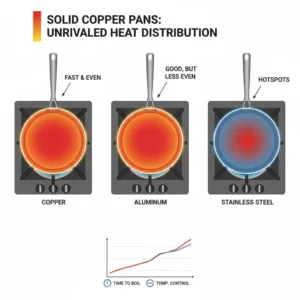
I promised we wouldn’t get too bogged down in the classroom, but a little bit of science helps justify the price tag of these beauties. Copper has a thermal conductivity of approximately $401 \text{ W/m·K}$. To put that in perspective, stainless steel is only about $14 \text{ W/m·K}$.
This means that copper is nearly 30 times better at moving heat than stainless steel. When you place a solid copper pan on a burner, the energy moves through the metal and across the surface almost instantly. This prevents “hot spots,” which are the main cause of burnt food.
Thermal Diffusivity and Your Food
Thermal diffusivity is the rate at which a material conducts thermal energy relative to its heat capacity. Copper’s high diffusivity means it doesn’t just get hot; it gets hot everywhere at once. This is why when you use a pure copper pot, you’ll notice that the sides of the pot are often just as hot as the bottom. This creates a “surround-sound” heating effect for your food.
Budget vs. Premium: Is the Extra Cost Worth It?
I get asked this all the time: “I can buy a copper-bottom pan for $40, why should I spend $400 on solid copper pans?” The answer is in the “solid” part. Those cheap pans usually have a paper-thin wash of copper on the bottom that is mostly for decoration. To get the actual benefits, you need at least 1.5mm to 2mm of real, solid copper.
| Category | Price Range | Real Copper Content | Expected Lifespan |
| Budget “Copper-Tone” | $20 – $60 | < 0.5mm (wash) | 2-5 years |
| Mid-Range Multi-Ply | $100 – $200 | 1.0mm – 1.5mm | 10-20 years |
| Premium Solid Copper | $300 – $600+ | 2.0mm – 2.5mm | Lifetime |
Maintenance: Keeping Your Copper Pans Solid and Shiny
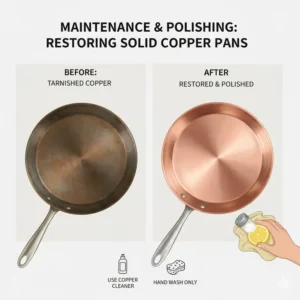
I’ll be honest with you—if you hate cleaning, solid copper pans might drive you a little crazy. Copper oxidizes. It develops a “patina” (a dark, brownish-green coating) over time. Some people love this look because it shows the pan is being used. However, if you want that showroom shine, you’ll need to polish them.
How I Clean My Copper
-
The Natural Way: A mixture of lemon juice and salt. Rub it on the copper, wait a minute, and watch the tarnish disappear. It’s like magic.
-
The Pro Way: Use a dedicated cleaner like Wright’s Copper Cream. It’s faster and leaves a protective coating.
-
Inside the Pan: If you have a stainless lining, scrub away! If you have a tin lining, use only soft sponges. Never use steel wool on tin.
Common Pitfalls to Avoid
-
Dishwashers: Never put solid copper pans in the dishwasher. The harsh chemicals will strip the shine and can even damage the bond between the metals.
-
High Heat Dry: Never leave a tin-lined pure copper pot on a high flame while empty. The tin can actually melt and bead up.
-
Metal Utensils on Tin: If your copper saucepans are tin-lined, stick to wood or silicone spatulas.
✨ Don’t Miss These Exclusive Deals! 🔍
Take your culinary skills to the next level with these carefully selected solid copper pans. Click on any of the product names in this article to check current pricing and availability on Amazon. Your dream kitchen is just one click away! 🛒✨
Conclusion: Is Copper Right For Your Kitchen?
At the end of the day, buying solid copper pans is an investment in your passion for cooking. They aren’t strictly necessary—you can certainly cook a great meal in a cheap aluminum pan—but they make the process more enjoyable, more precise, and frankly, more beautiful.
Whether you choose the professional-grade weight of a Mauviel M250C or the induction-friendly innovation of the De Buyer Prima Matera, you are buying a tool that can last for generations. I still use a pure copper pot that belonged to my grandmother, and it performs just as well today as it did fifty years ago. That is the true value of copper: it’s not just a pan; it’s a legacy.
If you are ready to take the plunge, start with one or two essential copper saucepans. Once you feel that immediate response to the heat, you’ll find it very hard to go back to anything else.
Frequently Asked Questions
✅ Yes, solid copper pans are perfectly safe as long as they are lined with stainless steel or tin. The lining prevents the copper from reacting with acidic foods. You only need to be cautious with unlined copper pots...
✅ Traditional copper saucepans do not work on induction because copper is non-magnetic. However, modern models like De Buyer Prima Matera or Hestan CopperBond have magnetic bases specifically designed to work perfectly on induction cooktops...
✅ Copper is a significantly more expensive raw material than steel or aluminum. Additionally, crafting solid copper pans requires specialized labor, often involving hand-riveting and manual polishing, which adds to the overall production cost...
✅ With regular home use, a tin-lined pan typically needs re-tinning every 8-12 years. You will know it is time when the copper begins to show through the tin in areas larger than a quarter-inch...
✅ Absolutely. Most solid copper pans are oven-safe up to the melting point of their lining. Stainless-lined pans can handle 500+ degrees, while tin-lined pots should stay below 450 degrees to prevent the lining from melting... ❓ Are solid copper pans safe for everyday cooking?
❓ Do copper saucepans work on induction stoves?
❓ Why is a pure copper pot so expensive compared to stainless steel?
❓ How often do I need to re-tin my copper pans solid?
❓ Can I put solid copper pans in the oven?
Recommended for You
- Copper Induction Pans: 7 Best That Work + Expert Guide 2025
- Copper Cookware: 7 Best Sets That Transform Your Cooking
- Saucepans That Can Go In The Oven: 7 Best Professional Picks for 2026
Disclaimer: This article contains affiliate links. If you purchase products through these links, we may earn a small commission at no additional cost to you.
✨ Found this helpful? Share it with your friends! 💬🤗