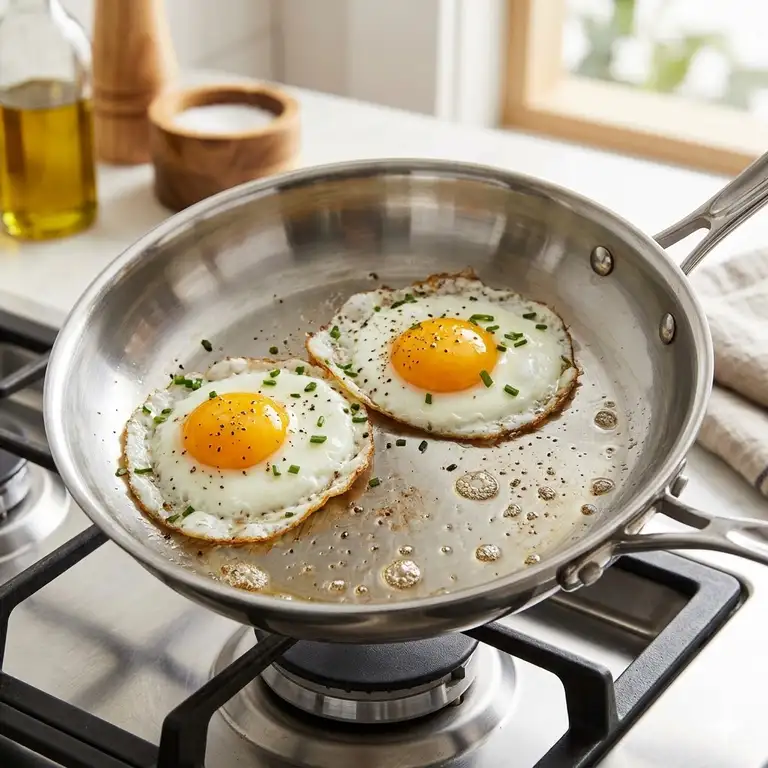
I’ve been there. You wake up, ready for a healthy breakfast, and you pull out your beautiful, gleaming pan. You crack an egg, and within seconds, it’s fused to the metal like superglue. You’re left with a mangled mess and a pan that requires twenty minutes of scrubbing. Many home cooks give up and retreat to the safety of Teflon, but I’m here to tell you that learning how to cook eggs in stainless steel pan is a culinary rite of passage that is well worth the effort.
✨Was this helpful? Spread the word! 🚀
Stainless steel is the workhorse of the professional kitchen. It doesn’t have the questionable chemical coatings of traditional non-stick surfaces, and it offers superior heat distribution. However, the learning curve is real. To succeed, you need to understand the physics of the metal. When you learn to cook eggs in stainless steel, you aren’t just making breakfast; you’re mastering temperature control and surface tension. Whether you want to fry eggs in stainless steel or scramble them into soft, pillowy clouds, the secret lies in the preparation of the pan.
Quick Comparison: Cooking Surfaces for Eggs
Before we dive into the “how-to,” let’s look at how stainless steel stacks up against other popular materials used in USA kitchens.
| Feature | Stainless Steel | Non-Stick (PTFE/Ceramic) | Cast Iron |
| Durability | Extremely High (Lifetime) | Low (2-5 years) | Very High (Generational) |
| Ease of Use | Moderate (Requires Technique) | Very Easy | Moderate (Needs Seasoning) |
| Chemical-Free | Yes | Often No | Yes |
| Heat Response | Fast & Even | Moderate | Slow & Retentive |
| Dishwasher Safe | Usually Yes | No | Absolutely Not |
| Browning (Maillard) | Excellent | Poor | Excellent |
Top 7 Stainless Steel Pans for Perfect Eggs: Expert Analysis
If you want to stop eggs in stainless steel pan sticking, you need a high-quality vessel. A cheap, thin pan will have hot spots that burn your eggs before they can release. Here are the top 7 pans I recommend for 2026, based on technical specifications and real-world performance.
1. All-Clad D3 Stainless 3-Ply Fry Pan, 10-Inch
The gold standard for professional and home kitchens alike. The All-Clad D3 Stainless 3-Ply Fry Pan features a classic bonded construction.
-
Technical Specifications: 3-ply construction with an aluminum core sandwiched between two layers of 18/10 stainless steel. Induction compatible. Made in the USA.
-
Customer Review Analysis: Users consistently praise the “heft” and “predictable heat.” One reviewer noted that while the handle takes time to get used to, the pan’s ability to hold a steady temp is unmatched.
-
Warranty: Limited Lifetime.
-
Professional Applications: Ideal for high-volume cafe environments and home chefs who want a “buy it once” product.
-
Pros: Incredible durability, even heating, stays shiny.
-
Cons: Expensive; the handle design can be polarizing.
2. Made In Cookware 10″ Stainless Clad Frying Pan
A modern favorite that has taken the internet by storm. The Made In Cookware 10″ Stainless Clad Frying Pan is designed for the modern cook.
-
Technical Specifications: 5-ply construction (3 layers of aluminum, 2 layers of stainless steel). Stay-cool handle. Rated up to 800°F.
-
Customer Review Analysis: Fans love the “slickness” of the steel when properly heated. It is often cited as being easier to clean than the All-Clad D3.
-
Warranty: Lifetime Warranty.
-
Professional Applications: Used in several Michelin-star restaurants across the USA.
-
Pros: 5-ply construction provides superior heat retention; ergonomic handle.
-
Cons: Slightly heavier than 3-ply options.
3. Heritage Steel 10.5 inch Titanium Series Frying Pan
For those worried about metal leaching, this is the premium choice. The Heritage Steel 10.5 inch Titanium Series Frying Pan uses a unique alloy.
-
Technical Specifications: 5-ply construction with a 316Ti (Titanium-strengthened) stainless steel interior. 10.5-inch diameter.
-
Customer Review Analysis: Owners report that the titanium-fortified surface is more resistant to salt pitting and seems “smoother” than standard 18/10 steel.
-
Warranty: Lifetime Warranty.
-
Professional Applications: Excellent for acidic sauces, but performs beautifully for delicate eggs.
-
Pros: Highly corrosion-resistant; USA-made; beautiful finish.
-
Cons: Harder to find in retail stores.
4. Tramontina Gourmet Tri-Ply Clad 10-Inch Fry Pan
The best value option that doesn’t sacrifice performance. The Tramontina Gourmet Tri-Ply Clad 10-Inch Fry Pan is a staple in budget-conscious but quality-driven kitchens.
-
Technical Specifications: Tri-ply clad construction. 18/10 stainless steel. Riveted handle.
-
Customer Review Analysis: Many users compare this directly to All-Clad, noting it performs about 90% as well for 40% of the price.
-
Warranty: Lifetime Warranty.
-
Professional Applications: Great for culinary students or home cooks on a budget.
-
Pros: Affordable; reliable performance; dishwasher safe.
-
Cons: Slightly thinner walls than premium models.
5. Cuisinart MCP22-24N MultiClad Pro Stainless 10-Inch Open Skillet
Another fantastic mid-range contender. The Cuisinart MCP22-24N MultiClad Pro Stainless 10-Inch Open Skillet offers a professional look and feel.
-
Technical Specifications: Triple-ply construction with Heat Surround technology. Tapered rims for drip-free pouring.
-
Customer Review Analysis: Customers appreciate the “cool grip” handle and the weight. It’s a very popular wedding registry item.
-
Warranty: Limited Lifetime Warranty.
-
Professional Applications: Perfect for home meal prep and everyday cooking.
-
Pros: Comfortable handle; excellent heat distribution.
-
Cons: Can discolor (rainbow tint) if overheated, though this is purely aesthetic.
6. Demeyere Industry 5-Ply 9.5-inch Stainless Steel Fry Pan
The Belgian powerhouse of cookware. The Demeyere Industry 5-Ply 9.5-inch Stainless Steel Fry Pan is a marvel of engineering.
-
Technical Specifications: 5-layer material. Silvinox surface treatment for easy cleaning. Stay-white finish. No rivets on the interior!
-
Customer Review Analysis: Reviewers are obsessed with the “no-rivet” design, which makes flipping stainless steel pan eggs much easier as there are no bumps to catch the spatula.
-
Warranty: 30-year warranty.
-
Professional Applications: Heavy-duty professional use.
-
Pros: Easiest to clean; incredibly sturdy; no-rivet interior.
-
Cons: Very heavy; very expensive.
7. Hestan NanoBond Molecular Titanium Stainless Steel Skillet
The high-tech future of the kitchen. The Hestan NanoBond Molecular Titanium Stainless Steel Skillet is basically indestructible.
-
Technical Specifications: Thousands of titanium nano-layers bonded to stainless steel. 400% harder than typical steel. Heat resistant to 1050°F.
-
Customer Review Analysis: Users say this pan is “magic.” It’s nearly impossible to scratch and has a dark, sleek appearance.
-
Warranty: Lifetime Warranty.
-
Professional Applications: High-end boutique kitchens.
-
Pros: Scratch-resistant; beautiful dark finish; highest heat rating.
-
Cons: The most expensive pan on this list.
✨ Don’t Miss These Exclusive Deals! 🔍
Take your kitchen to the next level with these carefully selected products. Click on any highlighted item to check current pricing and availability. These tools will help you master the art of cooking eggs like a seasoned chef! 🍳
💬 Just one click – help others make better buying decisions too!😊
Technical Specifications Matrix
| Product Name | Material Layers | Interior Surface | Induction Ready? | Handle Type |
| All-Clad D3 | 3-Ply | 18/10 Stainless | Yes | Classic V-Shape |
| Made In | 5-Ply | 18/10 Stainless | Yes | Ergonomic Curve |
| Heritage Steel | 5-Ply | 316Ti Titanium | Yes | Stay-Cool |
| Tramontina | 3-Ply | 18/10 Stainless | Yes | Riveted Tube |
| Cuisinart MCP | 3-Ply | 18/10 Stainless | Yes | Cool Grip |
| Demeyere | 5-Ply | Silvinox Treated | Yes | Rivetless |
| Hestan | 5-Ply | NanoBond Titanium | Yes | Ergonomic |
Budget vs. Premium Comparison
| Category | Recommended Model | Why Choose This? |
| Budget | Tramontina Gourmet | Best bang for your buck without losing the tri-ply benefits. |
| Mid-Range | Cuisinart MultiClad Pro | Solid performance and looks for a reasonable price. |
| Premium | All-Clad D3 | Proven longevity and industry-standard performance. |
| Ultra-Luxury | Hestan NanoBond | For the tech-lover who wants the most durable surface possible. |
The Science of Success: Why Eggs Stick
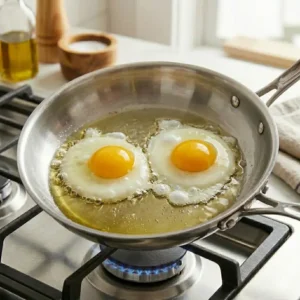
To understand how to cook eggs in stainless steel pan, we have to talk about physics. Stainless steel may look smooth to the naked eye, but at a microscopic level, it’s full of “pores” or hills and valleys. When you heat the pan, the metal expands. If you put an egg into a cold or lukewarm pan, the liquid protein seeps into these microscopic pores. As the egg cooks, it solidifies inside the pores, effectively anchoring itself to the pan. This is exactly why you experience eggs in stainless steel pan sticking.
The Leidenfrost Effect
The secret to a non-stick experience on steel is the Leidenfrost Effect. This occurs when a liquid comes into contact with a surface significantly hotter than its boiling point. A thin layer of vapor forms between the liquid and the surface, allowing the liquid to “float.” When you cook eggs in stainless steel, you want to reach the temperature where the moisture in the egg creates this vapor barrier immediately.
According to research from the National Institute of Standards and Technology (NIST), temperature control is the most critical variable in surface-protein interactions.
Step-by-Step Guide: How to Cook Eggs in Stainless Steel Pan
I’ve spent years perfecting this. If you follow these steps, I promise you’ll be able to fry eggs in stainless steel with ease.
Step 1: The Pre-Heat (The Most Important Part)
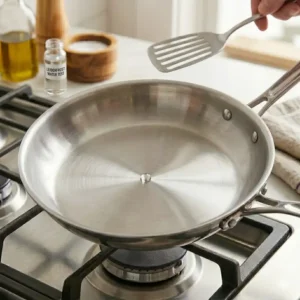
Place your empty pan over medium-low heat. Do not rush this. I usually let my All-Clad D3 or Made In pan heat for about 2-3 minutes. If the heat is too high, the oil will burn. If it’s too low, the egg will stick.
Step 2: The Water Drop Test
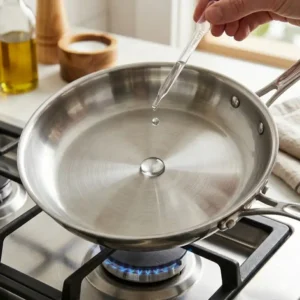
How do you know it’s ready? Use the water drop test. Flick a few drops of water onto the pan.
-
If they sizzle and evaporate: The pan is too cold.
-
If they sit there and do nothing: The pan is way too cold.
-
If they form a single ball and “dance” or glide across the surface like mercury: You’ve hit the Leidenfrost point! This is the sweet spot.
Step 3: Add Your Fat
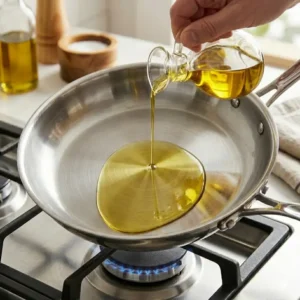
Once the pan is ready, add your oil or butter. I prefer a combination. Butter provides flavor and a visual cue (it should foam but not brown immediately), while a tiny bit of neutral oil (like avocado oil) raises the smoke point. Swirl the fat to coat the bottom and the sides. You want to see the oil “shimmer.”
Step 4: The Temperature Adjustment
After adding the fat, I often turn the heat down slightly. The pan is already hot enough to create the vapor barrier, but eggs are delicate and don’t need a raging fire to cook.
Step 5: Add the Eggs
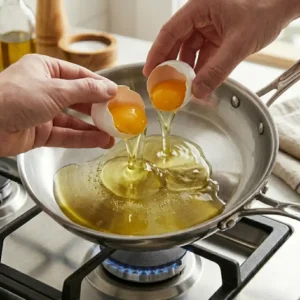
Carefully crack your eggs into the pan. You should hear a gentle sizzle. If it sounds like a jet engine, your pan is too hot. Let the eggs sit undisturbed for at least 30-45 seconds. This allows the bottom layer of protein to set and release from the metal naturally.
Step 6: The Gentle Release
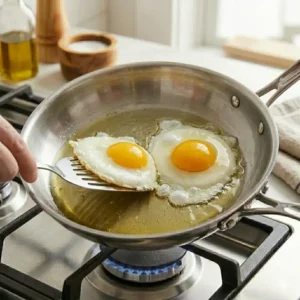
Using a thin, flexible metal spatula (like a fish turner), gently nudge the edges of the egg. If you’ve done it right, the egg will slide around like it’s on a sheet of ice. Now you can flip it or cover the pan to finish cooking the tops.
Common Variations of Eggs in Stainless Pan
While fried eggs are the most common test, you might want to try other styles.
Scrambled Eggs
Many people think scrambling eggs in stainless steel is impossible. It’s not! The trick is to use slightly more fat and keep the eggs moving.
-
Use the water drop test.
-
Add a generous pat of butter.
-
Pour in your whisked eggs.
-
Use a silicone spatula to continuously move the eggs from the edges to the center.
-
Remove from heat while they still look slightly wet; the residual heat of the stainless steel will finish them off.
Omelets
For a French omelet, you need a very smooth surface. This is where a pan like the Demeyere Industry shines because there are no rivets for the eggs to get caught on. The technique is similar to scrambled eggs, but you stop stirring once the base is set, then fold.
Performance Metrics: Egg Style Success Rate
| Egg Style | Difficulty (1-10) | Recommended Fat | Key Tip |
| Sunny Side Up | 4 | Butter + Oil | Cover with a lid for 30 seconds to set whites. |
| Over Easy | 6 | Butter | Use a thin metal spatula for the flip. |
| Scrambled | 7 | High Butter | Keep the eggs moving constantly. |
| French Omelet | 9 | Clarified Butter | Pan must be perfectly clean and pre-heated. |
| Poached (in pan) | 3 | Water/Vinegar | Use a deep stainless skillet. |
Troubleshooting: Why Did My Eggs Stick?
Even experts mess up sometimes. If your eggs in stainless steel pan sticking continues to be a problem, check these three things:
-
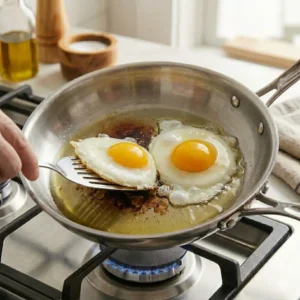
The Pan Was Dirty: Even a microscopic amount of leftover protein from your last meal can act as a bridge for new eggs to stick. I recommend using Bar Keepers Friend to keep your pans surgically clean.
-
The Eggs Were Too Cold: Taking eggs straight from the fridge and dropping them onto a hot pan causes a massive temperature drop, which can break the vapor barrier. Try letting your eggs sit on the counter for 10 minutes before cooking.
-
The Heat Was Inconsistent: If you have an electric coil stove, the heat pulses. This can make stainless steel cooking tricky. A heavier 5-ply pan like the Made In or Heritage Steel helps mitigate this because the extra metal layers act as a heat battery.
Benefits of Stainless Steel vs. Traditional Alternatives
Why go through all this trouble? Let’s quantify the benefits.
| Benefit | Stainless Steel | Traditional Non-Stick |
| Flavor Profile | Develops a better crust (fond). | Minimal crust development. |
| Health Safety | No PFOA/PFAS concerns. | Risk of fumes at high heat. |
| Lifespan | Can last 50+ years. | Usually tossed every 3 years. |
| Versatility | Can go from stove to 500°F oven. | Usually limited to 400°F. |
| Utensil Choice | Metal spatulas are fine. | Plastic or silicone only. |
Benefit Quantification: Long-Term Value
| Metric | Stainless Steel (Premium) | Non-Stick (Average) |
| Initial Cost | $100 – $200 | $30 – $50 |
| Replacement Frequency | 0 times in 10 years | 3-4 times in 10 years |
| 10-Year Total Cost | $150 | $120 – $200 |
| Resale Value | High | Zero |
Maintenance and Care for Your Stainless Steel
To keep your stainless steel pan eggs sliding off easily, you have to treat the pan with respect.
Daily Cleaning
After the pan has cooled down, wash it with warm soapy water. Do not put a screaming hot pan into cold water, as this can cause “thermal shock” and warp the metal, even in a high-end All-Clad D3.
Deep Cleaning
Once a week, or whenever you see “rainbow stains” or white calcium deposits, use Bar Keepers Friend. Make a paste, rub it on with a soft sponge, let it sit for a minute, and rinse. Your pan will look brand new. A clean pan is a non-stick pan.
User Compatibility Analysis
| User Type | Recommended Pan | Why? |
| The Beginner | Tramontina Gourmet | Low entry price to practice the technique. |
| The Professional | Demeyere Industry | No rivets and heavy 5-ply construction. |
| The Health-Conscious | Heritage Steel | Titanium-strengthened surface is ultra-inert. |
| The Minimalist | Made In | Sleek design that covers all cooking needs. |
✨ Don’t Miss These Exclusive Deals! 🔍
Ready to ditch the Teflon for good? Take your kitchen to the next level with these carefully selected products. Click on any highlighted item to check current pricing and availability. These pans and tools will help you create the perfect breakfast every single morning! 🍳
Conclusion: You Are Now an Egg Master
Learning how to cook eggs in stainless steel pan is one of those skills that separates the casual cook from the enthusiast. It requires patience, a bit of scientific understanding, and the right equipment. By choosing a high-quality pan like the All-Clad D3 or the Made In Stainless Clad, you are giving yourself the best possible chance of success.
Remember the steps: pre-heat, the water drop test, add your fat, and be patient. Before long, you’ll be flipping over-easy eggs with the confidence of a short-order cook. You’ll save money on replacing cheap non-stick pans, and your food will taste better thanks to the superior heat properties of steel.
Frequently Asked Questions
✅ Eggs stick primarily because the pan is either too cold or has microscopic food residue. When the pan isn't properly pre-heated to the Leidenfrost point, the egg proteins bond with the metal's pores, creating a physical attachment...
✅ Yes, but extra virgin olive oil has a lower smoke point. For best results when learning how to cook eggs in stainless steel pan, use butter or a high-smoke-point oil like avocado or grapeseed oil...
✅ A combination is best. Butter provides flavor and its foaming action acts as a visual thermometer, while a small amount of oil prevents the butter from burning too quickly at the temperatures required for a non-stick surface...
✅ Technically, no. You can 'semi-season' it by heating oil until it smokes and then wiping it out, but this is temporary. The real secret is proper temperature control and the Leidenfrost effect rather than a permanent seasoning layer...
✅ Generally, yes. High-quality stainless steel like 18/10 or 316Ti does not have chemical coatings that can flake off or release toxic fumes (PFAS/PFOA) when overheated, making it a favorite for health-conscious cooks in the USA... ❓ Why do my eggs always stick to my stainless steel pan?
❓ Can I use olive oil to cook eggs in a stainless pan?
❓ Is it better to use butter or oil for eggs in stainless steel?
❓ Do I need to season a stainless steel pan like cast iron?
❓ Is stainless steel safer than non-stick for cooking eggs?
Recommended for You:
- How to Season a Stainless Steel Pan Properly: 7 Easy Steps for a Perfect Non-Stick Finish
- How to use stainless steel pan without sticking: 7 Pro Secrets!
- 7 Best stainless steel sauce pan with lids for 2026 Professional Chefs
Disclaimer: This article contains affiliate links. If you purchase products through these links, we may earn a small commission at no additional cost to you.
✨ Found this helpful? Share it with your friends! 💬🤗