A cook who flips food by lifting the pan with one hand will feel the cast iron vs carbon steel decision in the wrist before anywhere else. Spec pages and reviewers put Lodge’s classic 12-inch cast iron skillet at roughly 7.7 to 8.3 pounds, while Lodge’s own spec sheet lists its 12-inch carbon steel skillet at 4.15 pounds. That gap, together with how quickly each metal answers the burner, explains most of what follows.
This cast iron guide for 2027 leans on Lodge and de Buyer spec pages, America’s Test Kitchen’s carbon steel testing, Prudent Reviews’ side-by-side comparison, Made In’s own explainer and several owner forums. No pan was cooked on for this piece, so every comment about feel is credited to a named reviewer, and prices appear as ranges because the current price on Amazon.com may differ.
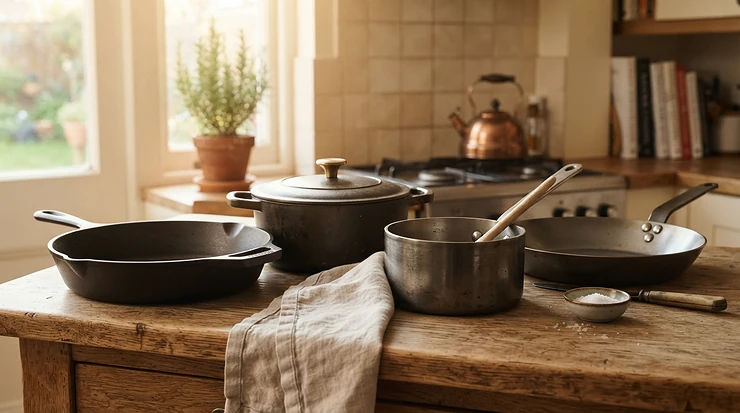
Three skillets stand in for the two families: one cast iron, one pre-seasoned carbon steel and one French carbon steel that ships bare.
Eight pounds or four: where the two metals really part ways
Cast iron stores heat; carbon steel reacts to it. The short answer follows from how each is made. Prudent Reviews puts cast iron at about 98% iron and 2% carbon, sometimes up to 3%, poured into a mold. Carbon steel is about 99% iron and 1% carbon, and Made In adds that it is hammered or pressed from a flat sheet.
The weight gap is real, though it depends on the pan. Abt and Sportsman’s list the Lodge 12-Inch Cast Iron Skillet at 7.69 pounds, against 4.15 pounds for the Lodge 12-Inch Seasoned Carbon Steel Skillet: a difference of about 3.5 pounds, close to half (our arithmetic). The de Buyer Mineral B 12.5-Inch Carbon Steel Fry Pan narrows it. At 5.8 pounds on the maker’s page, it is only about two pounds, or a quarter, lighter than the cast iron Lodge.
Cast iron can also be trimmed. Prudent Reviews lists the thinner-walled Lodge Chef Collection 12-inch skillet at 6.3 pounds, within half a pound of the de Buyer. So “carbon steel is light” is true of some steel pans and not others.
Heat is the second divide. Prudent Reviews calls cast iron one of the least responsive cookware types but a strong heat holder, and says carbon steel adjusts faster, which suits delicate foods. Made In, a company that sells both metals, claims carbon steel reaches searing temperature in about 90 seconds against three to four minutes for cast iron; treat that as a vendor’s figure, not a lab result. Cook’s Illustrated takes a friendlier view of steel, saying it shares much of cast iron’s heat retention with far less weight, so the sources disagree on how wide the retention gap is. Thicker steel should narrow it, though that is reasoning rather than a measurement.
Surface texture matters at the stove. Prudent Reviews describes cast iron as bumpy, which grips food for searing but makes flipping eggs and pancakes harder, and carbon steel as smooth. The same article notes that cast iron handles are cast in one piece, while carbon steel pans carry a longer, riveted handle.
Heat, handling, rust and acid, criterion by criterion
Criterion
Cast iron
Carbon steel
Where it comes from
12-inch weight
About 7.7 to 8.3 lb for the Lodge 12-Inch Cast Iron Skillet; 6.3 lb for the Lodge Chef Collection
4.15 lb to 5.8 lb for the two steel pans here
Lodge, de Buyer, Prudent Reviews
Heat behavior
Holds heat, slow to respond
Responds quickly, holds less
Prudent Reviews, Made In
Surface
Bumpy
Smooth
Prudent Reviews
Rust and discoloration
Resists rust better when dried
Rusts and discolors more readily
Prudent Reviews, Reviewed
Acidic foods
A splash is fine; a simmer strips seasoning
Same, though a patina can be rebuilt
Prudent Reviews, America’s Test Kitchen
Dishwasher
No
No
Prudent Reviews, Made In
Ships seasoned
Yes, for Lodge
Lodge yes; de Buyer arrives with a beeswax coat
Maker pages
Two rows decide most purchases: weight and rust. Everything else looks alike because both metals rely on the same baked-on oil layer, which Made In says is built the same way on either one. A steel pan therefore adds no new chores, only a stricter habit of drying it.
Three skillets to put side by side
All three are 12-inch class pans, so the comparison isn’t muddied by size.
Model
Metal
Weight
Thickness
Flat cooking surface
Ships seasoned?
Price band
Lodge 12-Inch Cast Iron Skillet
Cast iron
About 7.7 to 8.3 lb, by source
Not listed
Not listed
Yes, vegetable oil
Around $30 to $35
Lodge 12-Inch Seasoned Carbon Steel Skillet
Carbon steel
4.15 lb (Lodge), 4.2 lb (ATK)
2.8 mm (ATK)
9¼ in (ATK)
Yes
Around $45 to $50
de Buyer Mineral B 12.5-Inch Carbon Steel Fry Pan
Carbon steel
5.8 lb (maker)
3 mm (maker)
9 in (maker)
No, beeswax coat
Around $110 to $140
Read the “12-inch” label with care. Sizes measure the rim, which is why the flat floor of both steel pans comes in near nine inches, and why a rim-to-rim number says little about how many steaks fit. The price spread is just as wide: the de Buyer costs several times what the cast iron Lodge does (our arithmetic from the bands above).
Curious which of the three fits your stove? Have a look at the listings after the entries below.
Between roughly $30 and $35 at the outdoor retailers whose pages list it, the Lodge 12-Inch Cast Iron Skillet (model L10SK3) is the cheapest way into either metal. It is made in the USA and seasoned with soy-based vegetable oil, per Webstaurant’s listing, and Abt’s spec sheet gives a height of 2.25 inches and an overall length of 18 inches. KaTom’s page marks it safe for induction, oven, grill and campfire, and adds a limited lifetime warranty.
Weight is the bill for that bargain. Abt and Sportsman’s list 7.69 pounds, Sutherlands 7.89, and Prudent Reviews cites 8.1 and 8.3 pounds in two different articles, so weigh the one you hold if lifting matters. A camping writer at Realtree put the 12-inch Lodge cast iron at over seven pounds on a scale and said that anyone hiking in should lean toward carbon steel.
Owner evidence is mostly warm but not uniform. Webstaurant’s page shows 4.8 stars from 25 reviews. One owner in a Good Sam Club RV forum thread, by contrast, scrubbed a new Lodge cast iron skillet with steel wool, reseasoned it three times in the oven and still had food sticking, after which Lodge sent a replacement. That is a single report, not a pattern.
The bumpy surface Prudent Reviews describes is part of the trade: it grips a sear and slows an egg flip. The weight is the price of the heat the pan stores.
Lodge 12-Inch Cast Iron SkilletSee current price, sizes and reviews on Amazon.
The two best-known testers disagree about this pan, which is worth knowing before spending around $45 to $50 on it. America’s Test Kitchen rated the Lodge 12-Inch Seasoned Carbon Steel Skillet Recommended with Reservations: the factory seasoning helped at first, but ATK wrote that its “slick seasoning actually deteriorated as we cooked,” food began to stick, and new layers were hard to build. Reviewed, meanwhile, called it one of two pre-seasoned pans in its test and said it kept its seasoning even after soap cleaning, while marking it down for an uncomfortable handle and shallow flared edges that let grease splatter during searing.
Just One Cookbook’s roundup points the same way as ATK for the 10-inch version, relaying that Serious Eats found food still stuck to it out of the box and that ATK found it one of the few pans to lose seasoning during testing. Two outlets flag the seasoning; one praises it. That split is itself the finding.
Lodge’s spec sheet lists model CRS12 at 4.15 pounds, with a 12-inch rim and a 20.87-inch overall length. ATK measured 2.8 mm steel, a 9¼-inch cooking surface and 1.375-inch sides, the lowest in its selected results, which squares with Reviewed’s note about splatter. A different SKU, CRS12HH61, adds a silicone handle holder and weighs 4.45 pounds on the same sheet. Induction listings conflict: Chefsdeal calls the CRS12 induction ready, while Abt’s spec table says no.
It is the lightest pan in this comparison by more than a pound, and the only steel pan here that arrives seasoned.
Lodge 12-Inch Seasoned Carbon Steel SkilletSee current price, sizes and reviews on Amazon.
A steak seared hard and finished with a pan sauce in the same pan is the job a 3-millimeter steel pan like the de Buyer Mineral B 12.5-Inch Carbon Steel Fry Pan is built for. De Buyer’s US page lists model 5610.32 as 99% iron and 1% carbon, 12.5 inches across with a 9-inch cooking surface, 5.8 pounds, a beeswax finish and a riveted, epoxy-coated steel handle, and says seasoning is required. ATK rated the 12.5-inch Mineral B Recommended and found it browned food well and released it easily once seasoned.
Weight and the handle are the complaints. ATK says the heft and high-angled handle made the pan harder to maneuver, and the author of Just One Cookbook, who cooks with the 10.25-inch version, says its handle can get a bit hot during extended cooking, so a silicone sleeve goes on.
Oven use needs attention. Webstaurant’s page for the 5610.32 says the epoxy-coated handle limits oven time to about 10 minutes at 400°F. De Buyer’s Pro line (5680.32) swaps in a cast stainless handle, is listed as oven-safe and weighs 6.4 pounds, so confirm the line before you pick the size.
Pages checked put the pan between roughly $110 and $140, the widest band of the three, and it is the only pan here that ships unseasoned.
de Buyer Mineral B 12.5-Inch Carbon Steel Fry PanSee current price, sizes and reviews on Amazon.
Seasoning, soap and acid: cast iron steps that carry over to carbon steel
One routine covers both metals, since Made In says its carbon steel and cast iron use the same process. The cast iron steps below also work for steel:
Scrub off any shipping coat. The de Buyer arrives with a beeswax finish, and Reviewed’s tester had to scrub the beeswax off another French steel pan with steel wool. Both Lodge pans ship seasoned and skip this.
Wipe on a very thin film of oil. ATK’s rule for a 12-inch carbon steel pan is about a quarter teaspoon, wiped until nearly none remains and then heated to bond.
Heat past the oil’s smoke point, let the pan cool, and repeat. Made In describes this loop for both of its pans.
Cook, wash by hand, dry completely and rub on a light film of oil. Lodge’s cleaning page says a little mild soap is fine and soaking invites rust.
On soap, the sources split. Lodge says mild soap is fine on its cast iron, while Reviewed advises against soapy water on carbon steel, though Reviewed’s own tester found the Lodge 12-Inch Seasoned Carbon Steel Skillet kept its seasoning after soap cleaning. Neither metal belongs in the dishwasher.
A few cast iron tips travel well to steel. Blotchy, streaky seasoning is normal, according to the r/carbonsteel community’s FAQ, which says to judge a pan by how it performs rather than how it looks. And keep tomato sauce short: Prudent Reviews says a splash of lemon or wine is fine on a well-seasoned pan, but tomato sauce or long red-wine braises strip seasoning from both. ATK watched a tomato sauce remove most of a carbon steel pan’s patina and restored it with a few rounds of heating with oil, about 10 minutes.
What to cook: cast iron ideas and carbon steel ideas
Prudent Reviews sends eggs, stir-fry and sautéed vegetables to carbon steel, and pizza, cornbread, pies and stove-to-oven baking to cast iron; both do searing, browning, frying and campfire cooking. Made In’s list is similar, adding crepes and pan sauces for steel, and thick chops, braising and oven roasting for cast iron.
Those cast iron ideas follow from heat storage: a cold steak, or a batter that needs steady oven heat, benefits from a pan that doesn’t flinch. The steel ideas follow from speed and a smooth floor. Cook’s Illustrated argues carbon steel may be the most versatile skillet a kitchen can own, so the line between the two is a tendency, not a rule.
Cast iron cost vs carbon steel cost: what you actually pay
The Lodge 12-Inch Cast Iron Skillet sits around $30 to $35, the Lodge 12-Inch Seasoned Carbon Steel Skillet around $45 to $50 (Home Depot and Walmart pages, per Reviewed), and the de Buyer Mineral B 12.5-Inch Carbon Steel Fry Pan around $110 to $140. Buying both Lodge pans comes to roughly $75 to $85 (our arithmetic).
Metal doesn’t set the price; brand and finish do. Prudent Reviews says a good cast iron skillet costs under $50 and carbon steel typically runs $60 to $70, yet Made In’s own page puts its Made In Seasoned Cast Iron Skillet well over $150 while its 10-inch Made In Seasoned Carbon Steel Frying Pan lists under $100.
Thin steel can cost more later. ATK did not recommend the 3.3-pound Vollrath Carbon Steel 12½-Inch Fry Pan, and Just One Cookbook relays reviewers who say it can warp with extensive use. Prudent Reviews says both metals can sit on a burner for hours without warping, so the risk looks tied to very thin pans rather than the metal itself. That is reasoning from conflicting reports. On lifespan, Prudent Reviews says both can last a lifetime, KaTom lists a limited lifetime warranty on the cast iron Lodge, and Mauviel USA’s comparison page describes de Buyer coverage as lifetime.
Which pan for which cook
A first skillet that has to handle everything is the case for cast iron. Prudent Reviews tells beginners and anyone simplifying their kitchen to start there, and Field Company, which sells both, calls cast iron the foundation and carbon steel the pan to add later. On a cast iron 2027 shopping list, the Lodge 12-Inch Cast Iron Skillet is the one to price first.
Someone who flips, tosses and makes eggs most mornings, a hypothetical but common profile, gets more from the lighter steel. The Lodge 12-Inch Seasoned Carbon Steel Skillet is the lightest of the three, though its seasoning record deserves the ATK caveat above. The de Buyer Mineral B 12.5-Inch Carbon Steel Fry Pan rewards a cook willing to season it, but at 5.8 pounds it’s no featherweight.
Camp cooks and cornbread bakers lean toward cast iron for heat and oven work, apart from the weight issue Realtree raised. And Prudent Reviews points out that serious cooks often own both. When people weigh cast iron vs carbon steel for a single pan, the deciding question is usually whether the pan gets lifted all the time or mostly sits on the burner.
Weight, rust, induction and soap: straight answers
Is carbon steel better than cast iron?
Neither wins outright. Carbon steel is lighter and answers burner changes faster, while cast iron holds heat longer for deep sears and oven baking. Prudent Reviews points a one-pan kitchen toward cast iron and treats carbon steel as a quicker, lighter second pan.
Do both work on induction?
Made In says both work on induction, and retailer pages list Lodge's cast iron skillet as induction-ready. Listings disagree on Lodge's 12-inch carbon steel pan, though: one says yes, another no. Check the listing or manual first.
Does carbon steel rust faster than cast iron?
Reviewers say yes. Prudent Reviews reports carbon steel discolors and rusts more readily than well-kept cast iron, and Reviewed warns that bare carbon steel rusts quickly. Dry the pan immediately after washing and wipe on a thin film of oil before storing it.
Can you cook tomato sauce in them?
A splash is fine; a simmer is not. Prudent Reviews says tomato sauce or long red-wine braises strip seasoning from both metals, and America's Test Kitchen saw tomato sauce remove most of a carbon steel pan's patina, which a few rounds of heating with oil restored.
Can you wash them with soap?
Sources split. Lodge says a little mild soap is fine on cast iron, though soaking invites rust, while Reviewed advises against soapy water on carbon steel. Whichever you follow, dry the pan completely, never use the dishwasher, and finish with a thin coat of oil.
Pick by the job you repeat most
Settle cast iron vs carbon steel by what the pan does most often. A pan that sits on the burner for steaks, cornbread and weekend braising suits the Lodge 12-Inch Cast Iron Skillet, which costs the least and weighs the most. A pan that gets lifted, tossed and flipped suits steel: the Lodge 12-Inch Seasoned Carbon Steel Skillet if you want it seasoned out of the box and can live with ATK’s reservations, or the de Buyer Mineral B 12.5-Inch Carbon Steel Fry Pan if you’re happy to season it yourself and pay more. Whichever you choose, take a closer look at the exact listing on Amazon.com for weight, handle and seasoning details before you order.
Disclaimer: This post contains affiliate links. As an Amazon Associate, we earn from qualifying purchases made through these links, at no additional cost to you.
Found a skillet that suits your wrist and your stove? Have a closer look at it on Amazon.com.
SmartCookLab is an independent buying-guide site for cookware, pots, pans, range hoods and kitchen appliances. Our editorial team compares products using manufacturer specifications, independent tests from specialist kitchen media, owner reports and retailer listings. We do not claim to have tested the products ourselves; see How We Choose Gear for our method.