As an Amazon Associate I earn from qualifying purchases. Links in this article may be affiliate links. How we choose gear
Ceramic vs nonstick comes down to one trade: a ceramic pan gives you a coating marketed as PFAS-free and oven ratings as high as 600°F, while PTFE nonstick tends to release food better for less money, and both coatings eventually wear out. For 2027 there is a legal angle too, because Rhode Island’s ban on PFAS-coated cookware starts on January 1, 2027.
In this guide, “nonstick” means the PTFE coatings sold under brand names such as Teflon, and “ceramic” means a thin ceramic-type layer over an aluminum pan, not a solid ceramic dish. The test results below come from America’s Test Kitchen’s skillet roundups, Prudent Reviews’ stress tests, Consumer Reports as summarized by Tasting Table, and maker and retailer spec pages; no pan was cooked on for this guide, so every opinion about feel or performance belongs to a named reviewer.
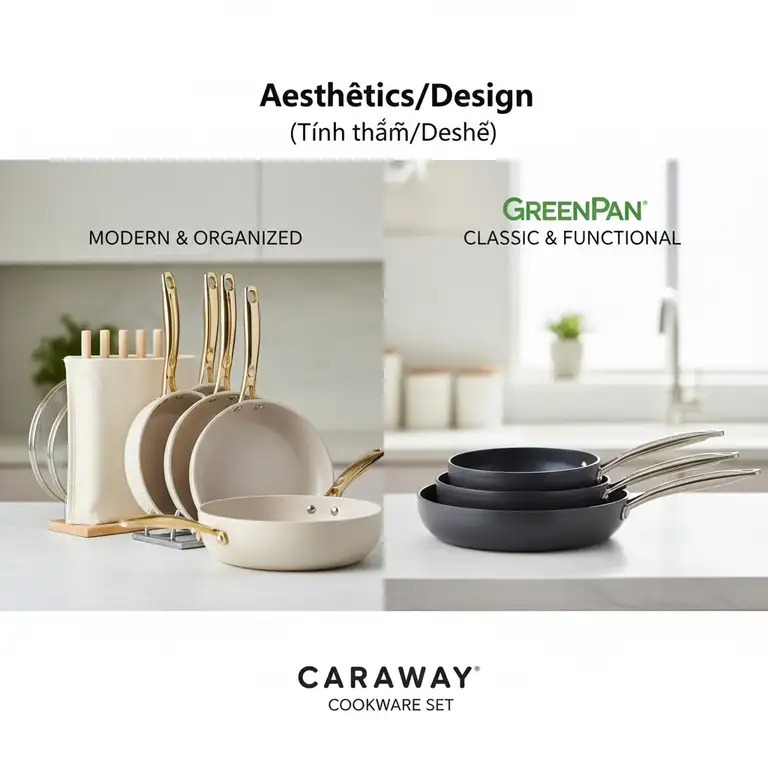
Three pans anchor this ceramic guide: a low-cost PTFE workhorse, a ceramic pick with a strong test record, and a premium ceramic with mixed reports.
Same aluminum pan, different coating: what actually changes
Prudent Reviews points out that ceramic-coated pans are built the same way as PTFE ones: a base metal first, the coating last. So the useful comparison is the coating, not the pan. America’s Test Kitchen adds a label warning in its nonstick skillet roundup: Scanpan, often assumed to be ceramic, contains PTFE. Read the box, not the reputation.
Heat is where the specs split first. ATK says PTFE coatings can emit toxic fumes above 500°F, advises skipping the broiler, and keeps oven use at or below 450°F unless the maker says lower. The ceramic pans here carry far higher oven ratings, 550°F for the Caraway Nonstick Ceramic Fry Pan and 600°F for the GreenPan Valencia Pro, while the PTFE T-fal Ultimate Hard Anodized Fry Pan is rated to 400°F. A higher oven rating is not permission for higher stovetop heat, though: ATK found its winning ceramic skillet runs hotter than its favorite PTFE pan, so the flame goes down or the cooking time shortens.
Release and wear are the contested part. ATK’s ceramic test fries up to 50 eggs with no oil at the start and again after cooking and abuse tests. The GreenPan Valencia Pro passed both rounds, Caraway’s skillet released 36 eggs in the repeat, a Cuisinart failed after nine and a Great Jones released eight. ATK’s PTFE roundup ran its own egg test, where some pans reached 100 eggs, a Cuisinart stopped releasing after 73, and the finish on one All-Clad skillet wore off. Those egg counts come from separate tests, so they should not be lined up against each other. What both pages share is the conclusion that coatings wear down.
Manufacturers and reviewers weigh this differently. Chemours, the company that owns the Teflon brand, says in a lifecycle assessment that seven ceramic pans are needed to match the nonstick performance of one pan with its Platinum coating; the page describes no test protocol, so treat it as a maker’s claim. Prudent Reviews’ Andrew Palermo lands in the middle: durability is about the same, with PTFE ahead on release and price. In his tally of Amazon reviews, about 3% of Calphalon’s PTFE buyers mentioned sticking against about 20% for its ceramic version, and for Cuisinart the figures were about 1% and 6%.
Ceramic vs nonstick head to head: heat, release, wear, safety
| Criterion | Ceramic-coated pan | PTFE nonstick pan |
|---|---|---|
| Coating | Ceramic-type layer marketed as free of PTFE, PFOA and PFAS | PTFE, a PFAS that the FDA authorizes for pots and pans |
| Oven ratings in the three pans below | 550°F to 600°F | 400°F |
| Stovetop heat | ATK: the winning ceramic pan runs hotter, so lower the heat | ATK: fumes possible above 500°F; most nonstick pans work best on medium-low heat, per CNN Underscored |
| Fresh release | Slick when new; Prudent Reviews had to nudge eggs on the GreenPan pans | Every skillet in ATK’s PTFE roundup passed the first egg test |
| After months of use | ATK: most ceramic pans did worse on the repeat egg test; Prudent Reviews expects all ceramic coatings to degrade | ATK: PTFE coatings eventually wear out; forum posters report replacing PTFE pans after roughly 6 to 18 months |
| Price tier | Usually higher for similar quality, per Prudent Reviews | Usually lower, per Prudent Reviews |
| State PFAS rules | Outside the bans when no PFAS is intentionally added | Covered where cookware bans exist, such as Minnesota since 2025 |
Release and price favor PTFE in the sources, oven range and PFAS status favor ceramic, and wear is a draw that nobody has settled. The Prudent Reviews comparison concludes that both types are safe when used properly and no longer treats ceramic as the clearly safer choice. The FDA’s page on authorized PFAS uses lists nonstick coating on pots and pans and says studies show only negligible amounts of PFAS in this coating migrate to food. The page says nothing about overheating, which is why ATK’s 500°F guidance matters.
Three pans that show the split
The makers’ own pages for two of the three pans would not load, so the spec lines below come from ATK, CNN Underscored, NBC Select and retailer listings, and each entry says which.
| Model | Coating | Oven rating | Induction | Size and weight in the sources | Warranty in the sources |
|---|---|---|---|---|---|
| GreenPan Valencia Pro | Diamond-infused ceramic on hard anodized aluminum | 600°F | Yes | 12-inch: 9.5-inch cooking surface, 2.60 lb | Not shown on the listing |
| T-fal Ultimate Hard Anodized Fry Pan | Titanium-reinforced PTFE-based nonstick on hard anodized aluminum | 400°F (lid 350°F) | No | 12-inch with lid | Limited lifetime |
| Caraway Nonstick Ceramic Fry Pan | Proprietary ceramic | 550°F | Yes | 10.5-inch, 2.7 lb | 1-year limited |
1. GreenPan Valencia Pro — ceramic with the best test record
Among ceramic pans, the test results favor this one. America’s Test Kitchen named the 12-inch GreenPan Valencia Pro the winner of its ceramic skillet roundup after it passed the 50-egg release test both before and after the abuse rounds, which most rivals did not manage. The same page lists a 9.5-inch cooking surface, 2.60 pounds and induction compatibility, and notes the pan runs hotter than ATK’s favorite PTFE skillet.
A Walmart listing for the 8-inch size supplies the stovetop details: a diamond-infused Thermolon Minerals Pro coating, a hard anodized aluminum body, a magnetic induction base, and a 600°F rating for oven and broiler. It also calls the pan dishwasher safe and metal-utensil safe, yet Taste of Home reports that the maker recommends hand washing all its cookware. Treat the listing as a ceiling, not a routine.
Real-use reports are mixed in a familiar way. Taste of Home’s Bryce Gruber has used a set of GreenPan Valencia Pro frypans since February 2022 and says the nonstick quality dissipates a little over time while still outlasting the PTFE pans she used to replace yearly; that is one reviewer’s long-term view. Prudent Reviews’ stress tests saw a more pronounced decline in egg release than on Made In and Caraway, though not by much. In a Hungry Onion forum thread from summer 2025, one member said a GreenPan (the line was not named) failed after about six months, while another reported no coating problems on a GreenPan wok after years of careful, infrequent use. Those are anecdotes, not a trend.
The GreenPan Valencia Pro name also covers a tri-ply stainless line, which is a different pan; the specs here are for the hard anodized one. Check the current price on Amazon.com. Prudent Reviews calls it lighter and cheaper than Caraway.
Pros:
- Passed both rounds of ATK’s 50-egg test
- 600°F oven and broiler rating with an induction base, per a Walmart listing
- Light, at 2.60 pounds for the 12-inch per ATK
Cons:
- Runs hotter than ATK’s PTFE favorite, so heat control matters
- Prudent Reviews saw a clearer decline in egg release than on two rivals
- Care guidance conflicts: the listing says dishwasher safe, the maker recommends hand washing
2. T-fal Ultimate Hard Anodized Fry Pan — a low-cost PTFE workhorse
Around $35 to $55, in CNN Underscored’s pricing, makes this the least expensive of the three in these sources. CNN’s testers cooked pancakes, an omelet, fish and a sticky sauce without oil: nothing stuck, the pan showed no scratches after metal-utensil tests, and it came out of a 400°F oven looking unchanged. The same review lists drawbacks. The lid tops out at 350°F, the red Thermo-Spot preheat indicator felt gimmicky, and the maker still advises using metal utensils with care.
That price buys PTFE, so the trade-offs described above apply. ATK says PTFE can emit toxic fumes above 500°F, and Minnesota’s pollution control agency names Teflon (PTFE) among the coatings prohibited under its PFAS cookware law. The Amazon.com listing for the 12-inch with lid adds two limits: it excludes induction, and it calls the pan dishwasher safe while its care instructions say hand wash only. Induction cooks have a sibling to consider, T-fal Experience, which ATK named its Best Buy and lists as an induction option, although it too is rated to just 400°F in the oven.
Evidence from forum owners is less flattering than the CNN result. In the same Hungry Onion thread, one member reported a Calphalon PTFE pan, used daily for scrambled eggs, losing its coating from the center within about six months, and another replaces a PTFE pan every 12 to 18 months. Those are different brands and a handful of anecdotes, but they are a reminder that heavy egg cooking wears any coating.
Sources cite model numbers E76597 and E76598 for 12-inch versions with a lid, so match the exact model number to the listing you open. The Amazon.com listing shows a limited lifetime warranty.
3. Caraway Nonstick Ceramic Fry Pan — premium ceramic, mixed durability reports
Consumer Reports and America’s Test Kitchen disagree about this pan, and both can be right. Tasting Table’s summary of Consumer Reports’ 2026 ranking puts the Caraway first among nonstick frying pans: four eggs fried back to back, with oil only before the first, all released; heating was even; and durability was its one imperfect score, although it held up to steel wool. ATK tested differently. After cooking and abuse rounds, its Caraway skillet released 36 eggs in the repeat test, which counted as worse than the GreenPan Valencia Pro, which passed. Consumer Reports’ own pages sit behind a membership, so the details here come through Tasting Table. A likely reason for the gap is that the two outlets weigh early performance and post-wear release differently, which is reasoning from their test descriptions rather than something either one states.
The maker’s page says the coating is made without PTFE, PFOA and PFAS, and without lead or cadmium. It lists a 550°F oven rating, support for gas, electric and induction, a 2.7-pound 10.5-inch pan, 8-inch and 12-inch alternatives, a 30-day trial and a 1-year limited warranty. NBC Select’s roundup puts the 10.5-inch at around $125, with a glass lid about $60 more.
Durability worries appear outside the lab as well. Prudent Reviews’ tester ranked it among the two best ceramic pans but noted an uneven cooking surface and expects the shiny exterior to chip and flake over time. LeafScore’s at-home tests found stains, scratches and loosening handles at about the one-year mark. The one-year warranty comes with a price more than double the top of CNN’s range for the T-fal Ultimate Hard Anodized Fry Pan.
Check current availability and size options on Amazon.com for any of the three, because size and lid choices shift the price.
Ceramic cost over three years: the replacement math
Sticker price misleads here, because coating life sets the bill more than pan quality does. This table uses CNN Underscored’s rough $35 to $55 for the T-fal Ultimate Hard Anodized Fry Pan (midpoint about $46) and NBC Select’s roughly $125 for the Caraway Nonstick Ceramic Fry Pan, and assumes each pan is replaced the moment it fails. The totals are our arithmetic.
| Lifespan assumed | T-fal Ultimate Hard Anodized Fry Pan, 3 years | Caraway Nonstick Ceramic Fry Pan, 3 years |
|---|---|---|
| Replaced yearly | About $138 (3 pans) | About $375 (3 pans) |
| Replaced every 2 years | About $92 (2 pans) | About $250 (2 pans) |
| Lasts all 3 years | About $46 (1 pan) | About $125 (1 pan) |
To break even against a yearly replacement of the T-fal Ultimate Hard Anodized Fry Pan, the Caraway Nonstick Ceramic Fry Pan would need to last about 2.7 years ($125 divided by $46). NBC Select’s experts say nonstick pans may need replacing about once a year with daily use and can last several years when lightly used, so the interval, not the badge, decides who wins. The GreenPan Valencia Pro has no sourced price here; check the current price on Amazon.com and run the same division.
Two ceramic ideas follow from the math. Buy the smaller size you actually cook with, since Caraway sells 8-inch, 10.5-inch and 12-inch pans and a smaller pan costs less to replace. And treat any nonstick surface as a consumable rather than an heirloom, which is how LeafScore frames it too, writing that ceramic coatings do not last very long.
Ceramic tips and steps that slow the wear
Wear is where ceramic punishes habits, and a PTFE pan benefits from the same routine. Tape these ceramic steps inside a cabinet door:
- Heat slowly and stay at low to medium. CNN Underscored says most nonstick pans work best on medium-low heat, and excess heat wears the coating; LeafScore also recommends heating slowly.
- Cook with a little butter or a high smoke-point oil, not aerosol spray. CNN says sprays leave buildup that reduces release, LeafScore agrees, and Caraway’s page recommends a small amount of oil or butter.
- Use silicone or wooden tools. ATK recommends them for PTFE pans, and LeafScore lists wood or silicone over metal.
- Let the pan cool, then soak instead of scraping. ATK’s testers found a hot-water soak loosened sauce and caramelized sugar, and warned that scrubbing degrades the surface; Taste of Home’s reviewer uses the soft side of a sponge.
- Wash by hand even when the listing says dishwasher safe. Two of the three pans here have listings that conflict with their own care advice.
- Store pans with trivets or wrapped, as LeafScore suggests, so stacked pans do not scratch each other.
Knowing when to stop matters as much. NBC Select’s experts name three signs: coating that flakes, blisters or pulls away; deep scratches that expose the metal underneath; and food that still sticks when the pan is used correctly, which one expert called the most important sign.
What the 2027 PFAS rules mean for ceramic and PTFE pans
Rules, not only reviews, now shape what is on shelves. Minnesota’s pollution control agency says cookware with intentionally added PFAS has been prohibited since January 1, 2025, and names Teflon (PTFE) as covered; its page does not mention ceramic coatings. A January 2026 Morgan Lewis summary adds that Colorado and Maine began barring cookware sales with intentionally added PFAS on January 1, 2026, and Connecticut followed on July 1, 2026 with a prior-notice route that allows continued sales.
For 2027, Rhode Island’s environment department lists January 1, 2027 as the start of its cookware prohibition and counts electric PFAS-coated frying pans as covered. Its page does not address pans already in homes. The FDA’s authorization and the state bans can both be true at once, because one is a food-contact finding and the other is chemicals policy.
For a shopper, that means PTFE pans face sales restrictions in some states while ceramic pans with no intentionally added PFAS fall outside the definition. Elsewhere you can still buy either. Timelines and exemptions keep changing, so check your state environmental agency before relying on this list.
Which pan fits which kitchen
Take a hypothetical household on a gas range that scrambles eggs most mornings and accepts pans as consumables. The T-fal Ultimate Hard Anodized Fry Pan matches that pattern: the lowest cost in the sources, a 400°F oven limit that has no bearing on stovetop eggs, and a replacement bill that stays small even if the coating lasts only a year.
Now take a cook on an induction cooktop who also finishes dishes under the broiler or simply prefers a coating marketed as PFAS-free. The GreenPan Valencia Pro fits better, with an induction base, a 600°F oven and broiler rating and the strongest independent record among the ceramic pans in these sources. It still needs gentler heat and hand washing.
A third buyer weighs Consumer Reports’ ranking above other tests and is comfortable paying around $125. The Caraway Nonstick Ceramic Fry Pan earns its place on that basis, with the caveat that ATK’s repeat egg test and a one-year home test both describe wear.
Searing steaks is a different job for all three. ATK suggests cast iron or carbon steel for cooks who want something longer-lasting than any nonstick coating.
Safety, lifespan, utensils, induction, and replacement: straight answers
Is ceramic nonstick safer than PTFE nonstick?
How long does a ceramic pan stay nonstick?
Can you use metal utensils on ceramic or PTFE pans?
Do ceramic and nonstick pans work on induction?
When should you replace a nonstick or ceramic pan?
How to decide between ceramic and PTFE pans for 2027
For most kitchens, ceramic vs nonstick resolves along three lines: your cooktop, your oven, and how often you are willing to replace the pan. A gas or electric stove, a tight budget and daily eggs point to the T-fal Ultimate Hard Anodized Fry Pan, bought as a consumable. Induction, a broiler habit or a preference for a PFAS-free coating point to the GreenPan Valencia Pro, the ceramic pan with the strongest independent test record in the sources above. The Caraway Nonstick Ceramic Fry Pan suits buyers who accept a higher price and a one-year warranty for a pan Consumer Reports ranked first. Whichever you pick, low heat, soft tools and hand washing do more for coating life than the badge on the box. Check current availability below, and compare sizes before you order.
Recommended for You
- Wolf range: 7 Best Models Compared & Honest Costs (2027)
- Oven-safe broiler-safe cookware: 6 Picks That Take the Heat
- Nonstick woks: Choices for Every Budget and Stove
Disclaimer: This post contains affiliate links. As an Amazon Associate, we earn from qualifying purchases made through these links, at no additional cost to you.
Ready to match a pan to your stove? Compare sizes and availability on Amazon.com and pick the one that fits your cooktop.