One crack in a Teflon-coated pan can shed roughly 9,100 plastic particles, and a broken coating about 2.3 million, according to a 2022 Flinders University release on a study done with the University of Newcastle. That number is why the cookware to avoid in 2027 is mostly a matter of condition rather than brand: the sources worry about pans that are scratched, flaking or overheated more than about an intact one.
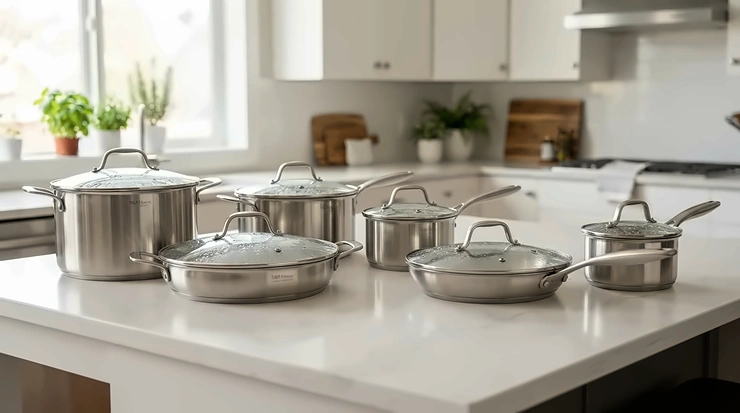
Three things earn a place on the avoid list: worn or overheated PTFE nonstick, imported aluminum and brass pots the FDA has flagged for lead, and labels like “PFOA-free” that promise less than they sound like. Everything else comes down to your stove, your patience and what you cook, so the five swaps below are matched to kitchens instead of ranked.
Sourcing here is regulators, one university study, Consumer Reports, America’s Test Kitchen and NBC Select write-ups, and owner threads, with every opinion about handling credited to whoever voiced it; none of the five pans was tested for this article. One date matters for shoppers: Rhode Island’s ban on cookware with intentionally added PFAS begins on January 1, 2027.
What the evidence says to avoid: worn nonstick, lead-prone imports, vague labels
Regulators, labs and testers disagree on how much harm a worn nonstick pan does, and they agree on when to retire one. The three subsections below keep those questions apart.
Cookware to avoid microplastics: scratched and flaking nonstick coatings
The Flinders and Newcastle team used Raman imaging on scratched and broken Teflon surfaces and published in Science of The Total Environment in 2022. Professor Youhong Tang called the findings a strong warning to choose and use utensils carefully, and the team asked for more research because Teflon belongs to the PFAS family.
Germany’s Federal Institute for Risk Assessment (BfR) reads the same material differently. Its July 2025 FAQ says tiny particles from a scratched PTFE coating are not expected to affect health, because PTFE is inert and passes through the body unchanged. America’s Test Kitchen makes a similar point about flakes, yet still tells owners to replace a chipping pan because chipping tends to continue. Consumer Reports is blunter: any chip or scratch means replacement.
So the evidence splits on harm and converges on action. Ceramic coatings get no free pass either. America’s Test Kitchen says ceramic nonstick typically wears out faster than PTFE and chips more often.
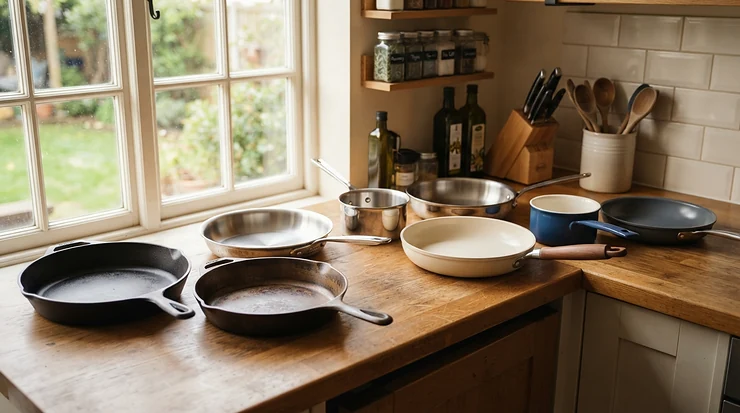
The best cookware to avoid microplastics, then, is cookware with no polymer layer to wear: stainless steel, cast iron, carbon steel and enameled cast iron. That is our reasoning from how the study framed PTFE coatings, not a finding about those metals, since the study itself looked at Teflon surfaces.
Heat belongs here too. NBC Select’s experts advise keeping nonstick below 500°F, or below the maker’s lower limit, and one of them says a hotter pan releases more PFAS vapors. The BfR adds that PTFE cookware should never be heated empty, and that the coating can release harmful gases above roughly 360°C, around 680°F by our conversion.
Imported aluminum and brass pots flagged for lead
The FDA’s imported-cookware alert tells retailers and consumers not to sell or use certain imported cookware made from aluminum, brass, or aluminum alloys sold as Hindalium, Hindolium, Indalium or Indolium. Tested examples include aluminum saucepans, kadai (karahi) pans, degda and patila pots, milk pans and brass topes, under brand names such as Silver Horse, IKM, Sonex, Town Food Service, Chef and JK Vallabhdas.
The agency’s advice is to match your pot against the table on its page, which lists brand and product names, label text, retailers and photos, and to throw away any match. On disposal the FDA is explicit: do not donate or refurbish the cookware. The agency says no known safe level of lead exposure exists, that young children, women of child-bearing age and breastfeeding people may face higher risk, and that anyone worried about exposure should contact a health care provider. The page was last updated on December 3, 2025, and it warns that other products may also be affected.
Best cookware to avoid forever chemicals starts at the label
America’s Test Kitchen explains that PTFE is itself a PFAS and is what makes conventional nonstick slick. PFOA, the compound behind the cancer classification discussed below, was a processing aid, and NBC Select reports that Teflon has been made without it since major companies phased it out by 2014.
That does not make the label reliable on its own. In a Consumer Reports lab check of three pans sold as PFOA-free, one PTFE pan contained PFOA anyway, and the magazine stopped listing “PFOA-free” in its ratings. Its nonstick ratings now flag whether a pan is made without PTFE, based on what manufacturers say. “Non-toxic” is weaker still: Food Network quotes an FDA official saying the agency has no official definition of the word for cookware.
On the regulatory side, the FDA’s page on authorized PFAS uses lists nonstick coating on pots and pans as one of four authorized categories. It describes the coating as highly polymerized, bonded at very high temperatures, and says studies show only negligible amounts migrate to food. An FDA press officer told America’s Test Kitchen the agency is not aware of research showing that authorized PFAS in cookware raise a safety concern, and the FDA says it keeps reviewing new science.
Where cancer enters the story, and where the evidence stops
Searches for the best cookware to avoid cancer tend to end at one classification, so here is what it says. In November 2023 the International Agency for Research on Cancer placed PFOA in Group 1, carcinogenic to humans, and PFOS in Group 2B, possibly carcinogenic, as summarized by UL Solutions and Cancer Research UK.
Cancer Research UK adds context. The Group 1 call rested mainly on animal studies and strong evidence of cancer-related changes in the body, human evidence was limited to kidney and testicular cancers, and IARC’s groups rank hazard rather than risk, which is why smoking and air pollution share the group. EPA’s summary of PFAS research lists an increased risk of some cancers, naming prostate, kidney and testicular, next to effects on fertility, immunity and cholesterol, and says studies are still catching up because thousands of PFAS exist and most research covers only a few.
None of those bodies tested a frying pan. The pan-specific statements are narrower: the FDA says negligible amounts migrate from nonstick coatings, and the BfR expects no health risk from intact PTFE cookware used properly. NBC Select’s expert David Nadler adds that the amounts from nonstick cookware are minor next to exposures like vehicle emissions and pesticides.
The defensible reading is modest. No cookware can be promised to prevent cancer, and the sources do not show that a nonstick pan causes it. What a PFAS-free cooking surface does is remove one possible source of a chemical class that EPA says is under active study. In this article that means stainless steel, cast iron, carbon steel, enameled iron, and ceramic coatings sold as PTFE-free.
Eggs, acid and weight: what separates the five swaps
Three differences decide which swap suits a kitchen. The first is release: eggs and fish slide best on a coating or a well-built seasoning, while stainless needs oil, preheating and some skill, as NBC Select notes of a stainless sauté pan. The second is acid. Lodge’s seasoning guide says tomatoes can break down seasoning on cast iron, and America’s Test Kitchen found that simmering tomato sauce in a carbon-steel skillet stripped most of the dark patina, which makes bare iron and steel poor choices for sauces. The third is weight and wear: ceramic wears fastest per America’s Test Kitchen, and an enameled Dutch oven weighs more than many cooks expect.
Model
Food-contact surface
Weight in the sources
Oven limit in the sources
Care notes
Tramontina Tri-Ply Clad 12-Inch Fry Pan
Uncoated 18/10 stainless
Not given
500°F (Prudent Reviews)
Oil and preheating; handle heats fast
Lodge 10.25-Inch Pre-Seasoned Cast Iron Skillet
Seasoned cast iron
About 5 to 5.4 lb (listings)
Oven-safe; no limit printed
Hand-wash, dry, re-oil
Mauviel M’STEEL Black Carbon Steel Frying Pan
Carbon steel you season
5.1 lb (America’s Test Kitchen)
Used in the oven; no limit printed
Scrub off wax, season, skip acid
Caraway Nonstick Ceramic Fry Pan
Ceramic coating on aluminum core
Not given
550°F (NBC Select)
Hand-wash, low to medium heat
Lodge 6-Quart Enameled Cast Iron Dutch Oven
Porcelain enamel
About 12.7 to 15 lb
500°F (Lodge reply on a Target listing)
Avoid heating empty; metal can chip it
Only the Caraway Nonstick Ceramic Fry Pan leans on a thin coating as its nonstick layer. Seasoning on iron and steel is baked-on oil that can be rebuilt with a little oil and heat, while enamel is glass that chips when struck, as Prudent Reviews’ dropped-spatula test shows below.
Situation by situation: the swap that fits each cook
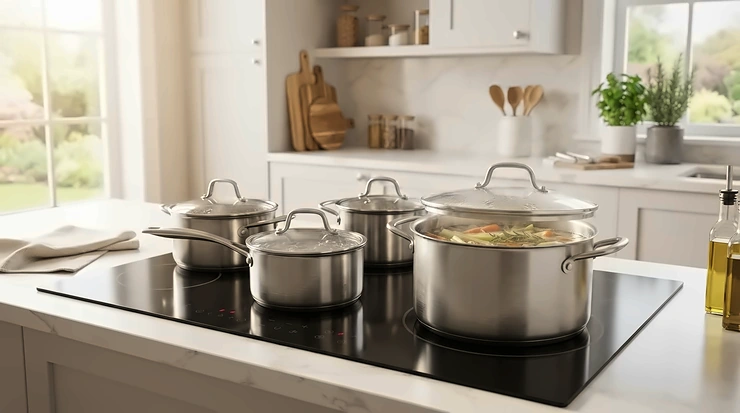
For anyone building the best cookware to avoid forever chemicals and plastic shedding, the pattern in the sources is plain: bare or enameled metal first, and one ceramic pan for eggs if you want a slick surface without PTFE.
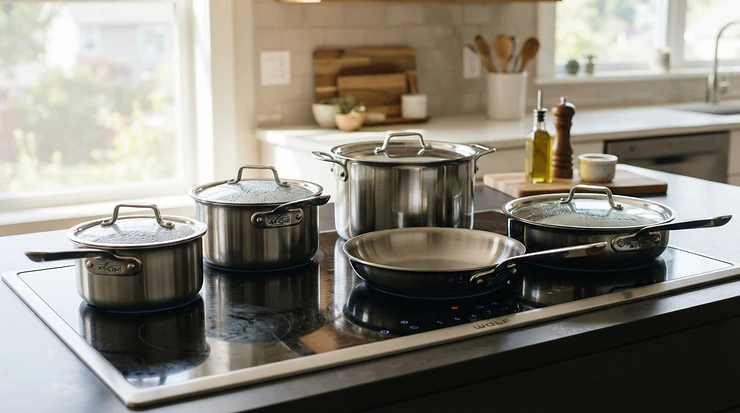
Prudent Reviews counts this pan among the stainless skillets under $100 that it tested, which makes it the least expensive route into clad stainless in this article. A Macy’s listing describes 18/10 stainless over an aluminum core with a magnetic stainless outer layer, induction-ready, and Prudent Reviews says the stainless tri-ply line is the only Tramontina cookware in its review rated to 500°F. On a medium burner its pan reached 356°F after one minute and 450°F after two, quicker than the Henckels and Cuisinart pans it was compared against.
That speed has a cost. The same reviewer saw minor warping after several months of regular use, a slight dip at the center that did not change cooking much; that is one tester’s report. Sticking is the other adjustment, and a customer review reproduced on the Macy’s listing complains that everything sticks, eggs included. The handle is rounded, riveted and lacks a silicone grip, so it heats faster than Tramontina’s nonstick pans.
Check the current price on Amazon.com. Listings call this pan both “Gourmet” and “Signature,” so match the exact model before ordering.
Tramontina Tri-Ply Clad 12-Inch Fry PanSee current price, sizes and reviews on Amazon.
Weight is what you pay. Listings put the pan between about 5 and 5.4 pounds, and Homes & Gardens, reviewing the related Lodge Chef Collection skillet, calls it heavy, sturdy and unapologetically simple, with a rough, textured surface and a spec-table price around $30. That reviewer saw flakes of loose seasoning when flipping eggs, which she calls normal for a new rough-surface pan, and eggs stuck in a few rough spots while still holding their shape.
Lodge’s own seasoning guide traces the texture to sand casting. Owner reports split on what the texture means over time. A member of the Egghead forum says that once the seasoning on a pre-seasoned Lodge fails, it needs sanding or it keeps flaking. A member of AmazingRibs describes Lodge skillets that started rough and turned glass-smooth with use, and says a trashed seasoning plus a pat of butter still produced a clean omelet. Those are single posts with opposite lessons, and read together they suggest the pan rewards regular cooking more than a one-time setup.
Care follows the usual iron routine: hand-wash with a sponge, dry thoroughly, re-oil lightly. The related pan worked on induction, gas, electric and over a campfire in Homes & Gardens’ testing, and it handles searing and browning well.
Lodge 10.25-Inch Pre-Seasoned Cast Iron SkilletSee current price, sizes and reviews on Amazon.
Eggs without a coating are the job this pan is hired for. America’s Test Kitchen names the 12.6-inch version its best carbon-steel skillet for most home cooks: 5.1 pounds, a 10-inch cooking surface, 2.25-inch sides, 2.5 mm thick, induction-compatible, and released food well once seasoned. It ships unseasoned under a thick layer of beeswax that must be scrubbed off, and ATK’s price note puts it around $120. Reviewed.com also picked a Mauviel pan as its favorite carbon steel, with an uncomfortable handle and a small interior surface among the cons for the 12.5-inch size.
A recall story explains why seasoning matters. Matfer Bourgeat, America’s Test Kitchen’s former carbon-steel winner, had certain batches recalled in France in April 2024 after regional testing, and Prudent Reviews says the bare, unseasoned pans released iron, chromium and arsenic above limits. Matfer disputes the test method, says its pans comply with French and EU standards, and America’s Test Kitchen notes there is no US recall. Whichever side is right, the practical lesson in both accounts is the same: season the pan first and keep acidic food out of it.
Mauviel M’STEEL Black Carbon Steel Frying PanSee current price, sizes and reviews on Amazon.
Ceramic is the one swap here that behaves like the nonstick you are replacing, including the lifespan. Consumer Reports lists the pan as Recommended: it heats evenly, has a sturdy handle, works on induction and held up well in durability testing, though it is not dishwasher-safe. NBC Select describes an aluminum core with a ceramic interior, oven-safe to 550°F, for all stovetops, best on low to medium heat, with prices between $115 and $170 across the three retailers it listed. Sur La Table’s Alycia Johnson told NBC Select that high heat and metal utensils can damage the coating.
The PTFE-free claim rests on NBC Select’s decision to include only brands that state PFAS-free or uncoated, and on Consumer Reports’ note that its PTFE-free flags come from manufacturer claims.
Durability is the sticking point. America’s Test Kitchen says both PTFE and ceramic lose their nonstick ability and ceramic usually wears faster. NBC Select’s Tracy Zimmermann says well-cared-for nonstick can last many years and poorly cared-for pans only months, and a May 2024 r/AskCulinary thread shows several commenters describing a nonstick pan per year before moving to carbon steel or cast iron, a handful of anecdotes rather than a measured rate.
Pros:
Slick surface without PTFE, per the maker’s claims as relayed by Consumer Reports and NBC Select
Induction-ready, with a 550°F oven rating per NBC Select
Recommended by Consumer Reports after durability testing
Cons:
Hand-wash only, and low to medium heat works best
Ceramic coatings usually wear faster than PTFE, per America’s Test Kitchen
Priced above stainless and iron in the sources
Caraway Nonstick Ceramic Fry PanSee current price, sizes and reviews on Amazon.
Tomato sauce is where bare iron and carbon steel lose their seasoning, and this pot exists to fill that gap. Gear Patrol calls it its best overall Dutch oven for value, praising sturdy wide handles and even heating at about $80, while Target lists it near $90. Weight depends on the source: Prudent Reviews gives 12.7 pounds, Consumer Reports about 13, and a Target listing 15. Lodge Customer Care’s reply on that Target listing says it is oven-safe to 500°F and should not be heated empty, and Consumer Reports lists it as induction-compatible.
Enamel is the weak point. Prudent Reviews found it the only pot to chip slightly when a metal spatula was dropped on it, saw bubbling in the enamel inside the lid, and noted it is made in China, yet it also says Lodge was the only brand tested that offered to replace or repair a pot if the enamel chips or cracks under normal use. A Gear Patrol tester reported four years of heavy use with no visible degradation.
Pros:
Enamel surface, so acidic sauces do not strip a seasoning
Replace-or-repair promise for normal-use chips, per Prudent Reviews
One of the cheaper enameled pots in Gear Patrol’s list
Cons:
Heavy, at roughly 12.7 to 15 pounds
Chipped under a dropped metal spatula in one test
Lodge 6-Quart Enameled Cast Iron Dutch OvenSee current price, sizes and reviews on Amazon.
Knowing what to avoid with cookware you already own matters as much as the shopping list, because the habits that wear coatings are consistent across the sources and most cost nothing to change.
Heating nonstick empty or past 500°F, per NBC Select’s experts and the BfR.
Metal utensils on any coating; soft turners are the advice from the Flinders researchers as reported by Popular Science.
Simmering tomato sauce or wine in bare carbon steel or seasoned iron, per America’s Test Kitchen and Lodge.
Dropping metal on enamel or heating an enameled pot empty, per Prudent Reviews and Lodge Customer Care.
Sending hand-wash pans through the dishwasher; Consumer Reports and NBC Select both list the Caraway Nonstick Ceramic Fry Pan as not dishwasher-safe.
Rhode Island’s January 2027 deadline: what the law covers
The Rhode Island Department of Environmental Management says its PFAS in Consumer Products Ban Act of 2024 bars anyone from manufacturing, selling, offering or distributing for sale cookware with intentionally added PFAS from January 1, 2027. The statute names pots, pans, skillets, grills, baking sheets, molds, trays, bowls and cooking utensils, and electric frying pans and skillets count when PFAS sits on the food-contact surface. Air fryers and rice cookers are generally treated as small appliances, but a basket or tray with PFAS on the food-contact surface is treated as cookware. Other states have their own timelines, so check yours.
Cookware to avoid steps: a 20-minute kitchen audit
Line up every pan and pot and sort them by food-contact surface: coating, bare metal or enamel.
Inspect each coated pan under bright light. America’s Test Kitchen’s signs for retirement are flaking, a deeply scratched and dry whitish surface, and constant sticking that re-oiling does not fix; Consumer Reports says any chip or scratch is enough.
Compare any imported aluminum, brass or Hindalium pot with the FDA’s lead table, and discard a match instead of donating it.
Replace by job, not by set. America’s Test Kitchen advises against spending much on a nonstick skillet and points cooks who want a naturally nonstick surface to carbon steel or cast iron.
Reset the habits in the previous section, starting with heat and utensils.
Straight answers on nonstick safety, lead, ceramic and cancer worries
Is nonstick cookware safe to use?
The FDA authorizes certain PFAS in nonstick coatings and says only negligible amounts migrate to food, and Germany's BfR expects no health risk with proper use. Both warn against overheating, and Consumer Reports says to replace any pan with chips or scratches.
Which cookware does the FDA warn about for lead?
Certain imported pots and pans made of aluminum, brass or aluminum alloys sold as Hindalium or Indalium, including saucepans, kadai pans and brass topes. The FDA says to throw them away rather than donate them, and it keeps adding products to its list as testing continues.
Is ceramic nonstick free of forever chemicals?
Ceramic coatings are marketed as PTFE-free, and Consumer Reports flags PTFE-free pans based on manufacturer claims. America's Test Kitchen adds that ceramic coatings usually wear out faster than PTFE and chip more often, so durability, not chemistry, is the usual complaint.
Does nonstick cookware cause cancer?
The sources reviewed here do not show that. IARC classed PFOA as carcinogenic to humans in 2023, but Cancer Research UK stresses that this ranks hazard, not risk, and that human evidence was limited to kidney and testicular cancers.
When should you throw out a scratched nonstick pan?
Consumer Reports says to replace a pan with any chips or scratches. America's Test Kitchen says flaking is not a safety issue but advises replacing the pan anyway, because chipping keeps going, and heavy sticking after re-oiling is another sign.
Which swap to buy first
Start with the scratched nonstick pan you use most, then any imported aluminum or brass pot that matches the FDA’s list; for most kitchens those two items are the whole list of cookware to avoid. After that, decide by how you cook. The Tramontina Tri-Ply Clad 12-Inch Fry Pan suits daily dinners if you will use oil and preheat. The Lodge 10.25-Inch Pre-Seasoned Cast Iron Skillet is the cheap searing pan, and the Mauviel M’STEEL Black Carbon Steel Frying Pan is the PTFE-free route to eggs if you accept seasoning. The Caraway Nonstick Ceramic Fry Pan is for buyers who want a ceramic surface and will treat it as a consumable. Sauces and soups belong in the Lodge 6-Quart Enameled Cast Iron Dutch Oven. Check current availability on Amazon.com for the size your burner fits.
Disclaimer: This post contains affiliate links. As an Amazon Associate, we earn from qualifying purchases made through these links, at no additional cost to you.
Replace the one pan you already distrust before buying anything else.
SmartCookLab is an independent buying-guide site for cookware, pots, pans, range hoods and kitchen appliances. Our editorial team compares products using manufacturer specifications, independent tests from specialist kitchen media, owner reports and retailer listings. We do not claim to have tested the products ourselves; see How We Choose Gear for our method.