Buy the pan that is easy to lift with dinner in it, not the one that only looks slim on a spec sheet, and let the pot’s lid do the draining. That one rule sorts most of the market. Lightweight easy-to-handle cookware for seniors comes down to a skillet near 2.5 pounds empty, a grip that suits the hand or a second handle to share the load, and a pot that never has to be tipped over a colander. For 2027, the five pieces below tie each of those needs to a kitchen situation instead of a ranking.
Weights, handle notes and wear reports here trace to America’s Test Kitchen’s skillet tests, The Kitchn’s nonstick roundup, Prudent Reviews’ weight chart, a specialist cooking site’s review of one ceramic pan, and retailer spec pages. No pan was cooked with for this guide, so every remark about feel belongs to a named tester, and prices are ranges taken from those pages. The Amazon.com price may differ.
The audience is anyone whose wrists or grip make a heavy skillet unpleasant, and the sons and daughters shopping for them. An occupational therapist can fit a tool to one particular hand; nothing here is medical advice.
Why 2.5 pounds is the number to watch, and what dinner adds
America’s Test Kitchen’s 12-inch nonstick skillet test puts numbers on a feeling most cooks know. Its favorites weighed 2.5 to 2.75 pounds and were easy to lift and carry. The heaviest 12-inch pans ran 3.8 to 4.9 pounds, and testers found them awkward to hold in the air with one hand while scraping food out.
The spread inside a single material is wider than most shoppers expect. Prudent Reviews’ weight chart lists a 12-inch T-fal Simply Cook aluminum nonstick pan at 1.8 pounds and a 12-inch Anolon X aluminum nonstick skillet at 5 pounds, a gap of 3.2 pounds (our arithmetic) between two pans made of the same metal.
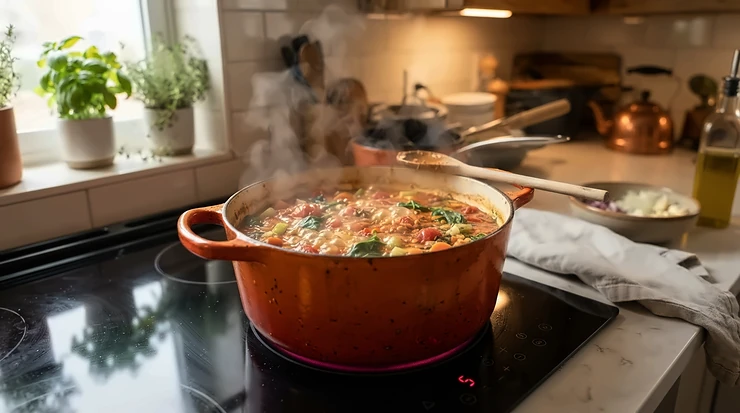
Pots are a different problem, because water is the weight. The same chart puts a 5.5-quart enameled cast-iron Dutch oven at roughly 11 pounds empty. A quart of water adds about 2.1 pounds (our arithmetic), so four quarts for pasta brings that pot to nearly 19 pounds on its way to the sink. The pasta pot in entry 5 weighs 3.35 pounds empty, which puts the same four quarts at about 12 pounds.
Light has a cost, and the sources are specific about it. Prudent Reviews says the thin-walled T-fal Simply Cook heats fast and burns food if left unwatched, and The Kitchn’s writer found the light Calphalon pans cooked best over lowered heat. Heavier did not mean tougher in America’s Test Kitchen’s heat-then-ice-water test, where none of the skillets warped, the lightest included.
Handle shape, a second grip and the stove: what actually decides
A second handle changes how weight reaches the hands. The Arthritis Foundation’s kitchen-tools page advises pots and pans with two handles so the weight spreads into both hands, and it names Tramontina’s helper handle as an example without saying which lines have one. America’s Test Kitchen’s testers found a helper handle made lifting and transferring easier on its heavier All-Clad pans, and Prudent Reviews recommends one for pans of 12 inches and up. A reviewer of the GreenLife skillet below says the same thing from the other side: at 2.27 pounds it felt a little unwieldy with food in it, and a helper handle was what it lacked.
Grip shape is the part spec sheets skip. In America’s Test Kitchen’s tests the T-fal handles were soft and comfortable, All-Clad’s concave metal handle felt a little sharp, and Tramontina’s was the longest in the lineup, which some testers disliked. Prudent Reviews adds a warning that applies to any brand: screw-on handles are notorious for loosening.
Then comes the stove. Induction needs a magnetic base, and the five pieces split. The T-fal and the Cuisinart pot are listed as induction compatible. Food Network says the Tramontina Professional is not, a Walmart listing says the same of the GreenLife, and retailer pages for the Calphalon set name gas, electric and glass tops only. The best lightweight easy-to-handle cookware for seniors is therefore the piece that fits the burner, the wrist and the budget at once, and no single pan wins all three.
Empty weight, grip and stovetop fit for each pick
Pick
Size
Empty weight
Handle
Induction
T-fal Experience Nonstick Fry Pan 12.5 Inch
12.5 in
2.50 lb (America’s Test Kitchen)
Soft and padded
Yes (America’s Test Kitchen)
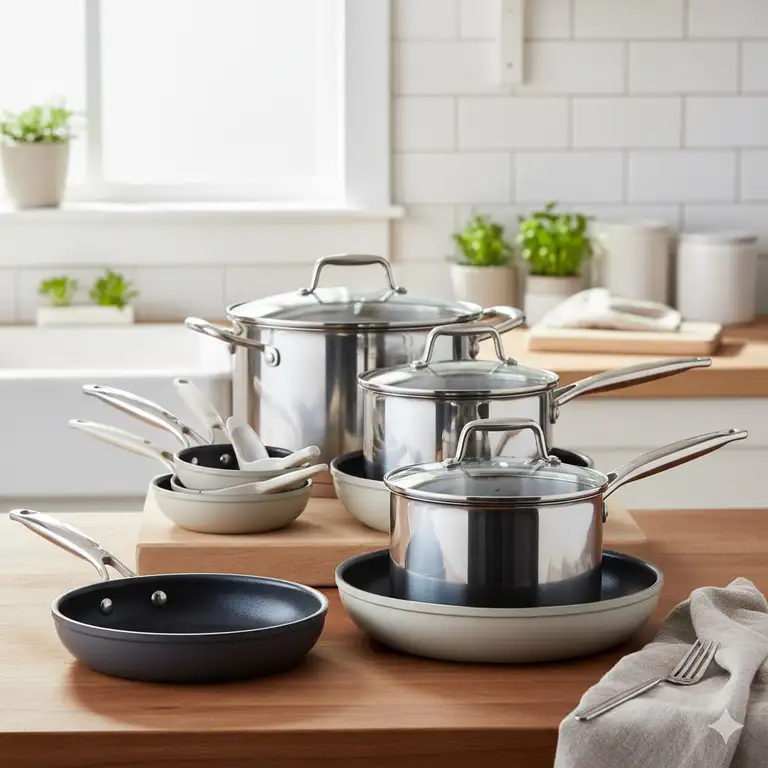
Calphalon Hard-Anodized Nonstick 8-Inch and 10-Inch Frying Pan Set
8 in and 10 in
10-inch pan: 1 lb 8.8 oz (The Kitchn)
Long stainless steel
Not mentioned in listings
Tramontina Professional Nonstick Restaurant Fry Pan
10 in
2.64 lb (Food Network)
Long, with silicone guard
No (Food Network)
GreenLife Soft Grip 12-Inch Frypan
12 in
2.27 lb (The Skillful Cook)
Bakelite soft grip
No (Walmart listing)
Cuisinart Chef’s Classic 6-Quart Pasta Pot with Straining Cover
6 qt
3.35 lb (manual summary)
Two riveted stainless steel
Yes
Two things stand out. The 12.5-inch T-fal Experience Nonstick Fry Pan 12.5 Inch is the bigger pan yet weighs about 0.14 pound less than the 10-inch Tramontina Professional Nonstick Restaurant Fry Pan (our arithmetic), so diameter alone says little about heft. And only two of the five are confirmed for induction, which matters more than a few ounces if the kitchen has an induction hob.
Five kitchens, five pieces: matching the pan to the cook
Each entry starts from a situation and works back to the product. Anyone who plans to buy lightweight easy-to-handle cookware for seniors as a gift can shortcut the choice by asking which task is hardest: lifting a full pot, flipping food, or gripping the handle.
A 12-inch skillet is the pan most kitchens reach for every day, which makes its weight the first number to get right. America’s Test Kitchen named this T-fal its Best Buy at 2.50 pounds, and its testers called it “very lightweight” with a soft, padded handle they found comfortable. The same page lists it as induction compatible and ovensafe to 400°F, under model numbers H9090564 or E93808.
The shape has one quirk: the cooking surface is slightly domed, so oil drifts to the edges and fried eggs rarely come out round. Prudent Reviews warns about a cousin, the thin-walled T-fal Simply Cook, as more prone to warping, but that is a separate and lighter line, so its verdict does not transfer to the Experience pan. This one has a single long handle and no helper handle, which argues for modest loads rather than a full pan of stew. The price runs around $40 to $50 for the 10.5-inch and 12.5-inch sizes.
Pros:
✅ 2.50 pounds in a 12.5-inch pan, among the lightest 12-inch skillets America’s Test Kitchen weighed
✅ Soft handle that testers liked, and induction compatible
Cons:
❌ Slightly domed surface, so oil runs to the edges
❌ No helper handle
Check current availability on Amazon.com.
T-fal Experience Nonstick Fry Pan 12.5 InchSee current price, sizes and reviews on Amazon.
Consider a hypothetical household of one, where dinner is two eggs or a single chicken breast. A 12-inch skillet is more pan than that meal needs, and a 10-inch one weighs far less. Its writer added that the light weight suits people with limited hand strength and that the two pans stack neatly.
The trade-offs are the usual ones for thin aluminum. The Kitchn reports that the walls and coating are likely to wear sooner than sturdier pans, that the PTFE surface showed short marks after metal spatula passes, and that budget nonstick like this may need replacing every two to three years. A Mr. Coffee retailer page lists the set as model TA138890S with stainless steel handles, a 450°F oven limit, a limited 10-year warranty and gas, electric and glass stovetops; induction is not mentioned. It also shows 4.1 out of 5 from 69 reviews, with two displayed complaints that the pans fell short of older Calphalon cookware or did not feel truly nonstick.
Calphalon sells several nonstick lines with near-identical names, so confirm the exact model number on the listing; America’s Test Kitchen’s 12-inch Calphalon Classic, for instance, dented badly in its durability tests and is a different product. The set costs between $55 and $75 according to The Kitchn’s two figures.
Calphalon Hard-Anodized Nonstick 8-Inch and 10-Inch Frying Pan SetSee current price, sizes and reviews on Amazon.
Food Network’s listing shows prices from the mid-$20s to $40 across retailers, which makes this one of the cheaper pans with serious critical backing. It named the pan its Best Value, weighing 2.64 pounds in the 10-inch size, the heaviest 10-inch pan in its list and described as heavy for some. America’s Test Kitchen weighed the 12-inch PRO3004 at 2.75 pounds, inside its favorites’ range.
Prudent Reviews likes the build: heavy-gauge aluminum, a 9.75-inch handle with a triple-riveted silicone grip, and a four-year Wirecutter test it says the nonstick surface survived. The same review notes that the rivets collect oil and food, and The Kitchn reports that the dark surface scratched immediately, so wood or silicone utensils are the rule and replacement every few years is likely. The pan is dishwasher safe, made in the USA and not induction compatible, per Food Network.
It suits cooks who want a sturdier body and can handle a pan a few tenths of a pound heavier than the T-fal. Not every Tramontina pan carries a second handle, and the Arthritis Foundation page does not say which do.
Pros:
✅ Heavy-gauge aluminum body with a silicone handle guard
✅ Dishwasher safe and priced low
Cons:
❌ Heaviest 10-inch pan in Food Network’s list
❌ Not induction compatible
❌ Longest handle in America’s Test Kitchen’s lineup, which some testers disliked
See the current listing on Amazon.com.
Tramontina Professional Nonstick Restaurant Fry PanSee current price, sizes and reviews on Amazon.
Plan for replacement with this one. The Skillful Cook’s reviewer puts the worst case for the nonstick coating at about six months and the realistic case at 12 to 18 months of regular use, citing Amazon reviews for the longer figure, and the two-year warranty covers manufacturing defects rather than wear.
What it offers is the handle: a bakelite soft grip that the same reviewer found more comfortable than a narrow metal handle, though not dramatically so, and that grew warm near the pan after 15 minutes of boiling water. The pan weighs 2.27 pounds in that review, and Prudent Reviews’ chart lists a 12-inch GreenLife Soft Grip at 2.3 pounds. With food in it the reviewer called it a little unwieldy and wished for a helper handle. Heating was uneven, with a hot center, though eggs released well without oil.
The Walmart listing describes the coating as free of PFAS, PFOA, lead and cadmium, which is the maker’s claim, and says the pan works on all stovetops except induction. It lists the pan as dishwasher safe while the reviewer says to hand-wash, so read the label. The cooking surface measures 9.5 inches, smaller than the name suggests. Check the current price on Amazon.com.
The oven limit is 350°F.
GreenLife Soft Grip 12-Inch FrypanSee current price, sizes and reviews on Amazon.
Water, not metal, is what makes a pasta pot heavy. At 3.35 pounds empty and 6.3 quarts, this pot (model 766S-22 on a manual summary) is a fraction of the roughly 11 pounds of a same-size enameled cast-iron Dutch oven, and four quarts of water bring it to about 12 pounds against nearly 19 (our arithmetic). Sur La Table’s page lists wide easy-grip handles, a tapered rim for clean pouring, measurement markings inside and induction compatibility.
The lid is the point. Per the manual summary, tabs on the lid line up with notches on the rim and a slight twist locks it, after which you tilt the pot so liquid pours through the perforations. Crate & Barrel describes the handles as riveted stainless steel. The manual summary adds that the handles can still get warm and calls for oven mitts.
A lighter pot does not remove every risk. Hospital for Special Surgery occupational therapist Preston Lockwood, quoted by CreakyJoints, advises against carrying a heavy pot of boiling water: slide it off the burner onto a dish towel toward the sink, use tongs to move pasta into a colander, or let the water cool before dumping it. For some cooks that route beats any straining lid.
Sources disagree on the oven limit, with the manual summary giving 550°F and Crate & Barrel giving 500°F for the pot and 350°F for the lid, so the label on the pot decides. Beyond the retailer pages and that summary, no independent test of this exact pot turned up, so its handling claims rest on the maker’s and retailers’ descriptions. Check the current price on Amazon.com.
Sur La Table lists the pot and lid as dishwasher safe, with a lifetime warranty.
Cuisinart Chef’s Classic 6-Quart Pasta Pot with Straining CoverSee current price, sizes and reviews on Amazon.
Lightweight easy-to-handle cookware for seniors reviews: what wears out first
Across the sources, thin light pans lose their coating before they lose their shape. The Kitchn puts replacement of budget nonstick at two to three years, The Skillful Cook’s reviewer puts a ceramic pan at six to 18 months, and The Kitchn also notes that ceramic may wear out quickly with high heat and dishwashing. Warping appears mostly as a warning about the thinnest pans, such as the T-fal Simply Cook, rather than as a finding from a test. Loose handles come up as a design flaw, not a wear item, in Prudent Reviews’ advice against screw-on handles.
That makes cost a question of replacement cycles. A pan at $25 to $40 that lasts two to three years works out to roughly $8 to $20 a year (our arithmetic, applying The Kitchn’s replacement estimate). Cheap lightweight easy-to-handle cookware for seniors can make sense when replacement is built into the plan, and the price spread among the three pans with sourced ranges is narrow, roughly $25 to $75 across the Tramontina, the T-fal and the Calphalon set. The lightweight easy-to-handle cookware for seniors price should therefore be the last tiebreaker, after weight, handle and stove.
Where the word “lightweight” misleads
The label is not a number. Prudent Reviews’ chart lists a 12-inch aluminum nonstick skillet at 5 pounds, and America’s Test Kitchen weighed a 12.5-inch nonstick pan at 4.9 pounds. Look for a weight in pounds, and compare weights from one source, since Prudent’s own chart gives the T-fal Simply Cook as 1.8 pounds in one place and 2.75 in another.
“Stay-cool” is not “cool”. The Cuisinart manual summary warns that handles can get warm, and the GreenLife handle warmed after 15 minutes of boiling water, so mitts stay in the kitchen either way.
Sets also carry a hidden cost. A set bundles pieces nobody lifts often with the one that matters, so buying the single piece that gets lifted most, a skillet or a pasta pot, spends the budget where the weight is.
Pounds, helper handles, induction and coating life: short answers
❓ How heavy is too heavy for a senior-friendly 12-inch skillet?
✅ There is no official cutoff, but America's Test Kitchen found 2.5 to 2.75 pounds easy to lift and carry, while 12-inch pans of 3.8 to 4.9 pounds were hard to hold aloft. Judge a pan by its weight with food in it, since empty weight understates the load.
❓ Is aluminum the lightest cookware material?
✅ In Prudent Reviews' chart, 12-inch aluminum nonstick skillets run from 1.8 to 5 pounds, carbon steel from 4.3 to 7, and enameled cast-iron Dutch ovens top 11. Thin aluminum is light but can warp and burn food if left unwatched, according to that review.
❓ Does a lightweight pan need a helper handle?
✅ Prudent Reviews recommends helper handles on pans of 12 inches or larger, and the Arthritis Foundation advises two-handled pots and pans so the weight spreads into both hands. A 10-inch pan weighing about 1.55 pounds carries far less load, so a single handle matters less there.
❓ How long does lightweight nonstick cookware last?
✅ Expect two to three years from budget PTFE pans, according to The Kitchn, and as little as six months to about 18 months from a ceramic-coated pan, according to one reviewer citing Amazon feedback. Testers recommend wood or silicone utensils and moderate heat.
❓ Will lightweight cookware work on an induction cooktop?
✅ Only if the base is magnetic, so look for the word induction on the listing. Of the five pieces here, two are listed as induction compatible and two as not, while the Calphalon pages name gas, electric and glass tops only.
Which lightweight piece to buy first
If the budget allows one purchase, start with the piece that gets lifted most. For most kitchens that is the 12-inch skillet, and at 2.50 pounds with a padded handle the T-fal Experience Nonstick Fry Pan 12.5 Inch is the best-sourced starting point. Add the Cuisinart Chef’s Classic 6-Quart Pasta Pot with Straining Cover if carrying water is the hard part, or choose the Calphalon Hard-Anodized Nonstick 8-Inch and 10-Inch Frying Pan Set when meals are small. Whatever the pick, judge lightweight easy-to-handle cookware for seniors by its weight with food in it, its handle and whether it fits the stove, and treat price as the tiebreaker.
Disclaimer: This post contains affiliate links. As an Amazon Associate, we earn from qualifying purchases made through these links, at no additional cost to you.
Start with one lighter pan and see how the first week of cooking feels.
SmartCookLab is an independent buying-guide site for cookware, pots, pans, range hoods and kitchen appliances. Our editorial team compares products using manufacturer specifications, independent tests from specialist kitchen media, owner reports and retailer listings. We do not claim to have tested the products ourselves; see How We Choose Gear for our method.