America’s Test Kitchen’s wok lineup ran from a carbon steel winner at 3 pounds 4.6 ounces to a cast iron wok at 11 pounds 9.6 ounces, a gap of more than eight pounds that helps explain why its testers favored carbon steel woks around 3 to 4 pounds. Consumer Reports reached a similar verdict, since all five of its top-rated woks are carbon steel and flat-bottomed. For a 2027 purchase, that narrows carbon steel woks to four decisions: the base shape, the size, pre-seasoned or bare, and the care routine.
A flat-bottom wok of 13 to 14 inches that weighs 3 to 4 pounds is the profile The Kitchn’s summary of Grace Young’s advice recommends, and the one America’s Test Kitchen’s testers preferred. Season it in thin layers unless it arrives pre-seasoned, and dry it over heat after every wash. A round bottom only pays off on a gas burner strong enough to heat it, so the four woks below split along that line.
The findings below rest on published tests from America’s Test Kitchen, Consumer Reports, Tasting Table and Reviewed, on maker spec pages, and on owner threads, and a problem reported by only one owner is labeled as one report.
What is carbon steel, and why do wok makers use it?
Carbon steel is an iron alloy with about 1 percent carbon, according to Made In, a cookware maker that sells its own carbon steel woks. Cast iron holds 2 to 4 percent and is poured into molds, while a carbon steel pan or wok is stamped from a single sheet and bent into shape, which leaves the finished piece lighter and tougher.
Weight shows up in the tests. America’s Test Kitchen’s testers found cast iron woks, at about 4.5 to 12 pounds, slower to respond and harder to maneuver than carbon steel ones, and they tied thin steel’s quick heating and cooling to better control as ingredients go in and out. Tasting Table adds that carbon steel tolerates the very high temperatures behind wok hei, the smoky “breath of the wok” flavor.
The trade is rust and reactivity. Bare carbon steel rusts if left wet, and Made In’s guide calls it a reactive metal, so wine, tomato, citrus and vinegar can wear the seasoning or leave a metallic taste. Both problems have routines, and the method below covers them.
The method: from stove match to the first stir-fry
Each step ties to a wok in the shortlist further down.
Match the base to your burner
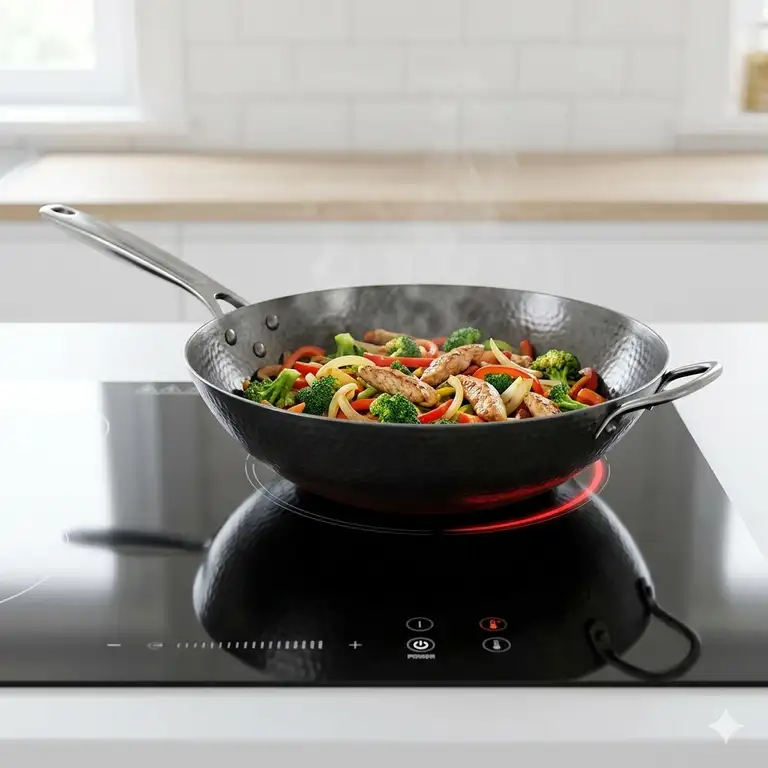
Start with the stove, because it decides the bottom shape. Made In says round-bottom woks work only on gas or an open flame, usually with a ring on a flat cooktop, while flat-bottom carbon steel woks sit on gas, electric or induction. America’s Test Kitchen called round bottoms impractical on most American stoves, unstable and poor at heating on electric and induction, and noted that a ring on gas can reduce heat. The Kitchn’s write-up of Grace Young’s advice goes further: a round-bottom wok with a ring suits only very powerful professional ranges.
Flat bottoms bring their own risk. America’s Test Kitchen says carbon steel on electric or induction carries a higher chance of warping from uneven heating, and thorough preheating helps.
Pick a size and weight you can lift
Fourteen inches suits most households in The Kitchn’s summary, with larger woks unwieldy and smaller ones crowding the food. America’s Test Kitchen says that size serves two to six people, and its preferred models had flat bottoms 6 to 7 inches wide. Its testers also favored woks around 3 to 4 pounds because they are easier to move.
Thickness is the other number on a listing. The Joyce Chen Classic Series 14-Inch Carbon Steel Wok quotes 1.5 mm in its flat-bottom version, and the Craft Wok Traditional Hand Hammered Carbon Steel Pow Wok quotes 15 gauge, which its listing equates with 1.8 mm.
Decide between pre-seasoned and bare steel
Every carbon steel wok needs seasoning. America’s Test Kitchen found that pre-seasoned ones cost more but are nonstick from the start, a real help on electric and induction stoves where seasoning the sides is harder, though a factory finish never matched a long-used wok’s patina in its tests. Tasting Table saw the same split: its testers found the pre-seasoned Yosukata 13.5-Inch Carbon Steel Wok more nonstick than the bare steel woks beside it.
Bare steel costs less and lets you build the finish yourself, in exchange for one long session at the stove before the first dinner.
Season it in thin layers
Grace Young’s stovetop method, as The Kitchn describes it, runs like this:
Scrub the new wok inside and out with a steel scrubber and dish soap to remove the factory oil, rinse with hot water, and dry it over low heat for a minute or two.
Heat it on your strongest burner until a flicked drop of water evaporates within one to two seconds.
Take it off the heat, add 2 tablespoons of oil, and swirl it up the sides.
Return it to the heat with scallions and ginger, drop to medium, and stir-fry for 15 to 20 minutes, smearing the aromatics up the walls.
Wash with hot water only, no soap, and dry over low heat. Silver metal turns mottled yellow-brown, sometimes with blue, yellow or black patches.
The Woks of Life takes another route: heat the bare wok until the metal darkens and shows a blue tint, add hot water, scrub, dry, then wipe on thin layers of vegetable oil and repeat as needed. It also says to wrap wooden handles in thick foil first, because thin foil scorches them.
A stovetop heats mostly the base, so America’s Test Kitchen suggests seasoning outdoors, on gas, or in an oven with wooden handles removed or protected when the sides refuse to darken. Made In’s wok guide calls the process no different from seasoning any other carbon steel pan, which means a skillet in your cabinet already teaches the habit.
Cook fatty food first, then wash and dry on heat
A new wok absorbs fat, so The Kitchn’s summary points to stir-fries, bacon and deep-fried food for building the finish. Steaming, boiling, poaching and acidic ingredients such as tomatoes or vinegar can damage fresh seasoning, though they are fine once the wok is well used.
Washing is simpler than the folklore suggests. The Woks of Life uses water for light cooking and adds dish soap for oily or saucy dishes, then dries the wok on the burner until every drop evaporates and wipes the inside with a few drops of oil once it cools. It rules out the dishwasher and warns that cold water on a very hot wok may warp it.
Why new carbon steel woks go wrong in the first month
Most early failures come from a short list of causes, and several have documented fixes.
Grace Young calls the splotchy stage “teenage,” according to The Kitchn: the seasoning may look uneven, feel gummy or rust, especially in humid weather or after weeks of disuse. Her fix is a “facial” of 1½ teaspoons of oil and 1 tablespoon of kosher salt scrubbed in with folded paper towels, and her timeline for a deep nonstick patina is about a year of regular cooking.
Factory seasoning has its own complaints. Made In’s product page, which hosts reviews of its own pre-seasoned wok, includes buyers who saw the finish wear off or turn patchy after the first use.
A bottom that stops being flat matters most on a glass top. One member of an eGullet thread reports that a 14-inch Joyce Chen flat-bottom wok turned convex on an induction burner and now wobbles. Another member replied that induction can still work if the pan sits steadily and suggested a silicone trivet, mallet-and-board straightening, or a round-bottom wok on a ring. The original poster, hunting for steel thick enough not to warp on a 3,500-watt burner, settled on a 3 mm wok with a 4.5-inch flat base.
Out-of-the-box flatness is worth checking too. On r/carbonsteel in July 2024, one poster returned a flat-bottom Yosukata 13.5-Inch Carbon Steel Wok because one edge sat about 5 mm off the counter and the pan tipped toward the handle. The replies offered alternatives but never said whether the flaw was typical, so it is one report, not a pattern.
Hot handles round out the list. Consumer Reports says the helper handle on its Wok Shop 14-Inch Carbon Steel Wok pick can get hot, and Tasting Table’s testers found the metal sleeve on the wooden handle of the Yosukata 13.5-Inch Carbon Steel Wok got very hot. A pot holder solves it, but it is easier to know in advance.
Carbon steel woks reviews: where the test lineups agree
Consumer Reports tested 10 woks and named five, listed alphabetically. Its page says cooking evenness was excellent in every wok, and that smooth and hammered interiors cooked the same, though the hammered Kaqinu 12.6-Inch Carbon Steel Wok and Souped Up Recipes 12.5-Inch Carbon Steel Wok were harder to clean and lacked helper handles. Tasting Table’s 2023 test named Helen’s Asian Kitchen Carbon Steel Wok best overall, noting its smoky fried rice and cool handle but shallow sides that made tossing difficult. America’s Test Kitchen rated the same brand’s 14-inch model recommended and judged its 4 pounds slightly heavy.
Reviewed’s page, updated in October 2023, praised the round-bottom Craft Wok Traditional Hand Hammered Carbon Steel Pow Wok for heating quickly and evenly, and marked down the Joyce Chen Pro Chef 14-Inch Carbon Steel Wok for being heavy and hard to season evenly. That Pro Chef line is a different product from the Classic Series further down.
Across these carbon steel woks reviews, nobody calls the metal uneven. The complaints are about handles, weight, seasoning and flatness, which is why the best carbon steel woks below are sorted by those traits.
The best carbon steel woks, matched to your stove and the steps above
Anyone searching for the best carbon steel wok 2027 on a flat electric or induction top can start with the Yosukata 13.5-Inch Carbon Steel Wok, which is why it comes first. The other three cover a lower budget, thicker steel, and gas.
Wok
Base
Listed weight
Seasoned at purchase
Cooktops listed
Yosukata 13.5-Inch Carbon Steel Wok
Flat
3.6 lb
Yes
Gas, electric coil, smooth-surface induction
Joyce Chen Classic Series 14-Inch Carbon Steel Wok
Flat, 1.5 mm
3.24 lb
No
Gas, electric coil, induction
Babish 14-Inch Carbon Steel Flat Bottom Wok
Flat, about 6 in.
5 lb
Listed as seasoned by Consumer Reports
Gas, smooth-surface induction
Craft Wok Traditional Hand Hammered Carbon Steel Pow Wok
Round, 1.8 mm
4.6 lb
No
Gas; a ring for electric
Weights come from marketplace listings, except the round-bottom wok’s figure, which comes from Reviewed, and the Joyce Chen figure that matches America’s Test Kitchen’s 3 pounds 3¾ ounces. The Babish 14-Inch Carbon Steel Flat Bottom Wok weighs about 1.4 pounds more than the Yosukata 13.5-Inch Carbon Steel Wok, and America’s Test Kitchen’s testers favored the lighter range for tossing. Only the Craft Wok Traditional Hand Hammered Carbon Steel Pow Wok is limited to gas.
Skipping the first seasoning session is the main reason to start here. America’s Test Kitchen rated this 13.5-inch pre-seasoned wok highly recommended, and Tasting Table named it best for stir-frying, crediting high sides that made tossing easy. The same test noted that the metal sleeve on the wood handle gets very hot and that the narrow bottom heated liquid less evenly.
Marketplace listings for the black flat-bottom version give 3.6 pounds, a beech wood handle, hand washing only, no oven use and a 600°F maximum, with pre-seasoning done above 600°F. Yosukata lists more than one 13.5-inch version, and a blue 15-gauge variant lists 2.72 kg, about 6 pounds by our arithmetic, so confirm you are ordering the 3.6-pound black one. The July 2024 r/carbonsteel return noted above is the one flatness complaint found.
Tasting Table’s 2023 test put it around $60, so treat that as a rough anchor and check the current price on Amazon.com.
Yosukata 13.5-Inch Carbon Steel WokSee current price, sizes and reviews on Amazon.
Cost sits at the center of this one. America’s Test Kitchen named the 14-inch Classic Series, at 3 pounds 3¾ ounces, a Best Buy beside the IMUSA 14-Inch Non-Coated Wok with Wood Handle, and said both need seasoning and come without accessories yet perform about as well as the winner. The listing gives 1.5 mm steel, birch handles, 3.24 pounds and hand washing only, and one retailer page shows between $60 and $70 for the flat-bottom version; the 1.8 mm round-bottom sibling is made for wok rings.
The weak spot is flatness over time. The eGullet member described above is the clearest case: a thin 14-inch Joyce Chen flat bottom, though the post does not name the series, that bowed on induction, which echoes America’s Test Kitchen’s warning about warping on electric and induction tops. On gas, thin steel is a strength, because it heats and cools fast. Compare that range with the Amazon.com listing before ordering.
Joyce Chen Classic Series 14-Inch Carbon Steel WokSee current price, sizes and reviews on Amazon.
Consumer Reports put this wok among its five top performers, scoring its cooking evenness top-notch and its water heating very good, and describing it as smooth, seasoned, easy to clean and fitted with a metal helper handle. Listings give model 131286.01R, 5 pounds, a 5-quart capacity, a 6-inch flat base, riveted wooden handles, gas and smooth-surface induction compatibility, a 500°F listed maximum and a limited lifetime warranty.
Weight is the trade-off. One buyer review mirrored on a Desertcart listing calls it heavy for tossing and says the helper handle warms up enough to need a silicone cover, while the same reviewer reports no warping of the base at any temperature. That is one reviewer’s account, not a test result.
A cook who stirs more than tosses gets stability on an electric or induction top in exchange for the extra pounds. Check the current price on Amazon.com.
Babish 14-Inch Carbon Steel Flat Bottom WokSee current price, sizes and reviews on Amazon.
A round bottom changes the whole decision. This 14-inch model, 731W88, is 15-gauge (1.8 mm) steel with a wooden handle and a steel helper handle, and the maker’s copy says it is hand hammered by professionals in Guangzhou. Its listing says it is not compatible with flat electric or induction stoves, and Reviewed agrees that electric users would need a ring to balance it.
Reviewed’s testers were pretty happy with its performance, finding that it heated quickly and evenly and was easy to season, if time-consuming. It weighs 4.6 pounds there. Buyer reviews mirrored on Desertcart split: some describe rust soon after washing and one reports a black layer peeling through three seasoning attempts, while others say rust complaints trace to skipped drying and oiling. America’s Test Kitchen warns that a ring on gas can reduce heat, so this wok suits a burner that can spare it. Check the current price on Amazon.com.
A step up in cost is the Made In Seasoned Carbon Steel Wok, which the maker’s own page lists as 13.5 inches overall with a 5.5-inch cooking surface, 3.5 pounds, 1.5 mm steel, riveted stainless handle, gas, electric and induction use, a 1200°F heat rating and a lifetime warranty, at around $120 on that page. Its 4.7-star average from 4,398 reviews is the seller’s own data and the maker’s page is the only detailed source opened for it. Some of those reviewers report patchy seasoning, and one three-star review says the sides did not get hot enough on induction.
Craft Wok Traditional Hand Hammered Carbon Steel Pow WokSee current price, sizes and reviews on Amazon.
Carbon steel vs stainless steel: which cook should switch?
The Takeout says carbon steel handles intense heat and builds a nonstick patina but needs drying, oiling and re-seasoning, while stainless resists rust, is dishwasher-safe and copes with acidic dishes like tomato sauce. KaTom, a restaurant-equipment seller, adds that stainless is heavier, which makes lifting and tossing harder, and that food may stick without enough preheating or oil.
On carbon steel vs stainless steel for wok hei, the sources split. The Takeout says stainless lacks the heat retention to reproduce it, while KaTom says careful preheating and smaller batches can get close, with no data on the page to back that. A cook who wants dishwasher cleanup and tomato-heavy sauces will be happier in stainless; a cook chasing char and willing to dry a wok over heat belongs with carbon steel.
Carbon steel wok answers on soap, stainless, and induction
❓ What is carbon steel?
✅ Carbon steel is an iron alloy with about 1 percent carbon, according to Made In's cookware guide, stamped from a sheet rather than cast. That makes pans and woks lighter and tougher than cast iron, but unlike stainless steel it rusts without seasoning and drying.
❓ Is carbon steel better than stainless steel for a wok?
✅ The Takeout and KaTom both favor carbon steel for high-heat stir-frying, since it heats fast and weighs less. Stainless wins on convenience: no seasoning, dishwasher-safe, and fine with acidic sauces. They disagree on whether stainless can match wok hei.
❓ Can you use soap on a carbon steel wok?
✅ Yes, once seasoned. The Woks of Life uses dish soap for oily or saucy dishes, then dries the wok over heat and wipes on a few drops of oil. Grace Young's first-seasoning method skips soap entirely, and The Woks of Life bans the dishwasher.
❓ Do carbon steel woks work on induction cooktops?
✅ Flat-bottom ones do, because carbon steel is magnetic; round-bottom woks need gas or a ring and heat poorly on induction. America's Test Kitchen notes a higher warping risk on electric and induction tops, and thorough preheating helps.
❓ How long does a carbon steel wok take to become nonstick?
✅ Grace Young, quoted by The Kitchn, says a deep nonstick patina can take about a year of regular use, with a splotchy 'teenage' stage along the way. A pre-seasoned wok is nonstick from day one but still improves as you cook.
A decision rule for your first carbon steel wok
A best carbon steel wok 2027 list means little until the stove is settled, and once it is, the choice follows. On a gas burner with real power, the round-bottom Craft Wok Traditional Hand Hammered Carbon Steel Pow Wok earns its place. On electric or induction, a flat 13.5- to 14-inch wok is the safer route: the Yosukata 13.5-Inch Carbon Steel Wok for a pre-seasoned start, the Joyce Chen Classic Series 14-Inch Carbon Steel Wok for the lowest cost, and the Babish 14-Inch Carbon Steel Flat Bottom Wok for thicker, heavier steel.
Whichever you pick, season in thin layers, expect a splotchy first month, and dry the pan over heat every time, since The Woks of Life ties that step to preventing rust. That routine, more than the brand, is what carbon steel woks ask of you. Compare the current listings for the base shape that fits your stove.
Disclaimer: This post contains affiliate links. As an Amazon Associate, we earn from qualifying purchases made through these links, at no additional cost to you.
A seasoned wok improves with every dinner, so start the first batch this week.
SmartCookLab is an independent buying-guide site for cookware, pots, pans, range hoods and kitchen appliances. Our editorial team compares products using manufacturer specifications, independent tests from specialist kitchen media, owner reports and retailer listings. We do not claim to have tested the products ourselves; see How We Choose Gear for our method.