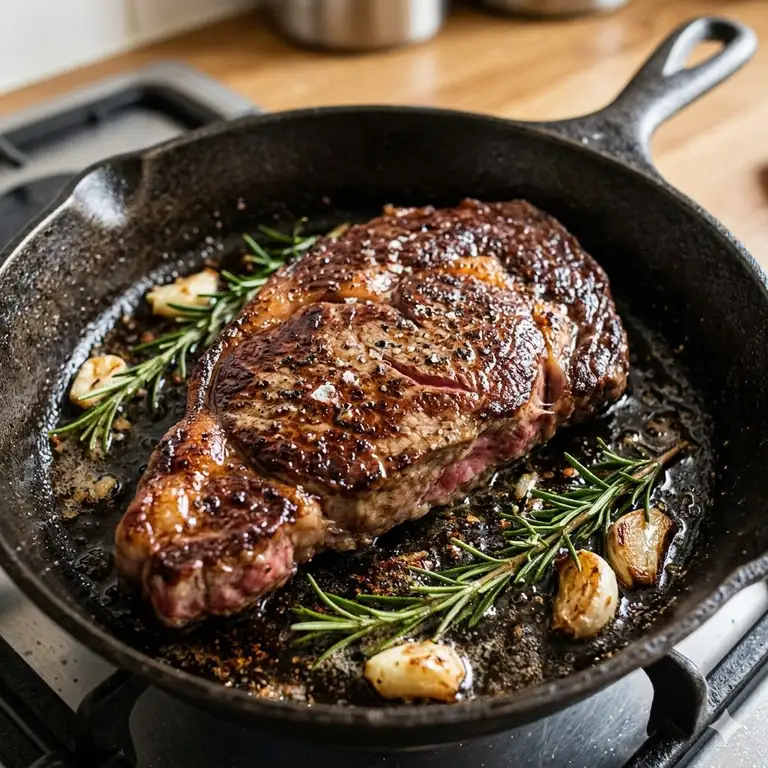
I’ve been there. You’re standing in your kitchen, a beautiful, marbled ribeye in one hand and a heavy, slightly intimidating hunk of black metal in the other. You want that restaurant-quality crust—that dark, salty, umami-rich bark that shatters when you bite into it—but you’re worried about setting off the smoke alarm or, worse, ruining a thirty-dollar piece of meat. Well, I have some good news for you. Learning how to cook steak in cast iron pan step by step is actually one of the most rewarding culinary skills you can master. It’s not just about heat; it’s about the relationship between the iron and the protein.
✨Was this helpful? Spread the word! 🚀
In this guide, I am going to walk you through the entire process. We aren’t just talking about flipping meat; we are diving deep into the physics of heat retention, the chemistry of the Maillard reaction, and the specific tools that make the difference between a grey, boiled-looking slab and a masterpiece. Whether you are using a family heirloom or a brand-new skillet, mastering how to cook steak in cast iron pan step by step will change your Friday nights forever.
Cast Iron vs. Other Pan Types: Why Iron Wins
Before we get into the nitty-gritty of how to cook steak in cast iron pan step by step, let’s look at why your choice of vessel matters. Most people reach for non-stick because it’s easy to clean, or stainless steel because it looks professional. But for a steak? They just don’t have the “thump.”
| Feature | Cast Iron Skillet | Stainless Steel (Tri-Ply) | Non-Stick (Teflon/Ceramic) |
| Heat Retention | Exceptional (High Thermal Mass) | Moderate | Low |
| Searing Capability | Superior (Extreme Crust) | Good | Poor (Cannot handle high heat) |
| Durability | Multi-generational (100+ years) | Very High | Low (2-5 years) |
| Non-Stick Level | High (When Seasoned) | Low (Needs oil/technique) | Excellent (Initially) |
| Oven Safety | Yes (Up to 600°F+) | Yes (Up to 500°F) | Limited (Often < 400°F) |
Top 7 Cast Iron Skillets for Steak: Expert Analysis
If you want to master how to cook steak in cast iron pan step by step, you need the right gear. I have researched the top-performing pans on the market today. These are real products available right now that provide the thermal mass necessary for a perfect sear.
1. Lodge 12 Inch Cast Iron Skillet with Red Silicone Hot Handle Holder (Model: L10SK3ASHH41B)
The absolute gold standard for beginners and pros alike. This pan is a workhorse. It comes pre-seasoned with 100% natural vegetable oil, making it ready to use for your first attempt at how to cook steak in cast iron pan step by step.
-
Technical Specifications:
-
Diameter: 12 inches
-
Weight: 7.89 lbs
-
Material: Seasoned Cast Iron
-
Handle: Integrated with silicone sleeve
-
-
Customer Review Analysis: Users love the “set it and forget it” durability. Common feedback highlights that while the surface is slightly pebbly, it smooths out with use. Some experts recommend a quick stovetop re-seasoning before the first steak.
-
Pros: Extremely affordable, made in the USA, virtually indestructible.
-
Cons: Heavy for some users, factory seasoning can be a bit rough.
2. Le Creuset Enamel Cast Iron Signature Iron Handle Skillet, 11.75 inches (Model: LS2024-3067)
If you want luxury and performance, this is the one. Unlike raw iron, this has a black satin enamel interior that doesn’t require traditional seasoning. It’s perfect for learning how to cook steak in cast iron pan step by step without the maintenance of raw iron.
-
Technical Specifications:
-
Diameter: 11.75 inches
-
Weight: 6.3 lbs
-
Material: Enameled Cast Iron
-
Heat Source: Compatible with all stovetops, including induction.
-
-
Customer Review Analysis: Reviewers rave about the heat distribution and the fact that it is dishwasher safe (though I’d still hand wash it!). It creates a beautiful fond for pan sauces.
-
Pros: No seasoning required, beautiful color options, ergonomic helper handle.
-
Cons: Very expensive, enamel can chip if dropped.
3. Victoria Cast Iron Skillet 12 inch (Model: SKL-212)
A favorite among chefs who prefer a longer handle for better leverage. This Colombian-made pan is famous for its smooth casting and high-quality flaxseed oil seasoning.
-
Technical Specifications:
-
Diameter: 12 inches
-
Weight: 6.7 lbs
-
Handle Length: Extended 13-inch total length
-
Curvature: Precision-poured spouts.
-
-
Customer Review Analysis: Many customers prefer this over Lodge because the longer handle stays cooler for longer. The flaxseed seasoning is noted for being particularly slick.
-
Pros: Great ergonomics, excellent out-of-the-box seasoning, large pour spouts.
-
Cons: Some reports of the seasoning flaking if cleaned too aggressively.
4. Smithey Ironware No. 12 Cast Iron Skillet
This is a premium, artisan skillet. It features a polished interior surface that is as smooth as glass. If you are serious about how to cook steak in cast iron pan step by step, this polished finish makes a massive difference in the crust release.
-
Technical Specifications:
-
Diameter: 12 inches
-
Weight: 8 lbs
-
Finish: Machine-polished interior
-
Origin: Hand-forged in Charleston, SC.
-
-
Customer Review Analysis: Users describe this as “the Ferrari of pans.” The smoothness is unmatched. It’s often cited as an heirloom piece that performs better than vintage pans.
-
Pros: Incredible non-stick performance, stunning aesthetics, deep sides.
-
Cons: Extremely heavy, very high price point.
5. Stargazer 10.5-inch Cast Iron Skillet
A modern take on a classic. The Stargazer features a unique “stay-cool” handle design and a flared rim for drip-free pouring. It’s a great mid-range option for those who want a smoother finish than a Lodge but don’t want to spend $200.
-
Technical Specifications:
-
Diameter: 10.5 inches
-
Weight: 5.2 lbs
-
Finish: Micro-textured surface
-
Handle: Forked “stay-cool” design.
-
-
Customer Review Analysis: People love the weight-to-performance ratio. The handle actually stays cool enough to touch during shorter sears.
-
Pros: Innovative handle, lighter than traditional 12-inch pans, easy to clean.
-
Cons: 10.5 inches can be tight for two large steaks.
6. Field Company No. 8 Cast Iron Skillet
The Field Company focused on making a skillet that mimics the thin, light vintage pans from the early 20th century. It is significantly lighter than a Lodge, making it easier to handle while executing how to cook steak in cast iron pan step by step.
-
Technical Specifications:
-
Diameter: 10.25 inches
-
Weight: 4.5 lbs
-
Surface: Machined smooth
-
Brand: Field Company.
-
-
Customer Review Analysis: Enthusiasts call this the closest thing to a vintage Griswold. It heats up quickly and is very easy on the wrists.
-
Pros: Very lightweight, incredibly smooth, minimalist design.
-
Cons: Thinner walls mean it loses heat slightly faster than heavier pans.
7. Butter Pat Industries Heather Polished Cast Iron Skillet
Butter Pat uses a proprietary casting method that creates a pan with no mechanical smoothing, yet it is thin and smooth. It’s a masterpiece of engineering for the most dedicated steak lovers.
-
Technical Specifications:
-
Diameter: 10 inches
-
Weight: 4.8 lbs
-
Design: Hand-cast, no machining
-
Warranty: 100-year guarantee.
-
-
Customer Review Analysis: Reviews focus on the “soul” of the pan. It’s highly responsive to temperature changes, which is great for precision searing.
-
Pros: Exceptional craftsmanship, thin but retains heat well.
-
Cons: Rarity and high cost make it a luxury item.
✨ Don’t Miss These Exclusive Deals!
🔍 Take your kitchen to the next level with these carefully selected products. Click on any highlighted item to check current pricing and availability. These tools will help you master the art of the perfect steak! ✨
💬 Just one click – help others make better buying decisions too!😊
Comparison: Technical Specifications Matrix
| Product | Interior Finish | Weight | Best For… |
| Lodge 12 Inch | Textured | 7.9 lbs | Budget/Value |
| Le Creuset Signature | Enamel | 6.3 lbs | Ease of Maintenance |
| Victoria 12 Inch | Textured | 6.7 lbs | Ergonomics |
| Smithey No. 12 | Mirror Smooth | 8.0 lbs | Ultimate Sear |
| Stargazer 10.5″ | Micro-Textured | 5.2 lbs | Modern Features |
| Field Co. No. 8 | Machined Smooth | 4.5 lbs | Lightweight Handling |
| Butter Pat Heather | Cast Smooth | 4.8 lbs | Professional Precision |
The Science of the Sear: Why Your Steak Needs Cast Iron
Why are we so obsessed with this specific pan? It comes down to Thermal Mass. When you drop a cold (even room temp) steak into a thin pan, the pan’s temperature plummets. Instead of searing, the steak begins to steam in its own juices. Grey steak is the enemy.
Cast iron, like the Lodge 12 Inch Cast Iron Skillet, acts as a heat battery. It takes a while to charge up, but once it’s hot, it stays hot. This allows for the Maillard Reaction—a chemical reaction between amino acids and reducing sugars that gives browned food its distinctive flavor. According to food science resources like Serious Eats, this reaction only really kicks into high gear above 300°F (150°C).
Table: Benefits of High Thermal Mass in Steak Cooking
| Metric | High Mass (Cast Iron) | Low Mass (Thin Steel/Aluminum) |
| Recovery Time | < 10 seconds | 60-90 seconds |
| Crust Thickness | 1.5-2.5 mm | < 1 mm |
| Juice Retention | High (Fast Sear) | Moderate (Slow Sear leads to drying) |
| Basting Capability | Excellent (Holds butter heat) | Poor (Butter cools too fast) |
How to cook steak in cast iron pan step by step: The Definitive Guide
Alright, let’s get into the actual process. I have broken this down into the specific phases you need to follow to ensure success.
Step 1: Selecting and Preparing the Meat
You can’t cook a great steak if you start with a bad one. For cast iron, I recommend a steak that is at least 1.5-2inches thick. A thin steak will overcook in the middle before the outside gets a crust.
-
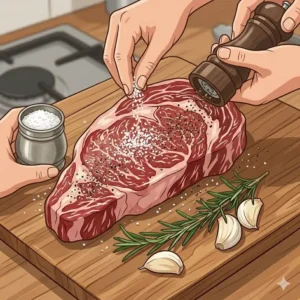
Dry Brining: This is the “secret” step. Salt your steak generously on all sides at least 45 minutes before cooking (or up to 24 hours in the fridge). The salt draws out moisture, dissolves into a brine, and is then reabsorbed, seasoning the meat deeply and breaking down proteins.
-
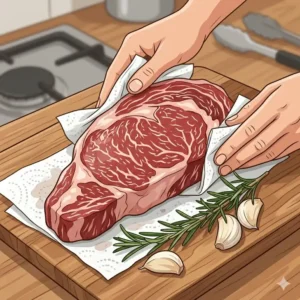
Pat it Dry: Right before cooking, use paper towels to dry the surface. Moisture is the enemy of the sear. If there is water on the surface, it has to evaporate before the Maillard reaction can start.
-
Temper (Optional): While many debate this, I like to let the steak sit out for 30 minutes to take the chill off.
Step 2: Preparing the Pan
Place your Victoria Cast Iron Skillet 12 inch on the burner. Start with medium heat for about 5 minutes. You want to heat it slowly so it expands evenly. Then, crank it to medium-high.
-
The Smoke Point: Use an oil with a high smoke point. Avocado oil, Grapeseed oil, or Beef Tallow are perfect. Do not use butter or extra virgin olive oil yet—they will burn and turn bitter.
-
Testing Heat: When the oil starts to shimmer and just barely sends up a wisp of smoke, you are ready.
Step 3: The Initial Sear
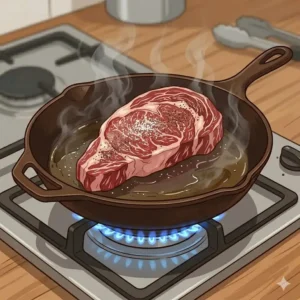
Lay the steak into the pan, laying it away from you to avoid oil splashes.
-
The Sound: You should hear a violent sizzle. If it’s quiet, your pan isn’t hot enough.
-
Don’t Touch: Let it sit for about 2-3 minutes. You want it to develop a dark mahogany color. If it’s sticking, it’s usually not done searing yet. Meat releases naturally once the crust is formed.
Step 4: The Flip and the Butter Baste
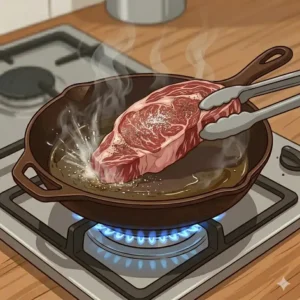
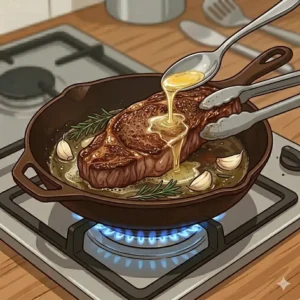
Flip the steak using tongs. Now comes the magic part of how to cook steak in cast iron pan step by step.
-
Add the Aromatics: Toss in 3 tablespoons of unsalted butter, 3 cloves of smashed garlic, and a few sprigs of fresh thyme or rosemary.
-
The Baste: Tilt the pan slightly so the melting butter pools at the bottom with the garlic and herbs. Use a large spoon to continuously pour that hot, flavored butter over the steak. This “top-down” cooking helps create an even crust and adds incredible depth.
Step 5: Checking the Temperature
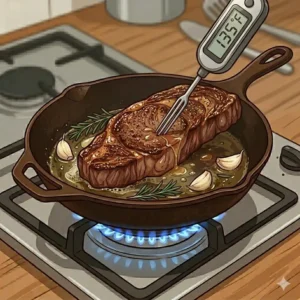
Stop guessing. I use a digital thermometer every single time.
| Desired Doneness | Pull Temp (from pan) | Final Temp (after rest) |
| Rare | 120°F | 125°F |
| Medium-Rare | 130°F | 135°F |
| Medium | 140°F | 145°F |
| Medium-Well | 150°F | 155°F |
| Well Done | 160°F | 165°F |
Step 6: The Rest
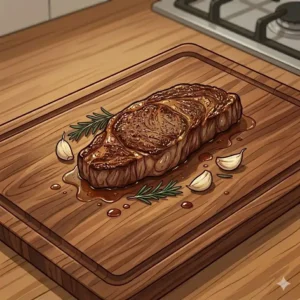
This is the hardest part. Take the steak out of the Smithey Ironware No. 12 and put it on a cutting board or a warm plate. Let it rest for at least 10 minutes.
-
Why? During cooking, the muscle fibers contract and push juices to the center. Resting allows those fibers to relax and reabsorb the juices. If you cut it too soon, all that flavor runs out on the board.
Budget vs. Premium: Finding Your Perfect Pan
You don’t need to spend a fortune to learn how to cook steak in cast iron pan step by step, but there are differences in the experience.
| Feature | Budget ($20-$50) | Premium ($150-$250) |
| Surface Texture | Rough/Sand-like | Polished/Smooth |
| Weight | Often heavier | Optimized weight/balance |
| Cooling Handle | Rarely | Often included in design |
| Seasoning | Basic vegetable oil | Multi-layered flax or organic oils |
| Cooking Result | Equal (with technique) | Slightly better release/easier cleanup |
Troubleshooting Common Steak Mistakes
Even when following a guide on how to cook steak in cast iron pan step by step, things can go sideways. Here is how I fix the most common issues:
-
“My steak is grey and boiled!”
-
Cause: Pan wasn’t hot enough or the steak was wet.
-
Fix: Make sure the oil is shimmering-hot. Use a paper towel to bone-dry the meat.
-
-
“The outside is burnt but the inside is raw!”
-
Cause: Heat was too high or the steak was too thick.
-
Fix: For thick steaks, sear the outside, then move the whole cast iron pan into a 400°F oven to finish the interior.
-
-
“My kitchen is full of smoke!”
-
Cause: Using oil with a low smoke point (like butter or EVOO) too early.
-
Fix: Use Avocado oil for the sear. Only add butter at the very end for basting.
-
Feature Matrix: Essential Tools for the Perfect Steak
| Tool | Importance | Why You Need It |
| Cast Iron Pan | Critical | For the heat retention and sear. |
| Instant-Read Thermometer | Critical | To prevent overcooking. |
| Long Tongs | High | To flip safely without piercing meat. |
| Large Spoon | Medium | For the butter basting process. |
| Coarse Kosher Salt | High | For better crust and even seasoning. |
Maintenance: Caring for Your Cast Iron Skillet
Once you’ve mastered how to cook steak in cast iron pan step by step, you need to treat your pan right so it lasts another hundred years.
-
Cleaning: Don’t be afraid of a little soap. Modern dish soap doesn’t have lye and won’t hurt a seasoned pan. Just don’t soak it in the sink.
-
Drying: This is the most important step. Dry it with a towel, then put it on a warm burner for 2 minutes to evaporate any remaining moisture.
-
Oiling: While the pan is still warm, rub a tiny drop (half a teaspoon) of oil into the surface. Wipe it out until it looks like there’s nothing left. This prevents rust.
For more detailed maintenance, the USDA Food Safety guidelines offer great tips on keeping your cooking surfaces hygienic and safe.
✨ Ready to Start Cooking? 🚀
🔍 Don’t settle for mediocre steak. Equip your kitchen with a professional-grade skillet. Check out our top-rated Lodge and Le Creuset options on Amazon now and see the difference that real cast iron makes. Happy searing! 🥩✨
Conclusion: You are Now a Steak Master
Learning how to cook steak in cast iron pan step by step is a journey. My first few tries weren’t perfect—I once smoked out my entire apartment building—but once you understand how the iron holds heat, it becomes second nature. Remember: dry the meat, heat the pan until it’s shimmering, sear with high-heat oil, and finish with a luxurious butter baste.
Whether you choose a classic Lodge or a high-end Smithey, the pan is simply the tool. Your patience and technique are what create the meal. Now, go get a thick-cut ribeye and put these steps into practice!
FAQs
✅ You should use oils with a high smoke point, such as avocado oil, grapeseed oil, or canola oil. These can handle the 400-500°F temperatures required for a proper sear without burning or becoming bitter...
✅ For steaks thicker than 1.5 inches, an oven finish is recommended. After searing both sides on the stovetop, place the pan in a 400°F oven for 4-7 minutes until the internal temperature reaches your desired doneness...
✅ No, do not use butter for the initial sear because its milk solids burn at low temperatures. Instead, add butter, garlic, and herbs during the last 2 minutes of cooking to perform a butter baste for flavor...
✅ Flip the steak once it releases naturally from the pan surface, usually after 2.5-3 minutes. If the meat feels like it is sticking, the crust hasn't fully formed yet; give it another 30 seconds before trying again...
✅ Yes, wash it with warm water and a small amount of mild dish soap. Avoid steel wool; use a chainmail scrubber or stiff brush. Most importantly, dry the pan immediately on a warm burner to prevent any rust... ❓ What is the best oil for cooking steak in a cast iron pan?
❓ Do I need to put the cast iron pan in the oven for steak?
❓ Can I use butter to sear my steak in cast iron?
❓ How do I know when to flip the steak in the pan?
❓ Should I wash my cast iron pan after cooking steak?
Recommended for You:
- How to Season a Stainless Steel Pan Properly: 7 Easy Steps for a Perfect Non-Stick Finish
- How to use stainless steel pan without sticking: 7 Pro Secrets!
- Induction Freestanding Ranges: 7 Best Power Picks for 2026 Kitchens
Disclaimer: This article contains affiliate links. If you purchase products through these links, we may earn a small commission at no additional cost to you.
✨ Found this helpful? Share it with your friends! 💬🤗