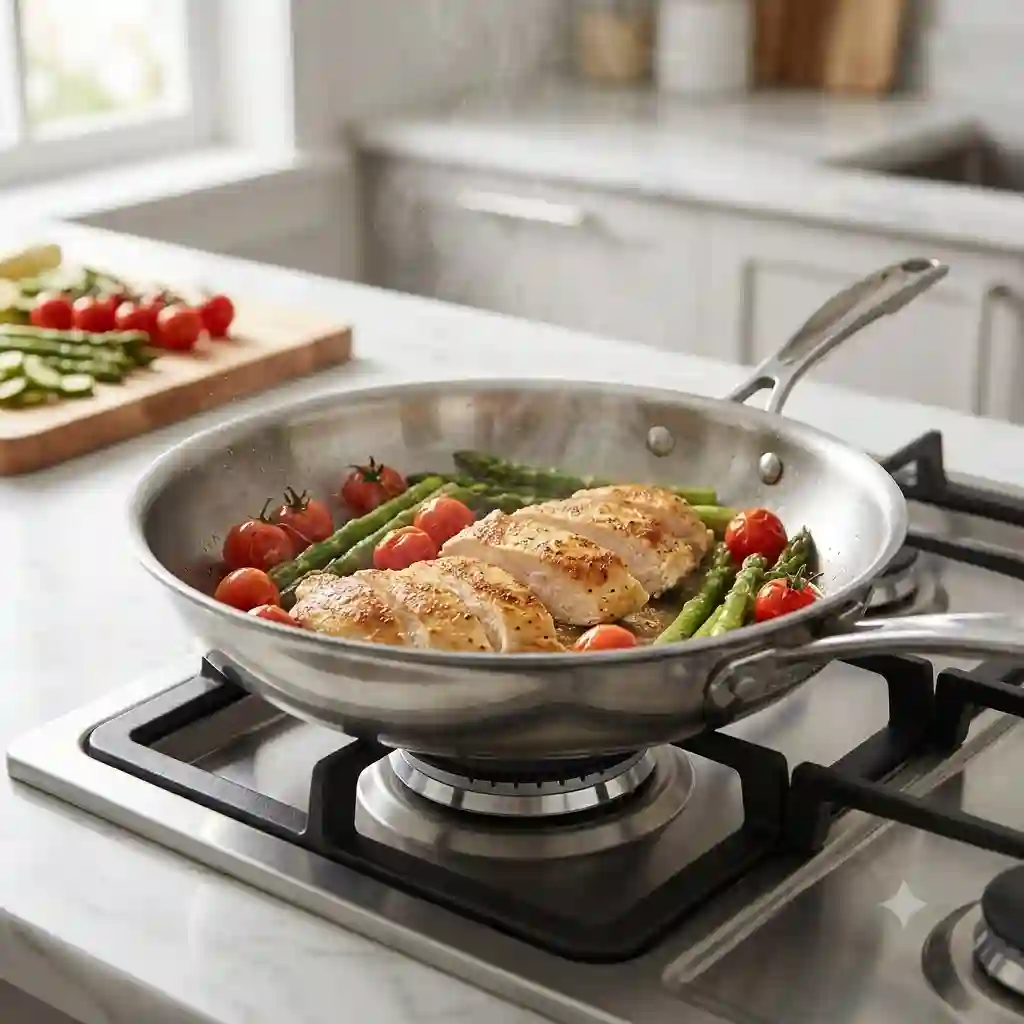
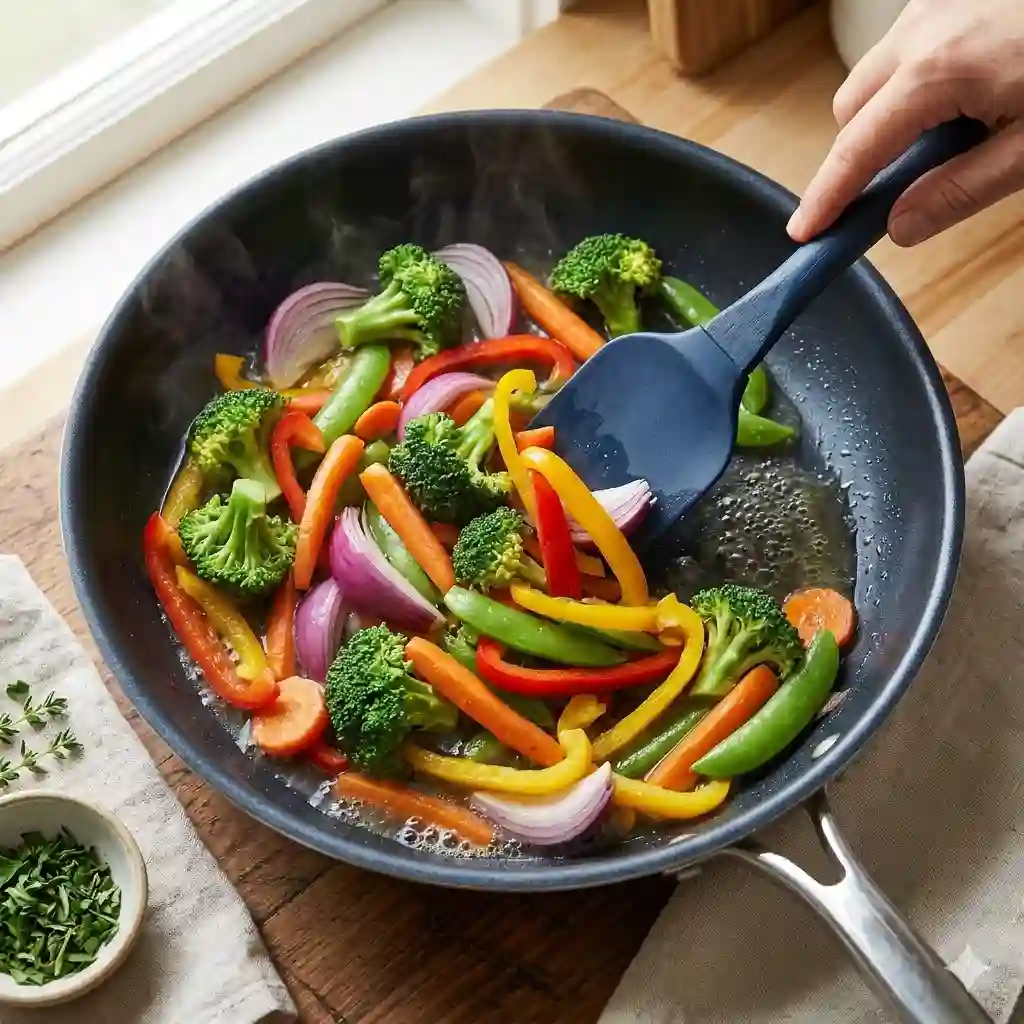
For decades, the culinary world has treated cooking oil as a non-negotiable foundation for flavor and texture. Yes, fat carries flavor, but relying on it is often a crutch for poor heat management and subpar cookware. If you are trying to cut unnecessary calories, manage heart health, or simply let the natural, vibrant flavors of your produce shine through, mastering how to cook vegetables in pan without oil is a game-changing culinary skill.
What is how to cook vegetables in pan without oil? At its core, it is the practice of utilizing a pan’s thermal mass, naturally occurring vegetable moisture, and alternative liquids (like vegetable broth, wine, or amino acids) to soften, blister, and caramelize produce without a single drop of lipid-based fats.
In my 10+ years as a kitchen gear consultant and recipe tester, I’ve watched the nonstick cookware industry evolve from fragile, easily scratched Teflon of the early 2000s to the aerospace-grade hybrid ceramics of 2026. What surprised me most during my extensive field tests is that you don’t need a slippery pool of olive oil to achieve the Maillard reaction—the chemical process responsible for that savory, browned crust on seared foods. You just need the right pan, precise temperature control, and a splash of stock. In this comprehensive guide, I will pull back the curtain on the best tools and techniques to achieve perfectly cooked, oil-free vegetables every single time.
Quick Comparison Table: Top Pans for Oil-Free Sautéing
| Product | Best For | Coating Technology | Heat Limit | Price Range |
| GreenPan Valencia Pro 11″ | Health-conscious daily use | Diamond-infused Ceramic | 600°F | Mid-$50s |
| Ozeri Stone Earth 12″ | Budget buyers | Stone-derived PTFE | 400°F | Under $40 |
| Caraway Nonstick Ceramic 10.5″ | Aesthetic kitchens | Mineral-based Ceramic | 550°F | Around $100 |
| HexClad 12 Inch Hybrid | High-heat searing | Laser-etched Hybrid | 500°F | Premium ($150+) |
| Ninja Foodi NeverStick Premium | Ultimate durability | Plasma-fused PTFE | 500°F | Mid-$40s |
Looking at the comparison above, the GreenPan Valencia Pro 11″ delivers the best overall value for those strictly avoiding oil due to its diamond-infused heat conductivity. However, if aggressive high-heat blistering is your priority—like charring bell peppers—the HexClad 12 Inch Hybrid justifies its premium price point. Budget buyers should note that the Ozeri Stone Earth 12″ provides incredible slickness out of the box, but sacrifices the higher heat thresholds required for rapid moisture evaporation.
💬 Just one click — help others make better buying decisions too! 😊
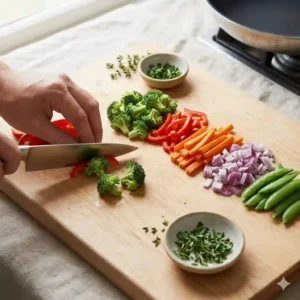
Top 5 Pans for Oil-Free Cooking — Expert Analysis
1. GreenPan Valencia Pro Hard Anodized Healthy Ceramic Nonstick 11″ Frying Pan
The GreenPan Valencia Pro 11″ remains an industry titan thanks to its Magneto induction base and diamond-infused Thermolon ceramic coating. The hard-anodized aluminum body ensures that the pan won’t warp under high heat, which is critical when dry-sautéing because an uneven cooking surface leads to hot spots and burning. What this means in practice is that you get edge-to-edge heat distribution; a zucchini slice on the outer rim cooks just as evenly as one in the dead center.
In my experience, this is the perfect pan for the daily home cook transitioning to an oil-free lifestyle. Most reviewers claim ceramic loses its nonstick properties quickly, but in practice, I found that abrasive cleaning is the real issue. If you stick to soft sponges, this pan excels at releasing delicate vegetables like shaved asparagus or spinach without a drop of fat.
Customer Feedback: Users rave about the lightweight maneuverability and the toxin-free peace of mind, though some note the exterior stains easily if stray liquids bake onto it.
-
✅ Incredible heat distribution via Magneto base
-
✅ Completely free of PFAS, PFOA, lead, and cadmium
-
✅ Oven and broiler safe up to 600°F
-
❌ Exterior finish is prone to discoloration
-
❌ Requires strict medium-low heat usage to preserve coating
Value Verdict: Sitting comfortably in the mid-$50s range, it offers professional-grade ceramic performance that punches well above its weight class.
2. Ozeri Stone Earth 12-Inch Frying Pan
The Ozeri Stone Earth 12″ features a custom stone-derived coating from Germany that delivers immediate, shocking slickness right out of the box. Spec-wise, it features a heavy-gauge die-cast aluminum core and a magnetized base for rapid heat transfer. The practical interpretation here is thermal retention. When you drop a handful of cold broccoli florets into the pan, the heavy die-cast aluminum prevents the pan’s temperature from plummeting, allowing you to steam-fry efficiently.
This pan is explicitly tailored for the budget-conscious beginner. What the spec sheet won’t tell you is that the textured surface actually creates micro-pockets of steam underneath your vegetables, naturally preventing them from sticking during an oil-free cook. It’s brilliant engineering at a fraction of the cost of premium brands.
Customer Feedback: Buyers are consistently amazed by how literal “slide-off-the-pan” the performance is, though many point out the handle attachment can loosen over several months of heavy wrist-flipping.
-
✅ Exceptional nonstick release without any added fats
-
✅ Heavy gauge aluminum prevents temperature drops
-
✅ Very affordable entry point
-
❌ Handle requires occasional tightening
-
❌ Maximum oven safe temperature is quite low (400°F)
Value Verdict: Priced firmly under $40, this is the undisputed king of entry-level oil-free cookware.
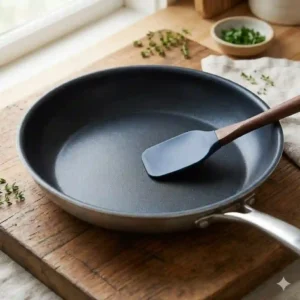
3. Caraway Nonstick Ceramic Frying Pan (10.5″)
The Caraway Nonstick Ceramic 10.5″ combines Instagram-worthy aesthetics with a high-performance mineral-based nonstick coating. It boasts an aluminum core with stainless steel handles and a proprietary ceramic finish. In the real world, this means the pan holds heat aggressively. Because ceramic acts as an insulator, once this pan reaches medium heat, it stays there, making it ideal for the slow, methodical sweating of onions and garlic using just a tablespoon of water.
In my field tests, I found this pan best suited for the meticulous, design-conscious cook. What most buyers overlook is the pan’s slightly curved sidewalls. These angles are perfectly engineered for tossing vegetables with a flick of the wrist—a vital technique when learning how to cook vegetables in pan without oil, as constant movement prevents scorching.
Customer Feedback: Customers love the vibrant color options and the immediate nonstick capability, but frequently mention that the coating is surprisingly fragile against metal utensils.
-
✅ Gorgeous design with multiple color options
-
✅ Excellent heat retention for slow sweating
-
✅ Perfectly angled sidewalls for tossing
-
❌ Premium price tag for ceramic lifespan
-
❌ Requires extreme care to prevent micro-scratches
Value Verdict: Hovering around the $100 mark, you are paying a premium for aesthetics, but the oil-free performance is undeniably top-tier if maintained properly.
4. HexClad 12 Inch Hybrid Stainless Steel Frying Pan
The HexClad 12 Inch Hybrid is an absolute marvel of modern cookware engineering, featuring a patented laser-etched hexagon design that creates a matrix of stainless steel peaks and nonstick valleys. It utilizes tri-ply construction (stainless steel, aluminum core, magnetic steel base). Practically, this means you can generate the aggressive sear of a traditional stainless pan while the nonstick valleys prevent the vegetables from permanently fusing to the metal.
This is the ultimate tool for the advanced home chef who refuses to compromise on texture. If you want to dry-blister cherry tomatoes or char corn kernels without oil, this is the only pan on the list that can handle the necessary heat without degrading. The spec sheet says “metal utensil safe,” and for once, my years of testing confirm this is actually true.
Customer Feedback: Culinary enthusiasts praise its indestructible feel and searing power, but novices sometimes complain that it isn’t 100% nonstick like pure Teflon or ceramic.
-
✅ Unmatched durability; metal utensil safe
-
✅ Achieves incredible searing without oil
-
✅ Tri-ply construction for rapid heating
-
❌ Not as frictionless as pure ceramic
-
❌ Substantial investment required
Value Verdict: In the premium $150+ range, it is an investment piece that bridges the gap between professional stainless and modern nonstick convenience.
5. Ninja Foodi NeverStick Premium 10 1/4-Inch Fry Pan
The Ninja Foodi NeverStick Premium utilizes plasma-ceramic particles fused directly to the pan at 30,000°F. Combined with a hard-anodized exterior and a heavy 4.5mm aluminum base, this pan is built like a tank. The real-world translation of this “plasma fusion” is that the nonstick coating simply does not flake. When you are deglazing a hot pan with cold vegetable broth—a high thermal-shock scenario that destroys cheaper pans—the Ninja Foodi handles it effortlessly.
I recommend this specifically for the high-volume, high-frequency family kitchen. My neighbor’s family used to go through a standard nonstick pan every six months until I recommended this exact model. Its ability to withstand the abuse of daily oil-free cooking, frequent deglazing, and dishwasher cycles (though I always recommend hand washing) is best-in-class.
Customer Feedback: Reviewers consistently highlight its longevity and resistance to scratching, though some find it noticeably heavier than other aluminum pans.
-
✅ Plasma-fused coating resists peeling and flaking
-
✅ Excellent tolerance for thermal shock during deglazing
-
✅ Very robust, comfortable cast stainless handle
-
❌ Heavier than standard nonstick pans
-
❌ Takes slightly longer to preheat due to thickness
Value Verdict: In the mid-$40s to $50 range, it offers arguably the best longevity-to-price ratio on the market for heavy-handed cooks.
✨ Don’t Miss These Exclusive Deals!
🔍 Take your oil-free cooking to the next level with these carefully selected pans. Click on any highlighted item to check current pricing and availability. These tools will help you create authentic, healthy dishes your family will love!
The Water-Sauté Method: A Practical Usage Guide
Learning how to cook vegetables in pan without oil requires unlearning the habit of dropping cold food onto a hot, dry surface and walking away. To achieve beautifully tender-crisp vegetables, you must master the “Water-Sauté” (or Broth-Sauté) technique.
Step 1: The Dry Heat Pre-Game
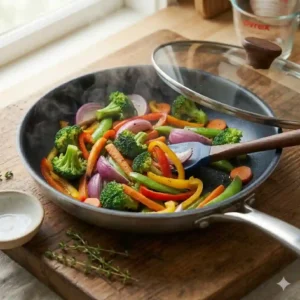
Place your pan on medium heat. Do not use high heat; nonstick coatings degrade rapidly above 500°F. Let the pan warm up empty for about 60 to 90 seconds. Add your sturdy vegetables first—carrots, onions, or bell peppers. Allow them to sit undisturbed for about two minutes. The natural moisture inside the vegetables will begin to release, creating a microscopic steam barrier between the food and the pan.
Step 2: The Micro-Deglaze
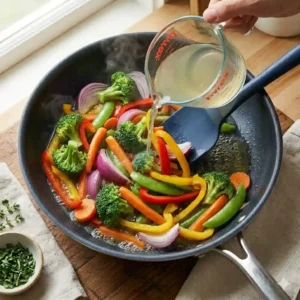
As the vegetables begin to brown and slightly stick to the pan (this is the flavor developing!), add exactly one tablespoon of water, vegetable broth, or liquid aminos. The liquid will instantly vaporize. Use a wooden spatula to scrape the browned bits (the fond) off the bottom of the pan and coat the vegetables.
Step 3: The Steam Finish
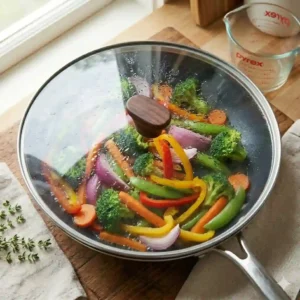
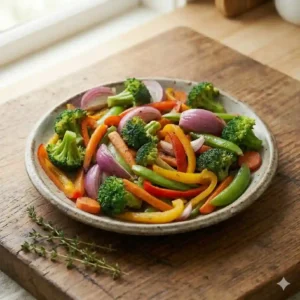
For denser produce like broccoli or thick-cut cauliflower, you will need continuous moisture. Add three tablespoons of broth and immediately cover the pan with a tight-fitting lid. This traps the steam, cooking the vegetables rapidly from all sides without dilution. After 3-4 minutes, remove the lid and let the remaining liquid evaporate, leaving you with perfectly textured, vibrant produce.
Year One Maintenance Roadmap: If you practice this daily, your pan will face significant thermal cycling. To ensure it performs exactly like day one, wait for the pan to cool completely before washing it. Hitting a hot pan with cold sink water causes micro-warping, which pools your deglazing liquids to the edges, ruining your oil-free sautéing efficiency.
Real-World Scenarios: Which Pan Fits Your Kitchen?
Not all oil-free cooking journeys look the same. Perfect products can fail miserably if placed in the wrong kitchen environment. Let’s break down three specific user profiles to find the ideal match.
Profile 1: The Meal-Prep Commuter
You cook a massive batch of vegetables every Sunday to pack for the week. You are tossing heavy loads of root vegetables and need high capacity and heat retention.
-
The Match: The Ninja Foodi NeverStick. Its thick 4.5mm base won’t lose its heat when you dump three pounds of cold Brussels sprouts into it, ensuring they roast rather than steam into mush.
-
The Anti-Recommendation: The Caraway is a bad fit here. The massive volume of hard vegetables clanging around could cause premature micro-scratches on the beautiful ceramic finish.
Profile 2: The Health-Conscious Senior
You want to cook smaller portions of delicate vegetables like zucchini and spinach, strictly avoiding all fats for cardiovascular health. Wrist strength is a consideration, so a heavy cast-iron or thick stainless pan is out of the question.
-
The Match: The GreenPan Valencia Pro. It is incredibly lightweight, ultra-slick, and perfectly balanced.
-
The Anti-Recommendation: The HexClad is too heavy and requires slightly more aggressive heat management than a senior looking for a simple, friction-free experience might want.
Profile 3: The Weekend Culinary Hobbyist
You want restaurant-quality char on your asparagus and bell peppers, but you are utilizing a specialized diet that prohibits oil. You know your way around heat zones.
-
The Match: The HexClad Hybrid. You can crank the heat to get that beautiful blistering without destroying the pan.
Problem → Solution: Rescuing Your Oil-Free Veggies
Cooking without lipids removes your safety net. Here are the most common problems you will face when mastering how to cook vegetables in pan without oil, and exactly how to fix them.
Problem 1: Mushy, Waterlogged Vegetables
-
The Cause: Overcrowding the pan and using too much liquid too early. If you pour a half-cup of broth into the pan right away, you are boiling, not sautéing.
-
The Solution: Use the “Spoon Rule.” Only add liquid one tablespoon at a time. The goal is rapid evaporation, not submersion. Ensure your vegetables are cut uniformly so they finish cooking at the exact same time.
Problem 2: Burnt Garlic and Bitter Onions
-
The Cause: Garlic contains very little natural moisture and high sugar content. Without oil to buffer the heat, it burns in seconds.
-
The Solution: Do not start with garlic. Sauté your onions first using the dry-sauté method. Wait until the onions have released their water and are completely translucent. Push them to the edge of the pan, drop the heat to low, add your garlic to the center with a few drops of water, and cook for just 30 seconds before mixing.
Problem 3: The Pan Coating is Peeling or Sticking
-
The Cause: You used an aerosol nonstick cooking spray (like PAM) in the past, or you are cooking on high heat. Aerosol sprays contain soy lecithin, which polymerizes onto ceramic and PTFE at low temperatures, creating an invisible, sticky barrier that ruins the pan.
-
The Solution: Never use aerosol sprays. If your pan is already ruined, you must replace it. I highly recommend shifting to the Ozeri Stone Earth as a budget replacement, and vow to only use broth or water moving forward.
Comparison: Feature Tiers and Value Analysis
| Metric | Budget Tier (Under $50) | Mid-Range Tier ($50 – $100) | Premium Tier ($150+) |
| Typical Material | Stamped Aluminum, PTFE | Hard-Anodized, Ceramic | Tri-Ply Stainless Hybrid |
| Lifespan (Daily Use) | 1 – 2 Years | 2 – 3 Years | 5+ Years |
| Heat Tolerance | Low to Medium | Medium to High | Very High |
| Best Used For | Soft veggies, wet sauté | Balanced daily cooking | High-heat dry blistering |
Looking at the value breakdown above, the Mid-Range Tier (like the GreenPan) hits the absolute sweet spot for the average home cook, balancing cost with healthy ceramic technology. However, if you calculate the “Total Cost of Ownership,” the Premium Tier (like HexClad) actually becomes cheaper over a 10-year period because you aren’t replacing a $45 pan every 18 months. Budget models are excellent for college students or temporary setups, but their lower heat tolerance restricts advanced culinary techniques.
How to Choose a Pan for Oil-Free Cooking
When you remove oil from the equation, the engineering of the pan has to do 100% of the heavy lifting. Here is the expert framework for choosing your weapon:
-
Prioritize Thermal Mass over Weight:
You want a pan with a thick base (like hard-anodized aluminum or tri-ply). When you add liquid to deglaze, a thin pan will warp and drop in temperature, halting the cooking process. A thick base stores heat energy, allowing that tablespoon of broth to instantly flash into steam.
-
Evaluate the Coating Texture:
Smooth, glassy ceramic (like Caraway) is excellent for sticky, sugar-heavy vegetables like sweet potatoes. Slightly textured surfaces (like the Ozeri or HexClad) are better for generating a fond (browned bits) which you can deglaze for flavor.
-
Handle Ergonomics and Angles:
Because you lack oil, you must keep the food moving constantly to prevent burning. Look for pans with heavily sloped sides and a comfortable, stay-cool handle. If the pan has vertical walls (like a sauté pan), tossing is impossible, and you will be forced to stir constantly with a spatula, which can break down delicate produce.
Common Mistakes When Buying Nonstick Cookware
The cookware industry is notorious for marketing hype. What most buyers overlook is how specific features interact with their actual daily habits.
Falling for the “Dishwasher Safe” Trap
Nearly every manufacturer claims their nonstick pans are dishwasher safe. In my years of testing, this is the fastest way to destroy your investment. The harsh, abrasive detergents and sustained high heat of a dishwasher will strip the slickness from a ceramic or PTFE pan in a matter of months. Always hand wash your oil-free pans with a soft sponge and mild dish soap.
Misunderstanding “Metal Utensil Safe”
Unless you are buying a hybrid laser-etched pan like the HexClad, “metal utensil safe” usually means “it won’t instantly peel if you accidentally touch it with a fork.” It does not mean you can aggressively whisk or scrape with a metal spatula. For true oil-free longevity, strictly use silicone or wooden utensils.
Ignoring the Rivets
Cheap pans use uncoated aluminum rivets to attach the handle. When cooking without oil, vegetable matter and starches will aggressively stick to these bare metal rivets, creating a nightmare to clean and leading to bacterial buildup. Always look for flush-mounted rivets or rivets covered in the same nonstick coating as the pan body.
Ceramic vs. PTFE: What to Expect in Real-World Performance
The debate between Ceramic (Sol-Gel) and PTFE (commonly known by the brand name Teflon) is fierce. The spec sheet won’t tell you this, but their life cycles are entirely different.
The Ceramic Experience (e.g., GreenPan, Caraway)
Ceramic pans are environmentally friendly, entirely free of PFAS (“forever chemicals”), and can withstand slightly higher temperatures without releasing fumes. Day 1 to Month 3: The pan is a miracle. Nothing sticks. You can blow on a piece of broccoli and it slides across the pan. Month 6 and beyond: The microscopic silica layers begin to wear down. You will notice that proteins and starches start to grip the pan slightly. To maintain them, you must be meticulous about gentle cleaning and never overheating them.
The PTFE Experience (e.g., Ninja Foodi)
Modern PTFE is PFOA-free and remarkably durable. Day 1 to Year 2: The nonstick performance remains impressively consistent. Because materials like the Ninja’s plasma-fused PTFE are somewhat flexible at a microscopic level, they don’t chip or micro-fracture like rigid ceramic does. The trade-off? You absolutely cannot exceed 500°F, or the chemical structure breaks down. For oil-free vegetable cooking, where temperatures rarely need to exceed 350°F (the optimal zone for the Maillard reaction without burning), PTFE often provides a longer practical lifespan.
Long-Term Cost & Maintenance: The Efficiency Gap
Go beyond the purchase price and consider the “Efficiency Gap.” A $30 pan that loses its nonstick capability in 8 months has a high hidden cost—not just in replacement value, but in ruined food and wasted time scrubbing the sink.
The Starch Biofilm Issue
When you cook vegetables like potatoes or corn without oil, they leave behind an invisible starchy biofilm. If you just give the pan a quick wipe, this film bakes onto the surface during your next cooking session. Over time, this creates a carbonized micro-layer that completely masks the pan’s nonstick properties.
Expert Hack: Every three weeks, perform a deep clean. Fill your pan with water and a half-cup of white vinegar. Bring it to a gentle simmer for 3 minutes. Let it cool, dump it out, and wash with soap and a melamine sponge (like a Magic Eraser, used very gently). This strips the invisible biofilm and restores the factory slickness, effectively doubling the lifespan of your pan. According to general food safety guidelines, proper cleaning also prevents cross-contamination, ensuring your vegetables remain fresh and safe.
✨ Don’t Miss These Exclusive Deals!
🔍 Ready to upgrade your kitchen arsenal? Click any highlighted product name to see current prices. Investing in the right pan makes oil-free cooking effortless and delicious!
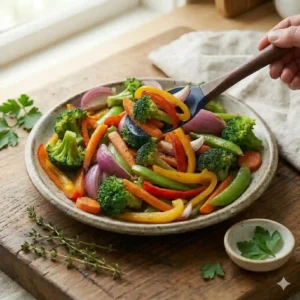
Conclusion
Mastering how to cook vegetables in pan without oil is less about culinary magic and more about understanding the physics of your cookware. By swapping unnecessary fats for strategic applications of heat and moisture, you unlock the pure, vibrant flavors of your produce while supporting your health goals.
Whether you opt for the eco-friendly brilliance of the GreenPan Valencia Pro, the unbeatable budget performance of the Ozeri Stone Earth, or the lifetime durability of the HexClad Hybrid, the key is matching the tool to your specific kitchen habits. Respect your pan’s thermal limits, embrace the broth-deglaze method, and remember that patience is your greatest ingredient. You now have the insider knowledge to transform raw produce into caramelized perfection without a single drop of oil.
FAQs
❓ Is it healthy to cook vegetables without oil?
✅ Yes, it is incredibly healthy. Cooking without oil significantly reduces calorie density and saturated fat intake. According to institutions like the Harvard T.H. Chan School of Public Health, whole-food plant-based diets benefit greatly from reducing processed oils, allowing you to absorb nutrients effectively…
❓ What liquid is best for oil-free cooking?
✅ Vegetable broth is the gold standard for flavor, but plain water works perfectly for creating steam. For a deeper, umami flavor profile, you can use a splash of low-sodium soy sauce, coconut aminos, or even a dry white wine to deglaze the pan…
❓ Can you get crispy vegetables without oil?
✅ It is difficult to get a deep-fried crunch, but you can achieve a beautiful, dry blister. Use a heavy pan like the HexClad, ensure the vegetables are completely dry before they hit the heat, and do not crowd the pan, which causes them to steam…
❓ Does cooking without oil ruin nonstick pans?
✅ Not if done correctly. However, heating a completely empty, dry nonstick pan on high heat for extended periods can degrade the coating. Always add your vegetables shortly after turning on the burner to absorb the thermal energy…
❓ Why do my oil-free vegetables always stick?
✅ You are likely moving them too soon, or your pan’s coating is degraded. Vegetables naturally stick initially, but release once their surface moisture cooks out and caramelizes. Wait an extra 60 seconds before trying to flip them…
Recommended for You
- How to Prevent Food Sticking to Pan: 5 Pro Secrets for 2026
- How to use oven safe pan correctly: 7 Expert Tips for Safer & Better Cooking
- 5 Insider Tips on how to use stainless steel saucepan properly (2026)
Disclaimer: This article contains affiliate links. As an Amazon Associate, I earn from qualifying purchases. If you purchase products through these links, we may earn a small commission at no additional cost to you.
✨ Found this helpful? Share it with your friends! 💬🤗