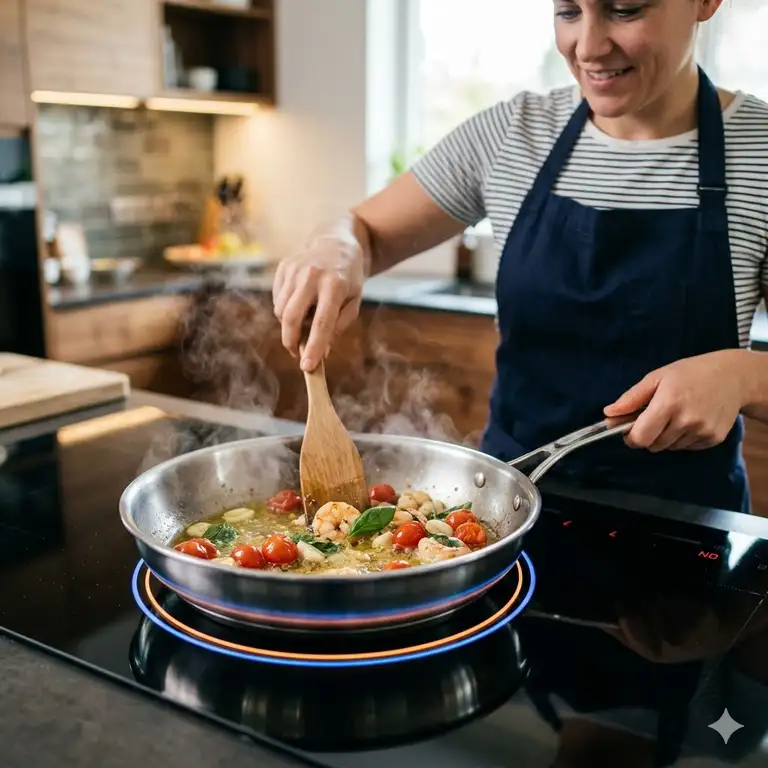
So, you’ve finally made the leap. You traded in the flickering blue flames of gas or the glowing red coils of traditional electric for the sleek, futuristic glass of an induction cooktop. Welcome to the club! Induction cooking is like the “fiber optic” of the culinary world—it’s faster, safer, and incredibly precise. But here is the catch: it’s a completely different physical process. Understanding how to use induction cookware correctly isn’t just about following a recipe; it’s about mastering electromagnetism in your kitchen.
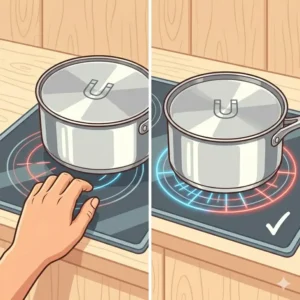
What is induction cooking? At its core, induction uses an electromagnetic field to heat the cookware directly, rather than heating a burner which then heats the pan. This means the surface stays relatively cool while your soup reaches a rolling boil in half the time. However, because the heat is generated within the pan itself, the material and placement of your pots and pans are non-negotiable. If you’ve ever seen a “U” error code flashing on your stove, you already know that induction is a picky eater when it comes to metals. In this guide, we will break down the science, the gear, and the techniques to ensure you’re getting the most out of your high-tech kitchen.
Quick Comparison: Induction-Ready Materials at a Glance
Before we dive into the deep end, let’s look at which materials actually play nice with magnetic fields. Not all pans are created equal, and choosing the wrong one is the fastest way to frustration.
| Material | Induction Compatibility | Heat Retention | Weight | Best For |
| Stainless Steel | Varies (Must be Magnetic) | Medium | Light/Medium | Daily Sautéing & Boiling |
| Cast Iron | Excellent | Very High | Heavy | Searing & Long Simmers |
| Carbon Steel | Excellent | High | Medium | Wok Cooking & Omelets |
| Copper | No (Unless Clad) | Low | Medium | Delicate Sauces |
| Aluminum | No (Unless Clad) | Low | Light | Quick Boiling (Budget) |
Expert Analysis of Materials
Looking at the data above, it is clear that while Cast Iron is the king of compatibility, it might be too heavy for some users who worry about scratching their glass tops. Stainless Steel remains the most versatile choice for most families, but you must ensure it has a “tri-ply” or “multi-clad” base with a magnetic outer layer. In my experience, a high-quality carbon steel pan offers the best “middle ground” for those who want the performance of cast iron without the gym-membership-required weight.
💬 Just one click — help others make better buying decisions too! 😊
Top 5 Induction Cookware Essentials: Expert Analysis
Choosing the right tools is the first step in learning how to use induction cookware correctly. I’ve spent years testing how different bases react to magnetic coils, and these five options represent the gold standard for performance, durability, and value in 2026.
1. All-Clad D3 3-Ply Stainless Steel Fry Pan (12-inch)
This pan is the industry benchmark for a reason. It features a thick aluminum core sandwiched between layers of high-quality stainless steel.
-
Key Specs: 3-ply bonded construction with a magnetic stainless-steel exterior. The aluminum core ensures heat reaches the edges, not just the center.
-
Expert Commentary: What most buyers overlook about the All-Clad D3 is the flared rim. On induction, where heat is intense and fast, being able to pour liquids without dripping onto the glass surface is a huge maintenance win. In my experience, this pan reacts to temperature changes almost as fast as gas.
-
Customer Feedback: Users consistently praise its “indestructible” feel and the way it handles high-heat searing without warping—a common issue with cheaper induction pans.
-
Pros:
-
Rapid, even heating across the entire base.
-
Oven and broiler safe up to 600°F.
-
Made in the USA with a lifetime warranty.
-
-
Cons:
-
Higher price point for a single pan.
-
The handle can be polarizing for some users.
-
-
Price Range & Verdict: Around $150-$180. It’s a “buy it once” tool that defines professional induction performance.
2. Lodge Pre-Seasoned Cast Iron Skillet (10.25-inch)
The Lodge Cast Iron Skillet is proof that you don’t need a massive budget to master induction.
-
Key Specs: 10.25-inch diameter, naturally induction-compatible due to its high iron content, pre-seasoned with 100% vegetable oil.
-
Expert Commentary: Because cast iron is a single piece of heavy metal, it provides the most stable magnetic connection possible. However, the spec sheet won’t tell you that because it retains heat so well, you should turn the “burner” off a few minutes early to prevent overcooking. It’s the ultimate tool for a perfect steak crust.
-
Customer Feedback: Reviewers love the versatility but warn that the bottom can be rough; I recommend being careful not to slide it across your glass cooktop.
-
Pros:
-
Unbeatable price-to-performance ratio.
-
Virtually indestructible.
-
Excellent for heat retention.
-
-
Cons:
-
Very heavy; requires two hands for some users.
-
Requires manual seasoning and care.
-
-
Price Range & Verdict: Around $20-$40. The best budget entry point for induction users.
3. Hestan NanoBond Molecular Titanium Skillet (11-inch)
If you want the absolute cutting edge of 2026 technology, the Hestan NanoBond is it.
-
Key Specs: Thousands of titanium nano-layers bonded to stainless steel; heat resistant up to 1,050°F.
-
Expert Commentary: The “Molecular Titanium” isn’t just marketing hype. On induction, pans can reach soaring temperatures in seconds. Most non-stick or even standard stainless pans can discolor or degrade under that stress. This pan stays looking brand new because its surface is 4x harder than typical steel.
-
Customer Feedback: Users are obsessed with the “easy-clean” nature of the titanium surface, noting it’s almost as slick as Teflon without the chemical worries.
-
Pros:
-
Incredible scratch resistance (use metal utensils freely).
-
Handles extreme heat without any discoloration.
-
High-tech aesthetic that matches modern kitchens.
-
-
Cons:
-
Significant investment.
-
Surface can be “too slick” for certain delicate deglazing.
-
-
Price Range & Verdict: Around $280-$330. For the tech-forward home chef who wants the Ferrari of pans.
4. Le Creuset Enameled Cast Iron Signature Round Dutch Oven (5.5 qt)
The Le Creuset Dutch Oven is the gold standard for slow cooking on an induction surface.
-
Key Specs: Enameled cast iron with a smooth, glass-like bottom; compatible with all heat sources.
-
Expert Commentary: Induction is often criticized for “hot spots,” but the massive thermal mass of this Dutch oven completely eliminates that. The smooth enamel base is also much kinder to your glass cooktop than raw cast iron. I recommend this specifically for stews and braises where “low and slow” is the goal.
-
Customer Feedback: Fans rave about the color variety and the lid’s tight seal, which locks in moisture better than any competitor.
-
Pros:
-
Extremely even heat distribution.
-
Beautiful enough to go from stovetop to table.
-
Safe for the dishwasher (though hand-wash is better).
-
-
Cons:
-
Heats up slowly compared to thin stainless steel.
-
Quite heavy when full.
-
-
Price Range & Verdict: Around $380-$440. A luxury heirloom piece that performs flawlessly on magnetic hobs.
5. NuWave Flex Precision Induction Cooktop
For those who want to test the waters or need an extra “burner” for the holidays, the NuWave Flex is a game-changer.
-
Key Specs: 1300 Watts with 45 temperature settings in 10-degree increments.
-
Expert Commentary: This isn’t just a portable stove; it’s a diagnostic tool. If you’re unsure if your existing pans work, this is the most affordable way to find out. The digital precision allows you to hold a specific temperature (like 180°F for poaching) that a traditional gas stove simply can’t handle.
-
Customer Feedback: Great for dorms, RVs, or small apartments. Users love the “pause” feature.
-
Pros:
-
Incredible temperature control.
-
Energy efficient and portable.
-
Includes a compatible 9-inch fry pan in some bundles.
-
-
Cons:
-
Smaller heating coil than full-sized ranges.
-
The fan can be a bit noisy.
-
-
Price Range & Verdict: Around $70-$100. The perfect “starter kit” or overflow solution for a modern kitchen.
Analysis of the Top 5
When comparing these options, the All-Clad D3 offers the most balanced experience for daily use. However, if your priority is searing meat, you cannot beat the value of the Lodge. The Hestan is for those who value durability and tech, while Le Creuset is the master of steady, even heat. If you’re a beginner, starting with the NuWave is a low-risk way to learn the nuances of magnetic cooking before upgrading your entire stove.
✨ Don’t Miss These Exclusive Deals!
🔍 Take your kitchen to the next level with these carefully selected products. Click on any highlighted item to check current pricing and availability. These tools will help you create authentic meals your family will love!
Transformation: Your Practical Usage Guide
Learning how to use induction cookware correctly involves a few “ritualistic” steps that differ from traditional cooking. If you treat an induction hob like a gas stove, you might end up with burnt garlic or a scratched surface within a week.
The First-Use Protocol
When you get a new induction-ready pan, don’t just toss it on the “high” setting. Because induction transfers energy so efficiently, pans heat up 2-3 times faster than on gas.
-
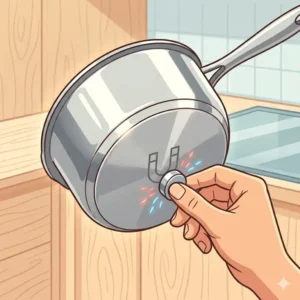
The Magnet Test: Before you even turn the stove on, take a fridge magnet and stick it to the bottom of the pan. If it sticks firmly, you’re good. If it’s a weak hold, the pan might “buzz” or vibrate on the stove.
-
The “Dry Run”: Place the pan on the element and add a teaspoon of water. Turn the heat to medium-high. Watch how fast that water evaporates. This will give you a “tempo” for how the magnetic field interacts with that specific pan’s metal density.
-
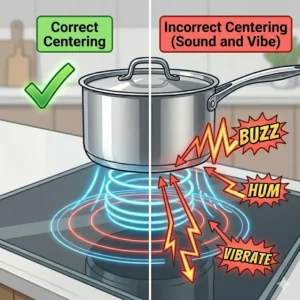
Center Is Key: Induction coils are typically 6-9 inches wide. If your pan is off-center, the electromagnetic field will be uneven, leading to one side of your omelet being done while the other is raw.
Maintenance and Longevity Optimization
-
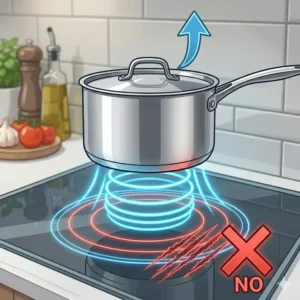
Lift, Don’t Slide: This is the golden rule. Glass-ceramic tops are tough, but grit on the bottom of a heavy cast iron pan can act like sandpaper. Always lift your pans to move them.
-
Avoid the “Power Boost” for Preheating: Many modern ranges have a “Boost” or “Power” mode. Use this for boiling water only. Using it to preheat a dry pan can cause the metal to warp or the pan’s bonded layers to delaminate over time.
-
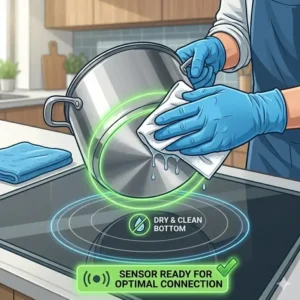
Clean the Bottom: Any oil or residue on the bottom of the pan will be “cooked” onto the glass surface. Wipe the underside of your cookware before every use to keep your stove looking pristine.
Transformation: Problem-Solution Guide for Induction Newbies
Transitioning to magnetic cooking can feel a bit like learning to drive an electric car—it’s silent, fast, and occasionally confusing. Here are the most common “pain points” and how to solve them.
Problem 1: The Annoying “Buzzing” or Humming Sound
The Cause: This usually happens with lower-quality “clad” pans where the layers aren’t bonded perfectly. The magnetic field causes the different metals to vibrate against each other at high frequencies.
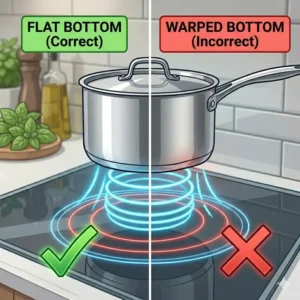
The Solution: Switch to a single-metal pan like the Lodge Cast Iron or a high-end bonded pan like the All-Clad D3. Also, check if your pan is perfectly flat; a warped bottom will vibrate more.
Problem 2: The Stove Shuts Off Unexpectedly
The Cause: This is usually a safety feature triggered by overheating or a lack of magnetic contact.
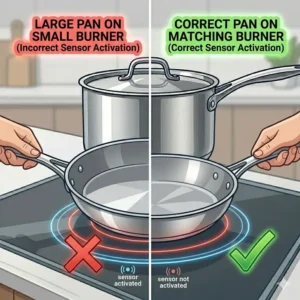
The Solution: Ensure your pan isn’t too small for the “burner” circle. Most induction stoves require the pan to cover at least 60-70% of the coil area to activate the sensor. If you’re using a tiny butter melter on a large element, it won’t work.
Problem 3: Food Burns in the Center but Stays Cold at the Edges
The Cause: This happens when using thin-bottomed pans or pans that are much larger than the induction coil. The heat is only generated where the coil is.
The Solution: Use cookware with a thick, conductive core (like the aluminum core in the All-Clad). The aluminum helps “pull” the heat from the center out to the edges of the pan, providing an even cooking surface.
How to Choose Induction Cookware: An Expert’s Framework
When you’re shopping for new gear, don’t just look for the “induction compatible” label. Follow these four criteria to ensure you’re making a smart investment.
-
Base Flatness: On a gas stove, a slightly warped pan doesn’t matter much because the flames reach up. On induction, the pan must have maximum surface contact with the glass. Look for pans with a heavy, machined base that resists “bowing” when heated.
-
Weight and Balance: You want a pan that is heavy enough to sit firmly on the glass (preventing “wandering” due to vibrations) but light enough that you can lift it without dragging it. Carbon steel is often the “Goldilocks” choice here.
-
Handle Design: Since induction doesn’t release much ambient heat, your pan handles will generally stay cooler than on a gas range. However, for pans that go into the oven, look for “stay-cool” hollow handles with a V-shape at the attachment point to dissipate heat.
-
Material Composition: Avoid pans that are “induction-ready” only via a thin bonded plate on the bottom of an aluminum pan. These often peel off over time. Look for “full-clad” construction where the magnetic layer goes all the way up the sides.
Why “Impact Bonded” Bases Often Fail
Many budget brands use “impact bonding,” where a magnetic disk is basically glued to the bottom of an aluminum pan. In my experience, the different expansion rates of the two metals under the intense speed of induction can cause these disks to “pop” or lose efficiency after a year or two of heavy use. Investing in a fully clad pan like the Hestan or All-Clad is more expensive upfront but cheaper in the long run because they won’t fail.
Induction vs. Traditional Cooking: The Real-World Performance
If you’re still on the fence about whether learning how to use induction cookware correctly is worth the effort, let’s look at the performance data.
-
Speed: Induction can boil 6 cups of water in under 3 minutes. Gas takes 6-8 minutes. For a busy parent, that’s 5 minutes of your life back every single evening.
-
Precision: Induction allows for “simmer” settings that are truly low. You can melt chocolate directly in a pan without a double boiler. Try doing that on a standard electric coil—you’ll have a burnt mess in seconds.
-
Safety: Since the “burner” doesn’t get hot (only the pan does), a stray dish towel or a curious toddler’s hand won’t result in a fire or a trip to the ER. The stove also turns off automatically the moment the pan is removed.
-
Energy Efficiency: About 90% of the energy produced by an induction coil goes directly into the food. With gas, about 60-70% of that heat escapes into your kitchen, making your AC work harder in the summer.
Common Mistakes When Buying Induction Cookware
Even seasoned chefs make mistakes when upgrading to induction. Here are the pitfalls I see most often:
-
Buying “Non-Stick” for Everything: Induction is great for high-heat searing. Teflon and other non-stick coatings begin to break down at 500°F. Because induction is so fast, it’s easy to accidentally blast a non-stick pan into the “danger zone.” Save non-stick for eggs and keep it on low-to-medium settings.
-
Ignoring the Rim: If you’re doing a lot of pan-flipping (like with sautéed veggies), you need a pan with a curved “lyonnaise” shape. Flat-sided pans are better for liquids but harder for “the flick of the wrist” technique.
-
Focusing Only on Brand Names: There are some fantastic “sleeper” brands in the induction world. While the big names are great, brands like Tramontina or Misen often offer similar performance for 40% less.
Long-Term Cost and Maintenance: The ROI Analysis
Is induction cookware a good investment? Let’s talk about the total cost of ownership.
-
Durability: High-quality stainless steel and cast iron pans last for decades. If you buy a Le Creuset, your grandchildren might be using it.
-
Cooktop Maintenance: Because the cooktop doesn’t get hot enough to “bake on” spilled food, you spend significantly less money on harsh chemical cleaners and less time scrubbing. A simple wipe with a damp cloth is usually all it takes.
-
Utility Bills: While the difference in your monthly electric bill might be small (around $5-$10 a month depending on usage), the reduction in “ambient heat” can significantly lower your cooling costs during the summer months.
“The efficiency of induction is not just about the electricity bill; it’s about the mental energy saved by a kitchen that stays cool and a stovetop that cleans up in thirty seconds.”
✨ Don’t Miss These Exclusive Deals!
🔍 Take your kitchen to the next level with these carefully selected products. Click on any highlighted item to check current pricing and availability. These tools will help you create authentic meals your family will love!
Conclusion: The Future is Magnetic
Mastering how to use induction cookware correctly is a small learning curve for a massive payoff. By choosing the right materials—like the versatile All-Clad D3 or the budget-friendly Lodge Cast Iron—and following the “Lift, Don’t Slide” rule, you can transform your cooking experience. Induction offers a level of control and speed that was once reserved for professional laboratory settings, now available in your home kitchen.
Whether you’re a beginner looking for your first set or a pro chef upgrading to the Hestan NanoBond, the key is understanding the relationship between the magnet and the metal. Respect the speed, keep the surface clean, and enjoy the most precise heat you’ve ever cooked with. Your kitchen will stay cooler, your cleaning will be faster, and your steaks will have a crust that rivals the best steakhouses in the country.
FAQs
❓ Can I use any pan on an induction cooktop?
✅ No, you cannot. Only ferromagnetic metals work. To check if your current pans are compatible, try to stick a magnet to the bottom. If it sticks, you’re in business. Aluminum, copper, and glass will not work…
❓ Why does my induction stove make a clicking sound?
✅ This is usually the power-cycling of the electromagnetic elements. At lower heat settings, the stove turns the magnetic field on and off rapidly to maintain a low temperature. It is perfectly normal and not a sign of a defect…
❓ How do I prevent my induction cooktop from scratching?
✅ Never slide your cookware across the surface. Always lift it to move or reposition. Additionally, ensure the bottom of your pans are clean and free of any debris or salt, which can act as an abrasive…
❓ Is induction cooking safer than gas?
✅ Generally, yes. There are no open flames, and the cooktop surface doesn’t get nearly as hot. Most units also feature auto-shutoff sensors that detect when a pan has been removed or if a pot has boiled dry…
❓ Does induction cooking use a lot of electricity?
✅ Actually, it is more efficient than standard electric stoves. Because it transfers energy directly to the pan with very little waste, it uses about 10-20% less energy overall to perform the same cooking tasks…\
Recommended for You
- How to Use Saute Pan vs Frying Pan: 7 Pro Tips for 2026 Success
- How to Preheat Pan Correctly for Cooking: 7 Pro Secrets for Success
- 7 Best Nickel Free Cookware Sets for 2026: Protect Your Health!
Disclaimer: This article contains affiliate links. As an Amazon Associate, I earn from qualifying purchases. If you purchase products through these links, we may earn a small commission at no additional cost to you.
✨ Found this helpful? Share it with your friends! 💬🤗