I have been there. You just bought a shiny, expensive skillet, dreaming of that perfect golden-brown sear you see on cooking shows. You drop a piece of chicken in, and instead of a sizzle, you get a hostage situation. The chicken refuses to let go, and you end up eating shredded poultry bits and scrubbing the pan for an hour. It is a rite of passage for every home cook, but I am here to tell you it doesn’t have to be this way. Learning how to use stainless steel pan without sticking is less about “magic” and more about understanding the simple physics of heat and fat.
✨Was this helpful? Spread the word! 🚀
Stainless steel is the workhorse of the professional kitchen for a reason. It is durable, non-reactive, and produces the best “fond” (those tasty browned bits) for sauces. However, unlike Teflon, it is not inherently slippery. If you’ve been struggling with how to use a stainless steel pan without sticking, the problem usually isn’t the pan—it is the timing. By the end of this deep dive, you will be searing scallops like a Michelin-starred chef.
Stainless Steel vs. The World: Quick Comparison
Before we get into the “how,” let’s look at why you’d even want to bother with stainless steel compared to other options like non-stick or cast iron.
| Feature | Stainless Steel | Non-Stick (PTFE/Ceramic) | Cast Iron |
| Durability | High (Lifetime) | Low (2-5 years) | Very High (Generational) |
| Heat Retention | Moderate to High | Low | Extreme |
| Ease of Use | Moderate Curve | Very Easy | Moderate (Seasoning) |
| Searing Ability | Excellent | Poor | Excellent |
| Dishwasher Safe | Mostly Yes | Rarely | Absolutely Not |
| Chemical Free | Yes | Sometimes | Yes |
Top 7 Stainless Steel Pans for 2026: Expert Analysis
If you want to master how to use stainless steel pans without sticking, you need a pan that distributes heat evenly. Cheap, thin-bottomed pans create “hot spots” that cause food to burn and stick regardless of your technique. Here are the best performers currently available on Amazon.
1. All-Clad D3 Stainless 3-Ply Bonded Fry Pan (12-Inch)
The All-Clad D3 Stainless 3-Ply Bonded Fry Pan (12-Inch) is the industry benchmark. It features a classic tri-ply construction with an aluminum core sandwiched between high-quality stainless steel.
-
Technical Specifications: 3-ply bonded construction, 18/10 stainless steel cooking surface, riveted stainless steel handle, oven and broiler safe up to 600°F.
-
Customer Review Analysis: Users consistently praise its “indestructibility.” Some note the handle shape takes time to get used to, but the heat distribution is unparalleled.
-
Pros: Exceptional heat consistency, Made in the USA, lifetime warranty.
-
Cons: Expensive, handle can be uncomfortable for some.
2. Heritage Steel 12-inch Fry Pan (Titanium Strengthened)
The Heritage Steel 12-inch Fry Pan (Titanium Strengthened) is a hidden gem for those who want a “slicker” stainless experience. The 316Ti surface is more resistant to salt pitting and corrosion.
-
Technical Specifications: 5-ply construction, 316Ti titanium-strengthened stainless steel, stay-cool ergonomic handle.
-
Customer Review Analysis: Professional chefs love the ergonomic handle and the fact that it feels slightly more non-reactive than standard 304 steel.
-
Pros: Superior corrosion resistance, very comfortable handle.
-
Cons: Heavier than 3-ply models.
3. Made In Cookware 12-inch Stainless Clad Frying Pan
The Made In Cookware 12-inch Stainless Clad Frying Pan has taken the internet by storm. It offers professional-grade quality at a more accessible price point by selling directly to consumers.
-
Technical Specifications: 5-ply construction, Italian-made, oven safe up to 800°F, stay-cool handle.
-
Customer Review Analysis: Reviewers highlight the rapid heat-up time and the sleek aesthetic. Many transition from non-stick to this model successfully.
-
Pros: High heat tolerance, excellent weight balance.
-
Cons: Sells out frequently on Amazon.
4. Tramontina Gourmet 12-inch 3-Ply Clad Fry Pan
If you are looking for how to use stainless steel pan without sticking on a budget, the Tramontina Gourmet 12-inch 3-Ply Clad Fry Pan is your best bet. It mimics the All-Clad design at a fraction of the cost.
-
Technical Specifications: 18/10 stainless steel, tri-ply clad, NSF-certified, compatible with induction.
-
Customer Review Analysis: Often cited as the “best value” pan. Users report it performs 90% as well as premium brands.
-
Pros: Incredible value, solid performance.
-
Cons: Slightly thinner walls than premium options.
5. Cuisinart MCP22-30HN MultiClad Pro Stainless 12-Inch Skillet
The Cuisinart MCP22-30HN MultiClad Pro Stainless 12-Inch Skillet features “Heat Surround” technology, ensuring the sides of the pan are as hot as the bottom.
-
Technical Specifications: Triple-ply construction, brushed stainless exterior, tapered rims for drip-free pouring.
-
Customer Review Analysis: Users appreciate the pouring lip and the balanced weight. It is a favorite for large families.
-
Pros: Drip-free pouring, very durable.
-
Cons: Exterior can discolor if overheated.
6. Hestan ProBond Professional Clad Stainless Steel Skillet
The Hestan ProBond Professional Clad Stainless Steel Skillet is for the tech-obsessed cook. It features a triple-bonded construction with a unique “Cold Forged” base.
-
Technical Specifications: 18/10 stainless steel, 35% better heat conductivity than typical clad, flush rivets.
-
Customer Review Analysis: Customers rave about the flush rivets (no gunk buildup!) and the faster sear times.
-
Pros: Flush rivets for easy cleaning, beautiful design.
-
Cons: Very high price point.
7. Le Creuset Tri-Ply Clad Stainless Steel Fry Pan (12-Inch)
While famous for Dutch ovens, the Le Creuset Tri-Ply Clad Stainless Steel Fry Pan (12-Inch) is a top-tier skillet with a laser-etched capacity marking.
-
Technical Specifications: 3-ply construction, surgical grade stainless steel, stay-cool ergonomic loop handle.
-
Customer Review Analysis: Users love the “prestige” feel and the surprisingly good weight-to-performance ratio.
-
Pros: Beautiful finish, very easy to clean.
-
Cons: You pay a premium for the brand name.
✨ Don’t Miss These Exclusive Deals!
🔍 Take your kitchen to the next level with these carefully selected products. Click on any highlighted item to check current pricing and availability. These tools will help you master every recipe with confidence! 💎
💬 Just one click – help others make better buying decisions too! 😊
🔍 Technical Specifications Matrix: Top 7 Skillets
| Product Name | Construction | Max Temp | Origin | Main Feature |
| All-Clad D3 | 3-Ply | 600°F | USA | Classic Reliability |
| Heritage Steel | 5-Ply (316Ti) | 800°F | USA | Titanium Surface |
| Made In | 5-Ply | 800°F | Italy | Professional Grade |
| Tramontina | 3-Ply | 500°F | Brazil | Best Value |
| Cuisinart Pro | 3-Ply | 550°F | China | Drip-Free Pouring |
| Hestan ProBond | 3-Ply (Forged) | 600°F | Italy | Flush Rivets |
| Le Creuset | 3-Ply | 500°F | Portugal | Ergonomic Grip |
The Science of Sticking: Why It Happens
To understand how to use stainless steel pan without sticking, we have to talk about physics. Stainless steel, at a microscopic level, is actually quite porous. When you heat the pan, these pores expand. If you put cold food into a cold pan, the food sinks into these expanding pores and gets gripped by the metal. This is essentially a mechanical bond.
Furthermore, proteins (like those in meat or eggs) can form chemical bonds with the metal atoms. This is why meat seems to “glue” itself to the pan initially. To prevent this, we use the Leidenfrost Effect. This occurs when a liquid comes into contact with a surface significantly hotter than its boiling point, creating an insulating layer of vapor that keeps the liquid (and the food) hovering above the surface.
Performance Metrics Comparison
| Method | Stick Resistance | Heat Control Difficulty | Flavor Development (Fond) |
| Cold Pan Start | 0/10 | Easy | Low |
| Medium Heat + Oil | 7/10 | Moderate | High |
| Leidenfrost Method | 9.5/10 | High | Extreme |
| Overheating | 2/10 | Hard | Burnt |
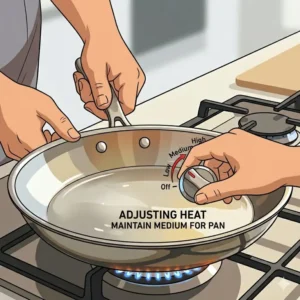
Step-by-Step: how to use stainless steel pan without sticking
Now, let’s get into the nitty-gritty. This is the process I use every single day. If you follow these steps, you will solve the mystery of using stainless steel pan without sticking forever.
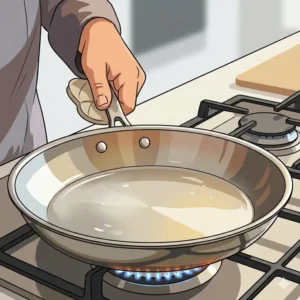
Step 1: The Proper Preheat
Patience is your best friend. Place your pan on a medium burner. Do not crank it to high! High heat will burn the oil before the pan is ready. Let it sit for about 2 to 3 minutes. Notably, the heat needs time to distribute through the aluminum core of a pan like the All-Clad D3.
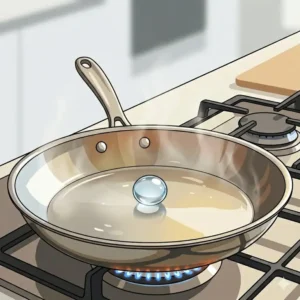
Step 2: The Water Drop Test
This is the secret weapon for how to use stainless steel pans without sticking. Take a half-teaspoon of water and flick it onto the pan.
-
If it sizzles and evaporates: The pan is too cold.
-
If it breaks into many small beads: You are getting closer, but not there yet.
-
If it forms one single bead that “skates” around like a hockey puck: Success! This is the Leidenfrost effect in action.
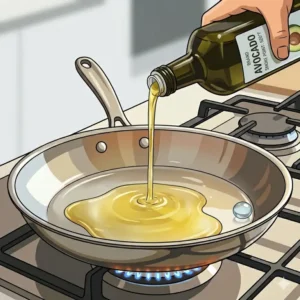
Step 3: Add the Fat
Once you see that water bead skating, wipe the water out and add your oil or butter. You want an oil with a high smoke point, such as avocado oil or grapeseed oil. You will notice the oil “shimmers” almost instantly. This means it is ready.
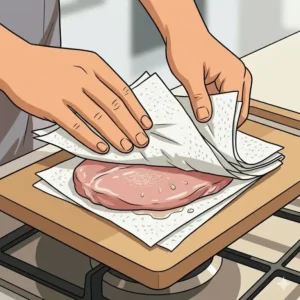
Step 4: The “Cold Food” Rule
If you take a steak directly from a $38°F$ refrigerator and drop it into the pan, you will drop the pan’s temperature instantly. This breaks the Leidenfrost vapor barrier and causes sticking. I always suggest letting your protein sit at room temperature for 15-20 minutes before cooking.
Step 5: Don’t Touch It!
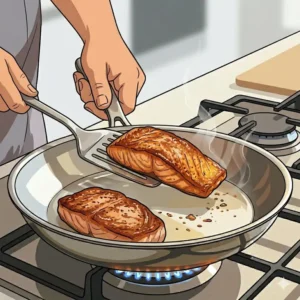
This is where most people fail at stainless steel pan how to use without sticking. When you first put the food in, it will stick. This is normal! As the proteins cook and brown (the Maillard reaction), they will naturally release from the pan. If you try to flip it and it resists, wait another 30 seconds. It will tell you when it is ready.
User Compatibility: Which Pan Fits Your Style?
| User Type | Recommended Pan | Why? |
| The Beginner | Tramontina Gourmet | Low risk, high reward. If you ruin it, you aren’t out $200. |
| The Pro Home Cook | Made In Skillet | Extremely responsive to heat changes. |
| The Aesthetic Cook | Le Creuset Tri-Ply | Looks stunning on an open shelf and performs brilliantly. |
| The Health Conscious | Heritage Steel | Titanium-strengthened surface is the most inert metal available. |
| The ‘Buy Once’ Guy | All-Clad D3 | It will literally outlive you. |
Common Variations and Shorthand: Tips for All Scenarios
Sometimes you might search for how to use stanless steel pan without sticking (don’t worry, we know what you meant!) or even how to use stainless steel pan without stickin. Regardless of how you spell it, the principles remain the same. Even for a 12ft pan (if such a giant thing existed!), the heat physics would be identical.
Using Stainless Steel for Eggs
Eggs are the “final boss” of stainless steel. To manage how to use stainless steel pan without sticking 2026 style for eggs:
-
Heat the pan to the water-drop stage.
-
Add oil, then a small pat of butter for flavor.
-
Wait for the butter foam to subside.
-
Drop the eggs in and reduce heat slightly.
-
Wait for the edges to set before moving.
Benefits Quantification: Why Switch from Non-Stick?
| Metric | Stainless Steel | Non-Stick |
| Lifespan (Years) | 50+ | 3 |
| Cost per Year | $3.00 | $15.00 |
| Max Temperature | 600°F-800°F | 450°F (Danger Zone) |
| Flavor/Sear Score | 10/10 | 4/10 |
Maintenance: Keeping the “Non-Stick” Surface
A dirty pan is a sticky pan. If you have “polymerized oil” (those brown sticky spots) on your Cuisinart MCP22-30HN, food will stick to those spots every time.
-
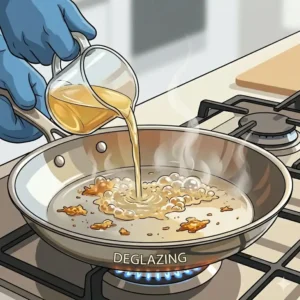
Deglazing: While the pan is still hot, pour in some water or wine to lift the bits.
-
Bar Keepers Friend: This is the “holy grail” cleaning product. It uses oxalic acid to remove mineral deposits and burnt oil without scratching the steel.
-
Avoid Steel Wool: Unless absolutely necessary, use a nylon scrubbie to keep the surface smooth.
Requirements Analysis for Success
-
Pan Quality: Clad construction (aluminum core).
-
Heat Source: Consistent gas or induction is best.
-
Fat: High smoke point oils ($>400°F$).
-
Patience: 3-5 minutes of prep time.
Outbound Resources for the Curious Cook
-
Learn about the Leidenfrost Effect on Wikipedia to see the physics in action.
-
Check the USDA Guidelines on Food Safety for internal temperature marks.
-
Read about the Maillard Reaction to understand why your food tastes better on steel.
✨ Master Your Kitchen Today!
🔍 Ready to stop tearing your food apart? Choosing the right tool is half the battle. Whether you go with the Hestan ProBond or the classic All-Clad, your future self will thank you. Click the links above to find the perfect addition to your culinary arsenal! 🍳
Conclusion
Learning how to use stainless steel pan without sticking is a fundamental skill that elevates your cooking from “making food” to “culinary art.” It requires a shift in mindset: you aren’t just heating a container; you are managing a thermodynamic environment. By preheating properly, using the water drop test, and having the patience to let the Maillard reaction do its work, you unlock the full potential of your Made In Cookware or Tramontina pans.
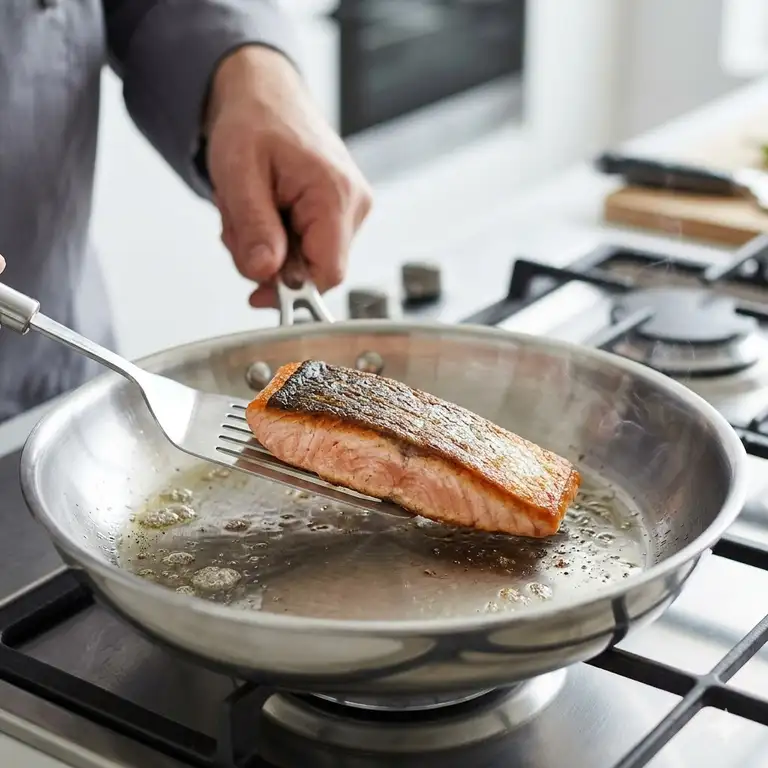
Remember, the goal isn’t just to prevent sticking—it is to create flavor. That golden crust on your steak or the crispy skin on your salmon is only possible because of the unique properties of stainless steel. So, take a deep breath, grab your All-Clad, and try that water test. You’ve got this!
FAQs
✅ Sticking occurs because the pan is either too cold or too hot. If the pan isn't preheated to the Leidenfrost point, the food's proteins bond with the metal's pores. Ensure you do the water drop test before adding oil...
✅ It is not recommended. Aerosol sprays contain lecithin, which leaves a gummy residue that burns at low temperatures. This residue creates a sticky film that is very difficult to remove and actually causes more food to stick over time...
✅ While you can temporarily season it by heating oil until it smokes, it isn't permanent. Stainless steel is designed to be used without a seasoned layer. Proper heat control and the Leidenfrost effect are more effective than attempting to season...
✅ Use Bar Keepers Friend and a soft sponge. For heavy burns, boil a mixture of water and vinegar in the pan for 10-15 minutes to loosen the debris. Avoid using heavy-duty steel wool, as it can create deep scratches...
✅ High smoke point oils like avocado, grapeseed, or refined coconut oil are ideal. These oils can withstand the high temperatures required for the Leidenfrost effect without breaking down or creating acrid flavors and sticky residues on your cookware surface... ❓ Why does everything stick to my stainless steel pan even with oil?
❓ Can you use PAM or aerosol sprays on stainless steel?
❓ Is it possible to 'season' a stainless steel pan like cast iron?
❓ How do I get burnt food off without ruining the finish?
❓ Which oil is best for cooking with stainless steel?
Recommended for You:
- 7 Best stainless steel sauce pan with lids for 2026 Professional Chefs
- Detachable Handle Pan Set: 7 Best Space-Saving Wonders for Your Kitchen!
- 7 Best Rice Cooker Without Nonstick Models for 2026: Expert Review
Disclaimer: This article contains affiliate links. If you purchase products through these links, we may earn a small commission at no additional cost to you.
✨ Found this helpful? Share it with your friends! 💬🤗