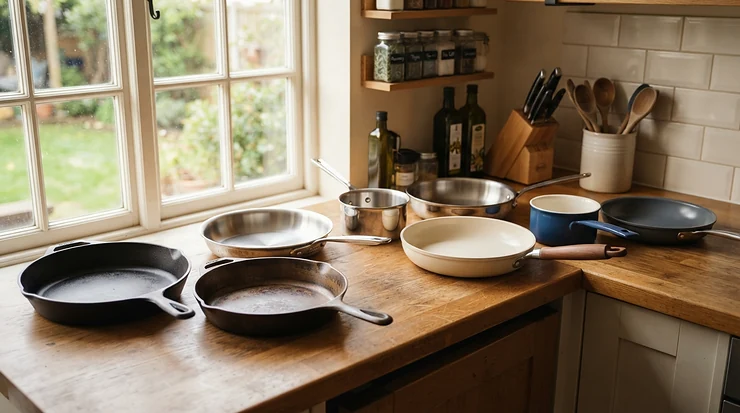
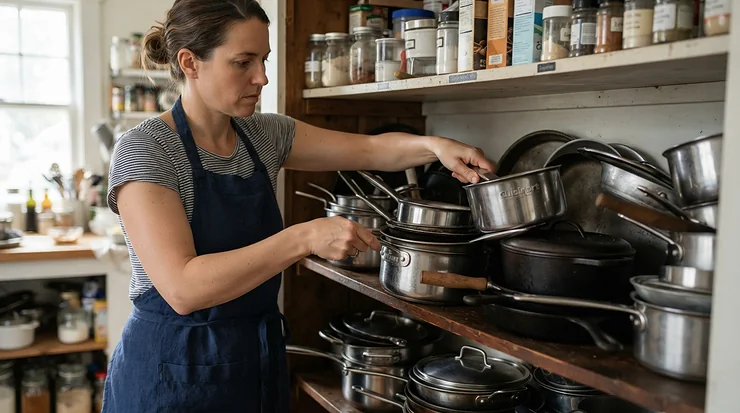
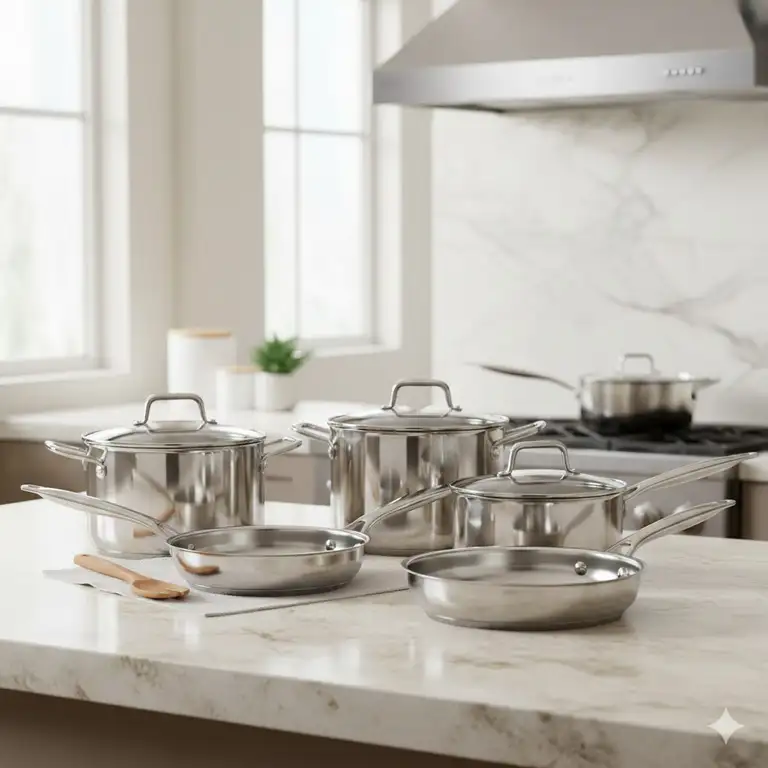
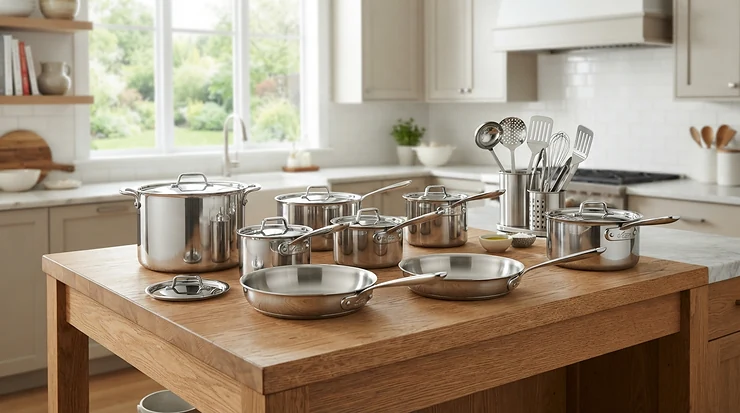
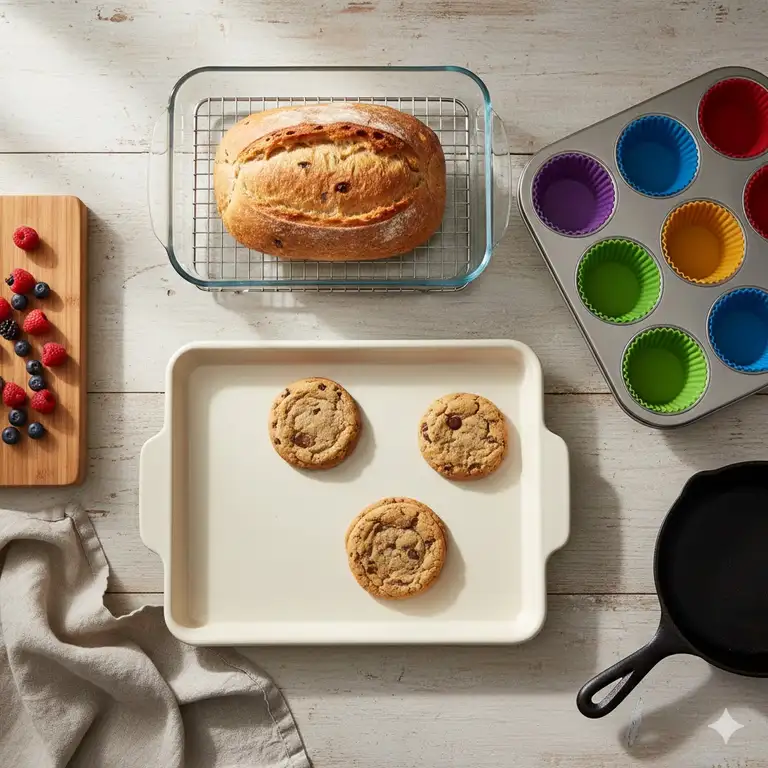
Nothing you cook in is chemically silent. Every pan gives up something to your food, so the useful question about the safest cookware materials is what each one releases, in what amount, and whether that matters for the people eating. A peer-reviewed test found new stainless steel adding nickel and chromium to tomato sauce, while an FDA notice warns that some imported aluminum and brass pots may leach lead. Those are very different problems, and this 2027 guide treats them that way.
Six pieces follow, one per material, from a stainless fry pan to a glass baking dish. The advice leans on that FDA notice, the leaching study and independent tester write-ups, and where a point rests only on a maker’s own page, the text says so.
None of the six has a nonstick coating. That is deliberate, and the next section explains why.
What “safe” means here: leaching, coatings, lead and breakage
The first test is what touches the food. Every piece here cooks on bare metal, seasoned iron, glass-like enamel, solid ceramic or glass, never on a polymer layer. Consumer Reports says nonstick coatings are often made with PFAS, that a pan labeled only as nonstick should be assumed to contain them, and that a PFOA-free claim alone does not rule out other PFAS. Some ceramic-coated pans do well in its tests, but a coating is a layer that can wear, and this list stays with surfaces that have nothing to lose.
Second comes measured release. Oregon State researchers cooked tomato sauce in stainless steel and found nickel rising up to 26-fold and chromium up to 7-fold after six hours, depending on the grade. New steel released the most, release fell with each cooking cycle until it leveled off after the sixth, and by the tenth cycle a 126-gram serving still carried an average of 88 micrograms of nickel and 86 of chromium.
Third is lead. The FDA says certain imported cookware made from aluminum, brass and aluminum alloys sold as Hindalium or Indalium can leach significant levels of lead, lists tested products in a table, and adds that other products may also be affected. Young children, women of child-bearing age and breastfeeding people may be at higher risk, according to the agency. Every piece below has a named maker and a model you can look up.
The fourth test is how a piece fails. Chipped enamel, thermal shock in glass and ceramic, hot handles and sheer weight all show up in the tester reports below, and they belong in the safety picture too.
This list suits households replacing worn nonstick, families with young children who would rather avoid coatings and imported unknowns, and cooks who want fewer coatings without relearning every dish at once.
Where the six land on leaching, upkeep and heat
Piece
Cooking surface
What it can add to food
Care
Heat note
Price tier
Tramontina Tri-Ply Clad 12-Inch Fry Pan
18/10 stainless steel
Nickel and chromium, most from new pans and long acidic simmers
Dishwasher-safe per listings
Oven-safe to 500°F, induction-ready
Low to middle
Lodge 12-Inch Cast Iron Skillet
Seasoned cast iron
Iron, mainly trace amounts
Hand wash, re-oil
Stove, oven, grill, campfire; about 8 lb
Low
de Buyer Mineral B 11-Inch Fry Pan
Seasoned carbon steel
Iron, as with cast iron
Hand wash, seasoning needed
Handle limited to 400°F for under 10 minutes
Middle to high
Xtrema Signature Skillet
Solid ceramic
Maker reports no extractable lead or cadmium (a maker claim)
Warm gradually, store apart
Heats slowly; stay at or below medium
High
Lodge 6-Quart Enameled Cast Iron Dutch Oven
Porcelain enamel over iron
Little while the enamel is intact
Hand wash
Oven-safe to 500°F
Low to middle
OXO Good Grips 3-Quart Glass Baking Dish with Lid
Borosilicate glass
No coating or metal in the cooking surface
Dishwasher-safe
Freezer to oven per maker; no stovetop
Low
The split that matters is between pieces that add something small (stainless and the iron-based pans) and pieces with a glass-like surface (enamel, ceramic, glass) that add little but can chip or crack. Price follows maker and finish: the two cheapest pieces are cast iron and glass, while the most expensive is the one carrying the most breakage warnings.
Pieces worth owning, from daily frying pan to baking dish
Searing, browning and pan sauces are the jobs that make people buy stainless steel, and this Tramontina handles them at a low-to-middle price. Retail listings describe an aluminum core between two layers of 18/10 stainless steel with a magnetic stainless exterior, so the surface that meets the food is steel, not a coating. The pan is induction-ready, rated oven-safe to 500°F, carries an NSF certification mark on retailer listings, and is made in Brazil.
The 18/10 label is the safety footnote. It means roughly 18 percent chromium and 10 percent nickel, and the Oregon State leaching study shows why that matters: brand-new steel released the most into tomato sauce, and release fell with each cooking cycle until it leveled off after about the sixth. Reading that pattern, the first weeks are the time to keep long tomato simmers for a different pot and use this pan for steaks, onions and eggs instead.
Prudent Reviews, testing the 12-inch pan against similarly priced clad pans, found it reached 356°F after one minute on medium and 450°F after two, ahead of comparable Henckels and Cuisinart pans. The same reviewer noted slight center warping in some pans of this line after several months. That is one tester’s report, not a pattern across many buyers.
Nothing about the surface is nonstick, so eggs and fish need a properly hot pan and enough fat. The riveted handle has no silicone sleeve and heats up, so keep a towel nearby.
Tramontina Tri-Ply Clad 12-Inch Fry PanSee current price, sizes and reviews on Amazon.
Weight is the first thing to know about the Lodge L10SK3: Prudent Reviews puts the 12-inch Classic at about 8 pounds, manageable with two hands thanks to the helper handle. It is cast in South Pittsburg, Tennessee, arrives seasoned and ready to use, and retail listings add that it works on induction, in the oven, on a grill and over a campfire. Lodge also lists smaller skillets, down to 6.5 inches, for anyone who finds eight pounds too much.
Surface and seasoning are where tester experience departs from the marketing. The same reviewer describes a rough, pebbled cooking surface that helps meat sear, a coarse base that can scratch a glass cooktop if dragged, and factory seasoning that can be thin or uneven and needs refreshing over time. Eggs, pancakes and fish released without sticking as long as the pan was greased. The short looped handle gets very hot, and the optional silicone grip slid off the 12-inch pan in that test.
On the health side, The Rational Kitchen, an affiliate-supported site that reasons from principles rather than measurements, argues that a well-seasoned pan leaks only trace iron and that the concern is mainly for people with hemochromatosis, and it warns that acidic foods and large volumes of liquid can strip seasoning. Treat that as one reasoned view, and ask a clinician if you have been told to limit iron.
Pros:
Cooks on seasoned iron with no coating to wear off
Handles stovetop, oven, grill and campfire per retailer listings
Among the least expensive pieces in this guide
Cons:
About 8 pounds in the 12-inch size
Rough finish and uneven factory seasoning, per Prudent Reviews
Hand wash only, per the retailer listing
Read the listing’s size line before ordering, because Lodge sells this design in several diameters.
Lodge 12-Inch Cast Iron SkilletSee current price, sizes and reviews on Amazon.
Carbon steel sits between cast iron and stainless, and de Buyer’s version sits in the middle-to-high price tier. The maker describes the body as 99 percent iron and 1 percent carbon, 3 millimeters thick, and the 11-inch pan weighs 4.8 pounds with an 8.3-inch cooking surface. Made in France, it ships with a beeswax finish and is not seasoned, so the first job is scrubbing the wax off and building a patina with thin coats of grapeseed or flaxseed oil. Consumer Reports lists carbon steel among its uncoated options. Stock and price move, so check the current price on Amazon.com.
The Skillful Cook, a reviewer with about three years of carbon steel use before testing this pan, found it seasoned more smoothly than any pan tried, with two thin coats enough for eggs and a near-black surface within weeks. The same page still calls the learning curve real: scrambled eggs stuck badly, probably because the pan was not hot enough, and the listed drawbacks include slow cooling and a poor fit for boiling pasta or making sauces, which can damage seasoning. One reader comment on that page reports a larger de Buyer pan sticking badly after two years and struggling with acidic sauces. It is a single report, and the reviewer did not dispute it.
The handle sets the limits. The classic epoxy-coated handle is rated for oven flash use only, at most 400°F for under 10 minutes, and the cast-stainless Pro version stayed oven-safe but became too hot to grab after about eight minutes on a 9-inch pan, according to The Skillful Cook.
de Buyer Mineral B 11-Inch Fry PanSee current price, sizes and reviews on Amazon.
Solid ceramic is the one material here with no metal in the pan body, which explains both its appeal and its most heated argument. The maker’s page describes the skillet as 100 percent ceramic with no coatings, tested and certified PFOA-free and PTFE-free, with no extractable lead or cadmium and California Prop 65 compliance. It lists three sizes, 7, 9 and 11 inches, weighing 1, 3 and 4 pounds, at roughly $85 to $170 depending on size. The test results behind those claims sit on a separate page that did not load when checked, so they remain maker claims in this article.
The argument involves lead screening. Tamara Rubin of Lead Safe Mama used XRF on a 1.25-quart Xtrema Versa pot, a different piece from this skillet, and reported 16,400 ppm lead in the painted logo on the outside base, with the black cooking glaze at 19 ppm. Heal Nourish Grow, a reviewer who cooks on Xtrema, notes that XRF measures total content rather than migration into food, and cites an April 2024 lab test commissioned by Mamavation in which two pieces leached lead in micrograms, well below Prop 65 safe-harbor levels. That reviewer judged the cookware safe but criticized Xtrema for dropping its metal-free claims and publishing pass/fail results instead of numbers. LeafScore says the company’s response to the XRF criticism hurt its reputation, while noting that Xtrema publishes quarterly test reports.
Expect a slow, careful pan. LeafScore found it fairly nonstick but less so than ceramic-coated pans, with uneven heating and real fragility under thermal shock: no cold piece onto a hot burner, no hot piece under cold water. Heal Nourish Grow recommends three to five minutes of preheating on the lowest setting, then staying at or below medium with a real film of oil. That reviewer also reports it is made in China under an American parent company, and that the 10-year warranty excludes thermal-shock breakage. The maker’s own pages disagree on the discount for later replacements, 50 percent on one and 40 percent on another.
Pros:
No metal in the pan body and no coating, per the maker
Oven, microwave, freezer and dishwasher use listed on the maker’s page
About 40 percent lighter than equivalent cast iron, per LeafScore
Cons:
Thermal shock and chips are the main failure modes
Slow, uneven heating that rules out hard searing
A contested record on lead testing and sparse published numbers
Confirm the size you want in the listing before ordering. The maker’s care notes say to store pieces separately to prevent chips.
Xtrema Signature SkilletSee current price, sizes and reviews on Amazon.
Long acidic simmers are where stainless and bare iron release the most, which is the argument for a glass-lined pot. Enamel is melted glass fired onto iron, and The Rational Kitchen calls it non-porous and non-reactive, though that site argues from principles more than measurements. Retailer listings rate this 6-quart pot oven-safe to 500°F and usable on induction, and they disagree on whether it is dishwasher-safe, so hand washing is the safe reading.
Tester evidence is mixed. The Skillful Cook tested the 5.5-quart pot from the same Essential Enamel line, not the 6-quart, and found it heavy at about 11 pounds 8 ounces with its lid, with discoloration on the exterior and a small chip inside during testing. The lid did not seal tightly and let steam escape, and the pot kept about 87.5 percent of its water in a braising test against roughly 92 percent for a Le Creuset. Searing was only average. That reviewer says a chip exposes the iron beneath and advises against cooking in pots with chipped enamel.
The Skillful Cook also reports that the Essential Enamel pots are made in China, while Lodge’s separate USA Enamel line, made in Tennessee, costs significantly more. Lodge Customer Care tells buyers not to heat the pot empty, to protect the enamel.
Lodge 6-Quart Enameled Cast Iron Dutch OvenSee current price, sizes and reviews on Amazon.
Frying is off the menu for glass, but baking, roasting, reheating and storing in one dish, with no coating and no metal, is where it earns a place. Iowa State University Extension explains the choice that matters: U.S. Pyrex and Anchor Hocking kitchenware is tempered soda-lime glass, which resists drops but handles sudden temperature change less well, while OXO uses thermal-shock-resistant borosilicate. Any glass can crack or shatter under thermal shock.
Retail listings for model 11176400 describe borosilicate glass for freezer-to-oven use and add that it is microwave and dishwasher safe. One listing showed a single price of $26.99 with 68 reviews and no average rating, and listings overall put it around $20 to $30. None of the pages states an oven temperature limit or country of origin, and they disagree on broiler use, so keep it off the broiler, which Iowa State also advises against for glass.
The extension service, relaying Consumer Reports guidance, adds the care rules that decide whether glass stays safe: set hot dishes on a dry towel, preheat the oven fully before the dish goes in, do not pour liquid into a hot dish, and discard anything chipped, cracked or scratched.
Pros:
Glass has no coating or metal to release
Borosilicate listed for freezer-to-oven moves
One dish for baking, serving and storing
Cons:
Not a stovetop piece
Broiler guidance conflicts between listings
Chips and cracks mean retirement, per Iowa State Extension
OXO Good Grips 3-Quart Glass Baking Dish with LidSee current price, sizes and reviews on Amazon.
Safety questions change with what is in the pan, so the same six pieces rank differently for frying, for sensitive households and for label-reading.
The safest cookware material for frying
Frying asks for high, sustained heat at the pan surface, and that favors surfaces with no coating to degrade. Consumer Reports’ own care advice for nonstick pans is to avoid high heat and never heat an empty pan, which is a reason to keep frying on uncoated metal. Among the six, the Lodge 12-Inch Cast Iron Skillet held heat best in Prudent Reviews’ water test, though by only a couple of degrees, and the Tramontina Tri-Ply Clad 12-Inch Fry Pan reached 450°F within two minutes on medium. The de Buyer Mineral B 11-Inch Fry Pan brings iron’s searing behavior at 4.8 pounds, with a 400°F oven limit on its handle. The Xtrema Signature Skillet is a poor match for hard searing because reviewers advise staying at or below medium, and the glass dish and Dutch oven are not frying vessels. The reasoning points to cast iron or stainless for most frying, with carbon steel when weight is the obstacle.
Safest cookware material for health: nickel, iron and lead
Three different substances are in play, and each points to a different material. Nickel and chromium come from stainless steel, and the Oregon State authors flag both as dermatitis concerns, with release driven by grade, cooking time and how new the pan is. Anyone with a known nickel allergy has reason to look at the iron-based and glass pieces first.
Iron comes from cast iron and carbon steel. The Rational Kitchen reasons that trace amounts from a seasoned pan matter mainly for people with hemochromatosis. If a doctor has told you to limit iron, ask before relying on bare iron pans; enameled cast iron and glass sidestep the question.
Lead is the FDA’s concern with specific imported aluminum, brass and Hindalium-type pots, and the agency tells owners of listed pieces to discard them and not donate or refurbish them. A branded pan with an identifiable maker, as with all six here, is a different situation from an unmarked imported pot.
Safest cookware material non toxic claims on the label
Non-toxic is a marketing phrase, so check what a listing can actually be tested against. Consumer Reports says to look for labels stating a coating has no PFAS, and to treat an unnamed nonstick material as PFAS until shown otherwise. For ceramic and enamel, the stronger signal is a maker that publishes actual test numbers. Heal Nourish Grow criticizes Xtrema for pass/fail summaries without figures, and LeafScore notes the brand now leans on leach testing instead of saying lead-free or metal-free, which is a fair reading of what any such label can prove.
Safest cookware materials steps: five checks before you buy or keep a pan
Read the surface, not the exterior. The listing should name what the food touches: a stainless grade, seasoned iron, enamel, solid ceramic or glass. A vague word like “premium” does not count.
Ask the coating question. Consumer Reports advises assuming an unnamed nonstick material contains PFAS, notes that PFOA-free is not enough on its own, and says to stop using coated pans once they are scratched, flaking or damaged.
Check imported aluminum and brass against the FDA table. The agency says other products may also be affected, so an unmarked pot of unclear alloy deserves suspicion even if it is not listed.
Match the metal to the food and the clock. Release rose with cooking time in the stainless study, so a 20-minute pan sauce and a six-hour tomato simmer are not the same exposure. Long acidic cooking belongs in enamel or glass.
Break in and retire correctly. Season iron and carbon steel, warm ceramic slowly, and retire enamel chipped down to the iron and glass with chips, cracks or scratches.
Quick answers on ceramic, aluminum, nickel and old pans
What is the safest cookware material to use every day?
No single material wins every job. Consumer Reports points to uncoated glass, stainless steel, carbon steel and cast iron, so a stainless or cast iron skillet covers daily frying while glass or enameled cast iron handles baking and long acidic simmers.
Is stainless steel or cast iron the safer choice?
Both are widely used uncoated options with different trade-offs. New stainless can add nickel and chromium, especially in long tomato simmers, while cast iron adds iron and can lose seasoning to acidic food. Sensitivities and cooking style should decide, not a single winner.
Is ceramic cookware safe?
It depends on whether the pan is solid ceramic or ceramic-coated. Consumer Reports says some ceramic nonstick coatings perform well, but a coating can wear. Solid ceramic has no coating, though it chips under thermal shock, so favor makers that publish actual test numbers.
Is aluminum cookware safe?
The FDA lead warning covers specific imported aluminum, brass and Hindalium-type pots, not every aluminum pan. Clad pans keep an aluminum core sandwiched between steel layers. Compare any unmarked or imported pot against the FDA's product table before you cook in it.
When should an old pan be thrown out?
Retire nonstick pans that are scratched or flaking, glass dishes with chips or cracks, and enamel chipped down to the iron. Anything on the FDA's imported-cookware lead table should go as well, and the agency says not to donate or refurbish it.
Start with stainless or iron, then add one specialist
The safest cookware materials are the ones that match how you cook. For daily frying, begin with the Tramontina Tri-Ply Clad 12-Inch Fry Pan or the Lodge 12-Inch Cast Iron Skillet, and let the choice turn on whether you would rather manage seasoning and weight or nickel and new-pan break-in. Add the Lodge 6-Quart Enameled Cast Iron Dutch Oven for long tomato simmers, the OXO Good Grips 3-Quart Glass Baking Dish with Lid for oven and fridge, and the de Buyer Mineral B 11-Inch Fry Pan when iron’s weight is the obstacle. Treat the Xtrema Signature Skillet as the careful, contested option: it suits someone who wants no metal in the pan body and will warm it slowly and handle it gently. Compare the exact model number before buying.
Disclaimer: This post contains affiliate links. As an Amazon Associate, we earn from qualifying purchases made through these links, at no additional cost to you.
Before any new pan reaches your cart, read the listing’s material line twice.
SmartCookLab is an independent buying-guide site for cookware, pots, pans, range hoods and kitchen appliances. Our editorial team compares products using manufacturer specifications, independent tests from specialist kitchen media, owner reports and retailer listings. We do not claim to have tested the products ourselves; see How We Choose Gear for our method.