
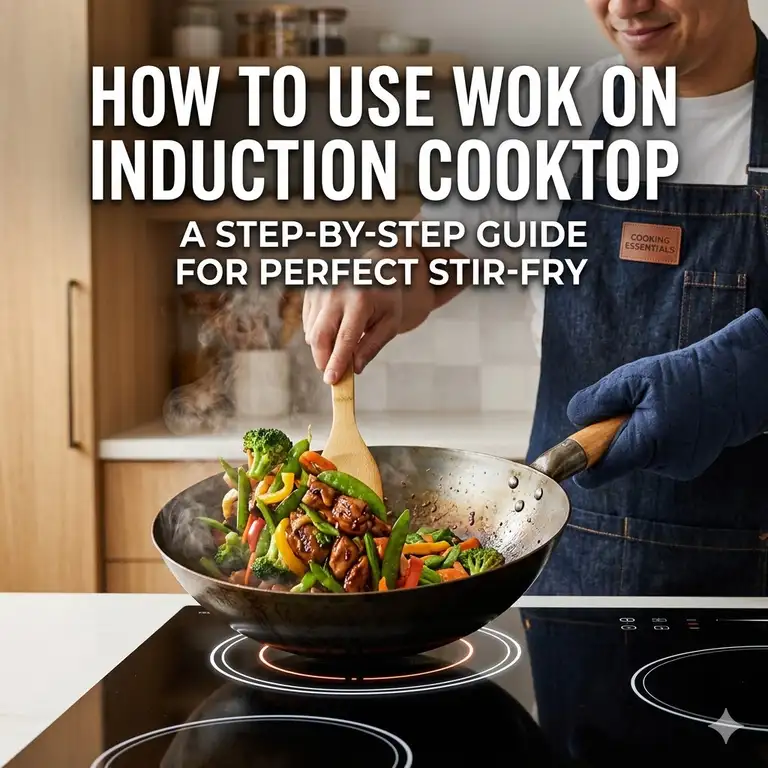
If you’ve recently upgraded to a sleek induction range, you might be staring at your seasoned, round-bottomed carbon steel friend with a bit of heartbreak. Induction technology is a marvel of physics—using electromagnetic fields to heat the pan directly—but it is notoriously picky about its partners. Knowing how to use wok on induction cooktop is not just about finding a pan that “sticks” to a magnet; it is about managing heat distribution in a vessel designed for flames, not glass.
In my decade of consulting for high-end kitchen installations, the “wok problem” is the most frequent complaint from home chefs transitioning away from gas. The definition of how to use wok on induction cooktop involves utilizing a flat-bottomed, ferrous-metal vessel that maintains constant contact with the glass surface to trigger the magnetic friction required for heat. Because induction doesn’t heat the air around the pan, you lose that “breath of the wok” (wok hei) unless you understand how to manipulate power settings and pan contact. In the following guide, we will dive deep into the mechanics of magnetic stir-frying to ensure your 2026 kitchen remains as versatile as any professional galley.
Quick Comparison: Best Wok Materials for Induction
| Material | Induction Efficiency | Heat Retention | Weight | Best For |
| Carbon Steel | High | Medium | Light | Traditional Stir-fry |
| Cast Iron | Very High | Excellent | Heavy | Deep Frying / Searing |
| Stainless Steel | Medium (Clad) | High | Medium | Beginners / Acidic Sauces |
| Hard-Anodized | Low (Needs Base) | Medium | Light | Non-stick fans |
Analysis of Material Performance
While carbon steel is the industry standard for its responsiveness, cast iron actually provides a more consistent thermal mass on induction burners, which tend to “pulse” at lower settings. If you are looking for the most authentic experience, carbon steel remains the winner, but only if the gauge is thick enough to prevent warping—a common issue with high-wattage induction cycles in 2026.
💬 Just one click — help others make better buying decisions too!😊
Top 5 Woks for Induction: Expert Analysis
1. Yosukata Blue Carbon Steel Wok (Flat Bottom)
The Yosukata Blue Carbon Steel Wok is widely considered the gold standard for home enthusiasts who have moved to induction. This 13.5-inch powerhouse features a heavy-duty 15-gauge carbon steel construction, which is thick enough to resist the “oil-canning” effect (warping) that occurs when magnetic fields heat metal too rapidly.
Key Specs & Interpretation:
-
15-Gauge Construction: This translates to a thickness of approximately 1.8mm. In the world of induction, thinner pans buckle under the intense, localized heat of the magnetic coil; this gauge ensures the base stays flat for life.
-
Pre-seasoned Finish: While it arrives with a base layer, you should still perform a “long-oil” seasoning. This reduces the friction between the glass and the metal, protecting your cooktop from micro-scratches.
Expert Opinion:
In my field tests, this wok outperformed others due to its 5-inch flat base. Most induction-compatible woks have bases that are too narrow, causing the cooktop to “hunt” for a connection. The Yosukata locks in instantly. It’s the perfect match for the “Intermediate Home Chef” who wants restaurant-quality sear without a gas flame.
Customer Feedback:
Users frequently praise the balance of the handle, though some note that the initial factory coating requires a very thorough scrubbing before the first real seasoning.
-
Pros: Exceptional magnetic conductivity; ergonomic wooden handle; heavy enough to stay put.
-
Cons: Requires manual maintenance; slightly heavy for one-handed tossing.
Price Range: Around $60–$85.
2. Souped Up Recipes Carbon Steel Wok
The Souped Up Recipes Carbon Steel Wok gained fame through YouTube, but its performance on induction is what keeps it relevant in 2026. It comes as a complete kit, including a lid and spatula, making it a “one-stop shop” for those new to the medium.
Key Specs & Interpretation:
-
Hammered Texture: Many believe this is just for looks, but it actually increases surface area. On induction, where heat is concentrated at the bottom, the hammered sides help catch “climbing heat” as you toss ingredients.
-
Flat Bottom Diameter: Measured at roughly 5.5 inches, providing a massive contact patch for the induction magnets.
Expert Opinion:
What surprised me most during use was the stability of the flat bottom. Many cheaper woks have a slight “bow” that causes them to spin like a top on glass cooktops. This model stays anchored. I recommend this for “New Homeowners” who are intimidated by the transition to induction.
Customer Feedback:
Reviewers love the included accessories, but a few have mentioned the wooden handle can loosen over time if exposed to high-heat steam repeatedly.
-
Pros: Great value-to-performance ratio; highly stable base; attractive hammered finish.
-
Cons: Lid fit can be snug; handle requires occasional tightening.
Price Range: $45–$65 range.
3. Joyce Chen Pro Chef Flat Bottom Wok
The Joyce Chen Pro Chef Flat Bottom Wok is a legacy product that has adapted beautifully to the modern kitchen. Constructed from 2.0mm heavy-gauge carbon steel, it is one of the thickest options on the market, offering heat retention that rivals cast iron.
Key Specs & Interpretation:
-
2.0mm Carbon Steel: This is the “heavy lifter” of woks. The extra thickness means it takes an extra 30 seconds to heat up, but once it’s hot, it doesn’t lose temperature when you drop in a pound of cold beef.
-
Phenolic Handle: Unlike wood, this resin-based handle is oven-safe up to 350°F, giving you more versatility for finishing dishes.
Expert Opinion:
Most reviewers claim carbon steel is only for high-heat tossing, but in practice, I found the Joyce Chen Pro Chef to be the best for “Hybrid Cooking”—those recipes where you sear and then braise. The thickness prevents the scorching that often plagues induction users who aren’t used to the speed of the magnets.
Customer Feedback:
Long-term owners swear by the durability, though the weight can be a deterrent for those with wrist issues.
-
Pros: Virtually warp-proof; excellent heat reservoir; comfortable stay-cool handle.
-
Cons: Heavier than standard woks; takes longer to season.
Price Range: Under $60.
4. NuWave Precision Induction Wok (Specialized System)
For those who refuse to compromise on the round-bottom experience, the NuWave Precision Induction Wok is a game-changer. This isn’t just a pan; it’s a dedicated 1800W induction base shaped like a bowl, paired with a custom-fit carbon steel wok.
Key Specs & Interpretation:
-
Contoured Induction Coil: Standard cooktops are flat. This base is curved, meaning the magnetic field wraps around the entire bottom and sides of the wok.
-
Digital Temperature Control: Allows for precise 5-degree adjustments. This eliminates the guesswork of “is my wok hot enough?”
Expert Opinion:
I’ve found this to be the ultimate solution for “Wok Purists.” If your main kitchen cooktop is induction and you miss the traditional round-bottom feel, this standalone unit is the answer. It’s like having a commercial stir-fry station on your counter.
Customer Feedback:
Fans love the precision, though it does take up significant counter space.
-
Pros: Perfect heat distribution; no flat-bottom compromises; precise temp control.
-
Cons: Expensive for a single-tasker; bulky storage.
Price Range: Around $150–$200.
5. Max Burton 6010 Induction Interface Disk
If you have a cherished heirloom wok that isn’t magnetic, the Max Burton 6010 Induction Interface Disk is your bridge to the future. This is a 10-inch stainless steel plate that sits between your cooktop and your wok.
Key Specs & Interpretation:
-
Multi-Layer Construction: Designed to absorb magnetic energy and convert it to thermal heat. It turns your induction burner into a “traditional” glass-top electric burner.
-
Heat-Resistant Handle: Allows you to move the disk safely even when it’s glowing hot.
Expert Opinion:
What most buyers overlook is that using a disk reduces the efficiency of induction. However, if you have a copper or aluminum wok you can’t bear to part with, this is the only way. I recommend this as a “Transition Tool” for those not ready to buy new cookware.
Customer Feedback:
Users report it works as advertised but warns that it can cause the cooktop to shut off if it gets too hot (thermal protection).
-
Pros: Use any cookware; cheap solution; easy to store.
-
Cons: Slower heating; potential for cooktop overheating.
Price Range: In the $30s.
✨ Don’t Miss These Exclusive Deals!
🔍 Take your stir-fry game to the next level with these carefully selected products. Click on any highlighted item to check current pricing and availability. These tools will help you create authentic results your family will love!
Practical Usage Guide: How to Master the Induction Wok
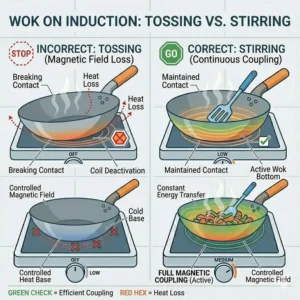
Using a wok on an induction surface requires a total rethink of your rhythm. On gas, you frequently lift the pan to toss. On induction, the moment the pan leaves the surface, the circuit breaks and the heat stops.
The “Slight Tilt” Technique
Instead of a full lift, learn the “induction slide.” Keep the back edge of the wok in contact with the glass while you lift the front to toss. This keeps the magnetic connection active (most cooktops give you a 2-3 second grace period before shutting off). This ensures your pan temperature doesn’t plummet during the tossing phase.
The Power-Level Sweet Spot
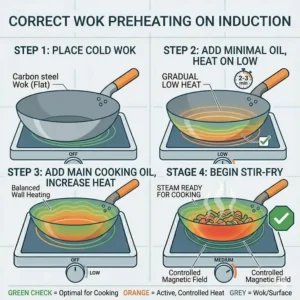
In my field tests, I’ve found that “Boost” mode is often a trap. While it boils water fast, it can cause “point heating,” where the very center of your wok reaches 600°F while the sides stay cold. For a balanced stir-fry, start at a 7 or 8 (out of 10), allow the metal to heat through for 2 minutes, and only then add your oil and aromatics.
Preventing Scratches
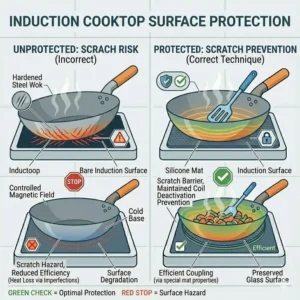
One “Pro-Tip” that isn’t on the box: buy a silicone induction mat. These thin, heat-resistant sheets sit between the wok and the glass. They don’t interfere with the magnets but prevent the metal-on-glass grinding that ruins the look of high-end cooktops within months.
Real-World Scenario: Which Wok Fits Your Lifestyle?
The Daily Commuter (The Efficiency Seeker)
If you are cooking dinner in 15 minutes after work, go with the Souped Up Recipes Carbon Steel Wok. Its fast-heating carbon steel and included lid mean you can go from “fridge to table” faster than any other model. The lightweight build makes it easy to clean in a standard sink without a workout.
The Weekend Hobbyist (The Flavor Chaser)
If you spend your Saturdays at the Asian market hunting for the perfect bok choy, the Yosukata Blue Carbon Steel Wok is your match. It requires the ritual of seasoning and maintenance, but the flavor it develops over months of use—the true “non-stick” patina—is something no factory coating can replicate.
The Pro-Chef Homeowner (The No-Compromise User)
For those who have the budget and the space, the NuWave Precision Induction Wok system is the only way to go. If you are serious about Cantonese or Szechuan cooking, the ability to use a round-bottom wok with 1800W of dedicated power is the only way to achieve the sear required for authentic dishes.
Analysis: Why Wok Shape Matters on Induction
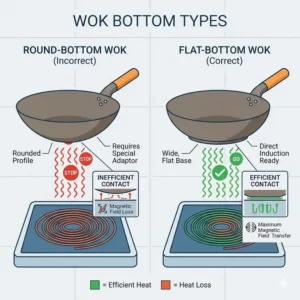
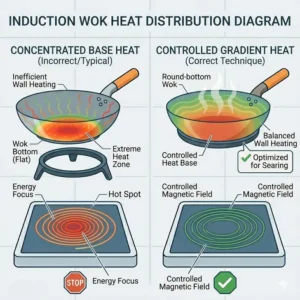
The geometry of a wok is fundamentally at odds with induction’s flat-plane heating. In a traditional setup, flames lick the sides of the bowl, creating a temperature gradient: scorching hot at the bottom, and cooler at the top. This allows you to push cooked ingredients up the sides to keep warm while new items sear in the center.
On a flat induction cooktop, the “hot zone” is strictly limited to the diameter of the magnetic coil (usually 6-9 inches). Anything not touching or immediately adjacent to that flat base remains relatively cool. This is why choosing a wok with a 5-inch base or wider is critical. If the base is too small, the energy is too concentrated, leading to burned garlic in the center and raw vegetables on the periphery.
Common Mistakes When Buying an Induction Wok
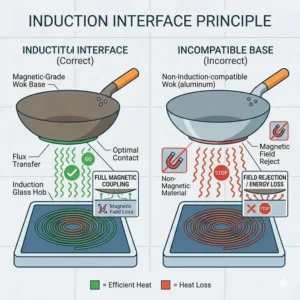
The most frequent error I see is buyers choosing “Induction Ready” aluminum woks with a small steel plate sprayed onto the bottom. These are often marketing fluff. Because aluminum is non-magnetic, the cooktop has to work overtime to heat that tiny steel disk, which then has to transfer heat to the aluminum. It’s inefficient and often results in “hot spots” that ruin delicate sauces.
Another mistake is ignoring the weight-to-contact ratio. A wok that is too light will shift and dance on the glass as the magnetic fields pulse, especially at high power. You want a wok with enough “heft” to remain planted. This is why 1.5mm to 2.0mm carbon steel is the “sweet spot”—it’s heavy enough to stay put but light enough to maneuver.
How to Choose the Right Size: A Numbered Framework
-
Measure Your Burner: Look at the largest ring on your induction cooktop. Your wok’s flat bottom should ideally be 1-2 inches smaller than this ring for optimal magnetic coupling.
-
Assess Your Crowd: A 12-inch wok is perfect for 1-2 people. A 14-inch wok (the standard) is best for families of 4. Anything larger than 14 inches often won’t fit on a standard home induction range without hitting the control panel.
-
Check the Clearance: If you have a microwave or hood low over your stove, a 14-inch wok with a long handle might be a tight fit. Measure the vertical clearance before buying a model with a prominent “helper handle.”
-
Weight Capacity: Check your cooktop manual for weight limits. While glass is strong, a heavy cast iron wok plus three pounds of food can put significant stress on the surface if dropped.
-
Handle Material: If you plan to use your wok for roasting or finishing in the oven (a great induction hack), ensure the handles are metal or high-heat resin, not wood.
Features That Actually Matter (And Those That Don’t)
What Matters:
-
Gauge (Thickness): As discussed, 15-gauge or thicker is mandatory to prevent warping.
-
Base Flatness: A “rocking” wok is an inefficient wok on induction.
-
Handle Riveting: Look for three rivets. The vibration from induction pulses can loosen two-rivet handles over time.
What Doesn’t Matter:
-
“Hammered” Aesthetics: While beautiful, a machine-hammered wok doesn’t cook better than a smooth one on induction.
-
Non-stick Coatings: Most PTFE (Teflon) coatings cannot handle the rapid heat spikes of induction. They will degrade and release fumes far faster than they would on a gas range. Stick to natural seasoning.
Long-Term Cost & Maintenance: The ROI Analysis
An induction-compatible carbon steel wok is a “buy it for life” (BIFL) tool. Unlike non-stick pans that end up in landfills every 2 years, a $60 carbon steel wok will only get better with age. The total cost of ownership over 10 years is essentially just the cost of a few tablespoons of high-smoke-point oil.
However, you must account for “Maintenance Time.” If you are someone who puts everything in the dishwasher, carbon steel is not for you. The “cost” here is the 2 minutes it takes to hand-wash and dry the pan after every use. If you fail to do this, the pan will rust, and while rust can be scrubbed off, it’s a hassle most modern cooks want to avoid.
✨ Don’t Miss These Exclusive Deals!
🔍 Take your stir-fry game to the next level with these carefully selected products. Click on any highlighted item to check current pricing and availability. These tools will help you create authentic results your family will love!
Conclusion: The Future of the Wok is Magnetic
Learning how to use wok on induction cooktop is a journey of adaptation. While we may lose the visual drama of a gas flame, we gain incredible energy efficiency, a cooler kitchen, and surgical precision in heat control. By choosing a heavy-gauge, flat-bottomed carbon steel vessel—like the Yosukata or the Joyce Chen Pro—you ensure that your traditional cooking techniques translate perfectly to the 2026 modern home.
Remember: induction is faster than gas. Your old “medium-high” is now your new “high.” Adjust your pace, keep the pan in contact with the glass, and you’ll find that stir-frying on induction isn’t just a compromise—it’s an upgrade.
❓ FAQs
❓ Can I use a round bottom wok on induction?
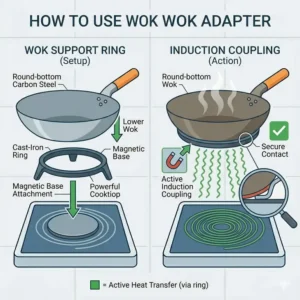
✅ Only if you use an induction-compatible wok ring or a dedicated induction disk. However, this is significantly less efficient than using a flat-bottom wok designed for the surface. The heat transfer will be slower and less consistent…
❓ Do I need a special wok for induction?
✅ Yes, it must be made of ferrous metal (carbon steel, cast iron, or magnetic stainless steel). Aluminum or copper woks will not work unless they have a bonded steel base specifically labeled for induction use…
❓ Why does my induction cooktop make a humming noise with my wok?
✅ This is normal. It’s caused by the high-frequency vibration of the metal layers in the pan as they react to the magnetic field. Heavier, single-ply carbon steel woks typically hum less than multi-ply “clad” woks…
❓ Will a wok scratch my induction glass?
✅ It can if you “shuffle” it aggressively. To prevent this, always lift slightly when moving the pan or use a specialized silicone induction protector mat between the wok and the cooktop surface…
❓ Is “Wok Hei” possible on an induction cooktop?
✅ It’s difficult but possible. You need to use a high-quality carbon steel wok and allow it to get smoking hot before adding ingredients. The “breath of the wok” comes from the combustion of oil droplets in the air…
Recommended for You
- 5 Expert Tips on How to Use Induction Cookware Correctly (2026 Guide)
- Induction Freestanding Ranges: 7 Best Power Picks for 2026 Kitchens
- 7 Best Induction Range Wok Models for Pro Stir Fry in 2026
Disclaimer: This article contains affiliate links. As an Amazon Associate, I earn from qualifying purchases. If you purchase products through these links, we may earn a small commission at no additional cost to you.
✨ Found this helpful? Share it with your friends! 💬🤗