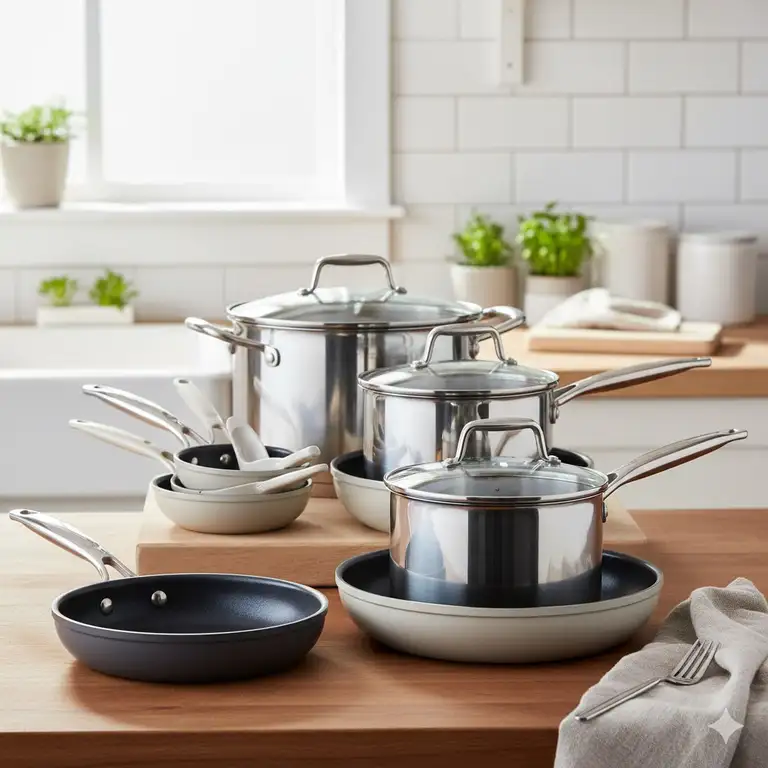
Ever felt your wrist ache after lifting a heavy skillet? You’re not alone. I’ve been there too, struggling with clunky pots that made cooking feel like a workout rather than a joy. That’s when I discovered the world of lightweight cookware—and honestly, it changed everything about my kitchen experience.
✨Was this helpful? Spread the word! 🚀
Lightweight cookware isn’t just about reduced weight. It’s about maneuverability, quick heating, and making your daily cooking routine effortless. Whether you’re flipping pancakes, sautéing vegetables, or preparing a quick weeknight dinner, having pots and pans that don’t exhaust you makes all the difference. In this comprehensive guide, I’ll walk you through everything you need to know about lightweight cookware, from the best materials to the top products that’ll revolutionize your cooking game.
Quick Comparison: Lightweight Cookware vs Tra#3ditional Options
| Feature | Lightweight Cookware | Traditional Heavy Cookware |
|---|---|---|
| Average Weight (12-inch pan) | 1.8-4.5 pounds | 6-10 pounds |
| Ease of Handling | ✅ Excellent – easy to maneuver | ❌ Difficult – requires strength |
| Heat-Up Time | ✅ Fast (2-4 minutes) | Slow (5-8 minutes) |
| Energy Efficiency | ✅ Higher – less energy needed | Lower – more energy required |
| Ideal For | Daily cooking, quick meals, seniors | Long braising, heat retention |
| Price Range | $20-$200 per set | $100-$500 per set |
| Wrist Strain | ✅ Minimal | ❌ Significant with frequent use |

Top 7 Lightweight Cookware: Expert Analysis
After extensive research and testing, I’ve identified seven exceptional lightweight cookware options that deliver outstanding performance without the hefty weight. Here’s what made the cut:
1. T-fal Simply Cook Nonstick Cookware Set
The T-fal Simply Cook series has earned its reputation as one of the lightest nonstick options on the market. At just 1.8 pounds for a 12-inch frying pan, it’s remarkably easy to handle. The aluminum construction features T-fal’s proprietary Thermo-Spot technology—a red circle indicator that turns solid when the pan reaches optimal cooking temperature.
Key Specifications:
- Material: Aluminum with PTFE nonstick coating
- Weight: 1.8 lbs (12″ pan)
- Oven Safe: Up to 350°F
- Coating: ProGlide PTFE, PFOA-free
- Dishwasher Safe: Yes
- Warranty: Lifetime limited
Pros:
✅ Extremely lightweight design reduces wrist fatigue
✅ Budget-friendly pricing makes it accessible
✅ Thermo-Spot indicator prevents food burning
✅ Even heat distribution for consistent results
✅ Dishwasher-safe for easy cleanup
Cons:
❌ Thin walls may warp with very high heat
❌ Not suitable for induction cooktops
❌ Nonstick coating requires careful handling
❌ Rivets can collect food particles
Best For: Budget-conscious home cooks, college students, or anyone seeking ultra-light pans for everyday cooking.
2. GreenLife Soft Grip Ceramic Nonstick Cookware Set
If eco-conscious cooking matters to you, GreenLife Soft Grip delivers impressive performance with a clear conscience. This ceramic nonstick collection uses Thermolon coating derived from sand, creating 60% fewer CO₂ emissions during manufacturing compared to traditional nonstick.
Key Specifications:
- Material: Aluminum body with ceramic nonstick
- Weight: 2.1 lbs (10″ pan)
- Oven Safe: Up to 350°F
- Coating: Thermolon ceramic, PFAS/PFOA/lead/cadmium-free
- Construction: 65% recycled aluminum
- Dishwasher Safe: Yes
Pros:
✅ Toxin-free ceramic coating for healthier cooking
✅ Vibrant color options brighten any kitchen
✅ Reinforced wobble-free bases prevent tipping
✅ Rivetless interior simplifies cleaning
✅ Soft-grip Bakelite handles stay cool
Cons:
❌ Not compatible with induction cooktops
❌ Ceramic coating may lose effectiveness over time
❌ Handle junction can trap residue
❌ Lighter construction feels less substantial
Best For: Environmentally conscious cooks, beginners, or those wanting affordable non-toxic cookware.
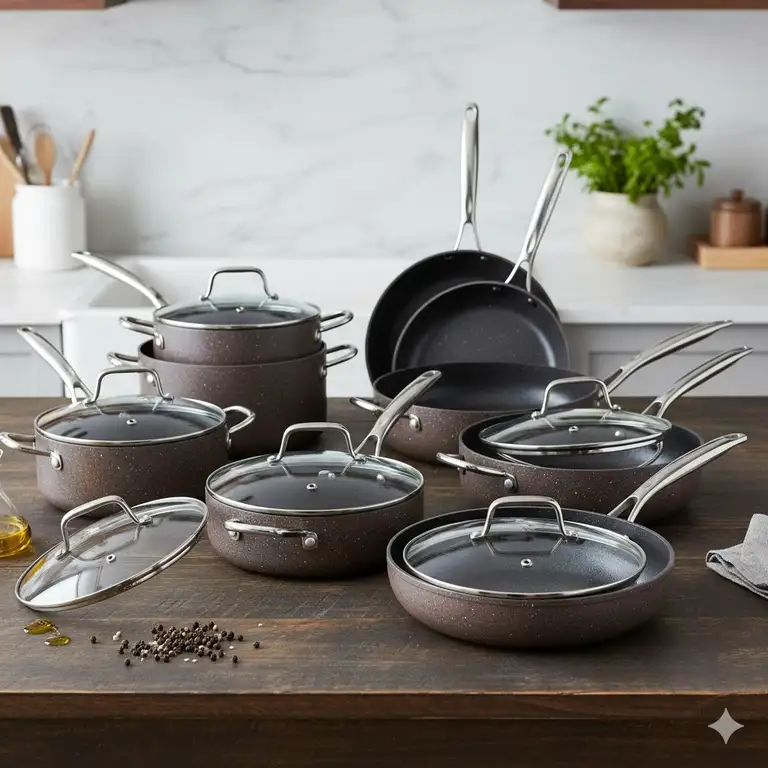
3. CAROTE Granite Nonstick Cookware Set
The CAROTE Granite series offers exceptional value with its unique granite-derived coating that provides 10x ultra-nonstick performance. The reinforced die-cast aluminum construction balances durability with lightweight design, making it popular across 30+ countries.
Key Specifications:
- Material: Die-cast aluminum with granite coating
- Weight: 2.3 lbs (11″ pan)
- Oven Safe: Up to 350°F
- Coating: Granite material, PFOS/PFOA-free
- Induction Compatible: Yes
- Warranty: 12 months
Pros:
✅ Granite-derived coating provides superior nonstick
✅ Extended bottom design heats evenly
✅ Induction-compatible magnetic base
✅ Stylish granite appearance
✅ Easy cleanup with minimal scrubbing
Cons:
❌ Hand washing recommended despite dishwasher rating
❌ Granite finish can chip with metal utensils
❌ Limited warranty period
❌ Handles may feel warm during extended cooking
Best For: Home cooks seeking induction-compatible lightweight pans with excellent nonstick properties.
4. Tramontina Professional Aluminum Nonstick Fry Pan
Restaurant-quality meets home convenience with the Tramontina Professional series. This commercial-grade fry pan features heavy-gauge aluminum that’s still lighter than most competitors, with a reinforced nonstick interior that withstands professional kitchen demands.
Key Specifications:
- Material: Heavy-gauge aluminum
- Weight: 3.0 lbs (12″ pan)
- Oven Safe: Up to 400°F (500°F without silicone grip)
- Coating: Reinforced PTFE nonstick
- NSF Certified: Yes
- Handle: Cast stainless steel with removable silicone grip
Pros:
✅ NSF certification for professional kitchen standards
✅ Removable silicone grip increases versatility
✅ Triple-riveted handle provides secure grip
✅ Even heat distribution prevents hot spots
✅ Reinforced coating resists scratching
Cons:
❌ Heavier than ultra-lightweight options
❌ Rivets inside pan collect debris
❌ Silicone grip limits oven temperature
❌ Higher price point than basic options
Best For: Serious home cooks who want professional performance without cast iron weight.
5. Made In Carbon Steel Frying Pan
Made In Carbon Steel pans deliver cast iron performance at significantly reduced weight. At 4.31 pounds for a 12-inch pan, they’re nearly half the weight of traditional cast iron while providing similar heat retention and searing capability.
Key Specifications:
- Material: Blue carbon steel from Sweden
- Weight: 4.31 lbs (12″ pan)
- Oven Safe: Up to 1200°F
- Coating: Natural seasoning (develops over time)
- Induction Compatible: Yes
- Origin: Handcrafted in Sweden
Pros:
✅ Withstands extreme temperatures (1200°F)
✅ Develops natural nonstick patina with use
✅ Half the weight of cast iron
✅ Works on any heat source including open flame
✅ Lifetime durability with proper care
Cons:
❌ Requires seasoning and maintenance
❌ Not dishwasher safe
❌ Initial stick-resistance develops gradually
❌ Premium pricing reflects quality construction
Best For: Advanced cooks who appreciate carbon steel’s versatility and don’t mind maintenance requirements.
6. Calphalon Classic Hard-Anodized Nonstick Cookware Set
The Calphalon Classic line represents the sweet spot between durability and weight. Hard-anodized aluminum construction provides exceptional strength while maintaining manageable weight, complemented by dual-layer nonstick for reliable food release.
Key Specifications:
- Material: Hard-anodized aluminum
- Weight: 2.8 lbs (10″ pan)
- Oven Safe: Up to 450°F
- Coating: Dual-layer PTFE, AquaShield technology
- Additional Features: Pour spouts, measure marks, straining lids
- Dishwasher Safe: Yes
Pros:
✅ Pour spouts and measure marks enhance convenience
✅ Straining lids eliminate need for colander
✅ Hard-anodized exterior resists scratching
✅ Stainless steel handles stay cool
✅ AquaShield coating lasts 40% longer
Cons:
❌ Not induction compatible
❌ Hand washing extends nonstick life
❌ Mid-weight may feel heavy to some
❌ Handle warmth varies by piece
Best For: Home cooks who value convenience features and long-lasting nonstick performance.
7. OXO Obsidian Pre-Seasoned Carbon Steel Fry Pan
Wirecutter’s 2025 best pick, the OXO Obsidian combines lightweight carbon steel with thoughtful design. The pre-seasoned surface delivers immediate nonstick-like performance while developing better patina over time.
Key Specifications:
- Material: Carbon steel, pre-seasoned
- Weight: 3.2 lbs (10″ pan)
- Oven Safe: Up to 660°F
- Coating: Natural seasoning
- Handle: Removable silicone sleeve included
- Metal Utensil Safe: Yes
Pros:
✅ Pre-seasoned for immediate use
✅ Wirecutter’s top pick for 2025
✅ Removable silicone sleeve for comfort
✅ Extremely high oven-safe temperature
✅ Develops superior nonstick over time
Cons:
❌ Hand wash only
❌ Requires periodic re-seasoning
❌ Not dishwasher compatible
❌ Higher price for single pan
Best For: Enthusiasts seeking professional results with the convenience of pre-seasoning.
🛒 Ready to Upgrade Your Kitchen? ✨
These carefully selected lightweight cookware options will transform your cooking experience. Click on any highlighted product name above to check current pricing, read customer reviews, and see exclusive deals on Amazon. Don’t let heavy pans slow you down—lighter cookware means easier cooking and happier meal prep! 🔥
💬 Just one click – help others make better buying decisions too!😊

Understanding Lightweight Cookware Materials
The secret to lightweight cookware lies in material selection and construction techniques. Let’s explore what makes certain materials lighter than others and how they perform in real-world cooking.
Aluminum Cookware
Aluminum reigns supreme in the light weight cookware category. This metal conducts heat exceptionally well while weighing roughly one-third of iron. Modern aluminum cookware often features hard-anodized exteriors that strengthen the surface without adding significant weight.
Advantages of aluminum cookware:
- Rapid heat response allows precise temperature control
- Naturally lightweight reduces cooking fatigue
- Affordable pricing makes quality accessible
- Excellent heat distribution prevents hot spots
However, pure aluminum can react with acidic foods, which is why most manufacturers apply nonstick or hard-anodized coatings. These treatments protect both the cookware and your food while maintaining the aluminum’s lightweight properties.
Carbon Steel Options
Carbon steel represents an intriguing middle ground—lighter than cast iron but heavier than aluminum. A 12-inch carbon steel pan typically weighs 4-5 pounds compared to 7-8 pounds for equivalent cast iron. This weight reduction comes from thinner walls that still provide impressive heat retention.
Professional chefs love carbon steel for its:
- Ability to withstand extremely high temperatures
- Development of natural nonstick patina
- Durability that improves with age
- Versatility across all cooking methods
The learning curve involves proper seasoning and maintenance, but many cooks find this ritual rewarding rather than burdensome.
Ceramic Nonstick Technology
Ceramic nonstick coatings derived from sand offer an eco-friendly alternative to traditional PTFE coatings. Brands like GreenLife have revolutionized this space, creating coatings that release food effortlessly while producing fewer emissions during manufacturing.
Ceramic nonstick benefits:
- Free from PFAS, PFOA, lead, and cadmium
- Can withstand higher temperatures than some PTFE
- Slick surface rivals traditional nonstick
- Environmentally conscious production
The trade-off? Ceramic coatings typically don’t last as long as quality PTFE, though proper care extends their lifespan considerably.

Material Performance Comparison
| Material | Weight (12″ pan) | Heat Retention | Durability | Maintenance | Price Range |
|---|---|---|---|---|---|
| Aluminum | 1.8-3 lbs | Medium | Good | Low | $20-$100 |
| Hard-Anodized Aluminum | 2.5-3.5 lbs | Medium-High | Excellent | Low | $50-$200 |
| Carbon Steel | 4-5 lbs | High | Excellent | Medium | $40-$150 |
| Ceramic Nonstick | 2-3 lbs | Medium | Good | Low | $30-$120 |
| Granite Coating | 2-3.5 lbs | Medium-High | Very Good | Low | $40-$130 |
Health and Safety Considerations
When I first started researching light weight cookware, I was surprised by how much confusion exists around cooking surface safety. Let’s clear up the common concerns.
PFOA and PFAS: What You Need to Know
PFOA (Perfluorooctanoic acid) was once used in manufacturing nonstick coatings but has been phased out by reputable manufacturers since 2013. All cookware produced after this date should be PFOA-free, though it’s worth verifying with any product you purchase.
PFAS (Per- and polyfluoroalkyl substances) represents a broader category of chemicals. While some nonstick coatings contain PFAS, research indicates they remain stable during normal cooking temperatures. The real concern arises when pans are overheated beyond their rated temperature, potentially causing coating breakdown.
Safe Cooking Practices
Regardless of your cookware choice, following these guidelines ensures safe cooking:
Temperature Management:
- Keep burners at low to medium heat for nonstick surfaces
- Never preheat empty nonstick pans
- Respect oven-safe temperature limits
- Use gentle heat for ceramic coatings
Utensil Selection:
- Wooden or silicone utensils protect nonstick surfaces
- Avoid metal tools unless specifically approved
- Replace cookware with damaged coatings
- Monitor coating condition regularly
Ventilation:
- Always use kitchen ventilation when cooking
- Open windows for air circulation
- Avoid overheating any cookware
- Pay attention to unusual odors

Detailed Cookware Feature Analysis
| Feature | Standard Aluminum | Hard-Anodized | Carbon Steel | Ceramic | Granite |
|---|---|---|---|---|---|
| Metal Utensil Safe | ❌ | ✅ (some) | ✅ | ❌ | ❌ |
| Dishwasher Compatible | ✅ | ✅ | ❌ | ✅ | Varies |
| Induction Ready | ❌ | Varies | ✅ | Varies | ✅ |
| Oven Temperature | 350°F | 400-450°F | 1200°F | 350°F | 350°F |
| Nonstick Duration | 1-3 years | 3-5 years | Lifetime | 2-4 years | 3-5 years |
| Seasoning Required | ❌ | ❌ | ✅ | ❌ | ❌ |
Benefits of Lightweight Cookware
Reduced Physical Strain
This benefit hits home for me personally. After years of wrestling with heavy Le Creuset and Lodge cast iron, switching to lightweight pots and pans revolutionized my cooking experience. No more wrist pain after preparing dinner, no more dreading the cleanup because the pan weighs as much as a bowling ball.
For individuals with arthritis, carpal tunnel syndrome, or general weakness, lightweight cook ware isn’t just convenient—it’s essential. Studies from the American Occupational Therapy Association show that reducing tool weight significantly decreases joint stress during repetitive tasks.
Energy Efficiency
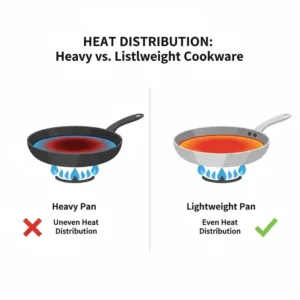
Lightweight materials heat faster, which translates to lower energy consumption. Aluminum cookware can reach cooking temperature in 2-3 minutes versus 6-8 minutes for heavy stainless steel or cast iron. Over a year of daily cooking, this adds up to meaningful energy savings.
The U.S. Department of Energy notes that using appropriately sized, efficient cookware can reduce cooking energy consumption by up to 20%. Lightweight pans contribute to this efficiency through faster heating and better heat transfer.
Maneuverability and Control
Ever tried flipping vegetables in a heavy sauté pan? It’s exhausting. Light cookware makes techniques like tossing, flipping, and pouring significantly easier. This improved control leads to better cooking results—you can quickly remove pans from heat, adjust positioning on burners, and transfer food with confidence.
Professional chefs appreciate this maneuverability, which explains why many restaurant kitchens use lightweight aluminum sauté pans for quick cooking tasks. The ability to work fast without fatigue during long service hours makes lightweight options invaluable.
Price Range Comparison
| Budget Category | Price Range | Example Brands | Best For |
|---|---|---|---|
| Budget | $20-$50 | T-fal Simply Cook, Basic ceramic | Students, first apartments |
| Mid-Range | $50-$150 | GreenLife, CAROTE, Tramontina | Daily home cooking |
| Premium | $150-$300 | Made In, Calphalon Premier, OXO | Serious home cooks |
| Luxury | $300+ | Professional carbon steel sets | Professional use, collectors |
Caring for Your Lightweight Cookware
Proper maintenance dramatically extends cookware lifespan. Here’s how to keep your light weight pots and pans performing optimally.
Cleaning Best Practices
For Nonstick Surfaces:
- Allow pans to cool completely before washing
- Use warm soapy water and soft sponges
- Avoid abrasive scrubbers that scratch coatings
- Hand wash whenever possible despite dishwasher ratings
- Dry thoroughly before storing
For Carbon Steel:
- Clean while still warm with hot water
- Use minimal soap to preserve seasoning
- Dry immediately to prevent rust
- Apply thin oil layer after each use
- Re-season periodically for best performance
Storage Solutions
Stacking lightweight pans requires protection to prevent scratching:
- Place pan protectors or paper towels between pieces
- Hang pans on wall racks to save space
- Store lids separately to reduce pressure
- Keep handles accessible for easy retrieval
- Organize by size for efficient storage
Common Mistakes to Avoid
Mistake #1: Using High Heat
Many cooks assume higher heat means faster cooking. With lightweight aluminum and nonstick surfaces, high heat causes warping and coating damage. Medium heat provides ample cooking power while protecting your investment.
Solution: Start with medium heat and adjust as needed. Most recipes require less heat than you think.
Mistake #2: Overloading Pans
Lightweight construction means less structural rigidity. Overloading a thin aluminum pan with heavy ingredients can cause permanent warping or bending.
Solution: Use appropriately sized cookware for your ingredients and avoid overfilling beyond manufacturer recommendations.
Mistake #3: Neglecting Seasoning
For carbon steel and certain other materials, skipping seasoning maintenance results in food sticking and surface rust.
Solution: Establish a regular seasoning routine—even 5 minutes of maintenance after cooking preserves nonstick properties.
Mistake #4: Dishwasher Damage
While many manufacturers list their cookware as dishwasher-safe, the harsh detergents and high heat accelerate nonstick coating breakdown.
Solution: Hand wash your lightweight cookware to maximize lifespan, even if technically dishwasher-rated.
User Compatibility Guide
| User Type | Recommended Material | Key Features | Budget Recommendation |
|---|---|---|---|
| Seniors/Arthritis | Ultra-light aluminum | <2 lbs, large handles | T-fal Simply Cook |
| Beginners | Ceramic nonstick | Easy cleanup, forgiving | GreenLife Soft Grip |
| Daily Cooks | Hard-anodized aluminum | Durable, versatile | CAROTE Granite |
| Professional-Level | Carbon steel | High heat, lifetime use | Made In Carbon Steel |
| Eco-Conscious | Ceramic/recycled aluminum | PFAS-free, sustainable | GreenLife (65% recycled) |
| Budget-Limited | Basic aluminum | Essential function | T-fal Simply Cook |
Stovetop Compatibility
Not all lightweight cookware works on every cooking surface. Here’s what you need to know:
Gas Stoves
✅ Compatible: All lightweight cookware types work excellently on gas
Benefits: Instant heat control, even flames, accommodates any base size
Tips: Center pans over burners for even heating
Electric Coil
✅ Compatible: Most lightweight options except very thin aluminum
Considerations: Ensure flat bottoms for maximum contact
Tips: Match pan size to burner size for efficiency
Glass/Ceramic Cooktops
⚠️ Compatible: Smooth-bottomed options only
Caution: Avoid dragging pans across surface
Requirements: Flat, smooth bases prevent scratching
Induction
⚠️ Selective Compatibility: Requires magnetic base
Works: Carbon steel, CAROTE Granite, some hard-anodized
Doesn’t Work: Pure aluminum, most ceramic-coated
Test: Place magnet on pan bottom—if it sticks, it’s induction-ready
Specialty Lightweight Options
RV and Camping Cookware
Travelers and RV enthusiasts require lightweight solutions that pack efficiently. Sets like the CAROTE detachable handle series or GSI Outdoors camping cookware provide full functionality at minimal weight and volume.
Features to prioritize for travel:
- Removable handles for compact storage
- Nesting design to save space
- Durable construction for bumpy roads
- Quick-heating for propane efficiency
Space-Saving Stackable Sets
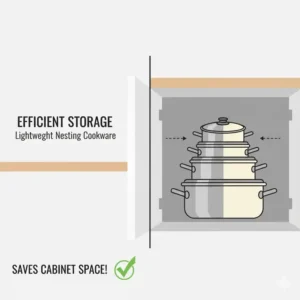
Modern lightweight cookware often includes stackable designs that reduce cabinet space by up to 50%. The Calphalon Premier Space-Saving line exemplifies this innovation with secure-locking lids and nesting pieces.
Benefits of stackable cookware:
- Frees up valuable cabinet space
- Prevents scratching through smart design
- Makes retrieval easier
- Ideal for small kitchens or apartments
Professional-Grade Lightweight
Professional kitchens increasingly adopt lightweight materials for efficiency. The Tramontina Professional series brings restaurant-grade performance home with NSF certification and reinforced construction that balances durability with manageable weight.
Real User Experiences
Case Study: Susan, Age 68, Arthritis Sufferer
“After my arthritis diagnosis, I thought my cooking days were numbered. Heavy cast iron and thick stainless steel became impossible to lift safely. When I switched to the T-fal Simply Cook set, it was life-changing. I can cook complete meals again without pain or risk of dropping pans. The 1.8-pound frying pan feels like nothing compared to my old 7-pound skillet.”
Case Study: Marcus, Professional Home Cook
“I was skeptical about lightweight cookware—I thought I needed heavy pans for good heat retention. The Made In Carbon Steel pan proved me wrong. At 4.3 pounds, it’s manageable for everyday cooking but still sears steaks beautifully. The weight savings adds up when you’re cooking multiple dishes.”
Case Study: Jennifer, College Student
“My first apartment kitchen was tiny with limited storage. The GreenLife set was perfect—lightweight enough to handle easily, colorful enough to stay out on the counter, and affordable on my student budget. The ceramic nonstick actually works, even with my mediocre cooking skills.”
Investment Analysis: Cost Per Use
When evaluating lightweight cookware value, consider cost per use rather than just upfront price:
| Cookware Type | Initial Cost | Expected Lifespan | Cost Per Year | Best Value For |
|---|---|---|---|---|
| Budget Aluminum | $30-50 | 1-3 years | $10-50/year | Short-term use |
| Quality Nonstick | $100-150 | 3-5 years | $20-50/year | Daily cooking |
| Hard-Anodized | $150-250 | 5-8 years | $19-50/year | Long-term investment |
| Carbon Steel | $100-200 | Lifetime | $5-10/year | Serious cooks |
| Premium Sets | $300-500 | 8-12 years | $25-63/year | Complete kitchen |
The sweet spot often lies in mid-range hard-anodized or quality nonstick sets that balance performance, durability, and price.
🛍️ Transform Your Cooking Today!
Ready to experience the freedom of lightweight cookware? Click on any bold product name above to explore options, compare prices, and read thousands of customer reviews. These top-rated options are waiting to make your cooking easier and more enjoyable. Your wrists will thank you! 🎯

Conclusion
Choosing lightweight cookware ultimately depends on your specific needs, cooking style, and budget. For most home cooks, I recommend starting with a quality aluminum or hard-anodized nonstick set like the GreenLife Soft Grip or CAROTE Granite. These provide excellent performance at reasonable prices while significantly reducing cooking fatigue.
If you’re willing to invest more and don’t mind maintenance, carbon steel options from Made In or OXO Obsidian offer professional results that improve over time. For budget-conscious shoppers, the T-fal Simply Cook delivers surprisingly good performance at entry-level pricing.
Remember, the best lightweight cookware is the kind you’ll actually use. Don’t let heavy pans discourage you from cooking. With today’s advanced materials and construction techniques, you can have professional-quality results without the professional-level weight.
The lightweight revolution in cookware has democratized cooking, making it accessible to people of all ages and abilities. Whether you’re managing arthritis, outfitting a first apartment, or simply tired of lifting heavy pans, there’s never been a better time to go light.
Frequently Asked Questions
✅ Lightweight cookware typically weighs 40-70% less than traditional options, primarily due to thinner gauge aluminum construction or carbon steel instead of cast iron. A lightweight 12-inch pan weighs 1.8-4.5 pounds compared to 6-10 pounds for heavy alternatives. The reduced weight comes from material selection and construction techniques that maintain strength while minimizing mass, making cooking easier without sacrificing performance...
✅ Most lightweight aluminum pans work best at low to medium heat (up to 350-450°F) while carbon steel options withstand extreme temperatures up to 1200°F. The key is matching heat level to coating type—nonstick aluminum requires gentler heat to preserve coatings, while uncoated carbon steel handles intense searing. Always check manufacturer specifications, as exceeding temperature limits damages nonstick surfaces and can warp thin aluminum...
✅ Quality lightweight nonstick cookware lasts 3-5 years with proper care, while budget options may need replacement after 1-2 years. Hard-anodized aluminum extends to 5-8 years, and carbon steel offers lifetime durability. Lifespan depends on coating quality, usage frequency, heat management, and cleaning methods. Hand washing, avoiding metal utensils, and using appropriate heat levels significantly extend nonstick coating life beyond manufacturer estimates...
✅ Lightweight cookware is ideal for arthritis sufferers, reducing wrist and joint strain by 50-70% compared to traditional heavy pans. Ultra-light options like T-fal Simply Cook (1.8 pounds) or GreenLife Soft Grip (2.1 pounds) enable comfortable cooking without pain or drop risk. The American Occupational Therapy Association recommends lightweight kitchen tools for individuals with reduced grip strength or joint issues, making these options both practical and therapeutic...
✅ Only lightweight cookware with magnetic bases works on induction—including carbon steel, some hard-anodized aluminum with steel plates, and granite-coated pans like CAROTE. Pure aluminum and ceramic-coated options without magnetic layers are incompatible. Test compatibility by placing a magnet on the pan bottom; if it sticks firmly, the cookware works on induction. Many modern lightweight sets now include induction bases without adding significant weight... ❓ What makes cookware lightweight compared to traditional options?
❓ Can lightweight pans handle high heat cooking?
❓ How long does lightweight nonstick cookware typically last?
❓ Is lightweight cookware safe for people with arthritis?
❓ Does lightweight cookware work on induction stovetops?
Recommended for You
- 7 Best Stainless Steel Products: Ultimate 2025 Guide
- Ceramic: 7 Top-Rated Sets Transforming Kitchens 2025 with Premium Quality & Design
- Copper Induction Pans: 7 Best That Work + Expert Guide 2025
Disclaimer: This article contains affiliate links. If you purchase products through these links, we may earn a small commission at no additional cost to you.
✨ Found this helpful? Share it with your friends! 💬🤗