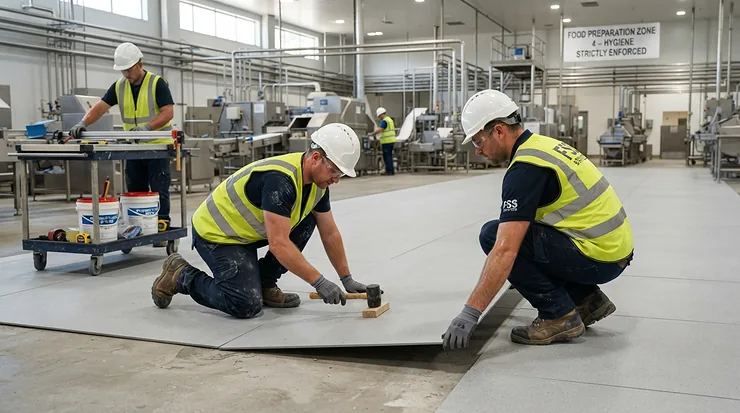
Which floor will still pass inspection after years of fryer splatter, daily wash-downs and loaded carts? For most operators weighing commercial kitchen flooring in 2027, the shortlist is quarry tile with epoxy grout, a poured resinous system such as urethane, or heat-welded sheet vinyl. The winner depends on how hot, wet and greasy each part of the room gets.
That last clause matters more than any brand name. A fryer line and a dish pit are different environments, and one material rarely wins both. Health departments also have the final word, so the floor you price has to be one your local inspector will accept.
I haven’t installed, poured or scrubbed any of these floors. What follows is built from a county plan-check sheet, OSHA’s own text, trade-press articles and product pages, and I point out where a source is a seller with something to sell. The method comes first, then the mistakes, then four inexpensive tools that protect whichever floor you pick.
Five steps to the best flooring for commercial kitchen use
Read the flooring rule your health department enforces, and ask about plan review before you request quotes.
Divide the kitchen into zones by heat, water and grease.
Match one floor type to each zone.
Ask for slip-resistance numbers and check the cove detail.
Plan the daily routine, drainage and cleaning gear before installation day.
Read the rule your inspector reads
Local codes grow out of model Food Code language: floors where food is handled should be smooth, durable and easy to clean, and California’s version adds nonabsorbent. The details then split by jurisdiction. Marin County, California, publishes a plan-check sheet on accepted flooring materials that shows how specific a county can get.
It accepts quarry, ceramic or porcelain tile at least 1/4 inch thick, with grout joints no wider than 1/4 inch and epoxy grout. It accepts troweled epoxy at least 1/4 inch thick and sealed against water, grease and acid. Sheet vinyl is allowed with conditions, including heat-welded seams, and in cooking and warewashing areas only an approved product such as Altro Safety Floor. Vinyl composition tile and sealed concrete are not accepted for kitchens there, and urethane is not mentioned at all, so applicants are told to ask.
The same sheet wants continuous coving at least 4 inches up the wall with a minimum 3/8-inch radius, and it requires samples and manufacturer specs to go to Environmental Health before anything is ordered. One county is not every county. Treat its sheet as a preview of the questions yours will ask.
Divide the room into zones, not one big floor
Heat, water, grease and cold each punish a floor differently. Sheet vinyl has very low heat tolerance according to an rd+d article by Steve Starr, and extremely hot equipment can melt it. Marin’s sheet bars vinyl from areas that stay below 55°F, which rules it out for walk-ins and reach-ins there. A dish pit adds standing water, and a grill line adds grease that makes a smooth surface treacherous.
Sketch the plan and mark four zones: the hot line, the wet area around the dish pit and floor drains, the prep and plating area, and cold storage. Dry storage and dining areas can fall under different rules (Marin allows vinyl composition tile in customer dining areas, for instance), so they rarely need the same floor.
Commercial kitchen flooring options, matched to each zone
Cost and lifespan figures in the table are material-only ranges from Flooring Clarity’s comparison of commercial kitchen floors. Labor, subfloor repair and downtime are extra. That source does not cover urethane, so its row leans on the rd+d article instead.
Floor type
Material cost
Lifespan
Where it does well
Where it struggles
Quarry tile with epoxy grout
$5 to $10 per sq ft
20+ years
Heat resistance, naturally textured surface
Unsealed grout traps dirt; a dropped stockpot can crack a tile
Troweled or poured epoxy
$3 to $12 per sq ft
10 to 20 years
Seamless, nonporous, chemical resistant
Slippery when wet unless textured; 3 to 5 days closed to install
Poured urethane
Not covered by Flooring Clarity
Not stated
Resists chemicals, moisture, heat and slipping; flexes with the slab
No cushioning; patching means cutting out a larger section
Heat-welded sheet vinyl
$4 to $8 per sq ft
7 to 15 years
Soft underfoot, 1 to 3 day install
Low heat tolerance; needs a smooth, dry slab
Sealed or polished concrete
$3 to $7 per sq ft (basic)
Not stated
Seamless, reuses the existing slab
Slippery wet unless treated; not accepted in Marin kitchens
Read the table by zone. Tile and urethane suit the hot line, because both tolerate heat. Epoxy and urethane make sense around drains since they have no grout to break down. Sheet vinyl belongs in lower-heat, drier zones where staff stand for hours, since the rd+d author notes its cushioning helps on long shifts.
Quarry tile deserves a closer look because its weak point is the grout. The rd+d author says all grout eventually breaks down and recommends industrial epoxy grout, the least porous option, though epoxy grout can crack if installed badly. He also calls a waterproof, anti-fracture membrane under the tile critical to the floor’s life. The upside: spot repairs are easier on tile than on urethane.
Poured urethane gets the strongest endorsement in that article, which calls it the most appropriate resinous option for a commercial kitchen over methyl methacrylate and epoxy. Installers who sell it make bigger claims, so ask for references and a written scope instead of relying on brochure language.
Concrete shows where sources disagree. Flooring Clarity lists polished concrete with sealers as a workable option, while Marin’s health department does not accept sealed concrete in kitchens. Your local rule decides.
Ask for slip-resistance numbers and check the cove
A technical bulletin from Creative Materials Corp. summarizing ANSI A326.3-2021 sorts floors into use categories. Back-of-house restaurant areas and anywhere oil, grease or fats may be present fall under the oils-and-greases category, which calls for a wet dynamic coefficient of friction (DCOF) above 0.55. A front-of-house area with an open kitchen needs above 0.50.
Two caveats from the same bulletin: the classifications rest on manufacturer declarations, and the standard does not prevent slips caused by sudden changes in traction. So ask the installer for the DCOF figure for the exact system and texture, not a general claim of “slip resistant”. Flooring Clarity warns that epoxy can turn slippery when wet if it has no texture.
Then pick up a tape measure. Marin’s sheet, for example, asks for a 4-inch minimum height, a 3/8-inch radius and a bullnosed top edge on tile coving, so measure what the installer proposes against your own county’s numbers.
Plan the routine before installation day
OSHA’s walking-working surfaces standard, 29 CFR 1910.22 says workroom floors should be kept clean and, to the extent feasible, dry. Where wet processes are used, drainage must be maintained and dry standing places such as mats should be provided where feasible. Surfaces must also be inspected “regularly and as necessary,” with hazards corrected before staff use them again.
The rd+d author adds the cleaning side: use the cleaners the floor maker recommends, skip the cheapest and harshest products, and finish by rinsing with clean water and squeegeeing off grease and dirt. Those two paragraphs are a shopping list, and the product section below follows it.
Where restaurant kitchen flooring goes wrong
Treating the cove and the equipment bases as an afterthought
Marin’s sheet requires the floor under equipment to be smooth, and a 90-degree floor-to-wall junction on tile is not approved. Settling cove height and radius is cheap before the pour and expensive after it, so put both in the quote, not on installation day.
Cleaning with whatever is in the closet
Harsh products shorten the life of floors and accessories alike. The rd+d article warns against the cheapest and harshest cleaners, and a mat maker’s care instructions, covered below, rule out harsh chlorine detergents. If the wrong chemical has already been used, stop and ask the installer which cleaner and dilution their warranty expects.
Ignoring moisture and heat limits
Sheet vinyl needs fully cured concrete beneath it. According to the rd+d article, trapped moisture creates hydrostatic pressure that can split seams, cause bubbling and grow mold under the sheet. Heat is the other limit, which is why the hot line and vinyl rarely belong together.
Four tools that protect the floor you chose
None of these replaces the floor, but each handles a step from the method above: a dry place to stand, the daily degrease, the grout scrub and the final dry-down.
A dish pit or fryer line is exactly where OSHA’s dry-standing-place language stops being abstract. This mat measures 3 by 5 feet and is 3/4 inch thick, with drain holes and tapered edges so liquid doesn’t pool, according to Webstaurant’s product page. The page also promises a 5-year guarantee against breakdown from grease if the mat is cared for properly, and it shows 4.9 out of 5 stars from 11 reviews, though most reviews refer to the red version.
Listings for the same model disagree on wording. One calls it grease-proof, while Webstaurant’s spec table lists grease-resistant, and its own FAQ explains that resistant mats suit limited grease and proof mats suit heavy exposure. Confirm which one you are buying before you put it behind a fryer.
Pros:
✅ Drain holes and tapered edges to keep liquid from pooling and to reduce tripping
✅ 3/4-inch anti-fatigue thickness for long standing shifts
✅ Five-year grease guarantee on the retailer page, with proper care
Cons:
❌ Care rules exclude power washers, steam cleaning and stiff-bristle brushes, which are common kitchen tools
❌ Hand washing with hot, soapy water is the only approved method on that page
Spray degreasers are the wrong format for a floor. Bob Vila’s degreaser tests rated Zep’s all-purpose spray and Lysol’s Kitchen Pro as light-to-medium duty, and neither lists floors as an approved surface. This concentrate is aimed at the job: Procter & Gamble’s Pro page describes it as a cleaner for greasy floors in commercial kitchens, and retailer listings say it works on quarry tile, unwaxed floors and other washable surfaces and can be used with chlorine bleach.
It is not a sanitizer, so food-contact surfaces still need one afterward. It is also written for unwaxed, non-finished surfaces. If your floor is a coated epoxy or urethane system, take the installer’s approved cleaner list over any retail listing. Retail listings give the dilution as 1 ounce per gallon of water, so a single gallon of concentrate makes up to 128 gallons of solution.
A stiff brush helps the floor and hurts the mat, which is why it sits at number three, not number one. Libman’s model 1681 has a rigid, non-swivel head with a 13.5 by 5 inch scrubbing surface, super stiff unflagged polymer fibers, and a powder-coated steel handle, according to Lowe’s listing, which describes it as suited to residential and commercial use. That non-swivel head concentrates pressure along grout lines, the weak point of tile floors.
A quarry tile manufacturer, Metropolitan Ceramics, recommends a weekly deck-brush scrub for its tile. That is a seller’s own care advice, so apply it to tile and grout only. Check with your installer before using any stiff brush on an epoxy or urethane surface.
The rd+d article’s maintenance advice ends with rinsing and squeegeeing, and this is the tool for the second half. Libman’s spec sheet describes a 24-inch curved, vulcanized natural-rubber blade meant to remove and contain liquid, a steel backing with an electrostatic-coated finish, and a 1.13-inch lacquered wood handle. Gofoodservice lists the overall length at 63.25 inches and says it is made in the USA.
Libman sells several 24-inch squeegees, so match model 1276 on the listing: the 542 is also curved, and the 515 uses a synthetic-rubber blade marketed as resistant to oils and petroleum-based liquids. I found no kitchen-grease comparison between natural and synthetic blades, and the listings I read carried no customer reviews, so the choice rests on specs. Pulling water toward a floor drain also supports OSHA’s call for drainage where wet processes are used.
Questions owners ask before they sign a flooring quote
❓ What are the best commercial kitchen flooring options for a small restaurant?
✅ Quarry tile with epoxy grout, troweled or poured epoxy, poured urethane and heat-welded sheet vinyl are the usual candidates. The best one depends on heat, water and local code. Get your health department's approved-materials list first, then ask installers to price one option per zone.
❓ Can I use vinyl or sealed concrete in a restaurant kitchen?
✅ It depends on the jurisdiction. Marin County accepts sheet vinyl only with conditions, including heat-welded seams, and bars vinyl composition tile and sealed concrete in kitchens. Other counties differ. Ask your health department for its list in writing before ordering.
❓ Does commercial restaurant flooring need to be slip resistant?
✅ Yes. Every source I read treats traction as a core requirement. ANSI A326.3-2021 sets a wet DCOF above 0.55 for back-of-house areas with oil or grease, though that number is manufacturer-declared. Ask for the figure for your exact system and texture.
❓ How much does restaurant kitchen flooring cost?
✅ Flooring Clarity's material-only ranges run from about $3 to $12 per square foot for epoxy, $5 to $10 for quarry tile, and $4 to $8 for sheet vinyl. Labor, slab repair and downtime are extra. Flooring Clarity doesn't cover urethane, so request quotes.
❓ How long will the kitchen be closed while the floor goes in?
✅ Flooring Clarity puts epoxy at a 3 to 5 day install with the kitchen closed, and sheet vinyl at 1 to 3 days. For tile and urethane, ask each installer for a written schedule that includes cure time.
A decision rule for your commercial kitchen
Choose by zone, then confirm with your inspector. For the hot line and wet area, tile with epoxy grout or a resinous floor such as urethane are the stronger candidates. Sheet vinyl suits cooler, drier zones. Whatever you pick for commercial kitchen flooring, get the cove detail and the slip-resistance number in writing before work starts.
Then buy the daily gear. A drained mat like the Cactus Mat VIP Black Cloud 2200-35H gives staff a dry place to stand, the Mr. Clean Professional Degreasing Floor Cleaner handles greasy tile, the Libman 14-in Poly Fiber Stiff Deck Brush scrubs the grout, and the Libman Commercial 1276 24-Inch Heavy-Duty Curved Floor Squeegee finishes the job. Check current availability below on Amazon.com for each of them.
Disclaimer: This post contains affiliate links. As an Amazon Associate, I earn from qualifying purchases made through these links, at no additional cost to you.
Take the zone table to your installer before the quotes come in.
At SmartCookLab, we are passionate about cooking and helping you find the best kitchen appliances and tools. Our team provides expert reviews, buying guides, and practical tips to enhance your cooking experience.
Home » Commercial kitchen flooring: A Practical Guide (2027) Which floor will still pass inspection after years of fryer splatter, daily wash-downs and loaded carts? For most operators weighing commercial
Home » Commercial kitchen flooring: A Practical Guide (2027) Which floor will still pass inspection after years of fryer splatter, daily wash-downs and loaded carts? For most operators weighing commercial
Home » Commercial kitchen flooring: A Practical Guide (2027) Which floor will still pass inspection after years of fryer splatter, daily wash-downs and loaded carts? For most operators weighing commercial