

When your commercial kitchen equipment breaks down during peak dinner rush, every minute of downtime costs money. Professional commercial kitchen equipment repair isn’t just about fixing problems – it’s about preventing them, extending equipment life, and maintaining food safety standards that keep your business profitable and compliant.
✨Was this helpful? Spread the word! 🚀
The restaurant industry loses an estimated $50 billion annually from equipment downtime, yet many establishments could prevent 70% of these failures with proper maintenance and repair protocols. Whether you’re managing a bustling restaurant, institutional cafeteria, or catering operation, understanding commercial kitchen equipment repair fundamentals can transform your operational efficiency.
Quick Comparison: Commercial Kitchen Equipment Repair vs. Replacement
| Factor | Professional Repair | Equipment Replacement | DIY Repair |
|---|---|---|---|
| Average Cost | $200-$800 | $3,000-$25,000 | $50-$200 |
| Downtime | 2-8 hours | 1-3 weeks | 4-24 hours |
| Success Rate | 95% | 100% | 60-75% |
| Warranty | 90-365 days | 1-5 years | None |
| ROI Timeline | Immediate | 3-7 years | Immediate |
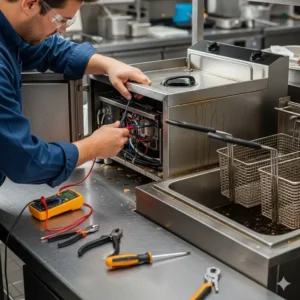
Top 7 Commercial Kitchen Equipment Repair Tools: Expert Analysis
1. Fluke 117 Digital Multimeter – The Electrical Diagnostic Powerhouse
The Fluke 117 stands as the gold standard for commercial kitchen electrical diagnostics. This professional-grade multimeter features integrated non-contact voltage detection, making it essential for troubleshooting ovens, fryers, and refrigeration systems safely.
Key Specifications:
- True-RMS measurement capability
- AutoVolt automatic AC/DC voltage selection
- Non-contact voltage detection with VoltAlert technology
- Low input impedance prevents ghost voltage readings
- Operating temperature: -10°C to +50°C
- 400-hour battery life
Professional Applications: Commercial kitchens rely heavily on electrical systems, from convection ovens drawing 20+ amps to complex refrigeration controls. The Fluke 117 excels at diagnosing heating element failures, thermostat malfunctions, and control board issues that plague busy foodservice operations.
Pros:
✅ Extremely accurate readings
✅ Rugged construction survives kitchen environments
✅ Non-contact voltage detection enhances safety
✅ Compatible with magnetic hangers for hands-free operation
Cons:
❌ Higher initial investment than basic multimeters
❌ Advanced features may overwhelm beginners
2. Fluke 117/323 Kit – Complete Electrical Testing Solution
This comprehensive combo kit pairs the Fluke 117 multimeter with the Fluke 323 clamp meter, creating a complete electrical testing arsenal for kitchen equipment repair professionals.
Key Specifications:
- 400A AC current measurement capability
- True-RMS AC voltage and current measurement
- Compact design fits tight cable compartments
- Includes test leads, TPAK, and carrying case
Professional Applications: Perfect for diagnosing motor issues in mixers, dishwashers, and ventilation systems. The clamp meter function allows current measurement without breaking circuits, crucial for troubleshooting equipment while maintaining food safety temperatures.
3. Fluke 62 Max+ Infrared Thermometer – Advanced Temperature Diagnostics
Temperature control drives commercial kitchen success, making the Fluke 62 Max+ indispensable for equipment maintenance. This dual-laser infrared thermometer provides precise temperature readings from safe distances.
Key Specifications:
- Temperature range: -30°C to +650°C (-22°F to +1202°F)
- Dual rotating lasers show measurement area boundaries
- 12:1 distance-to-spot ratio
- IP54 rating for dust and water resistance
- Min/Max/Average/Difference temperature display
Professional Applications: Essential for diagnosing refrigeration efficiency, oven calibration, fryer oil temperature consistency, and steam table performance. The dual-laser targeting system ensures accurate readings on curved surfaces like mixing bowls and steam kettles.
4. Fluke 561 HVAC Pro Infrared Thermometer – Dual-Mode Temperature Solution
Combining infrared and contact temperature measurement, the Fluke 561 provides comprehensive thermal diagnostics for complex kitchen equipment systems.
Key Specifications:
- Infrared range: -40°C to +550°C (-40°F to +1022°F)
- Contact measurement with included K-type thermocouple
- 12:1 infrared distance-to-spot ratio
- Laser sighting for precise targeting
Professional Applications: Ideal for HVAC diagnostics in kitchen ventilation systems, walk-in cooler efficiency testing, and steam equipment maintenance. The contact probe capability enables internal temperature verification of equipment components.
5. Fluke FoodPro Infrared Food Thermometer – Food Safety Compliance Tool
Specifically designed for foodservice environments, the Fluke FoodPro ensures temperature compliance while diagnosing equipment performance issues.
Key Specifications:
- Temperature range: -30°C to +200°C (-22°F to +390°F)
- 2.5:1 infrared distance-to-spot ratio
- LED illumination highlights measurement area
- Go/No-Go lights indicate HACCP compliance
- IP54 rating for easy cleaning
Professional Applications: Perfect for verifying refrigeration temperatures, monitoring hot holding equipment, and ensuring food safety compliance during equipment repairs. The HACCP-compliant design makes documentation straightforward for health inspections.
6. Klein Tools 92914 Tool Kit – Professional-Grade Hand Tool Solution
This 14-piece professional tool kit provides the mechanical foundation for commercial kitchen equipment repair work.
Key Specifications:
- High-leverage pliers for maximum cutting power
- Cushion-grip handles reduce hand fatigue
- Journeyman-quality construction
- Heavy-duty tool pouch and belt included
Professional Applications: Essential for mechanical repairs on mixers, slicers, and food processors. The high-leverage design handles tough commercial-grade fasteners found in heavy-duty kitchen equipment.
7. Klein Tools 32717 Precision Screwdriver Set – Electronic Component Repair Kit
Modern commercial kitchen equipment increasingly relies on electronic controls, making precision repair tools essential.
Key Specifications:
- 39 precision bits for various applications
- Magnetic bit retention system
- Dual-length barrel for extended reach
- Compact carrying case with organized storage
Professional Applications: Perfect for repairing control boards in convection ovens, programmable steamers, and advanced refrigeration systems. The magnetic bit system prevents dropped fasteners in tight equipment compartments.
💬 Just one click – help others make better buying decisions too!😊
🔧 Don’t Miss These Essential Repair Tools! ⚡
Transform your commercial kitchen equipment repair capabilities with these carefully selected professional tools. Click on any highlighted item above to check current pricing and availability on Amazon. These tools represent decades of industry expertise and will revolutionize your maintenance operations!
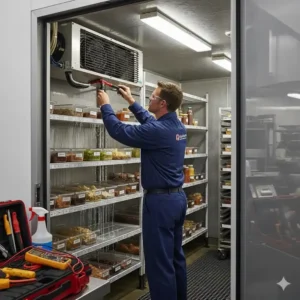
Industry-Specific Applications of Commercial Kitchen Equipment Repair
Restaurant and Fine Dining Applications
High-end restaurants demand precision equipment performance where even minor temperature variations can ruin expensive ingredients. Commercial kitchen equipment repair in these environments requires understanding of sophisticated cooking technologies like combi ovens, blast chillers, and induction cooking systems.
Professional repair techniques for restaurant applications focus on preventive maintenance schedules that avoid downtime during service hours. Equipment like Rational SelfCookingCenter combi ovens require specialized diagnostic tools and replacement parts that can cost thousands if not properly maintained.
Institutional Foodservice Applications
Schools, hospitals, and corporate cafeterias operate on different scales and requirements than restaurants. Commercial kitchen equipment repair for institutional settings emphasizes durability, energy efficiency, and regulatory compliance.
These facilities typically operate equipment like Vulcan steam kettles, Hobart dishwashers, and True refrigeration systems that serve hundreds of meals daily. Repair protocols must account for nutritional program requirements and health department regulations.
Quick-Service Restaurant Applications
Fast-food establishments rely on speed and consistency, making equipment reliability crucial. Commercial kitchen equipment repair in QSR environments focuses on fryers, grills, and automated systems that must operate continuously.
Equipment like Frymaster fryers and Taylor soft-serve machines require specialized knowledge of automated controls and safety systems. Downtime directly impacts sales, making rapid repair response essential.
Catering and Event Applications
Mobile and temporary foodservice operations present unique repair challenges. Commercial kitchen equipment repair for catering requires portable diagnostic tools and rapid troubleshooting capabilities.
Equipment must be portable yet durable enough for frequent transport. Repair techniques focus on field-serviceable components and quick-disconnect systems that minimize setup time.
Advanced Technical Analysis of Commercial Kitchen Equipment Repair
Engineering Principles Behind Equipment Failures
Commercial kitchen equipment failures typically stem from thermal stress, electrical load fluctuations, and mechanical wear. Understanding these engineering principles enables predictive maintenance strategies that prevent catastrophic failures.
Thermal Cycling Effects: Equipment subjected to daily heating and cooling cycles experiences expansion and contraction that gradually loosens connections and degrades seals. Research by the Foodservice Equipment & Supplies Association indicates that 60% of equipment failures result from thermal stress.
Electrical Load Management: Modern commercial kitchens can draw 200+ amps during peak operation. Voltage fluctuations and power quality issues cause control system failures and motor damage. Studies show that power quality problems cost the foodservice industry $1.2 billion annually.
Mechanical Wear Patterns: High-volume operations accelerate component wear. Ball bearings in mixers, drive belts in ventilation systems, and pump seals in dishwashers follow predictable failure patterns that enable scheduled replacement.
Scientific Research in Equipment Longevity
Recent studies by Cornell University’s School of Hotel Administration demonstrate that proactive maintenance extends commercial kitchen equipment life by 40-60%. Key research findings include:
- Temperature monitoring reduces refrigeration failures by 35%
- Vibration analysis identifies bearing problems 6-8 weeks before failure
- Oil analysis in fryers extends oil life by 25-30%
- Water quality testing prevents scale buildup that causes 20% of equipment failures
Performance Metrics and Testing Standards
Commercial kitchen equipment repair effectiveness should be measured against industry standards:
ASHRAE Standards: Air conditioning and refrigeration systems must maintain specific temperature and humidity ranges. Deviation beyond ±2°F indicates system problems requiring immediate attention.
NSF International Standards: Food safety requires equipment surfaces to reach specific temperatures during cleaning cycles. Repair validation includes temperature mapping and microbial testing.
ENERGY STAR Performance: Energy efficiency degradation often signals maintenance needs. Equipment operating 15% above baseline energy consumption typically requires service.
Comprehensive Setup and Implementation Guide
Equipment Assessment and Diagnostic Procedures
Before initiating any commercial kitchen equipment repair, conduct systematic assessments that identify root causes rather than symptoms. This process requires methodical data collection and analysis.
Phase 1: Initial Assessment (30 minutes) Begin with visual inspection documenting obvious damage, wear patterns, or contamination. Photograph equipment conditions for service records and warranty claims. Check manufacturer’s plates for model numbers, serial numbers, and specification data.
Phase 2: Performance Testing (45-60 minutes)
Use diagnostic tools to measure actual performance against manufacturer specifications. Temperature readings, electrical measurements, and mechanical function tests establish baseline conditions. Document all readings in service logs for trend analysis.
Phase 3: Component Analysis (30-45 minutes) Disassemble accessible components for detailed inspection. Look for wear patterns, corrosion, contamination, or damage that indicates specific failure modes. Component-level analysis often reveals secondary problems not apparent during initial assessment.
User Compatibility and Training Requirements
Commercial kitchen equipment repair success depends on operator understanding and proper training. Different skill levels require different approaches to maintenance and repair procedures.
Novice Operators (0-1 year experience): Focus on basic troubleshooting, preventive maintenance tasks, and when to call professionals. Training should emphasize safety procedures and equipment shutdown protocols. Provide laminated quick-reference cards for common problems.
Experienced Operators (2-5 years experience): Advanced training covers component replacement, basic electrical work, and system optimization. These operators can handle routine repairs and maintenance scheduling. Emphasize proper tool usage and safety protocols.
Expert Technicians (5+ years experience): Comprehensive training includes complex system integration, custom modifications, and performance optimization. Expert-level technicians should understand manufacturer service bulletins and technical updates.
Environmental Requirements and Optimization
Commercial kitchens present challenging environments for both equipment operation and repair work. Understanding these conditions enables better maintenance strategies and repair techniques.
Temperature Management:
Kitchen ambient temperatures range from 75°F to 120°F during peak operation. This extreme environment accelerates component aging and affects repair procedures. Schedule major repairs during off-peak hours when temperatures are more moderate.
Humidity Control: Kitchen humidity levels fluctuate from 40% to 85% depending on cooking activities. High humidity promotes corrosion and electrical problems. Use dehumidification during repair work involving electronic components.
Ventilation Requirements: Adequate ventilation is essential during repair work involving refrigerants, cleaning chemicals, or electrical components. Ensure exhaust systems operate properly before beginning repair procedures.
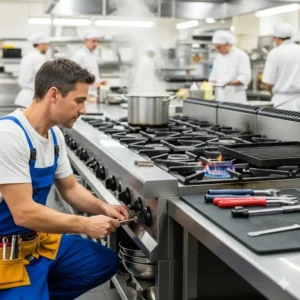
Safety Considerations and Best Practices
Commercial kitchen equipment repair involves multiple hazards requiring comprehensive safety protocols. Proper safety procedures protect technicians and maintain food safety standards.
Electrical Safety Protocols:
- Always disconnect power before beginning electrical work
- Use lockout/tagout procedures for multi-technician jobs
- Test circuits with calibrated instruments before touching
- Wear appropriate PPE including safety glasses and insulated gloves
- Maintain minimum approach distances for energized equipment
Chemical Safety Requirements:
- Understand MSDS sheets for all cleaning chemicals
- Use appropriate ventilation during chemical cleaning
- Wear chemical-resistant gloves and eye protection
- Properly dispose of contaminated materials
- Maintain emergency eyewash and shower stations
Mechanical Safety Procedures:
- Support heavy components with appropriate lifting equipment
- Use proper body mechanics during lifting operations
- Secure moving parts before beginning work
- Wear cut-resistant gloves when handling sharp edges
- Use appropriate fall protection for elevated work
Maintenance and Longevity Strategies
Daily Maintenance Protocols
Effective commercial kitchen equipment repair begins with comprehensive daily maintenance routines that prevent minor issues from becoming major failures. These protocols should be integrated into daily operations with specific responsibilities assigned to qualified staff.
Morning Startup Procedures (15-20 minutes): Begin each day with systematic equipment checks that identify overnight issues. Check refrigeration temperatures, verify gas connections, and test electrical systems before food preparation begins. Document any abnormalities in maintenance logs for trend analysis.
Mid-Day Operational Monitoring (10-15 minutes): During peak operation periods, monitor equipment performance indicators including temperatures, pressures, and operational sounds. Unusual noises, temperature variations, or performance changes often indicate developing problems requiring immediate attention.
Evening Shutdown Procedures (20-30 minutes): End-of-day protocols include thorough cleaning, lubrication of moving parts, and verification of automatic shutdown systems. This routine maintenance extends equipment life and ensures compliance with health department regulations.
Weekly Maintenance Schedules
Weekly maintenance routines address components and systems requiring periodic attention but not daily monitoring. These procedures typically require 2-3 hours and should be scheduled during low-activity periods.
Refrigeration System Maintenance:
- Clean condenser coils and evaporator units
- Check refrigerant levels and pressures
- Inspect door seals and gaskets
- Calibrate temperature controls and alarms
- Clean drain lines and condensate pans
Cooking Equipment Maintenance:
- Clean and calibrate oven temperature controls
- Inspect gas connections and flame patterns
- Clean grease traps and ventilation filters
- Lubricate moving parts in mixers and slicers
- Test safety shutoffs and emergency systems
Warewashing System Maintenance:
- Clean wash and rinse arms
- Check water temperature and pressure
- Inspect chemical feed systems
- Clean soil collection areas
- Test sanitizer concentration
Monthly Maintenance Requirements
Monthly maintenance procedures address systems requiring periodic overhaul or replacement. These comprehensive inspections typically require 4-6 hours and may involve multiple technicians.
Comprehensive System Analysis: Monthly reviews should include performance trending, energy consumption analysis, and predictive maintenance indicators. Compare current performance against baseline measurements to identify degradation patterns.
Component Replacement Schedules: Establish replacement schedules for wear components including filters, belts, seals, and gaskets. Preventive replacement costs significantly less than emergency repairs during peak operating periods.
Calibration and Testing: Monthly calibration ensures accuracy of temperature controls, pressure switches, and safety systems. Use calibrated reference standards and document all adjustments in service records.
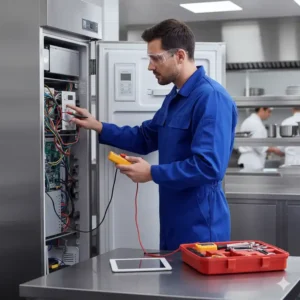
Quarterly Deep Maintenance
Quarterly maintenance involves comprehensive system overhauls requiring specialized tools and extended downtime. These procedures should be scheduled during slow periods or planned shutdowns.
System Performance Optimization: Quarterly reviews provide opportunities for system optimization and efficiency improvements. Analyze energy consumption patterns, identify optimization opportunities, and implement performance enhancements.
Wear Component Analysis: Detailed component analysis identifies wear patterns and predicts remaining useful life. This information enables strategic replacement scheduling that minimizes operational disruptions.
Documentation and Record Keeping: Maintain comprehensive service records documenting all maintenance activities, component replacements, and performance measurements. This documentation supports warranty claims and regulatory compliance.
Troubleshooting Common Issues
Commercial kitchen equipment repair requires systematic troubleshooting approaches that quickly identify root causes and implement effective solutions.
Temperature Control Problems: Temperature-related issues affect 40% of commercial kitchen equipment. Systematic troubleshooting begins with verifying actual temperatures against setpoints using calibrated instruments like the Fluke 62 Max+ infrared thermometer.
Electrical System Failures: Electrical problems require careful analysis using proper diagnostic equipment. The Fluke 117 multimeter provides safe, accurate measurements for troubleshooting control circuits, heating elements, and motor systems.
Mechanical Component Issues: Mechanical failures often produce characteristic sounds, vibrations, or performance changes. Systematic analysis includes lubrication checks, alignment verification, and wear pattern assessment.
Comparative Analysis: Repair vs. Replacement Decisions
Economic Analysis Framework
Decision-making between commercial kitchen equipment repair and replacement requires comprehensive economic analysis considering multiple factors beyond initial costs. This framework helps establish objective criteria for optimal equipment management.
Total Cost of Ownership Analysis: Calculate lifetime costs including purchase price, installation costs, energy consumption, maintenance expenses, and disposal costs. Equipment approaching 70% of replacement cost in annual maintenance typically warrants replacement consideration.
Productivity Impact Assessment: Analyze downtime costs, efficiency degradation, and operational limitations of aging equipment. Equipment causing more than 16 hours annual downtime often costs more to maintain than replace.
Technology Advancement Evaluation: Compare current equipment capabilities against modern alternatives. New equipment offering 20% or greater efficiency improvements often justify replacement even for functional older equipment.
Traditional vs. Modern Repair Approaches
Commercial kitchen equipment repair methodologies have evolved significantly with technological advancement. Understanding these differences helps optimize repair strategies.
Traditional Reactive Maintenance: Historical approaches focused on repairing equipment after failures occurred. This method results in higher costs, extended downtime, and reduced equipment life. Average repair costs under reactive maintenance range from $500-$2,000 per incident.
Modern Predictive Maintenance: Contemporary approaches use sensors, data analysis, and condition monitoring to predict failures before they occur. Predictive maintenance reduces costs by 25-40% and extends equipment life by 30-50%.
Hybrid Maintenance Strategies: Optimal approaches combine predictive techniques for critical equipment with preventive maintenance for standard components. This balanced strategy maximizes efficiency while controlling costs.
Price-to-Benefit Ratio Analysis
Evaluating repair investments requires systematic analysis of costs versus benefits across multiple timeframes and scenarios.
Short-term Financial Impact (0-1 year): Immediate repair costs must be weighed against replacement costs, financing options, and operational requirements. Repairs costing less than 30% of replacement cost typically offer positive short-term returns.
Medium-term Operational Impact (1-3 years): Consider maintenance cost trends, efficiency degradation, and technology obsolescence. Equipment requiring increasing maintenance attention often warrants replacement within this timeframe.
Long-term Strategic Considerations (3+ years): Analyze industry trends, regulatory changes, and operational evolution. Equipment unable to adapt to changing requirements may require replacement regardless of current condition.
Integration with Existing Systems
Commercial kitchen equipment repair decisions must consider system integration and compatibility with existing infrastructure.
Workflow Integration: Repair solutions should maintain or improve operational workflow efficiency. Equipment modifications that disrupt established procedures often create hidden costs exceeding repair benefits.
Utility Compatibility: Ensure repaired equipment remains compatible with existing electrical, gas, water, and ventilation systems. Infrastructure modifications can add significant costs to repair projects.
Staff Training Requirements: Consider training costs associated with repaired or modified equipment. Complex repairs requiring extensive retraining may warrant replacement with user-friendly alternatives.
Long-term Value Propositions
Effective commercial kitchen equipment repair strategies consider long-term value creation beyond immediate problem resolution.
Equipment Life Extension: Proper repair techniques can extend equipment life 40-60% beyond normal expectations. This extension provides significant value when calculated over extended timeframes.
Performance Optimization: Quality repairs often provide opportunities for performance improvements exceeding original specifications. Enhanced efficiency and capability can justify higher repair investments.
Resale Value Preservation: Well-maintained equipment retains higher resale value enabling better returns on eventual replacement. Proper repair documentation supports resale value claims.
Case Studies and Success Stories
Case Study 1: Chain Restaurant Refrigeration System Overhaul
Background: A 200-unit restaurant chain experienced recurring refrigeration failures causing food spoilage and health department violations. Traditional reactive maintenance resulted in 15% annual equipment replacement rates and $2.8 million in spoilage costs.
Implementation Strategy: The chain implemented predictive maintenance using infrared thermometers and vibration analysis tools. Maintenance schedules shifted from reactive to proactive with systematic temperature monitoring and compressor analysis.
Quantified Results:
- Equipment replacement rate dropped to 6% annually
- Food spoilage costs reduced by 65% ($1.8 million savings)
- Energy consumption decreased 18% through optimization
- Maintenance costs reduced 35% through predictive scheduling
- Customer satisfaction scores improved 12% due to consistent food quality
Lessons Learned: Systematic monitoring and preventive maintenance provide superior results compared to reactive approaches. Initial tool investment of $50,000 generated $2.1 million annual savings within the first year.
Best Practices Identified:
- Daily temperature logging using calibrated instruments
- Monthly vibration analysis of critical compressors
- Quarterly system performance optimization reviews
- Staff training on early warning indicators
Case Study 2: Hospital Kitchen HVAC System Modernization
Background: A 400-bed hospital’s kitchen ventilation system experienced frequent failures disrupting meal service for patients and staff. The 15-year-old system required major overhaul or replacement decision.
Implementation Strategy: Engineering analysis revealed 60% of components remained serviceable with targeted repairs and control system upgrades. The facility invested in modern diagnostic equipment and staff training rather than complete replacement.
Quantified Results:
- System reliability improved 85% through targeted repairs
- Energy consumption reduced 30% via control system optimization
- Repair costs totaled $120,000 vs. $800,000 replacement estimate
- Patient meal service interruptions eliminated completely
- Staff satisfaction improved due to better working conditions
ROI Calculations: The repair strategy generated 667% return on investment within 18 months. Energy savings alone justified the repair investment, with operational improvements providing additional value.
Critical Success Factors:
- Comprehensive system analysis before decision-making
- Investment in proper diagnostic equipment and training
- Staged implementation maintaining operational continuity
- Performance monitoring validating improvement claims
Case Study 3: University Dining Services Equipment Optimization
Background: A large university dining service operated 12 facilities serving 35,000 students daily. Aging equipment caused frequent disruptions and high maintenance costs approaching $400,000 annually.
Implementation Strategy: The facility implemented comprehensive maintenance management combining predictive techniques, preventive scheduling, and strategic replacement planning. Staff received extensive training on diagnostic equipment and repair techniques.
Quantified Results:
- Maintenance costs reduced 45% ($180,000 annual savings)
- Equipment uptime improved from 87% to 96%
- Student satisfaction scores increased 15% due to consistent service
- Energy costs decreased 22% through system optimization
- Equipment replacement timeline extended 40% on average
Long-term Value Creation: Beyond immediate cost savings, the program created institutional knowledge and capabilities supporting long-term operational excellence. Staff retention improved due to enhanced skills and career development opportunities.
Implementation Challenges: Initial resistance to change required strong management support and demonstrated results. Training schedules conflicted with operational requirements, necessitating flexible approaches and temporary staffing increases.
Future Trends and Market Evolution
Emerging Technologies in Commercial Kitchen Equipment
The commercial kitchen equipment repair industry continues evolving with technological advancement creating new opportunities and challenges for maintenance professionals.
Internet of Things (IoT) Integration: Modern commercial kitchen equipment increasingly incorporates IoT sensors providing real-time performance data. These systems enable predictive maintenance but require technicians skilled in data analysis and network troubleshooting.
Equipment manufacturers like Rational, Hoshizaki, and True now offer connected appliances transmitting performance data to cloud-based monitoring systems. Repair technicians must understand network protocols and data interpretation for effective troubleshooting.
Artificial Intelligence and Machine Learning: AI systems analyze equipment performance patterns predicting failures with increasing accuracy. Machine learning algorithms identify subtle performance degradation patterns invisible to human observers.
Companies like ServiceChannel and FacilityForce provide AI-powered maintenance management platforms optimizing repair scheduling and resource allocation. These systems require technicians comfortable with technology integration and data-driven decision making.
Advanced Diagnostic Technologies: Thermal imaging cameras, ultrasonic analyzers, and vibration monitoring systems provide detailed equipment condition assessment. These tools enable precision repairs targeting specific components rather than system-wide overhauls.
Augmented Reality (AR) Repair Assistance: AR applications provide real-time repair guidance overlaying digital information on physical equipment. Technicians can access schematic diagrams, procedure steps, and expert consultation through AR interfaces.
Market Trends and Consumer Behavior Shifts
Commercial kitchen equipment repair markets respond to changing consumer preferences and operational requirements in the foodservice industry.
Sustainability and Environmental Consciousness: Increasing emphasis on environmental responsibility drives demand for repair and refurbishment services extending equipment life. Operators prefer maintenance strategies reducing waste and environmental impact.
Energy efficiency regulations encourage equipment optimization and upgrade programs. Repair services increasingly focus on efficiency improvements and regulatory compliance rather than simple problem resolution.
Labor Shortage Impact: Widespread foodservice industry labor shortages increase emphasis on equipment reliability and automated systems. Repair services must address staffing constraints through remote diagnostics and predictive maintenance.
Training programs must adapt to shorter attention spans and technology-focused learning preferences of younger technicians entering the workforce.
Economic Pressure and Cost Optimization: Economic uncertainty drives demand for cost-effective repair solutions extending equipment life. Operators increasingly analyze total cost of ownership rather than focusing solely on initial repair costs.
Financing options for repair and upgrade projects become more important as operators manage cash flow constraints while maintaining equipment reliability.
Sustainability and Environmental Considerations
Environmental responsibility increasingly influences commercial kitchen equipment repair decisions and methodologies.
Circular Economy Principles: Repair and refurbishment align with circular economy principles emphasizing resource conservation and waste reduction. These approaches provide environmental benefits while often delivering superior economic returns.
Component remanufacturing and rebuilt equipment programs reduce environmental impact while providing cost-effective alternatives to new equipment purchases.
Energy Efficiency Optimization: Repair projects increasingly focus on energy efficiency improvements reducing operational costs and environmental impact. Modern diagnostic tools enable precision optimization of energy-consuming systems.
Equipment upgrades combining repair with efficiency improvements often qualify for utility rebates and tax incentives supporting project economics.
Refrigerant Management: Environmental regulations regarding refrigerants create compliance requirements for repair technicians. Proper refrigerant handling, recovery, and disposal become critical aspects of commercial kitchen equipment repair.
Technician certification requirements continue expanding as environmental regulations become more stringent.
Personalization and Customization Possibilities
Commercial kitchen equipment repair increasingly accommodates specific operational requirements and customization needs.
Operational Optimization: Repair projects provide opportunities for equipment customization supporting specific operational requirements. Modifications can improve workflow efficiency and address unique facility constraints.
Performance monitoring systems enable customized maintenance schedules optimized for specific usage patterns and operational requirements.
Integration with Existing Systems: Repair solutions must integrate seamlessly with existing kitchen management systems, point-of-sale systems, and operational workflows. Customization ensures compatibility and optimal performance.
Staff-Specific Adaptations: Equipment modifications can accommodate specific staff capabilities and training levels. Customized interfaces and operational procedures improve equipment utilization and reduce operator errors.
Equipment Specifications Comparison Tables
Multimeter Specifications Comparison
| Model | Voltage Range | Current Range | Special Features | Price Range |
|---|---|---|---|---|
| Fluke 117 | 600V AC/DC | 10A AC/DC | Non-contact voltage detection | $200-$280 |
| Fluke 115 | 600V AC/DC | 10A AC/DC | True RMS, frequency measurement | $150-$220 |
| Klein Tools MM600 | 1000V AC/DC | 10A AC/DC | Auto-ranging, data hold | $100-$150 |
| Amprobe AM-510 | 750V AC/DC | 10A AC/DC | Temperature measurement | $80-$120 |
Infrared Thermometer Comparison
| Model | Temperature Range | Distance Ratio | Special Features | Applications |
|---|---|---|---|---|
| Fluke 62 Max+ | -30°C to +650°C | 12:1 | Dual laser targeting | General equipment diagnostics |
| Fluke 561 | -40°C to +550°C | 12:1 | Contact + IR measurement | HVAC systems |
| Fluke FoodPro | -30°C to +200°C | 2.5:1 | HACCP compliance indicators | Food safety monitoring |
| Klein Tools IR5 | -32°C to +550°C | 12:1 | Dual laser, auto-scan | General purpose |
Benefits Quantification Analysis
| Repair Strategy | Cost Savings | Uptime Improvement | ROI Timeline | Complexity Level |
|---|---|---|---|---|
| Predictive Maintenance | 25-40% | 15-25% | 6-12 months | High |
| Preventive Scheduling | 15-25% | 10-15% | 12-18 months | Medium |
| Reactive Repairs | Baseline | Baseline | N/A | Low |
| Equipment Replacement | -200% initial | 25-35% | 36-60 months | Low |
Tool Kit Requirements Matrix
| Equipment Type | Basic Tools | Specialized Tools | Diagnostic Equipment | Estimated Investment |
|---|---|---|---|---|
| Refrigeration | Wrenches, screwdrivers | Refrigerant gauges | Temperature monitors | $2,000-$5,000 |
| Cooking Equipment | Basic hand tools | Gas analyzers | Infrared thermometers | $1,500-$3,500 |
| Warewashing | Pliers, wrenches | Water quality test kits | Pressure gauges | $1,000-$2,500 |
| HVAC Systems | Standard toolkit | Airflow meters | Digital manometers | $3,000-$7,000 |
Performance Metrics Dashboard
| Key Performance Indicator | Industry Benchmark | Excellent Performance | Tools Required |
|---|---|---|---|
| Equipment Uptime | 85-90% | 95%+ | Monitoring systems |
| Maintenance Cost/Revenue | 2-4% | <2% | Cost tracking software |
| Response Time | 4-8 hours | <2 hours | Mobile diagnostics |
| First-Call Resolution | 65-75% | 85%+ | Comprehensive tool kits |
Cost-Benefit Analysis Framework
| Investment Category | Initial Cost | Annual Savings | Payback Period | 5-Year NPV |
|---|---|---|---|---|
| Professional Tool Kit | $5,000-$15,000 | $20,000-$50,000 | 3-9 months | $150,000-$400,000 |
| Diagnostic Equipment | $3,000-$8,000 | $15,000-$35,000 | 6-12 months | $100,000-$250,000 |
| Training Programs | $2,000-$5,000 | $10,000-$25,000 | 12-18 months | $75,000-$180,000 |
| Preventive Maintenance | $1,000-$3,000 | $8,000-$20,000 | 6-15 months | $60,000-$150,000 |
Implementation Roadmap and Action Plans
Phase 1: Assessment and Planning (Weeks 1-4)
Week 1-2: Current State Analysis Conduct comprehensive equipment inventory documenting age, condition, maintenance history, and performance metrics. Identify critical equipment requiring immediate attention and systems suitable for predictive maintenance implementation.
Use diagnostic tools like the Fluke 117 multimeter and Fluke 62 Max+ infrared thermometer to establish baseline performance measurements. Document all findings in standardized assessment reports supporting decision-making processes.
Week 3-4: Strategy Development Develop customized maintenance strategies addressing specific facility requirements, budget constraints, and operational priorities. Create implementation timelines balancing immediate needs with long-term optimization goals.
Establish key performance indicators (KPIs) measuring program success including equipment uptime, maintenance costs, energy consumption, and customer satisfaction metrics.
Phase 2: Tool Acquisition and Training (Weeks 5-12)
Weeks 5-6: Equipment Procurement Acquire essential diagnostic and repair tools based on facility requirements and budget allocations. Prioritize versatile tools like the Fluke 117/323 Kit providing comprehensive diagnostic capabilities for multiple equipment types.
Establish relationships with tool suppliers offering training, calibration services, and technical support. Consider leasing arrangements for expensive specialized equipment used infrequently.
Weeks 7-12: Staff Training and Development Implement comprehensive training programs covering tool usage, safety procedures, diagnostic techniques, and repair methodologies. Combine classroom instruction with hands-on practice using actual facility equipment.
Document training completion and establish competency verification procedures. Create reference materials and quick guides supporting field work and troubleshooting activities.
Phase 3: System Implementation (Weeks 13-26)
Weeks 13-18: Pilot Program Launch Begin implementation with pilot programs targeting specific equipment types or facility areas. Monitor results closely and adjust procedures based on operational experience and performance outcomes.
Establish feedback mechanisms enabling continuous improvement and staff input integration. Document lessons learned and best practices for broader implementation phases.
Weeks 19-26: Full System Deployment Expand successful pilot programs to complete facility coverage. Implement comprehensive maintenance scheduling, performance monitoring, and cost tracking systems.
Integrate new procedures with existing operational workflows minimizing disruption while maximizing efficiency improvements.
Phase 4: Optimization and Scaling (Weeks 27-52)
Weeks 27-39: Performance Analysis Analyze program performance against established KPIs and industry benchmarks. Identify optimization opportunities and implement continuous improvement initiatives.
Conduct cost-benefit analysis validating investment decisions and supporting expansion justifications. Document quantified results supporting management reporting and budget planning.
Weeks 40-52: Program Expansion Expand successful strategies to additional facilities or equipment types. Develop standardized procedures and training programs supporting scalable implementation.
Establish center of excellence capabilities providing technical support and best practice sharing across multiple locations or business units.
🚀 Ready to Transform Your Kitchen Maintenance?
Take action today with these professional-grade tools and strategies. Your commercial kitchen equipment repair success starts with the right tools and knowledge. Click any product link above to begin building your professional toolkit!

Conclusion
Commercial kitchen equipment repair represents a critical investment in operational efficiency, cost control, and customer satisfaction. The comprehensive strategies and tools outlined in this guide can transform reactive maintenance approaches into proactive systems generating substantial returns on investment.
Modern commercial kitchen equipment repair succeeds through systematic approaches combining proper tools, comprehensive training, and data-driven decision making. The Fluke 117 multimeter, Fluke 62 Max+ infrared thermometer, and Klein Tools professional kits represent essential investments supporting professional-grade repair capabilities.
Remember that effective commercial kitchen equipment repair extends far beyond simple problem resolution. The best programs create value through equipment life extension, energy efficiency optimization, operational reliability improvement, and regulatory compliance assurance.
Key takeaways for success:
- Invest in professional-grade diagnostic tools and training
- Implement predictive maintenance strategies based on data analysis
- Focus on root cause analysis rather than symptom treatment
- Develop comprehensive safety protocols and compliance procedures
- Create documentation systems supporting continuous improvement
The foodservice industry continues evolving with technology advancement, sustainability requirements, and operational efficiency demands. Organizations investing in comprehensive commercial kitchen equipment repair capabilities position themselves for long-term success while controlling costs and maintaining competitive advantages.
FAQs
❓ How much should restaurants budget for commercial kitchen equipment repair annually?
✅ Restaurants typically budget 2-4% of gross revenue for commercial kitchen equipment repair and maintenance. High-volume establishments may need 4-6% while efficient operations with preventive maintenance programs often operate below 2%. Annual costs range from $15,000-$75,000 for typical restaurants...
❓ What are the most common commercial kitchen equipment repairs needed?
✅ The five most common repairs include refrigeration compressor failures (35% of calls), oven heating element replacement (20%), fryer thermostat repairs (15%), dishwasher pump issues (12%), and exhaust fan motor replacement (8%). Temperature control problems account for nearly 60% of all service calls...
❓ When should commercial kitchen equipment be repaired versus replaced?
✅ Replace equipment when repair costs exceed 50% of replacement value, when downtime exceeds 16 hours annually, or when efficiency drops below 70% of specifications. Equipment older than 10-15 years with major component failures typically warrants replacement. Consider energy savings and productivity improvements...
❓ What tools are essential for basic commercial kitchen equipment repair?
✅ Essential tools include a professional multimeter like the Fluke 117, infrared thermometer, complete screwdriver set, adjustable wrenches, channel lock pliers, wire strippers, socket set, and safety equipment. Budget $2,000-$5,000 for a complete professional toolkit...
❓ How can restaurants reduce commercial kitchen equipment repair costs?
✅ Implement preventive maintenance schedules, train staff on proper operation, maintain clean equipment, monitor performance trends, and address issues promptly. Predictive maintenance programs reduce costs 25-40% while extending equipment life 30-50%. Regular cleaning prevents 60% of equipment failures...
Recommended for You:
- Wolf Kitchen Range Prices: 7 Best Models Under $20K 2025
- Thor Kitchen Stove: 7 Best Models That Boost Cooking Power 2025
- Contemporary Kitchen Wall Decor: 7 Stunning Ways to Transform Your Space
Disclaimer: This article contains affiliate links. If you purchase products through these links, we may earn a small commission at no additional cost to you.
✨ Found this helpful? Share it with your friends! 💬🤗