Non toxic coffee makers keep hot water and brewed coffee on glass, porcelain or stainless steel instead of plastic, and for 2027 six models meet that test closely enough to recommend. Prices run from a porcelain cone at around $15 to $20 to a plastic-free drip machine at around $430 to $480. Only one of the six claims a fully plastic-free water path, and even that one carries plastic on the outside, which is why the material details matter more than the label.
Six brewers made the cut, sorted below by what touches the water, what plastic is left and what each costs to own. Material, capacity and warranty facts come from maker pages and the Specialty Coffee Association’s certified-brewer list; opinions on taste, noise and handling are credited to the reviewer who wrote them, because nobody ran these brewers in a test kitchen for this guide.
The short version: the Chemex Classic Series 6-Cup Coffeemaker is the simplest starting point for most kitchens, the Technivorm Moccamaster KBGV Select suits full pots for buyers who accept a plastic reservoir built to European material rules, and the SimplyGoodCoffee The Brewer Plastic-Free is the drip machine for anyone who won’t accept plastic near the water.
Plastic, BPA and PFAS: what the “non-toxic” label does and doesn’t tell you
No rule defines the term. Homes & Gardens, whose team tested brewers in a test kitchen and at testers’ homes, points out that “non-toxic” is not a regulated claim and tells shoppers to read the actual material list. The same guide cites medical toxicologist Kelly Johnson-Arbor on the possibility that coffee-maker plastics carry BPA and PFAS, notes that BPA-free plastics often swap in related bisphenols such as BPS and BPF that are still being studied, and adds that heating any plastic can shed microplastics.
Regulators read BPA differently. The FDA’s BPA page says BPA is safe at the levels currently found in food, and its 2012 move against BPA-based resins in baby bottles and sippy cups rested on manufacturers having abandoned them, not on a safety finding. That page is marked current as of April 2023.
Because the experts disagree, this guide makes no health claims. It ranks brewers by how much plastic sits near hot water and leaves the risk question to the researchers and agencies above. Homes & Gardens adds a practical point: fully plastic-free machines are rare, since reservoirs, housings, seals and gaskets usually use plastic, and manual glass or ceramic brewers are generally the least plastic-heavy.
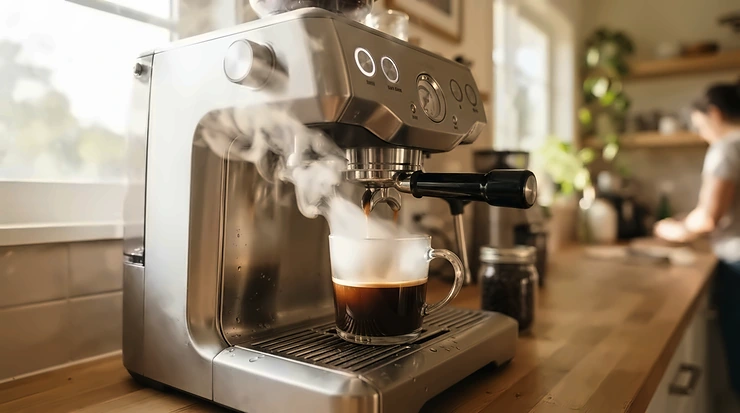
Mamavation, a consumer-advocacy site, goes further for espresso machines. It says it found none free of concerns, citing PTFE tubing and gaskets, aluminum on internal surfaces and PVC tubing that can carry phthalates, and it states that it couldn’t test machines for PTFE, so its rankings rest on what brands and parts sellers told it. Its small-appliance guide names Keurig, Nespresso, Mr. Coffee and Ninja among the brands it avoids, and it publishes no lab data for the coffee makers it approves.
Four filters shaped the shortlist: what touches hot water, what plastic remains elsewhere, whether parts can be replaced, and whether at least two independent sources describe the model. Every pick is sold in the US, and none is a pod machine.
Materials, plastic left over and price range, model by model
Only the Technivorm Moccamaster KBGV Select puts plastic in the water path according to the sources behind this table, and its maker says that plastic is free of BPA, BPF and phthalates. The two ends of the price range tell their own story: the manual brewers carry the strongest material case, while the automatic machines trade some of it for a button. Non toxic coffee makers reviews rarely agree on which trade is worth it, which is why the entries below keep the dissenting views.
Stock and sizes change often, so check current availability below for whichever row fits your mornings.
Six non toxic coffee makers, from a glass pour-over to a plastic-free drip machine
Among the best non toxic coffee makers 2027 shoppers will weigh, these six answer different kitchens: a one-mug desk setup, a family pot, a stovetop habit and a stainless press.
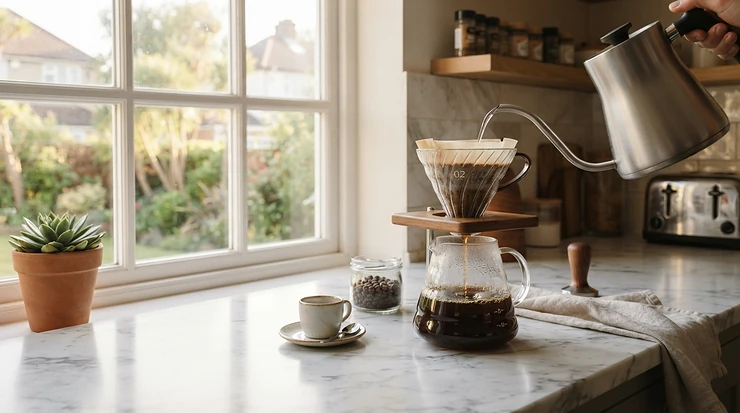
Households that brew one to three mugs at a time are the natural fit for the Chemex Classic Series 6-Cup Coffeemaker, and it gives the cleanest answer on this list to the plastic question. Homes & Gardens describes a borosilicate glass body with a wood collar and leather tie, and nothing else touches the water. Mamavation lists a Chemex glass-series pour-over as approved, and Homes & Gardens named the six-cup Classic its best glass option.
Capacity is 30 ounces, which that tester estimated at six five-ounce cups. One cup took about two minutes including a 30-second bloom, while larger batches drain more slowly. Retail listings on that review ran roughly $47 to $50, so figure on around $47 to $50 before filters.
Cleaning is simple: warm soapy water and a dish brush reach the base through the wide neck, and the carafe can go in the dishwasher once the collar is off. There are no measurement marks on the glass, and disposable bonded filters are sold separately with none in the box.
Two real-use notes shape the decision. Homes & Gardens’ tester had no breakages but washed it cautiously, and she found negative Amazon reviews describing carafes that arrived broken. Clive Coffee’s product page summarizes shopper feedback that the wood finish wears with cleaning, even by hand.
The filters are the wrinkle. Mamavation sent Chemex Natural Coffee Filters to a lab and reported 32 ppm of organic fluorine, a marker associated with PFAS, and it advises against using them. The method detects fluorine rather than naming compounds, and Mamavation itself lists other possible sources, so read it as a flag rather than a verdict; anyone who weighs it heavily can ask Chemex for its own test data before buying.
Filters are a separate purchase either way, so add a pack of bonded filters to the order.
Chemex Classic Series 6-Cup CoffeemakerSee current price, sizes and reviews on Amazon.
In the budget slot, Homes & Gardens picked the Melitta 1-Cup Porcelain Pour-Over Coffeemaker, a cone that sits on your mug and takes a paper filter for around $15 to $20 across Melitta’s own shop and other retailers. Melitta lists it for #2 or #4 cone filters and calls the cone top-rack dishwasher safe, and one retailer gives its footprint as about 4.6 inches across the top and 4 inches tall, enough to clear most mugs.
Homes & Gardens’ tester, an ex-barista, found it felt premium and produced smooth, light coffee. She also flagged that the single drain hole can over-brew a slow pour and that batches take a while, so this is a one-mug tool. That is one reviewer’s view.
None of the pages describing this cone publishes a glaze or lead test, which makes it the entry here that rests most on trust in the maker. Melitta also sells a black plastic cone under the same Pour-Over name, listed on its shop as BPA free, so the porcelain one is the version covered here.
Pros:
Only porcelain touches the water, per the listings
Top-rack dishwasher safe, according to Melitta
A starter supply of #2 filters comes in the box, per a retailer listing
Cons:
One mug at a time
A single drain hole can over-extract a slow pour
No glaze or lead test published
Homes & Gardens’ materials column for it reads simply: porcelain.
Melitta 1-Cup Porcelain Pour-Over CoffeemakerSee current price, sizes and reviews on Amazon.
Not every Bialetti qualifies. Mamavation puts the aluminum Moka Express in its not-favorite group of moka pots because those pots disclose aluminum construction, and the Bialetti Venus Moka Pot swaps in 18/10 stainless steel. Homes & Gardens tested the 6-cup size, which also comes in 4 and 10 cups, and describes a polished stainless body, a heat-tolerant plastic handle and a silicone gasket, with the handle as the only plastic part.
Bialetti’s New Zealand site says the Venus works on all cooktops including induction, except the 2-cup size. Homes & Gardens’ retailer links ran about $60 to $70.
Speed depends on technique. On a mid-setting electric burner the tester waited about 13 minutes with a cold start before coffee reached the top chamber and 20 to 22 minutes in total; warm tap water cut that to roughly 10 minutes, which she preferred. The manual asks for three throwaway brews to clear manufacturing residue, the lid and funnel edges are sharp enough that she cut her thumb, and every brew is a full pot.
Reviewers split sharply on the result. Homes & Gardens found the coffee smooth and rich, while Honest Coffee Guide scored the same pot 2 out of 5, reporting bitter, astringent, metallic-tasting coffee and a groove in the upper chamber that holds on to old grounds. Because Homes & Gardens’ tester had to depart from the printed instructions to get a timely brew, technique looks like part of the gap, though that is reasoning rather than a tested finding.
Replacement gaskets are sold by Bialetti and online retailers, so a worn seal doesn’t mean replacing the pot.
Bialetti Venus Moka PotSee current price, sizes and reviews on Amazon.
Plastic-free has a precise meaning for a French press: the filter. Aarke’s help center says the Aarke Coffee Press is polished stainless steel throughout, including the filter, plunger, body, spout and handle, with no plastic parts. Homes & Gardens contrasts it with the Espro P7, whose filter uses BPA-free plastic components, and calls the Aarke the better match for a strictly plastic-free kitchen.
It holds 34 ounces (1 liter) in a double-wall vacuum-insulated body and costs between $130 and $150 across Aarke’s US site and the reviews. Homes & Gardens measured water falling from 201.4°F to 156.2°F over three hours, while Tom’s Guide recorded about 150°F after two hours against roughly 134°F for the Espro; the two reviewers tested differently, so treat the numbers as a direction, not a head-to-head. All parts are dishwasher safe per Homes & Gardens, though the maker recommends hand washing.
The flaw is the last pour. Without a vacuum seal on the plunger, Tom’s Guide’s tester found the final cup bitter and silty enough to throw away and called that the main flaw, and she judged the Aarke overpriced next to rivals, recommending the Espro P7 instead. The sources also disagree on the price gap: Homes & Gardens says the Espro is typically about $5 cheaper, Tom’s Guide about $20.
Pros:
Filter, plunger and lid are all stainless steel, per Aarke
The exterior stays cool and the coffee stays warm for hours
Parts are dishwasher safe, per Homes & Gardens
Cons:
The filter scrapes the walls with a small noise
The last portion can turn silty and bitter
Premium price, and the steel shows smudges
Steel also means no window on the brew, so a timer replaces your eyes; Homes & Gardens’ tester steeped for five minutes at a 1:12 coffee-to-water ratio.
Aarke Coffee PressSee current price, sizes and reviews on Amazon.
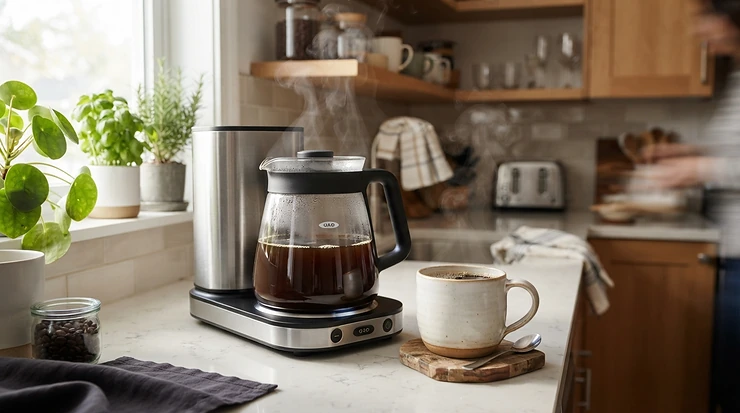
This is the one entry where plastic does sit in the water path, and the argument is over whether that matters. TechRadar reports that the maker calls every plastic part free of BPA, BPF and phthalates, with the water traveling through a copper element, a glass tube and a stainless outlet arm. Corner Coffee Store lists the reservoir, brew basket and buttons among the plastic parts, and a Tom’s Guide writer, partly agreeing with critics of the plastic, says European rules require virgin, BPA-free, phthalate-free plastic and expects no leaching; that is an opinion, not a lab result.
The credentials are real. Homes & Gardens describes a handmade Dutch machine that is modular, repairable and covered by a five-year warranty, and the SCA’s certified-brewer page lists the Technivorm Moccamaster KBGV Select at 40 ounces with a switch for half or full carafes. Tom’s Guide lists it around $350, TechRadar at $359 to $370 and a specialty retailer at $369 to $389, so budget roughly $350 to $390.
Testers disagree on performance. TechRadar’s barista timed a full carafe at about 3.5 minutes, Homes & Gardens at about six minutes for ten cups. TechGearLab wouldn’t recommend it unless you love the styling, citing plastic and poor water distribution, and Tom’s Guide agrees the water funnels down the center while grounds climb the sides, though it treats that as a drip-brewer problem rather than a Moccamaster one.
Durability evidence is thin and mixed. In a r/BuyItForLife thread, one poster relayed complaints about cracking plastic reservoirs and early switch failures, while one owner reported four trouble-free years. Upkeep is manual: none of the components are dishwasher safe per TechRadar, and Homes & Gardens says it needs descaling about every 100 cycles.
Spread over the five-year warranty, the price works out to roughly $70 to $78 a year (our arithmetic), though a warranty is not a lifespan.
Technivorm Moccamaster KBGV SelectSee current price, sizes and reviews on Amazon.
The maker’s own page calls this the only automatic drip coffee maker with a fully plastic-free brew path. It lists a borosilicate glass reservoir, a stainless steel flow path, medical-grade silicone seals, a stainless filter basket sized for #4 cone filters and a glass carafe, with water heated to 195 to 205°F and a five-year warranty. Mamavation lists the SimplyGoodCoffee The Brewer Plastic-Free, in 8-cup standard and programmable versions, among its plastic-free picks, though its coffee-maker section describes no testing method.
Expect around $430 to $480 for the standard version; the maker’s programmable page runs about $40 higher (our arithmetic from its two price tags), and Tom’s Guide lists the standard one near the top of that range at Amazon. The maker sells three versions of The Brewer, Glass, Thermal and Plastic-Free, and one retailer reviewer reported receiving the Glass version while expecting plastic-free, so confirm the product title before ordering.
The outside is where plastic remains. Tom’s Coffee Corner notes the shower-head stem sits in a plastic housing and the dripper’s outer surface is insulated with plastic, and says the body is anodized aluminum, which contradicts a product blurb that calls the machine free of both plastic and aluminum. Tom’s Guide likewise notes silicone and plastic on the exterior to prevent burns while saying the hot-water path has none.
Hands-on notes are mixed. Bob Vila’s reviewer rated it 4.4 out of 5 for smooth, rich coffee with no leaks or noise, but found the front drip-stop lever easy to knock into the wrong position, which sends coffee and grounds over the rim, and found the reservoir non-removable, so draining means tipping the unit over a sink. Tom’s Guide adds that even this brewer doesn’t spread water as evenly as a careful pour-over, and Tom’s Coffee Corner points out the brewer is made in China, had been on the market for about a year at the time of writing, and requires regular descaling to keep the warranty valid.
Pros:
Glass, stainless steel and silicone along the brew path, per the maker
Targets 195 to 205°F, per the maker
The maker’s programmable page says every component is a replaceable part
Cons:
Highest price in this guide
The reservoir doesn’t lift out
The drip-stop lever can cause overflow if left in the wrong position
Over the five-year warranty, $430 to $480 works out to roughly $86 to $96 a year (our arithmetic).
SimplyGoodCoffee The Brewer Plastic-FreeSee current price, sizes and reviews on Amazon.
A non toxic coffee maker under 100 dollars: three that qualify
Three of the six clear a $100 budget: the Melitta 1-Cup Porcelain Pour-Over Coffeemaker, the Chemex Classic Series 6-Cup Coffeemaker and the Bialetti Venus Moka Pot. A realistic non toxic coffee maker under 100 is a manual brewer, because the automatic machines with the least plastic in the sources above cost several times that.
Each answers a different morning. The Melitta suits one mug and a short pour, the Chemex covers up to 30 ounces and rewards patience, and the Bialetti makes espresso-style coffee but only in full-pot batches, which Homes & Gardens’ tester found too much for a two-person home.
Add the hidden costs before deciding. The Chemex needs bonded filters bought separately, the Bialetti needs a replacement gasket about once a year, and every manual brewer needs hot water from a kettle that deserves the same scrutiny as the brewer itself.
The best non toxic coffee maker for home: automatic or manual?
Start with how many mugs you pour at once. The Melitta makes one, the Chemex 30 ounces, the Aarke 34 ounces, the Moccamaster 40 ounces and the SimplyGoodCoffee 8 cups per the maker, so households of three or more who want everything poured together lean toward the drip machines or a big press.
Then decide where your plastic line sits. If plastic outside the hot-water path is fine, the Moccamaster is the better-documented machine, with years of reviews, a five-year warranty and repairable parts. If plastic near the water is a dealbreaker, the SimplyGoodCoffee is the only automatic option in the sources here, at roughly nine to ten times the Chemex’s price (our arithmetic) and with only about a year of public track record.
One caution on certification: the SCA page describes third-party testing against its brewing standards and says nothing about plastics, so a certified-brewer mark speaks to brew performance, not materials. For the best non toxic coffee maker for home use in a typical household, we’d start with the Chemex, step up to a drip machine only when mornings demand a full pot, and treat the choice between the two drip machines as a question about plastic tolerance rather than coffee quality.
Non toxic coffee makers reviews: where testers and owners push back
Complaints cluster by type. Glass brewers draw breakage worries, the porcelain cone over-brews slow pours, the stainless moka pot splits reviewers on bitterness and cleaning, the stainless press leaves a silty last cup, and the drip machines divide over water distribution, upkeep and cost. None of those points makes a pick wrong; each one is a reason to match the brewer to your habits.
Evidence is uneven across the six. The Chemex and the Moccamaster have long review trails, while the SimplyGoodCoffee had about a year of public coverage when one reviewer wrote it up, so its durability is the least proven claim in this guide.
To compare beyond these six, Homes & Gardens’ guide to the best non toxic coffee makers covers a wider field, including a stainless AeroPress and a lever espresso machine its testers found less plastic-heavy than other espresso options.
Pods, BPA-free labels, descaling and other loose ends
Is there a coffee maker with no plastic at all?
Manual brewers come closest: an all-glass pour-over has only a wood collar and leather tie, and a fully stainless French press has no plastic parts. Among automatic drip machines, one maker claims a plastic-free brew path, though reviewers still note plastic grips and insulation outside it.
Is a BPA-free coffee maker actually safe?
BPA-free only means that one chemical is absent. Homes & Gardens notes that makers often substitute related bisphenols still under study, while the FDA's page says BPA is safe at current food levels. For the most certainty, choose glass, porcelain or stainless steel near hot water.
Are Keurig and other pod machines non toxic?
Mamavation lists Keurig and Nespresso among the brands it avoids, citing plastic food-contact parts, though its coffee section publishes no lab data. Homes & Gardens says many machines use plastic in reservoirs, housings, seals and gaskets, so a manual brewer sidesteps the question.
What is the safest material for a coffee maker?
Borosilicate glass, stainless steel and porcelain are the materials favored across the sources reviewed, because none contains plastic. Homes & Gardens calls manual glass or ceramic brewers generally the least plastic-heavy choice, while stainless steel suits presses and moka pots.
How do I descale a non toxic coffee maker?
Follow the manual. Homes & Gardens recommends white vinegar or citric acid for a stainless moka pot, one drip machine needs descaling about every 100 cycles, and another makes regular descaling a warranty condition. Rinse thoroughly afterward so no cleaner flavors the next brew.
If you only buy one
For most kitchens, the Chemex Classic Series 6-Cup Coffeemaker is the simplest way into non toxic coffee makers: glass only, around $47 to $50, and no machine to descale. The Technivorm Moccamaster KBGV Select makes sense for full pots at the press of a switch if a plastic reservoir governed by European rules doesn’t bother you, and the SimplyGoodCoffee The Brewer Plastic-Free is the drip machine for buyers whose rule is no plastic near the water and whose budget stretches that far.
The Melitta 1-Cup Porcelain Pour-Over Coffeemaker, Bialetti Venus Moka Pot and Aarke Coffee Press fill the single-mug, stovetop and stainless-press gaps. Whatever you choose, read the material list rather than the words non-toxic, then see what’s in stock on Amazon.com for the version you want.
Disclaimer: This post contains affiliate links. As an Amazon Associate, we earn from qualifying purchases made through these links, at no additional cost to you.
Pick the brewer that fits your counter, then check today’s availability below.
SmartCookLab is an independent buying-guide site for cookware, pots, pans, range hoods and kitchen appliances. Our editorial team compares products using manufacturer specifications, independent tests from specialist kitchen media, owner reports and retailer listings. We do not claim to have tested the products ourselves; see How We Choose Gear for our method.