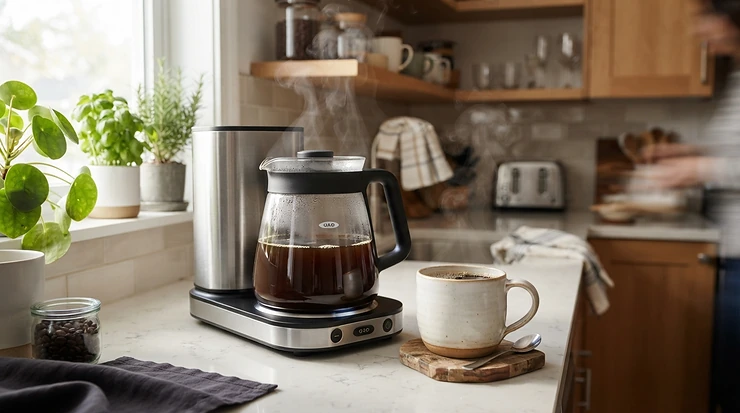
Which of the dozens of coffee makers on the shelf actually brews at the temperature coffee needs? For 2027 shopping, that one question sorts the field faster than any feature list. America’s Test Kitchen reports that the Specialty Coffee Association (SCA) wants water between 194°F and 205°F for the whole brew cycle, and several of the coffee makers in its tests spent only a sliver of the cycle there.
For most homes, the answer is a drip brewer that holds that range, makes 8 to 10 cups and pours into a thermal carafe. A French press suits anyone who would trade tidiness for a heavier cup. Below you will find a short method for narrowing the choice, what each price tier buys, the habits that spoil good coffee, and four real models (three drip machines and one press) matched to the method.
The findings rest on test write-ups from America’s Test Kitchen, Tom’s Guide and Food Network, the SCA’s own program notes, retailer spec pages and owner threads. No machine was brewed for this guide, so every taste verdict belongs to a named tester.
Coffee maker vs French press: the filter decides the cup
The coffee maker vs french press argument comes down to one part. A drip machine pushes hot water through grounds held in a paper filter, and that paper traps the oils that give coffee its richer, heavier feel. A press steeps coarse grounds for about four minutes and then pushes a metal mesh down, so more oil and fine sediment stay in the mug. America’s Test Kitchen adds that a press cup can turn very strong if it sits on the grounds, and that a drip machine fills a whole carafe without supervision.
Cholesterol enters the conversation here. Harvard Health Publishing says unfiltered coffee, French press included, may raise LDL (“bad”) cholesterol because it carries compounds that a paper filter would otherwise catch. The same page quotes a Harvard T.H. Chan School of Public Health professor saying the press has not been studied closely and that effects may depend on the beans and the roast. Anyone watching their numbers should raise it with a doctor rather than settle it from a shopping guide.
Convenience splits the two just as clearly. A press needs a kettle, a timer and a rinse of the mesh filter every time, and it brews one batch at once. A drip machine asks for water, grounds and a button.
Choosing coffee makers for home use, in the order that matters
Count mugs, not cups. Tom’s Guide notes that a coffee maker “cup” is about 5 ounces, so a 12-cup machine fills roughly seven mugs. Marketing is inconsistent: the spec pages for the Technivorm Moccamaster KBGV Select and the OXO Brew 8-Cup Coffee Maker both list a 40-ounce reservoir, yet one calls it 10 cups and the other 8. By the same mug yardstick, 40 ounces fills about four to five mugs (our arithmetic), which suits a hypothetical couple having two mugs each. A household of four, or one that hosts brunch, belongs in the 12- to 14-cup class.
Check temperature and brew time, the numbers a box rarely prints. The SCA’s Certified Home Brewer program, described on the SCA’s news page, puts brewers through independent third-party testing for brew temperature, extraction and consistency. America’s Test Kitchen went further and logged the share of each brew cycle spent inside 194°F to 205°F. Its winner, the thermal-carafe Moccamaster KBT, and the Technivorm Moccamaster KBGV Select both scored 91%, the OXO Brew 8-Cup Coffee Maker scored 54%, and another Cuisinart in the test scored 2%. Ideal brew time is under 8 minutes in that lab’s guide; one budget machine took about 17.5 minutes and a Zwilling took 13. Certification and a measured curve are different evidence: a brewer can pass a protocol and still spend half its cycle outside the range in a stricter test.
Sources also disagree about the Moccamaster’s badge. Tom’s Guide and Food Network call it SCA-approved or certified, while a Barista Life roundup that read the SCA’s current list says Moccamaster does not appear on the page, which covers brewers certified from 2023 onward. Look for the logo on the box before you rely on it.
Pick the carafe. America’s Test Kitchen’s reviewers preferred thermal carafes to glass ones. A glass pot on a hot plate keeps coffee warm by continuing to heat it, and a Coffee Locator review of the Cuisinart PerfecTemp 14-Cup (DCC-3200P1) lists flavor loss on the warming plate as its main complaint. A thermal carafe holds heat without reheating, at the cost of a higher price and a pot you cannot see through.
Decide whether you need a timer. America’s Test Kitchen’s reviewers treat programmable brewing as a compromise because ground coffee waits in the machine overnight. The Technivorm Moccamaster KBGV Select has no delayed start, a drawback Tom’s Guide lists, yet its spec pages say a full carafe takes 4 to 6 minutes, so the wait at the counter is short.
Check the parts you will handle weekly. Filter shape, tank design and warranty differ more than most buyers expect. The Moccamaster takes #4 cone filters, the OXO needs standard basket filters for a full pot and Kalita Wave 185 filters for its single-mug basket, and the Cuisinart takes basket filters only. Tom’s Guide says the OXO’s water tank is not removable, and a ShopSavvy summary says the same of the Cuisinart. Food Network recommends descaling with white vinegar and water or a descaling solution a couple of times a year, and a Seattle Coffee Gear guide says a Moccamaster that stops mid-brew should be descaled if the thermal cutoff keeps tripping.
How much coffee makers cost, and what the extra money buys
Shoppers who type “coffee makers how much” into a search bar usually want one number, and the sources give four. Prices below are ranges from retailer and review pages, and the current price on Amazon.com may differ.
Tier
Example from this guide
Price range from sources
Manual press
Bodum Chambord 34-Ounce French Press
Around $40
Programmable, big batch
Cuisinart PerfecTemp 14-Cup (DCC-3200P1)
Around $90 to $120
Thermal carafe, SCA-listed
OXO Brew 8-Cup Coffee Maker
Around $200 to $220
Hand-built drip
Technivorm Moccamaster KBGV Select
Around $330 to $380
At the very bottom, Food Network shows a 12-cup Black+Decker drip machine at around $35 to $55, and Tom’s Guide places espresso machines between roughly $500 and $800 and up, which is a different shopping trip entirely.
The extra money in the middle of this table buys three things you can verify. The first is measured brewing performance: 91% of the cycle in range for the Moccamaster family against 54% for the OXO in America’s Test Kitchen’s logs. The second is warranty length, with five years for the Moccamaster, three for the Cuisinart (Kohl’s listing) and two for the OXO (Seattle Coffee Gear). The third is repairability, which owners raise more than any spec: in a long r/BuyItForLife thread, Moccamaster owners describe replaceable parts, while OXO owners call some parts non-replaceable.
Coffee makers on sale: when the discounts tend to appear
A “sale” tag only compares today’s price with an earlier, higher one, so timing matters more than the badge. Top Ten Reviews says coffee makers are usually discounted in the weeks leading up to Black Friday, and advises watching from about three weeks before it to a few days after Cyber Monday. It adds that discounts often run through the after-Christmas sales into January, with Prime Day and Presidents’ Day also worth a look. Homes & Gardens’ kitchen appliance editor reports 20% to 40% off drip makers at Labor Day and says Cyber Monday prices are usually not as low as Black Friday itself.
Price trackers settle the rest. Top Ten Reviews points to CamelCamelCamel and Honey for confirming that a markdown is real. Pair that with a firm size and temperature requirement from the steps above, because a deep discount on the wrong machine is still the wrong machine.
Habits that make good coffee makers taste bad
Sizing is the first slip: a 14-cup machine brewing one mug a day is working far below its design volume. The Cuisinart PerfecTemp 14-Cup (DCC-3200P1) includes a 1-to-4-cup button for that case, and the Coffee Locator says it adjusts the cycle so a two-cup brew does not come out thin, which is the reviewer’s claim rather than a measurement.
Leaning on the Bold setting is the second. America’s Test Kitchen’s reviewers advise avoiding Strong or Bold settings because they over-extract, and recommend weighing coffee instead of using the included scoop. The SCA’s ratio of 55 grams of coffee per liter of water works out to about 65 grams for a 40-ounce pot (our arithmetic).
Letting coffee sit is the third. Auto shut-off varies: the Technivorm Moccamaster KBGV Select powers down at 100 minutes, and the Cuisinart PerfecTemp 14-Cup (DCC-3200P1) is adjustable from 0 to 4 hours. The Coffee Locator says flavor degrades the longer coffee sits on a warming plate, and it advises pouring leftovers into a thermal carafe.
Coffee makers reviews disagree: how to read them
Three kinds of evidence show up in reviews, and they answer different questions. Lab measurement (temperature curve, brew time, TDS) says whether a machine can extract coffee properly. Taste panels say whether people liked the cup. Owner threads say how a machine ages.
Disagreement between them is normal. Food Network named a Black+Decker 12-cup programmable its best basic pick at the bottom of the price range, while America’s Test Kitchen listed a Black+Decker 12-cup as not recommended after logging a brew cycle of about 17.5 minutes. Both can be true: a pot can taste acceptable to a panel and still brew too slowly for the under-8-minute ideal America’s Test Kitchen cites. When two reviewers split, the one that publishes numbers is easier to check.
Best coffee makers matched to each step
The four machines below each solve a different step from the method. The table compares the traits that actually change daily use.
Model
Type
Reservoir
Carafe
Timer
Warranty
Technivorm Moccamaster KBGV Select
Drip
40 oz
Glass, hot plate
None
5 years
OXO Brew 8-Cup Coffee Maker
Drip
40 oz
Thermal
None
2 years
Cuisinart PerfecTemp 14-Cup (DCC-3200P1)
Drip
14 cups
Glass, hot plate
24-hour
3 years
Bodum Chambord 34-Ounce French Press
Press
34 oz
Glass
Not applicable
Not listed
Two of the three drip machines have no timer, and only the OXO Brew 8-Cup Coffee Maker pairs a thermal carafe with SCA-listed brewing. The Cuisinart is the only one built for 14 cups, which is why it fits the large-household end of step 1.
At roughly $330 to $380 across Food Network, Tom’s Guide and retailer pages, the Technivorm Moccamaster KBGV Select sits at the top of this list on price. What the money buys is a copper boiling element that, according to a Clive Coffee listing, heats water to 196°F to 205°F, plus a half or full carafe selector and a drip-stop basket. Retailer spec pages put a full 40-ounce carafe at 4 to 6 minutes. Tom’s Guide says it reaches that range in under a minute and holds it through the brew.
Food Network’s testers said it “brewed our favorite tasting coffee by far”. America’s Test Kitchen measured it in range for 91% of the cycle, though it rated the Technivorm Moccamaster KBGV Select as recommended with reservations and gave the top spot to the thermal-carafe version. Long-run evidence leans positive. Several commenters in the r/BuyItForLife thread report about 5 years of use, and others report 6 to 10 or more, with minor faults such as a chipped hot plate or a broken glass pot. One report goes the other way: an owner on Tom’s Guide’s forum described a failure and an unhappy exchange with customer support, though it is a single account.
Pros:
Hot, fast brewing with a measured 91% of the cycle in range
Five-year warranty and widely reported replaceable parts
Cons:
No delayed start, and the glass pot relies on a hot plate
Highest price of the four
Technivorm Moccamaster KBGV SelectSee current price, sizes and reviews on Amazon.
Someone who drinks a single mug on weekdays and a full pot on weekends is the person this machine was designed around. A slider switches between 2-to-4-cup and 5-to-8-cup modes, and a removable well cover raises short mugs or makes room for a travel mug. OXO’s listing describes a double-wall, vacuum-insulated 40-ounce carafe with a brew-through lid, and the model number on Best Buy’s page is 8718800. Tom’s Guide names it its best budget drip pick, and retailer pages fall around $200 to $220.
OXO’s product page states the SCA certification, and Barista Life’s reading of the SCA’s list dates it to 2025. Tom’s Guide says the thermal carafe keeps coffee hot for a couple of hours. Owner reports are mixed, though. In the r/BuyItForLife thread, one owner’s 8-cup died after about five years, and others cite an insulated carafe that does not keep coffee very hot, slow pouring, finicky dials and a water diffuser that can fall into the grounds and cause overflows. Fans in the same thread like the price and the carafe, and several owners say they wish they had bought a Moccamaster. America’s Test Kitchen’s tasters called the cup mild and rounded. The two-year warranty is the shortest of the three drip machines here.
OXO Brew 8-Cup Coffee MakerSee current price, sizes and reviews on Amazon.
A household that fills four or more mugs before 8 a.m. is where a 14-cup machine earns its counter space. Food Network named the Cuisinart PerfecTemp 14-Cup (DCC-3200P1) its best overall drip pick, with retailers showing about $90 to $120 and coffee that stays hot for up to two hours. Kohl’s lists 1,025 watts, a 3-year limited warranty and a 14-inch height, and the feature set covers a 24-hour programmable start, a 1-to-4-cup setting, regular and bold strength, Brew Pause and an adjustable keep-warm plate.
None of the pages opened publishes a temperature curve for this exact model, which is the gap to weigh against its low price. Brand name does not close it: America’s Test Kitchen found a different Cuisinart model in range for just 2% of its cycle. Reviewers flag a few practical snags. HomeGrounds calls refilling the water tank awkward and notes that darker roasts over-extract easily, and Food Network says the carafe lid has to be lifted by hand. The Coffee Locator says the model is not SCA-certified and takes basket filters only, and Food Network adds a charcoal water filter that needs replacing about every 60 days.
Pros:
Lowest price of the three drip machines
24-hour timer, 1-to-4-cup mode and Brew Pause
Cons:
Glass carafe and warming plate, which the Coffee Locator says dulls flavor over time
Reservoir not removable
Cuisinart PerfecTemp 14-Cup (DCC-3200P1)See current price, sizes and reviews on Amazon.
Where the three machines above manage temperature for you, the Bodum Chambord 34-Ounce French Press manages nothing: the kettle, the timer and the coarse grind are all yours. That is exactly why it suits a buyer who prefers the thicker cup described in the French press section above. Department-store listings put the 34-ounce glass version around $40, and Homes & Gardens calls it a good first press because there is so little to learn. Its tester adds a caution: the press needs careful positioning for a smooth pour.
Technique matters more here than on a drip machine. Use coarse grounds and the roughly four-minute steep America’s Test Kitchen describes, and clean the mesh filter every time, since Tasting Table lists a neglected filter among the press’s drawbacks.
Bodum sells the Chambord in 12-, 17-, 34- and 51-ounce sizes, according to HomeGrounds, and Crate & Barrel lists both the 34- and 51-ounce versions.
Check current availability on Amazon.com for whichever of the four fits your counter, and compare the exact filter type before you order. For a wider field of tested brewers, Tom’s Guide’s coffee maker roundup covers drip, pod and espresso machines.
Bodum Chambord 34-Ounce French PressSee current price, sizes and reviews on Amazon.
Coffee maker answers on size, certification, French presses and sale timing
Is a drip coffee maker better than a French press?
Neither wins outright. Drip with a paper filter gives a cleaner cup and fills a whole carafe automatically, while a press gives more body and sediment. Harvard Health says unfiltered coffee may raise LDL cholesterol, so heavy daily drinkers may prefer paper filtering.
What size coffee maker do I need?
Count mugs, not cups. Makers treat a cup as about five ounces, so a 40-ounce reservoir fills roughly four to five mugs. Two people drinking two mugs each fit that size, while four regular drinkers need a 12- to 14-cup machine.
Do coffee makers need SCA certification?
No, but the certification signals that a brewer passed independent testing for brew temperature, extraction and consistency. Check the current list at sca.coffee, because older certifications may not appear. A measured temperature curve from a test lab is also useful evidence.
How much do coffee makers cost?
Pages in this guide show a French press near $40, a programmable 14-cup drip machine around $90 to $120, a thermal-carafe brewer around $200 to $220 and a hand-built drip maker near $330 to $380. Check the current price on Amazon.com.
When do coffee makers go on sale?
Top Ten Reviews says discounts tend to appear in the weeks before Black Friday and continue into January, with Prime Day and Presidents' Day also worth watching. A price tracker such as CamelCamelCamel shows whether a markdown is lower than usual.
Which of these coffee makers to buy
For most households shopping for coffee makers, the decision runs in one order: pick the volume, check the temperature evidence, then choose the carafe. The Technivorm Moccamaster KBGV Select has the best measured brewing record of the two drip machines America’s Test Kitchen logged and carries the longest warranty, which makes it the pick when the budget stretches. The OXO Brew 8-Cup Coffee Maker fits mornings that alternate between one mug and a full pot, thanks to its thermal carafe and single-mug mode. The Cuisinart PerfecTemp 14-Cup (DCC-3200P1) covers big batches and timers at the lowest drip price, and the Bodum Chambord 34-Ounce French Press is the low-cost, outlet-free route to a heavier cup. Check current availability below, and confirm the exact model number before you order.
Disclaimer: This post contains affiliate links. As an Amazon Associate, we earn from qualifying purchases made through these links, at no additional cost to you.
Settled on a brewer? Take a look at the current listing on Amazon.com and compare the carafe and filter details first.
SmartCookLab is an independent buying-guide site for cookware, pots, pans, range hoods and kitchen appliances. Our editorial team compares products using manufacturer specifications, independent tests from specialist kitchen media, owner reports and retailer listings. We do not claim to have tested the products ourselves; see How We Choose Gear for our method.