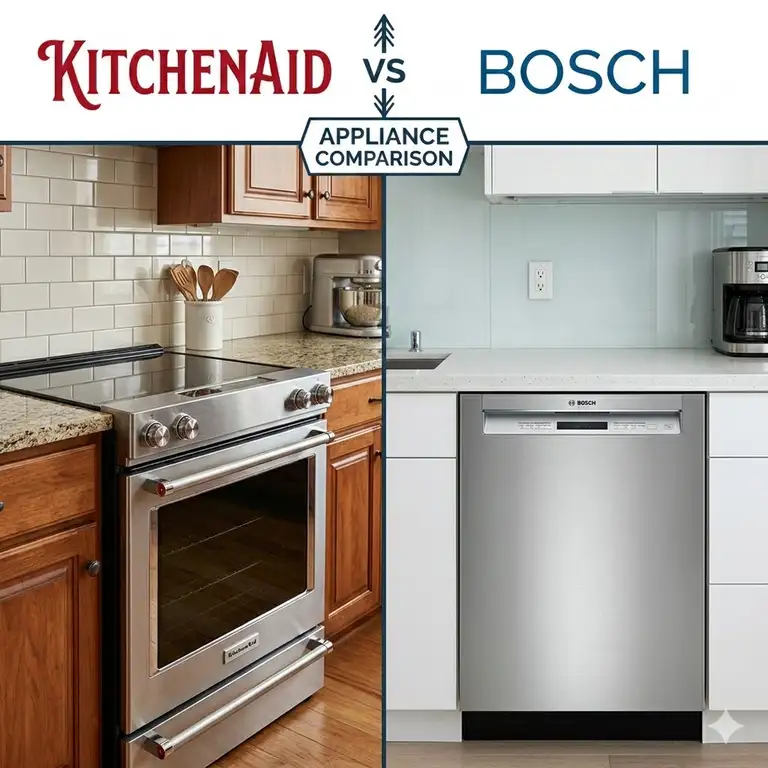
Deciding between a KitchenAid and a Bosch dishwasher is a bit like choosing between a rugged American SUV and a sleek German luxury sedan. Both will get you where you need to go, but the ride feels completely different. I’ve spent years hovering over open dishwasher doors, testing how well they handle stuck-on lasagna and whether they actually dry those pesky plastic containers. In the world of premium cleaning, the kitchenaid vs bosch debate is the heavyweight title fight that never seems to end.
✨Was this helpful? Spread the word! 🚀
As we move through 2026, the technology has only gotten better. Bosch is leaning harder into its “hush-quiet” reputation and mineral-based drying, while KitchenAid is doubling down on massive capacity and specialized scrubbing arms. Whether you’re looking for the industrial-chic look of a KitchenAid or the minimalist, flush-mount elegance of a Bosch, this guide is here to break down every nut, bolt, and spray arm.
Quick Comparison: At a Glance
Before we dive into the deep end, let’s look at how these two giants stack up against the general competition.
| Feature | KitchenAid | Bosch | Standard Mid-Range Brands |
| Primary Drying Method | ProDry™ (Heating Element + Fan) | CrystalDry™ (Zeolite Minerals) | Static/Venting |
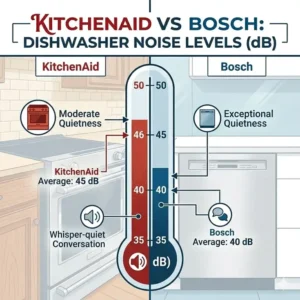
| Quietness Range | 39–46 dBA | 38–44 dBA | 48–52 dBA |
| Rack Flexibility | Deep 3rd Rack (Max Capacity) | Flexible 3rd Rack (V-Shape) | Basic 2nd Rack only |
| Cleaning Tech | FreeFlex™ Fit / ProWash™ | PrecisionWash® / PowerScrub | Standard spray arms |
| Origin | Mostly USA (Benton Harbor, MI) | Mostly Germany/USA (New Bern, NC) | Various |
Top 7 KitchenAid and Bosch Dishwashers: Expert Analysis
If you’re ready to buy, these are the heavy hitters currently dominating the market in 2026. I’ve selected these based on performance, reliability, and real-world user feedback.
1. Bosch 800 Series Dishwasher with CrystalDry SHP78CM5N
This is widely considered the gold standard of modern dishwashing. The 800 Series is famous for its CrystalDry technology, which uses natural minerals called Zeolites to transform moisture into heat.
-
Technical Specifications: 42 dBA noise level, 16 place settings, 3rd rack (Flexible), Stainless steel tub, Wi-Fi enabled via Home Connect.
-
Customer Review Analysis: Users consistently praise the bone-dry results on plastics. Some mention the touch controls are very sensitive, but the cleaning power is unmatched.
-
Warranty: 1-year limited warranty on entire appliance; 5-year limited on electronics/racks; Lifetime on stainless steel tub.
-
Professional Applications: Ideal for large families who use lots of Tupperware and need a machine that can run overnight without waking the baby.
-
Pros: Incredible drying, virtually silent, smart features.
-
Cons: Can be difficult to find in stock; price point is premium.
2. KitchenAid 39 dBA Dishwasher with ProDry System KDTM404KPS
KitchenAid’s answer to the “silent” trend. This model is one of the quietest on the market, almost to the point where you need the indicator light to know it’s on.
-
Technical Specifications: 39 dBA, 16 place settings, FreeFlex™ Third Rack, ProDry™ System, PrintShield™ Finish.
-
Customer Review Analysis: People love the FreeFlex™ Third Rack because it actually fits glasses, not just silverware. Critics sometimes point out that the heated drying uses more energy than Bosch’s mineral method.
-
Warranty: 1-year limited; 5-year limited on certain parts; Lifetime on tub/liner.
-
Professional Applications: Perfect for open-concept homes where the kitchen is right next to the living room.
-
Pros: Exceptionally quiet, massive 3rd rack, smudge-resistant finish.
-
Cons: Longer cycle times when using ProDry.
3. Bosch Benchmark Series SHX89CM5N
The “luxury” tier of the Bosch lineup. If the 800 series is a Mercedes, the Benchmark is a Maybach. It features a built-in water softener and a telescoping rack system.
-
Technical Specifications: 38 dBA, 15 place settings, Built-in water softener, TimeLight™ (projects time remaining on floor).
-
Customer Review Analysis: High-end users love the “feel” of the racks—they glide like butter. The water softener is a “game changer” for those with hard well water.
-
Warranty: 1-year full; 5-year electronics; Lifetime tub.
-
Professional Applications: High-end kitchen remodels where integration and silence are the highest priorities.
-
Pros: Most advanced features, ultra-smooth racks, great for hard water.
-
Cons: Very expensive.
4. KitchenAid 44 dBA Dishwasher with FreeFlex Fit KDTM604KPS
A mid-to-high range workhorse. This model balances the amazing 3rd rack with professional-grade cleaning arms.
-
Technical Specifications: 44 dBA, 16 place settings, Two Stemware Holders, ProWash™ Cycle.
-
Customer Review Analysis: Reviewers highlight the “ProWash” sensor, which adjusts the cycle based on how dirty the water is. It’s a favorite for “set it and forget it” types.
-
Warranty: 1-year limited; 5-year parts.
-
Professional Applications: Busy households that deal with heavily soiled pots and pans daily.
-
Pros: High capacity, great for greasy dishes, solid build.
-
Cons: 44 dBA is quiet, but noticeably louder than the 39 dBA models.
5. Bosch 500 Series Dishwasher SHP65CM5N
The “Sweet Spot.” This model offers the AutoAir feature, which pops the door open at the end of the cycle to let steam escape.
-
Technical Specifications: 44 dBA, 16 place settings, EasyGlide™ Rack System, AutoAir™ drying.
-
Customer Review Analysis: Users appreciate the AutoAir feature as a natural way to dry. Some find it annoying that the door pops open, but they admit it prevents that “damp” smell.
-
Warranty: Standard Bosch 1/5/Lifetime.
-
Professional Applications: Budget-conscious buyers who still want the German engineering and reliability of a Bosch.
-
Pros: Reliable, better drying than the 300 series, flexible racks.
-
Cons: Lacks the CrystalDry technology found in higher models.
6. KitchenAid 47 dBA Dishwasher with Front Controls KDFE104KPS
The entry point for KitchenAid quality. This is for the person who wants the brand name and the cleaning power without the bells and whistles.
-
Technical Specifications: 47 dBA, 14 place settings, Sani-Rinse option, Stainless steel interior.
-
Customer Review Analysis: It’s praised for its simplicity. “It just cleans well,” is a common sentiment. The front controls are a plus for those who don’t like hidden buttons.
-
Warranty: 1-year limited.
-
Professional Applications: Rental properties or “value” kitchen refreshes.
-
Pros: Affordable, easy to use, KitchenAid aesthetic.
-
Cons: Louder than most modern premium units; no 3rd rack.
7. Bosch 300 Series Dishwasher SHE53C85N
The entry-level Bosch that doesn’t feel like an entry-level. It still features a full stainless steel tub, unlike many competitors in this price bracket.
-
Technical Specifications: 46 dBA, 16 place settings, 3rd rack (standard), PureDry.
-
Customer Review Analysis: Users love that they can finally get a Bosch for under $900. It cleans just as well as the 800, it just doesn’t dry quite as fast.
-
Warranty: Standard Bosch 1/5/Lifetime.
-
Professional Applications: First-time homeowners looking for a reliable upgrade from basic builder models.
-
Pros: Stainless steel tub, Bosch reliability, 3rd rack included.
-
Cons: Basic drying system (static).
✨ Don’t Miss These Exclusive Deals!
🔍 Take your kitchen to the next level with these carefully selected products. Click on any highlighted item to check current pricing and availability. These tools will help you achieve a spotless kitchen your family will love! 🛒
💬 Just one click – help others make better buying decisions too!😊
🔍 Technical Specifications Matrix (Spec Matrix)
| Model Name | Noise Level | Drying Tech | 3rd Rack Type | Smart Features |
| Bosch 800 Series | 42 dBA | CrystalDry | Flexible V-Shape | Yes |
| KitchenAid 404 | 39 dBA | ProDry | FreeFlex Deep | No |
| Bosch Benchmark | 38 dBA | CrystalDry | Telescopic | Yes |
| KitchenAid 604 | 44 dBA | ProDry | FreeFlex Deep | No |
| Bosch 500 Series | 44 dBA | AutoAir | Standard | Yes |
| KitchenAid 104 | 47 dBA | Heated Dry | None | No |
| Bosch 300 Series | 46 dBA | PureDry | Standard | Yes |
The Core Battle: Cleaning Performance and Technology
When you look at kitchenaid vs bosch, you’re looking at two different philosophies of water management.
Bosch’s Precision Engineering
Bosch uses a system called PrecisionWash. It employs sensors to scan the dishes throughout the cycle, adjusting the water temperature and pressure. It’s highly efficient. One thing I love about Bosch is their “Bottom-Only” or “Top-Only” wash options, which are great for small loads.
KitchenAid’s Power Scrubbing
KitchenAid is more about “brute force” (in a sophisticated way). Their ProWash cycle is legendary for handling dried-on egg or peanut butter. If you are the type of person who hates pre-rinsing your dishes, KitchenAid is usually the more forgiving brand. They often include specialized “ProScrub” jets at the back of the machine specifically for burnt-on casserole dishes.
Secondary Keyword Deep Dive: kitchenaid vs whirlpool dishwasher
Wait, isn’t KitchenAid owned by Whirlpool? Yes, it is. But comparing a kitchenaid vs whirlpool dishwasher is like comparing a Lexus to a Toyota.
-
Whirlpool is built for value and longevity. They use plastic tubs in lower models and focus on being easy to repair.
-
KitchenAid uses higher-end materials, better sound insulation, and much more advanced racking systems.
If you’re on a tight budget, Whirlpool is great. If you want a quiet, luxury experience, KitchenAid is the clear winner within that corporate family.
Drying: The Mineral vs. The Element
This is the biggest point of contention in the kitchenaid vs bosch rivalry.
-
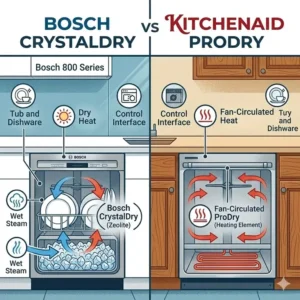
The Bosch Method (Zeolite/CrystalDry): Most Bosch models do not have a heating element at the bottom. Instead, they use a final rinse of very hot water and the heat-retaining properties of stainless steel. In the 800 and Benchmark series, they use Zeolite minerals. When moisture hits these minerals, it triggers a chemical reaction that releases intense heat. This is incredible for drying plastic without melting it.
-
The KitchenAid Method (ProDry): KitchenAid uses a traditional heating element plus a fan to circulate the hot air. This is the “classic” American way. It works exceptionally well for ceramic and glass. However, you have to be careful about putting thin plastics on the bottom rack, as the element can warp them.
Budget vs. Premium Comparison Table
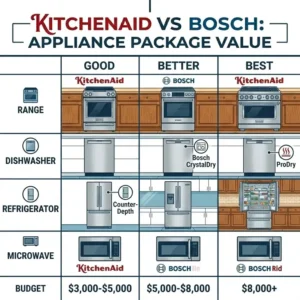
| Tier | Brand | Best Feature | Expected Performance |
| Budget ($) | Bosch 300 | Stainless Tub | Solid wash, decent dry |
| Mid-Range ($$) | KitchenAid 404 | 39 dBA Silence | Ultra-quiet, great 3rd rack |
| Premium ($$$) | Bosch 800 | CrystalDry | Best-in-class drying |
| Luxury ($$$+) | Bosch Benchmark | Water Softener | Professional grade |
User Experience: Racks and Loading
I’ve found that how you load a dishwasher is a very personal thing.
The KitchenAid FreeFlex™ Rack
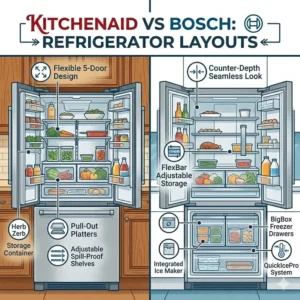
KitchenAid really won me over with the FreeFlex™ Third Rack. Most 3rd racks are just for flatware or large spoons. KitchenAid’s 3rd rack is deep enough to hold 6-inch glasses, bowls, and measuring cups. It effectively turns a two-rack dishwasher into a three-rack powerhouse, increasing capacity by about 30%.
The Bosch MyWay™ and V-Shape Racks
Bosch racks are highly adjustable. The “RackMatic” system allows you to change the height of the middle rack with one hand, even when it’s full. This is vital if you have tall wine glasses or huge stockpots. Bosch also uses a “V-shape” 3rd rack that creates more space for taller items in the rack below it.
Key Features/Benefits Comparison
| Feature | KitchenAid Benefit | Bosch Benefit |
| 3rd Rack | Fits deep bowls/glasses | Fits long utensils/small cups |
| Tub Material | All Stainless Steel | All Stainless Steel |
| Connectivity | Limited (Mostly high-end) | Standard (Home Connect) |
| Drying | Heated Fan (Fast) | Zeolite (Safe for Plastics) |
| Scrubbing | Specialized high-pressure jets | Precision sensors |
Installation and Aesthetics: The “Flush” Factor
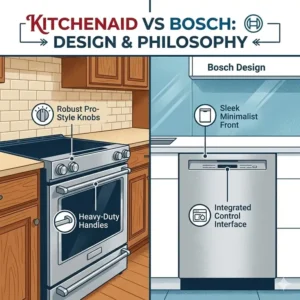
If you are a fan of “European style,” Bosch is your go-to. Most Bosch models are designed to sit perfectly flush with your cabinetry. They don’t have a protruding handle unless you choose one of the “bar handle” versions.
KitchenAid, on the other hand, has a very distinct “Pro-Style” look. They feature knurled handles with red medallions on the ends, matching their famous stand mixers. It’s a “statement” appliance. If you have other KitchenAid appliances, the kitchenaid vs bosch choice might come down to matching your existing handles.
🔍 Solution Category Analysis
| Solution | Best For | Recommendation |
| The “I Hate Plastics” Solution | Drying Tupperware | Bosch 800 Series |
| The “Open Concept” Solution | Maximum Silence | KitchenAid 39 dBA |
| The “Big Family” Solution | Max Capacity | KitchenAid with FreeFlex |
| The “Hard Water” Solution | Preventing Spots | Bosch Benchmark |
Reliability and Maintenance
Let’s talk about what happens when things go wrong.
-
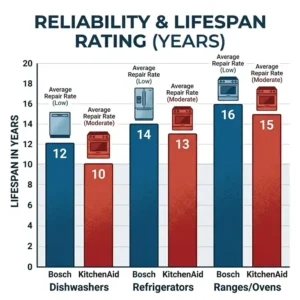
Bosch: Known for longevity. Their filter system is manual, meaning you have to pull it out and rinse it under the sink every few weeks. This prevents the “food grinder” from breaking, which is a common failure point in other brands.
-
KitchenAid: Being part of the Whirlpool family means that parts are everywhere. If your KitchenAid breaks in a small town in the USA, almost any technician can fix it. Bosch sometimes requires specialized European-appliance techs, though this is becoming less common in 2026.
“I’ve found that people who switch from a basic dishwasher to a Bosch are usually shocked by the silence, while those who switch to a KitchenAid are shocked by how much they can actually fit inside.”
Performance Metrics: Efficiency and Water Use
Both brands are incredibly efficient compared to the dishwashers of ten years ago. Most use between 2.4 and 3.5 gallons per cycle.
| Metric | KitchenAid Average | Bosch Average |
| Water Usage | 3.2 Gallons | 2.8 Gallons |
| Energy Star Rating | Certified | Certified (Most Efficient) |
| Cycle Time (Normal) | 2.5–3 hours | 2–2.5 hours |
| Leak Protection | Basic Float Switch | AquaStop® (24/7 Protection) |
The AquaStop® system on Bosch is worth a special mention. It’s a dual-sensor system that shuts off the water intake if it detects a leak, even if the machine is off. If you live in a condo or have expensive hardwood floors, this is a massive peace-of-mind feature.
Real-World Scenarios: Which one should you pick?
Scenario A: The “Meal Prepper”
You spend Sunday cooking, and you have 20 plastic containers to wash. You need them dry so you can put food in them immediately.
Winner: Bosch 800 Series. The CrystalDry will get those plastics drier than any heating element ever could.
Scenario B: The “Holiday Host”
You have 12 people over for dinner. You have wine glasses, dessert bowls, and massive platters.
Winner: KitchenAid with FreeFlex™ Third Rack. The sheer volume of “stuff” you can cram into a KitchenAid is unrivaled in the consumer market.
Scenario C: The “Smart Home Enthusiast”
You want to start your dishwasher from your phone and get an alert when it’s done.
Winner: Bosch. Their Home Connect app is significantly more polished and integrated than the KitchenAid smart offerings.
🔍 Benefits Quantification Table
| Benefit | KitchenAid (Estimated) | Bosch (Estimated) |
| Noise Reduction | 50% vs Standard | 60% vs Standard |
| Capacity Increase | +30% with FreeFlex | +15% with 3rd Rack |
| Drying Efficiency | High (Heated) | Ultra-High (Mineral) |
| Repair Accessibility | Excellent (Local) | Good (Specialized) |
✨ Upgrade Your Kitchen Today!
🔍 Ready to say goodbye to hand-drying and noisy cycles? Click on any of the product names in our top 7 list to check the latest 2026 pricing and user ratings. Investing in a high-quality dishwasher is the fastest way to reclaim your evenings! 🧼
Conclusion: Making the Final Choice
Choosing between a kitchenaid vs bosch dishwasher isn’t about finding the “better” machine—it’s about finding the machine that fits your lifestyle.
If you value maximum capacity, have a large family, and want a “pro-style” look that matches your oven and fridge, KitchenAid is your winner. The FreeFlex rack is a literal game-changer for loading efficiency.
If you value silence, advanced technology, and the best possible drying for plastics, Bosch (specifically the 800 series) is the king of the hill. Their mineral drying technology is simply light years ahead of the competition.
FAQs
✅ Bosch generally holds a slight edge in long-term reliability surveys. Their lack of a food grinder and use of manual filters reduces mechanical failure points. However, KitchenAid parts are more widely available for quick repairs across the USA...
✅ Yes, specifically the Bosch 800 and Benchmark series with CrystalDry. Because Zeolite minerals generate heat without a direct heating element, they can safely dry plastics without warping them, outperforming KitchenAid's traditional ProDry fan system in this specific area...
✅ Yes, most KitchenAid dishwashers are assembled in Findlay, Ohio. For many American consumers, this domestic manufacturing is a key deciding factor when comparing kitchenaid vs bosch, as Bosch is a German brand with some US assembly...
✅ Bosch uses multiple layers of sound-absorbing insulation and a solid molded base that dampens vibrations. They also utilize brushless motors and a unique drainage system that eliminates the 'gurgling' sound found in many standard American dishwasher models...
✅ High-efficiency (HE) detergent pods are recommended for both. Bosch specifically partners with Finish, but any high-quality pod will work. Avoid liquid detergents if possible, as they can lead to buildup in the precision sensors of these high-end machines... ❓ Which brand lasts longer, KitchenAid or Bosch?
❓ Does Bosch really dry plastic better than KitchenAid?
❓ Are KitchenAid dishwashers made in the USA?
❓ Why are Bosch dishwashers so quiet?
❓ Can I use any detergent in these dishwashers?
Recommended for You:
- KitchenAid Reviews on Appliances: 7 Top Picks for 2025 with Outstanding Performance
- Whirlpool vs Frigidaire vs Bosch Comparisons: 7 Key Differences Revealed for the Best Home Upgrade [2025]
- Bosch Dishwashers: 7 Premium Models Ranked 2025 for Superior Performance & Style
Disclaimer: This article contains affiliate links. If you purchase products through these links, we may earn a small commission at no additional cost to you.
✨ Found this helpful? Share it with your friends! 💬🤗