How do you start choosing pan size when the number stamped on a skillet describes its rim, not the flat floor where the food sits? In a Better Homes & Gardens piece syndicated on Yahoo, a Lodge chef says skillets are measured across the top with the handles left out, and a Meyer product lead adds that two pans with the same label can have different cooking floors. This 2027 choosing pan size guide works from tape measure to checkout: rim, floor, burner, headcount, then four real pans that fit those answers.
The findings rest on maker size guides, Prudent Reviews’ weighing and measuring, comments from Lodge and Meyer staff, and owner reviews on retailer listings; no pan was cooked with for this piece. It covers stovetop skillets and paella pans and leaves baking pans out.
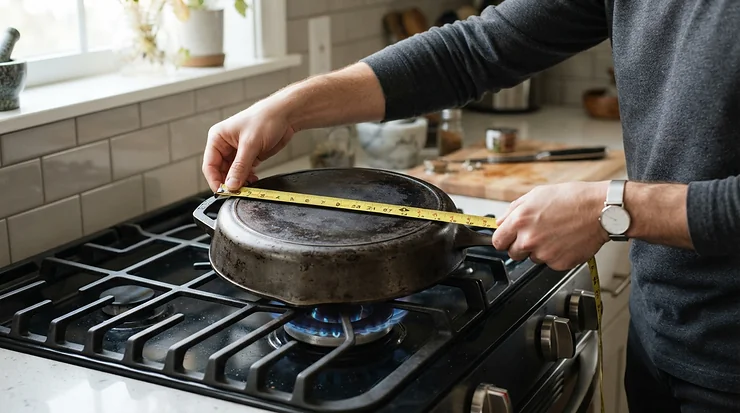
The label measures the rim, and food cooks on the floor
Across the top, edge to edge, handles excluded: that is the convention the cookware makers describe. Lodge’s chef says cast iron follows it, measured from the outside of one rim to the outside of the other. A pan with straight walls has a floor almost as wide as its rim. A pan with sloped walls loses width fast, and Prudent Reviews puts the rim at one to two inches larger than the floor on those pans. Its example is a Calphalon cast iron skillet that is exactly 12 inches rim to rim with a 10-inch flat floor.
A rule of thumb from Prudent’s 10-inch versus 12-inch comparison: the cooking surface runs about two inches under the advertised size. Treat it as a starting guess, because the Meyer product lead says design differences make the floor vary between pans carrying the same number.
Brand numbering adds a second trap. The 10 in Lodge’s L10SK3 refers to the number-10 stove eye from woodstove days, not to inches. The chef confirms that this skillet measures 12 inches across the top.
Choosing pan size steps: burner, headcount, floor, weight, fit
Five checks, in this order, settle most sizing decisions.
Measure the burner first. Take the diameter of the element or flame ring, not the grate around it. Prudent’s rule is that the rim should be no more than about one inch wider than the burner. The Takeout frames it more loosely, saying pan and burner should be as close in size as possible. Worked example (our arithmetic): a 10-inch element tops out at an 11-inch rim.
Count plates, not guests. Lodge’s size guide suggests an 8-inch skillet for one person’s breakfast, 10.25 to 12 inches for dinner, 12 inches for a family of four and 13.25 to 15 inches for potlucks. A Williams Sonoma specialist quoted by Prudent says an 8-inch skillet fits one chicken breast, a 10-inch fits two and a 12-inch fits three.
Judge the floor for browning. Crowded pans steam food rather than browning it, according to the Better Homes & Gardens Test Kitchen, and the Meyer product lead names avoiding overcrowding as the first consideration.
Weigh the lift. Prudent averages about 0.6 pounds per inch of diameter in cast iron, and a loaded 12-inch skillet is heavy to carry from stove to oven.
Check oven, shelf and cooktop. Handles add to the footprint, and induction needs a listing that says so.
Steps one and two do most of the work. A burner under 9 inches rules out the big pans no matter how many people you feed, while a household of one rules out the big pans whatever the burner.
Rim, floor, burner and headcount at a glance
The floor column below is rim minus two inches, which is our arithmetic from Prudent’s rule of thumb and will run wider on straight-walled pans. The burner column applies the one-inch rule. Use and weight come from Lodge’s cast iron size guide.
Rim size
Rule-of-thumb floor
Smallest burner (one-inch rule)
Lodge’s suggested use
Lodge cast iron weight
8 in
about 6 in
7 in
Breakfast
3.44 lb
10.25 in
about 8 in
9.25 in
Dinner for two
5.66 lb
12 in
about 10 in
11 in
Family dinners
7.69 lb
15 in
about 13 in
14 in
Feeding a crowd
12.3 lb
The 12-inch row shows why that size suits households of three or four and punishes small stoves: it needs an 11-inch element to follow Prudent’s rule. The 15-inch row is the extreme. Prudent says 15-inch and 17-inch skillets are too big for most indoor cooktops, and Lodge’s own guide tells buyers to confirm the burner is sized for the cookware. The Lodge size guide says the 10.25-inch and 12-inch skillets fit nicely on standard ranges.
Where owners go wrong: four sizing mistakes and the fix
Choosing pan size tips are easiest to remember as the errors they prevent, so here they are framed as the mistakes behind returns.
Buying by the stamped label. The L10SK3 case above is the obvious one. The fix is to find the top-to-top figure on the listing rather than trusting a model code.
Sizing for the best-case dinner party. The pan that suits eight guests twice a year gets in the way the other 360 days. Prudent recommends a 12-inch if you buy only one pan, and owning both a 10-inch and a 12-inch if budget and space allow. That pairing is the simplest of the choosing pan size ideas that avoids a drawer of sizes.
Ignoring how flat the pan sits. One reviewer on a Desertcart listing for a 15-inch Garcima paella pan returned it because it would not sit flat on an electric stovetop. That is a single report, but the pan’s gas and electric coil listing makes the fit worth checking before ordering.
Forgetting handles. A Spanish-language reviewer on the same listing warns that the 15-inch pan runs close to 20 inches counting handles, so check the stove and the storage space. Handles are excluded from the label figure.
A smaller version of the same lesson comes from the Lodge chef, who says an oversized skillet on a small burner heats unevenly, while a skillet too small for the burner wastes energy. It is a statement from the maker’s own cook, not a lab result.
Choosing paella pan size: count the rice, then check the burner
Paella breaks the usual skillet logic. The rice should sit shallow, so extra servings mean extra diameter rather than extra depth.
The Paella Company sizes pans by top diameter excluding handles and publishes main-course servings per size: 34 cm for three to four, 36 cm for four, 38 cm for five, 40 cm for five to six, 42 cm for six to seven and 46 cm for seven to eight. Its FAQ suggests about 100 grams of rice per person. Its advice is blunt: “It’s better to underfill a paella pan than to overfill it.”
Labels stamped on Spanish pans count “raciones”, which the retailer describes as tapas-size portions. Its example is a 50 cm pan marked for 14 tapas portions that is typically used for about 8 main-course servings. That gap explains why listings disagree. The Garcima 15-inch pan appears as 3 to 5 servings on some retailer pages and as 6 to 8 on a review site, while The Paella Company’s table puts a 38 cm pan at 5 main servings. Take the lower figure when the meal is the main course.
Heat is the other limit. A pan this wide covers more than a single burner, and the Desertcart reviewer who made it work used three low burners on a gas range, with 1.5 cups of rice and 4 cups of chicken stock.
Choosing pan size cost: a 30% premium and the bills behind it
Bigger costs more at the register and again at home. Prudent says a 12-inch pan runs about 30% more than the 10-inch in the same brand and collection, and weighs about 29% more on average. Cast iron averages roughly 5 pounds at 10 inches and 8 pounds at 12.
The hidden costs sit around the stove. The Takeout reports that a pan on a too-small burner can warp from concentrated center heat, and that heavy pans overhanging a small burner can be unstable, especially with hot liquid inside. A warped pan that rocks on the burner heats worse, which is a replacement purchase. The cheapest pan is the one that fits the burner the first time. Check the current price on Amazon.com for each model below; none of the figures here are prices.
Four pans matched to the steps
Each pick maps to a different answer from the steps above. Check current availability below for the size that matches your burner.
Two chicken breasts or one steak with a side set the scale for this pan. Lodge’s size guide pegs the 10.25-inch at five eggs and dinner for two, and the Williams Sonoma specialist’s chicken-breast count lines up. Prudent’s general claim, which is not a test result, is that a 10-inch pan heats faster and more evenly most of the time than a 12-inch and moves more easily from stove to oven.
Retailer listings describe a 2-inch depth, a helper handle, pre-seasoning and a Made in USA label, and one retailer lists induction compatibility. The L8SK3 code matches the 10.25-inch pan on those pages.
Pros:
Lodge says it fits standard ranges, so the burner rule rarely bites.
Weighs about 5.3 to 5.7 pounds depending on whether you trust Prudent or Lodge.
Cons:
Prudent’s chop count is two at a time, so a family of four cooks in batches.
Lodge L8SK3 10.25-Inch SkilletSee current price, sizes and reviews on Amazon.
The model code is the first thing to unlearn here: the Lodge chef says the 10 in L10SK3 refers to the old stove eye, and the skillet is 12 inches across the top. Lodge’s guide pairs that size with family dinners and six eggs, and a family of four is its recommendation.
Weight is the trade-off. Lodge lists 7.69 pounds, and Prudent weighed 7.89 pounds in one article and listed about 7.6 in another, so expect 7.6 to 7.9 pounds before any food. Burner fit matters too. By Prudent’s rule you need an element near 11 inches, and a Lodge product specialist quoted there says larger skillets will not heat evenly on an indoor stove if the burner is small. Prudent still recommends a 12-inch pan to anyone buying a single skillet.
A household that regularly cooks three or four portions of anything gets the most from the extra floor. A single cook with a small burner gets the least.
Lodge L10SK3 12-Inch SkilletSee current price, sizes and reviews on Amazon.
Stainless changes the weight math. Prudent’s table puts a 12-inch All-Clad stainless pan at 4 pounds against 7.6 for a Lodge cast iron skillet, and a listing for the Cuisinart 722-30H shows about 3.7 pounds.
A Macy’s page lists compatibility with electric, gas, glass, halogen and induction cooktops, oven safety to 500°F and a manufacturer’s lifetime warranty. An Office Depot page describes an aluminum-encapsulated base with a cool-touch handle, and the skillet has a helper handle for lifting with two hands. Neither page gives the flat-floor diameter, so measure or ask before assuming a 10-inch floor.
This is an open skillet; a version with a glass cover carries a different model number, 722-30GP1, on a Farm & Fleet page. Pick the number that matches whether you want the lid.
Cuisinart 722-30H 12-Inch Open SkilletSee current price, sizes and reviews on Amazon.
Close to 20 inches counting handles is the figure one reviewer gives, and that single detail decides whether this pan fits your stove, cabinet and oven. The rim is 38 cm, about 15.25 inches per one test site, and The Paella Company’s 38 cm entry lists a 33 cm base and 4.5 cm depth.
A Desertcart listing gives 2.55 pounds, hand wash only, oven safe, up to 550°F, with gas and electric coil compatibility and no induction mention. Of the 8 reviews on that page, one reviewer returned the pan for not sitting flat on electric, two reported rust, and one cooked on three low gas burners. Carbon steel needs seasoning and a light oil coat after washing.
Servings are disputed: 3 to 5 on retailer pages, 6 to 8 on a review site, and 5 main servings in The Paella Company’s table. Plan for five and underfill.
Garcima 15-Inch Carbon Steel Paella PanSee current price, sizes and reviews on Amazon.
Rim, burner and paella-rice answers before you order
Is a 10-inch or 12-inch pan better for two people?
A 10-inch is enough for two. Lodge's size guide calls its 10.25-inch skillet dinner for two, and Williams Sonoma's specialist says a 10-inch fits two chicken breasts. Choose a 12-inch only if your burner is about 11 inches or wider, or you cook batches.
Do you measure a pan from the inside or the outside edge?
Measure across the top from one outer rim edge to the other, leaving handles out. Lodge's chef says cast iron is measured this way, and Meyer's product lead calls it the standard. The flat floor will read about two inches smaller on sloped pans.
What size paella pan do I need for four people?
The Paella Company lists a 34 cm pan (about 13.4 inches) for three to four main servings and a 36 cm pan for four. Count about 100 g of rice per person, and keep the rice layer near 1 cm deep.
Can a pan be too big for the burner?
Yes. Prudent Reviews advises keeping the rim no more than about one inch wider than the burner, and a Lodge specialist says oversized skillets won't heat evenly on indoor stoves. The center overheats while the edges lag, and heavy overhanging pans can also become unstable.
Is the Lodge L10SK3 a 10-inch or 12-inch skillet?
It is a 12-inch skillet. Lodge's chef explains the 10 in L10SK3 comes from the old number-10 stove eye, not the diameter, and the pan measures 12 inches across the top. Always check the top-to-top figure before ordering.
Measure the burner first, then pick the pan
The sizing rule fits in one line: let the rim run no more than an inch past the burner, then let headcount choose. Two people and a mid-size element point to the Lodge L8SK3 10.25-Inch Skillet. A family of four with an element near 11 inches points to the Lodge L10SK3 12-Inch Skillet, or to the lighter Cuisinart 722-30H 12-Inch Open Skillet if lifting eight pounds is the sticking point. A paella night needs the Garcima 15-Inch Carbon Steel Paella Pan and a plan for heat, such as spreading it across burners or cooking outdoors. Whatever the label says, choosing pan size starts at the tape measure, not the shelf. Check current availability below, and compare each top-to-top figure against your own burner before you order.
Disclaimer: This post contains affiliate links. As an Amazon Associate, we earn from qualifying purchases made through these links, at no additional cost to you.
Ready to size up? Measure your burner today, then check Amazon.com for the pan that fits it.
SmartCookLab is an independent buying-guide site for cookware, pots, pans, range hoods and kitchen appliances. Our editorial team compares products using manufacturer specifications, independent tests from specialist kitchen media, owner reports and retailer listings. We do not claim to have tested the products ourselves; see How We Choose Gear for our method.