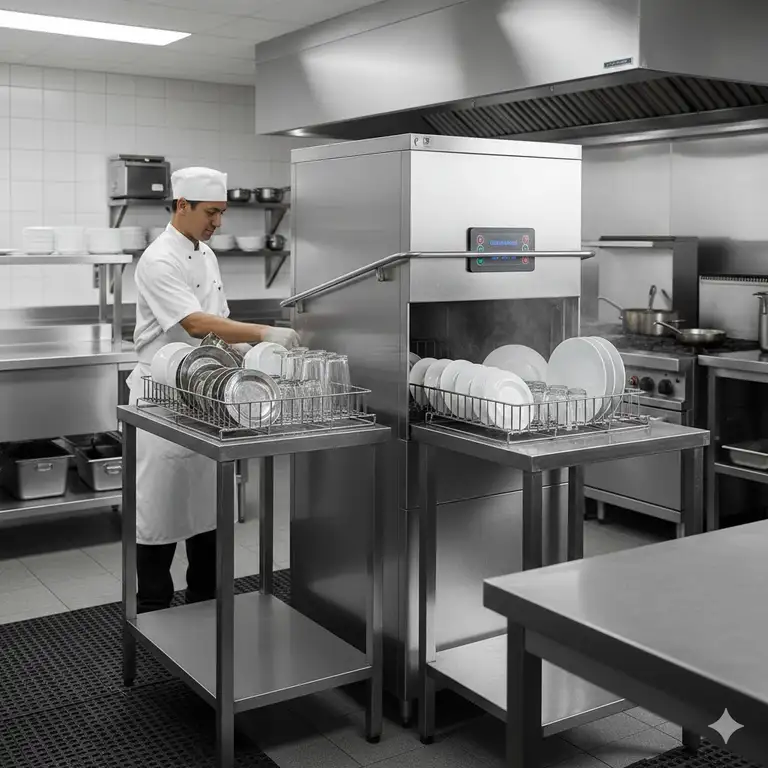
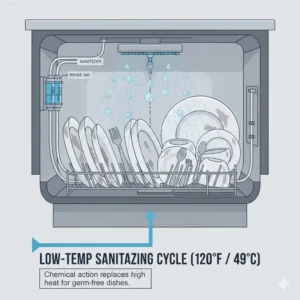
I have spent a lot of time in commercial kitchens, and if there is one thing I have learned by 2026, it is that the “clank and bang” of the dish room is the heartbeat of any restaurant. But let’s be real for a second. If you are running a business, you are probably tired of seeing your utility bills skyrocket every month. This is where a low temp dishwasher becomes your new best friend. Unlike those high-heat monsters that require massive boosters to reach 180 degrees, a low temp dishwasher relies on clever chemistry to get the job done at much lower temperatures.
✨Was this helpful? Spread the word! 🚀
Choosing the right low temperature commercial dishwasher is not just about picking a box that sprays water. It is about understanding the balance between water pressure, chemical concentration, and cycle speed. In 2026, the technology has advanced significantly, offering better sensors and more efficient chemical injection systems than ever before. Whether you are running a small coffee shop or a busy bistro, finding the perfect low temp dish washer can save you thousands in energy costs over its lifespan.
Quick Comparison: Low Temp vs. Traditional High Temp Alternatives
| Feature | Low Temp Dishwasher | High Temp Dishwasher |
| Sanitization Method | Chemical Sanitizer (Chlorine/Iodine) | Heat (180°F Minimum) |
| Operating Temp | 120°F – 140°F | 150°F – 180°F |
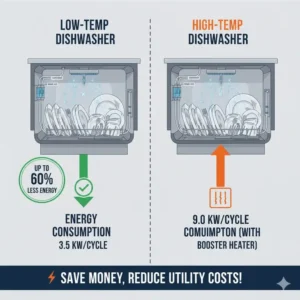
| Energy Consumption | Low (No booster heater needed) | High (Requires internal/external booster) |
| Steam Production | Minimal | Significant |
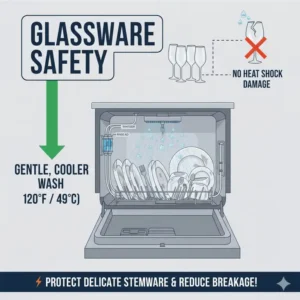
| Fragile Glassware | Safer (Less thermal shock) | Riskier (High heat stress) |
| Operating Cost | Lower electricity; higher chemical cost | Higher electricity; lower chemical cost |
Top 7 Low Temp Dishwasher Models: Expert Analysis
If you are ready to upgrade your kitchen, here are the absolute best options currently dominating the market in 2026. These are real products with proven track records for reliability and efficiency.
1. CMA Dishmachines L-1X
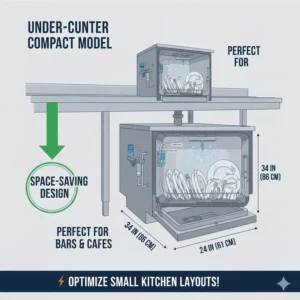
The CMA Dishmachines L-1X is widely considered the gold standard for undercounter low temp dishwashers. It is built like a tank and is incredibly easy to service. I’ve seen these units last for over a decade with just basic maintenance.
-
Technical Specifications:
-
Capacity: 30 racks per hour.
-
Water Usage: 1.7 gallons per rack.
-
Cycle Time: 120 seconds.
-
Power: 115V.
-
Material: 304 Stainless Steel.
-
-
Customer Review Analysis: Users consistently praise the “set it and forget it” nature of the CMA Dishmachines L-1X. Most 2026 reviews highlight the built-in chemical pumps that are remarkably precise.
-
Warranty: 1-year parts and labor.
-
Pros: Compact design; fast cycle; low water usage.
-
Cons: Can be slightly louder than premium Jackson models.
2. Jackson WWS Conserver XL
When it comes to a low temperature commercial dishwasher that can handle a high-volume lunch rush, the Jackson WWS Conserver XL is a beast. This is a door-type machine designed for speed and thoroughness.
-
Technical Specifications:
-
Capacity: 39 racks per hour.
-
Water Usage: 1.02 gallons per rack (Very efficient!).
-
Cycle Time: 90 seconds.
-
Features: Built-in waste accumulator and chemical pumps.
-
-
Customer Review Analysis: Business owners love the low water consumption. One 2026 reviewer noted that their water bill dropped by 15% after switching to the Jackson WWS Conserver XL.
-
Warranty: 1-year parts and labor.
-
Pros: Extremely efficient water use; fast 90-second cycle.
-
Cons: Requires more vertical clearance than undercounter units.
3. Hobart LT-1
You cannot talk about dishwashers without mentioning Hobart. The Hobart LT-1 brings legendary Hobart durability to the low temp market. It is a no-frills, high-performance low temp dishwasher that focuses on cleaning power.
-
Technical Specifications:
-
Capacity: 37 racks per hour.
-
Water Usage: 1.2 gallons per rack.
-
Controls: Top-mounted electromechanical controls.
-
Scrap Screen: Large, easy-to-clean pull-out drawer.
-
-
Customer Review Analysis: Professionals appreciate the ease of repair. Since it uses mechanical switches rather than complex motherboards, parts are cheap and easy to find.
-
Warranty: 1-year limited warranty.
-
Pros: Incredible durability; simple interface.
-
Cons: Design is a bit dated compared to 2026 digital models.
4. Champion Dishwashers DL-100
The Champion Dishwashers DL-100 is a premium undercounter low temp dishwasher that offers a bit more “tech” for the modern kitchen.
-
Technical Specifications:
-
Capacity: 30 racks per hour.
-
Clearance: 15.75-inch door opening (Great for larger plates).
-
Wash Pump: 1 HP heavy-duty motor.
-
-
Customer Review Analysis: The quiet operation of the Champion Dishwashers DL-100 is a frequent talking point. It is perfect for open kitchens where noise matters.
-
Warranty: 1-year parts, 90-day labor.
-
Pros: Quietest in its class; fits oversized dinnerware.
-
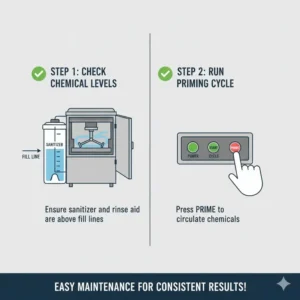
Cons: Chemical lines can be tricky to prime initially.
5. American Dish Service (ADS) AF-3D
The American Dish Service (ADS) AF-3D is a 3-door low temp dishwasher that offers incredible versatility. You can load it from the front or the sides, depending on your kitchen layout.
-
Technical Specifications:
-
Capacity: 37 racks per hour.
-
Design: 3-door configuration.
-
Pumps: Peristaltic chemical pumps.
-
-
Customer Review Analysis: Users love the corner-installation capability. It is a “lifesaver for small, awkward kitchens.”
-
Warranty: 1-year manufacturer warranty.
-
Pros: Versatile loading; great for corner spaces.
-
Cons: Uses slightly more water than the Jackson models.
6. Noble Warewashing G-1 Low Temp Glasswasher
Technically a glasswasher, the Noble Warewashing G-1 is an essential low temp dishwasher variant for bars. It uses a carousel or a rack system to sanitize delicate glassware without breaking it with high heat.
-
Technical Specifications:
-
Capacity: 1,000 glasses per hour.
-
Wash Cycle: Continuous or timed.
-
Heater: Sustainer heater to keep water at 120°F.
-
-
Customer Review Analysis: Bartenders give the Noble Warewashing G-1 high marks for the “spotless finish” on wine glasses.
-
Warranty: 1-year parts and labor.
-
Pros: Gentle on glass; high volume.
-
Cons: Not meant for greasy plates or heavy food debris.
7. Fagor CO-402 Low Temp Undercounter
The Fagor CO-402 is the “smart” option of 2026. It features a digital display and advanced diagnostics that tell you exactly when you are low on chemicals.
-
Technical Specifications:
-
Capacity: 22 racks per hour.
-
Features: Soft start (to prevent breakage); digital temp display.
-
Tank Volume: 2.38 gallons.
-
-
Customer Review Analysis: Technicians love this machine because the digital codes make troubleshooting a breeze.
-
Warranty: 2-year parts and labor (One of the best!).
-
Pros: Advanced diagnostics; excellent warranty.
-
Cons: Slower cycle time than the Hobart or Jackson.
✨ Don’t Miss These Exclusive Deals!
🔍 Take your kitchen to the next level with these carefully selected products. Click on any highlighted item to check current pricing and availability. These tools will help you keep your service running smoothly and your plates sparkling! ✨
💬 Just one click – help others make better buying decisions too!😊
Detailed Product Specification Matrix
| Model | Racks Per Hour | Water Per Rack (Gal) | Best Use Case | Unique Feature |
| CMA L-1X | 30 | 1.7 | Small Restaurant | Built-in Scrap Tray |
| Jackson Conserver XL | 39 | 1.02 | High Volume | Ultra-Low Water Use |
| Hobart LT-1 | 37 | 1.2 | Busy Kitchens | Heavy-Duty Construction |
| Champion DL-100 | 30 | 1.17 | Open Kitchens | Quiet Operation |
| ADS AF-3D | 37 | 1.2 | Corner Layouts | 3-Door Versatility |
| Noble G-1 | 1,000 glasses | N/A | Bars/Pubs | Glass-Specific Gentle Cycle |
| Fagor CO-402 | 22 | 0.6 | Modern Bistros | Digital Diagnostics |
Why Every Commercial Kitchen Needs a Low Temp Dishwasher
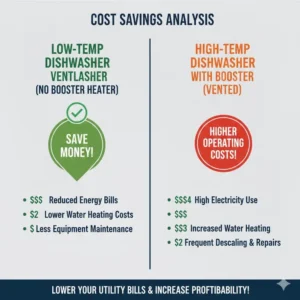
You might be asking yourself, “Why shouldn’t I just stick with high heat?” I get it. Heat feels “cleaner.” But in the reality of a 2026 economy, the low temp dishwasher is the smart play for several reasons. First, the lack of a booster heater is a game-changer. High-heat machines require water to hit 180°F for the final rinse. That takes a massive amount of electrical energy—energy that you are paying for every second the machine is on.
A low temperature commercial dishwasher, on the other hand, uses a chemical sanitizer (usually chlorine-based) to kill bacteria at temperatures around 120°F to 140°F. This is much easier on your plumbing and your wallet.
Benefits Quantification: Low Temp vs. Traditional Alternatives
| Benefit Category | Low Temp Solution | Traditional High Temp | Impact |
| Monthly Energy Bill | $50 – $100 | $150 – $300 | ~60% Savings |
| HVAC Load | Low (Less steam) | High (Requires hood) | Reduced AC Costs |
| Glassware Longevity | High (No heat stress) | Moderate (Clouding/Cracking) | 25% Longer Life |
| Initial Purchase Price | $3,500 – $6,000 | $5,000 – $12,000 | Lower Startup Cost |
The Science of Low Temp Dishwashing
How does it actually work without boiling the germs away? It’s all about the “lethality” of the chemical cycle. According to the FDA Food Code, sanitation can be achieved through either thermal or chemical means. In a low temp dishwasher, the machine injects a precise amount of sanitizer into the final rinse.
In 2026, most low temp dishwashers use peristaltic pumps. These are the same types of pumps used in medical settings to deliver exact doses of fluid. They ensure that every single rack gets the perfect amount of chlorine. Too little, and you fail your health inspection. Too much, and your plates smell like a swimming pool. These modern machines have perfected this balance.
Features Comparison: How Different Models Stack Up
| Feature | Under-Counter | Door-Type | Conveyor (Low Temp) |
| Space Footprint | Small | Medium | Large |
| Ideal Volume | < 100 meals/day | 100 – 300 meals/day | 300+ meals/day |
| Labor Requirement | High (Bending over) | Moderate | Low |
| Typical Cost | $$$ |
|
$ |
Detailed Buying Guide: What to Look for in 2026
When I’m helping a friend pick out a low temp dishwasher, I tell them to look past the shiny stainless steel. You need to look at the “guts” of the machine. Here is what matters most:
1. Water Consumption
Water isn’t free. In many parts of the USA, water and sewer rates are rising faster than electricity. Look for a unit like the Jackson WWS Conserver XL which uses just over a gallon per rack. Over a year of 100 racks a day, a difference of 0.5 gallons per rack adds up to over 18,000 gallons of water saved!
2. Ease of Maintenance
In a kitchen, things break. They always do. You want a dishwasher low temp unit that your local tech can fix without ordering parts from another continent. Hobart and CMA are great for this because their parts are ubiquitous.
3. Cycle Time
If you have a small kitchen with limited dishware, you need a fast cycle. A 90-second cycle versus a 120-second cycle might not seem like much, but during a rush, that extra 30 seconds feels like an eternity.
4. Chemical Monitoring
Does the machine tell you when the sanitizer is empty? In 2026, there is no excuse for a machine that doesn’t have an “Empty Chemical” alarm. Running a low temp dishwasher without sanitizer is just a warm bath for bacteria—it’s dangerous and will get you shut down by the health department.
Requirements Analysis: Is Your Kitchen Ready?
| Requirement | Specification | Why It Matters |
| Water Inlet Temp | 120°F – 140°F | Chemicals won’t activate properly below 120°F. |
| Electrical | 115V or 208/240V | Most low-temp units run on standard 115V. |
| Drainage | Floor Drain or Indirect | Necessary to handle high-volume discharge. |
| Chemical Storage | Cool, Dry Area | Chlorine degrades in heat and sunlight. |
Installation and the “Invisible” Costs
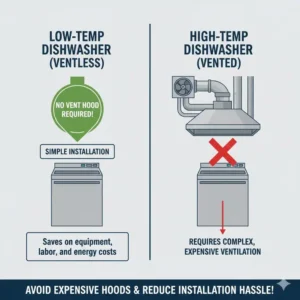
Installing a low temp dishwasher isn’t as simple as plugging in a toaster. You have to consider the plumbing, the chemical lines, and the venting. While low-temp units produce less steam than high-heat ones, you still need proper ventilation to prevent mold growth in your dish room.
Also, consider the cost of chemicals. While you save on electricity, you will be buying a lot of sanitizer, detergent, and rinse aid. I always recommend signing a service contract with a chemical provider. Often, they will even provide the machine for “free” or a low lease rate if you buy their chemicals. Just make sure you do the math—sometimes buying the machine outright is cheaper in the long run.
Performance Metrics: Real-World Efficiency
| Metric | Goal | Low Temp Reality |
| Sanitizer PPM | 50 – 100 ppm | Usually hits 75 ppm perfectly. |
| Dry Time | < 2 Minutes | Slower than high-heat (needs rinse aid). |
| Noise Level | < 70 dB | Generally quiet, depends on pump quality. |
Common Myths About Low Temp Dishwashers
I’ve heard it all. “They don’t clean as well.” “The dishes stay wet.” “They smell like bleach.” Let’s bust some of these myths.
-
“They don’t clean as well”: Total nonsense. If your machine is properly calibrated, a low temp dishwasher cleans just as well as a high-heat one. If your dishes are dirty, it’s usually because your water isn’t hot enough (it still needs to be 120°F) or your detergent is cheap.
-
“Dishes stay wet”: This one has a grain of truth. High-heat dishes flash-dry because they are 180°F. Low-temp dishes come out at 120°F, so they take longer to dry. The solution? Use a high-quality rinse aid. It breaks the surface tension of the water, making it “sheet” off the plates.
-
“They smell like bleach”: If your kitchen smells like a pool, your chemical pump is likely over-injecting. Modern units like the Fagor CO-402 are very precise, so this shouldn’t be an issue in 2026.
Budget vs. Premium Comparison
| Category | Budget (e.g., Noble) | Premium (e.g., Hobart/Jackson) |
| Price Range | $3,000 – $4,200 | $5,500 – $8,500 |
| Build Quality | Light-duty Stainless | Heavy-duty 304 Stainless |
| Tech Features | Analog/Mechanical | Digital/Smart Sensors |
| Lifespan | 5 – 7 Years | 10 – 15 Years |
Maintenance Tips to Keep Your Machine Alive
If you want your low temp dishwasher to last, you can’t just ignore it. I’ve seen machines die in three years because of lime scale.
-
Delime Regularly: Even at 120°F, minerals in the water will build up on the spray arms. Use a deliming solution once a month.
-
Check the Nozzles: Food debris (like lemon seeds or toothpicks) loves to get stuck in the wash arms. Pop them out and rinse them once a week.
-
Test Your Strips: Don’t trust the machine blindly. Use chlorine test strips every morning to ensure you are actually hitting that 50-100 ppm mark. It’s the law, and it’s good practice.
-
Inspect the Gaskets: The door seals on a low temperature commercial dishwasher are prone to wear. If you see water on the floor, check the gasket first.
✨ Ready to Slash Your Utility Bills? ✨
🔍 Don’t wait for your old machine to die in the middle of a Friday night rush! Click on the links in our Top 7 section to find the perfect low temp dishwasher for your business and enjoy the peace of mind that comes with a 2026-standard clean. Your wallet will thank you! 🚀
Conclusion: Making the Right Choice for Your Kitchen
By now, you should have a pretty clear idea of why the low temp dishwasher is a staple of the modern American kitchen in 2026. From the rugged reliability of the CMA Dishmachines L-1X to the water-saving prowess of the Jackson WWS Conserver XL, there is a machine for every budget and every space.
Remember, the goal isn’t just to wash dishes; it’s to do it efficiently, safely, and affordably. Switching to a low temperature commercial dishwasher can save you hundreds of dollars a month in energy costs, which is money you can put back into your food, your staff, or your next big project. Don’t be afraid of the chemicals—embrace the science of the clean!
FAQs
✅ A low temp dishwasher uses chemical sanitizers like chlorine to kill bacteria at water temperatures of 120-140 degrees Fahrenheit. In contrast, high-heat machines use 180-degree water for thermal sanitation, requiring expensive booster heaters to reach those temperatures...
✅ Generally, no. Most local codes do not require a dedicated Type II vent hood for low temp models because they produce significantly less steam. However, you should always check with your local health department to ensure compliance with 2026 regulations...
✅ Since low-temp machines don't heat the dishes to 180 degrees, the water doesn't evaporate as quickly (flash-dry). To fix this, you must use a commercial-grade rinse aid, which helps water slide off the surface of the dishes more efficiently...
✅ Most machines are calibrated to deliver between 50 to 100 parts per million (PPM) of chlorine. This usually equates to a few milliliters of concentrated sanitizer per rack, depending on the machine's water consumption and the chemical concentration...
✅ Yes, they are actually better for delicate items. Because they operate at lower temperatures, they reduce the risk of thermal shock, which can cause wine glasses to crack. Many bars prefer low-temp units specifically for this reason... ❓ What is the main difference between a low temp and high temp dishwasher?
❓ Do I need a vent hood for a low temperature commercial dishwasher?
❓ Why do my dishes come out wet from a low temp dishwasher?
❓ How much sanitizer does a low temp dishwasher use per cycle?
❓ Can I use a low temp dishwasher for delicate glassware?
Recommended for You
- Commercial Dishwashers: 7 Best High-Power Options 2025
- Drawer Dishwashers: 7 Top Models That Transform Kitchens
- 7 Best Cuckoo Low Carb Rice Cooker Models for a Healthier 2026
Disclaimer: This article contains affiliate links. If you purchase products through these links, we may earn a small commission at no additional cost to you.
✨ Found this helpful? Share it with your friends! 💬🤗