As an Amazon Associate we earn from qualifying purchases. Links in this article may be affiliate links. How we choose gear
Most pans sold as aluminum free stainless steel cookware still contain aluminum. Tramontina’s own product page describes an aluminum core bonded between layers of stainless steel, and Heritage Steel, a brand that turns up on plenty of non-toxic lists, states on its disclosures page that its cookware includes aluminum in its core. What the label usually promises is narrower: the aluminum sits between steel layers and never touches your food.
That gap between two meanings is the whole shopping problem in 2027. One meaning is common and cheap to satisfy. The other, no aluminum in any layer, is rare, and it changes what you can buy, what it costs and which stove it works on.
Everything below comes from manufacturer pages, published tests and forum threads, not from cooking in these pans ourselves, and each finding is tied to its source.
Aluminum free means two different things on a product page
The first meaning is a stainless cooking surface over a sealed aluminum core. Tramontina’s page for its tri-ply clad set lists an 18/10 stainless surface with an aluminum core bonded between the steel layers. Heritage Steel says the same about its five-ply pans and adds that, because the aluminum is fully sandwiched, food is not exposed to it. That is a company statement, but it matches how clad cookware is built across the category.
The second meaning is no aluminum anywhere in the pan. Among the stainless steel cookware without aluminum that we could verify, only two constructions qualify: copper bonded to a stainless lining, and single-layer stainless pots with no heat-spreading core at all. Anyone who wants no aluminum cookware in the broader sense can also look outside stainless, since cast iron and carbon steel are iron-based, but that is a different kind of pan with its own upkeep.
Does the stricter meaning matter for health? The sources treat it as a preference. The CDC’s public health statement on aluminum names food as the primary source of exposure, puts the average US adult at roughly 7 to 9 mg a day from food, and says oral exposure is usually not harmful. It adds that people with kidney disease can accumulate aluminum, and that frequent cooking of acidic food in aluminum pots may expose a person to more than stainless or glass would, though food cooked in aluminum pots is generally considered safe.
America’s Test Kitchen draws the same line from the cooking side. In its explainer on aluminum pans, bare aluminum can leach into wet, acidic, long-simmered food such as tomato sauce, while a skillet clad in stainless around an aluminum core can cook anything without risk. If sealed aluminum is fine with you, your options are wide. If it is not, they narrow fast.
Three questions that sort the field before you look at a brand
- Do you object to aluminum on the cooking surface only, or anywhere in the pan? Surface-only points to clad cookware. Anywhere points to lined copper or plain stainless pots.
- What is your stove? The clad pages both say their exteriors work on induction. The copper listing says induction needs the maker’s separate interface disc.
- What do you cook, and what will you spend? Daily skillet and saucepan work suits a set. Boiling by the gallon suits a single pot. Consumer Reports’ past copper tests put copper frying pans at about $150 to $540, against about $35 to $180 for a stainless skillet.
Here is how the four picks below line up against those questions.
| Construction | Aluminum in the pan | Aluminum touching food | Induction | Example here |
|---|---|---|---|---|
| Fully clad, aluminum core | Yes, sealed between steel layers | No, per the makers | Yes, per both pages read | Tramontina Tri-Ply Clad Stainless Steel Cookware Set, Heritage Steel Eater Series 8-Quart Stock Pot |
| Bonded copper with stainless lining | None listed | No | Only with a separate interface disc, per the listing | Mauviel M’Heritage 150 B Copper Round Pan |
| Single-layer stainless pot | None named in the listings read | No | Not stated | Bayou Classic 20-Quart Economy Stainless Steel Stock Pot |
The first row covers nearly every set you will see in a store. The second and third rows are the only places a literal zero, and each pays for it in a different currency: money and care for the copper, even heating for the thin pot. Whichever row you land in, the rest of this guide is about picking the best fit inside it.
Thickness deserves a word here, because it decides how a pan behaves whatever it is made of. Prudent Reviews measured a roughly 3 mm clad pan at about 360°F in the center after one minute on medium, against about 301°F for a 5.5 mm pan. After both were heated to 400°F and left for five minutes, the thinner pan had dropped to about 130°F and the thicker one to about 159°F. The tester’s conclusion: thicker pans hold heat longer but respond more slowly, and around 3 mm is the best balance for everyday cooking. Keep those numbers in mind for the thin pot in the last pick below, which has no core to make up for its gauge.
Four pans and pots, each matched to a kitchen
Stainless steel pans without aluminum are scarce enough that this shortlist is short on purpose: two sealed-core picks and two literal-zero picks, so each reader has a real choice inside their own meaning.
1. Tramontina Tri-Ply Clad Stainless Steel Cookware Set — budget clad set with a sealed core
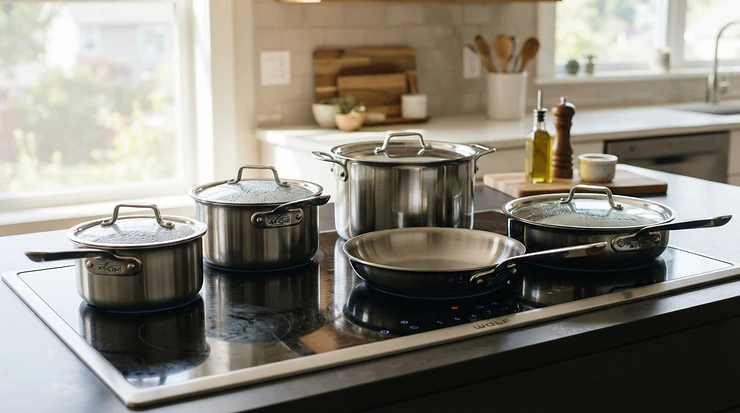
Replacing a worn nonstick set in one purchase is where this line earns its place. Tramontina’s page lists 18/10 stainless on the cooking surface, an aluminum core between the steel layers, compatibility with every cooktop including induction, a lifetime warranty and an oven limit of 400°F. Some third-party listings quote a higher oven figure, so go by the maker’s number. The page title says 12-piece, yet the included-items list names seven pans and pots.
Real-use data comes from Prudent Reviews, whose tester used a Tramontina tri-ply clad fry pan. It did not win any controlled test: its center hit 450°F in the conduction test, 17th of 31 pans, and it ranked 20th for evenness with a 97°F gap between center and edge. Yet the tester called it solid in everyday cooking. After several months the base warped very slightly upward, with no effect on cooking. That is one reviewer’s long-term observation, on a fry pan rather than the full set.
Pros:
- ✅ Aluminum sits fully inside steel, per the maker
- ✅ Works on induction, gas and electric
Cons:
- ❌ Slight warping reported in one long-term test
- ❌ Aluminum free only in the sealed-core sense
Prudent lists the fry pan in its lowest price tier, and for the set you should check the current price on Amazon.com. Compare the exact model number before buying, because the listing’s piece count and its title disagree.
2. Heritage Steel Eater Series 8-Quart Stock Pot — Tennessee-built clad that tolerates 800°F
Prudent Reviews calls the Eater Series the least expensive American-made pan it tested, which frames this pot as the premium-but-reachable end of sealed-core cookware. Heritage Steel’s page describes five-ply cladding that runs the full body of the pot, a 304 (18/10) stainless cooking surface, a magnetic 400-series exterior for induction, and a three-layer aluminum core between steel layers. It is oven safe to 800°F, broiler safe and covered by a lifetime warranty.
The company is unusually direct about what is inside. Its disclosures page says the cookware includes aluminum in the core and nickel in the cooking surface, and it says the aluminum layers are there to spread heat. It also notes that the cladded steel comes from South Korea and the pieces are finished at its Clarksville, Tennessee factory, so “made in USA” here means American assembly with global materials.
Prudent’s tester has used the Eater Series fry pan consistently since 2023. In his heat tests that pan landed mid-pack, with a center temperature of 413°F in the conduction test, 23rd of 31, at 2.8 mm thick and 2.9 pounds. The tester prices Heritage’s pricier Titanium Series about $30 above the Eater Series and calls the practical gain small for most home cooks.
3. Mauviel M’Heritage 150 B Copper Round Pan — no aluminum anywhere, at a premium
This is the only pick here that satisfies the strict meaning. The listing describes bilaminated copper and stainless steel, roughly 90% copper outside and 10% stainless inside, 1.5 mm thick, made in Villedieu-les-Poêles, Normandy. Nothing in that stack is aluminum. The listing is for the 4.7-inch round pan, and the M’Heritage line spans larger pieces, so confirm the size on Amazon before ordering. It also refers once to a nonstick surface, which contradicts its own stainless description; Consumer Reports describes Mauviel’s pans as stainless-lined and oven safe to 450°F.
Consumer Reports found in its lab tests that copper pans clean about as easily as stainless, and says the pans sold today carry a nonreactive lining, which is what makes them safe to cook in. Drying the outside thoroughly helps prevent tarnish. Its copper frying pan guide is a record of past tests, since CR no longer tests copper pans.
The friction is in the care rules. The listing says to avoid prolonged high heat, never leave the pan empty on a hot burner, skip metal utensils on the cooking surface and keep it out of the dishwasher unless marked safe. Induction works only with the maker’s interface disc, sold separately.
Pros:
- ✅ No aluminum in any layer, per the listing
- ✅ CR found lined copper about as easy to clean as stainless
Cons:
- ❌ Copper pans ran roughly $150 to $540 in CR’s past tests
- ❌ Induction needs a separate disc, and metal utensils are out
Curious about the size you need? Confirm the dimensions and the induction note on the listing before you order.
4. Bayou Classic 20-Quart Economy Stainless Steel Stock Pot — plain steel, no core, big batches
Boiling corn, crab or a weekend’s stock is where a thin single-layer pot makes sense. Retailer listings describe Bayou Classic’s stainless pots as 304 stainless with vented domed lids, and the maker positions the line as outdoor cooking gear. A crawfish-supply page for the 62-quart model describes a perforated basket that rests on a side ledge for steaming, which is the use these pots were built around. A hardware-store listing for the 20-quart model 1420 calls it all-stainless construction. Confirm on the Amazon listing that there is no aluminum base before relying on it.
The trade-off comes straight from the construction. Heritage Steel describes its aluminum layers as the part that spreads heat, so a pot with no such layer has nothing to even out a burner’s hot spot. It makes this a boiling and steaming tool first, and a sauce pot only with constant stirring. Check the current price on Amazon.com.
Non-toxic stainless steel cookware: what the label leaves out
Shoppers who search for non-toxic stainless steel cookware are often bundling several worries together, and aluminum is only one. Nickel is another. Heritage Steel’s disclosures page confirms its stainless cooking surface contains nickel, which it says helps corrosion resistance and durability, and argues diet is a far larger nickel source than cookware. A pan can pass the aluminum test and still fail a nickel one, so decide which concern you are filtering for. Non toxic stainless steel pans from different makers answer those questions differently.
Then there is the nonstick wish. Why are aluminum free nonstick stainless steel pot pans so hard to find? In one published test table from Prudent Reviews, the four hybrid pans listed, HexClad, Henckels Paradigm, Cooksy and Made In CeramiClad, were all 3-ply stainless with an aluminum core under the coating. The same site says coated pans eventually need replacing, though one hybrid it reviewed lasts longer than a typical nonstick pan.
For anyone who wants stainless steel cookware without aluminum and without a coating, the honest answer is the two constructions above: lined copper, or plain single-layer pots. Uncoated clad stainless, preheated and oiled, skips the coating but keeps the sealed core.
That leaves a practical split. People who want a nonstick feel and accept a sealed core are buying a coated clad pan and a replacement cycle. People who want zero aluminum are buying uncoated metal and learning to preheat. Neither group is wrong, but they should not shop from the same list. Browsing for non toxic stainless steel pans with that split in mind saves a lot of scrolling past hybrids that were never going to qualify.
Three ways an aluminum-free plan quietly fails
The dishwasher eats the rim. Prudent Reviews notes that the rims of most stainless pans are unsealed, so the bonded aluminum layer is visible between the steel. Repeated dishwasher cycles can make that layer shrink back, leaving the steel layers sharp. The same article reports that All-Clad settled a class action alleging exactly this, agreed to refund or replace damaged pans without admitting wrongdoing, and now recommends hand washing. In a separate review, the same tester says a pan with sealed rims removes the risk entirely.
The listing never names the core. Tri-ply, by definition, puts a metal core between two steel layers, and the two clad makers both name that core as aluminum. A listing that says tri-ply or “pure stainless” without naming the core deserves a question before you buy.
A deep gouge starts an argument. Commenters in an r/StainlessSteel thread about a Tramontina pan scored by a knife split. Some said it was fine, just ugly. One warned against acidic foods because of possible aluminum leaching, and another said the health risk was reason enough to replace it. A few suggested sanding. None of it was tested, so treat it as owner opinion, not data. If that argument would keep you up, the lined-copper and single-layer routes avoid it altogether. Shoppers hunting for no aluminum cookware at the strictest level are really choosing between those two, and a clad pan, however well sealed, cannot give them that.
Five answers about stainless steel pans without aluminum
❓ Does stainless steel cookware have aluminum in it?
❓ Is aluminum core cookware safe?
❓ Can scratches expose the aluminum in a clad pan?
❓ Is there nonstick stainless steel without aluminum?
❓ Does copper stainless cookware work on induction?
Pick the meaning first, then the pan
Decide which kind of aluminum free stainless steel cookware you want before comparing brands, because that choice sorts nearly everything else. If sealed aluminum is acceptable, the Tramontina Tri-Ply Clad Stainless Steel Cookware Set covers a first kitchen cheaply, and the Heritage Steel Eater Series 8-Quart Stock Pot is the sturdier, pricier route with an 800°F oven limit. If you want none at all, the Mauviel M’Heritage 150 B Copper Round Pan is the careful, expensive answer, and the Bayou Classic 20-Quart Economy Stainless Steel Stock Pot is the cheap, thin one for boiling.
Whichever you choose, wash clad pans by hand and find the line on the listing that names the core. Read it before you pay, since the product title alone rarely says which meaning you are buying.
Recommended for You
- 7 Best Stainless Steel Cookware Without Aluminum for 2026: Non Toxic!
- 7 Best Nickel Free Cookware Sets for 2026: Protect Your Health!
- 7 Best Ceramic Coated Stainless Steel Cookware Sets for 2026: Expert Reviews
Disclaimer: This post contains affiliate links. As an Amazon Associate, we earn from qualifying purchases made through these links, at no additional cost to you.
Whatever you cook in, find the line that names the core before you check out. 🔍