Can a coating sold for garages and basements really survive a kitchen? Sometimes, but only when the floor underneath cooperates. An epoxy kitchen floor is a resin coating that bonds to concrete, so a sound slab is the first requirement and the product comes second. This 2027 guide matches four real products to four common kitchen situations, along with the prep traps, slip risks and cure times that decide whether the finish lasts.
Everything below comes from manufacturer data sheets, retailer listings, trade guides and forum threads, not from my own kitchen. Nearly every long-term report I could find describes garage or basement floors, so treat kitchen durability as an extrapolation from those and from the cautions contractors give for residential work.
Three questions that settle whether your slab can take epoxy
What is under the finish?
Epoxy kitchen flooring is a treatment for concrete. Rust-Oleum’s data sheet for its basement coating is written for sound concrete, asks new slabs to cure at least 28 days and wants any sealer or curing agent removed first. KILZ asks for 30 days on new concrete. If your kitchen sits over a wood-framed floor, the renovation-quote site RenoQuotes lists a wood subfloor, active moisture and major slab cracks as reasons epoxy may be the wrong choice.
Specialist systems exist for tile and wood. ArmorGarage sells a bonding-primer kit for both, but its own page says the product is not recommended where water is continuous or hot, such as sinks, tubs and showers. That kit is a separate product with its own limits, so it is not one of the four picks below.
Is the slab sealed or damp?
Mark Powers, an epoxy specialist quoted by This Old House, says the concrete should be at least 60 days old or unsealed, and he suggests a simple check: splash water on it, and beading means a sealer is present. The same guide describes epoxy cost and prep in detail, including his preferred application range of 50 to 80°F. Rust-Oleum’s sheet sets 60 to 85°F, humidity no higher than 85 percent and a surface at least 5°F above the dew point, and it says the coating is not for floors with a moisture problem.
Can the kitchen go offline?
Cure time is the part people underestimate. Rust-Oleum lists 8 hours to light foot traffic and 24 hours to normal traffic for its basement kit. KILZ asks for 24 to 48 hours before heavy foot traffic. Angi says epoxy floors can take 24 to 72 hours to cure, and some mixtures need up to a week for full strength. Ventilation matters too: Angi warns that epoxy odors can irritate the eyes and throat, and a hardware retailer’s spec listing for the gray Rust-Oleum kit shows an ammonia odor and 113 g/L of VOCs.
What does an epoxy kitchen floor look like?
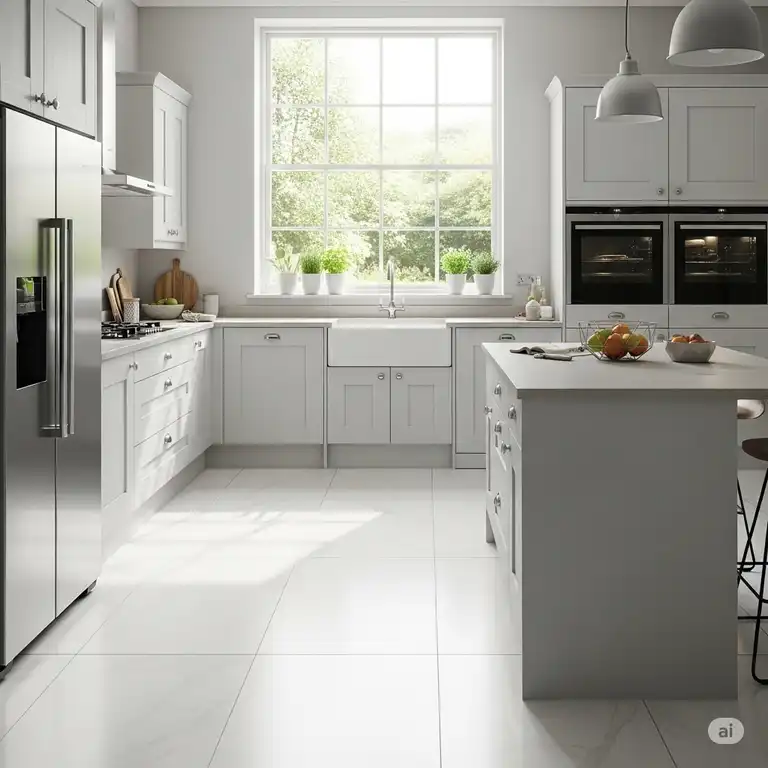
Mostly like a smooth, seamless sheet with no grout lines. House Digest describes the finish as glossy, sleek and contemporary, and non-porous enough that spills wipe up. The DIY kits in this guide give you solid color, usually with the option of scattered vinyl chips. Rust-Oleum EpoxyShield Basement Floor Coating Kit is a satin finish that can be used with or without chips, while a flake-heavy system such as ArmorGarage’s chip kit is sold as a medium-flake, terrazzo-style look.
Fancier looks belong to contractors. This Old House prices metallic epoxy at roughly $5 to $12 per square foot and puts decorative flakes at about $10 per 1-pound bag. The marble-effect epoxy resin kitchen floor that RenoQuotes shows from a Quebec installer is poured, layered work, not a one-coat kit result. A high-gloss surface also shows scratches and dust more than a satin one, which I infer from how glossy finishes behave rather than from a source.
Four kitchen situations, four picks for epoxy kitchen flooring
A small galley kitchen on a bare, dry slab is the natural home for this kit. Rust-Oleum’s data sheet calls it a two-component, water-based epoxy for sound concrete, applied in one coat under most circumstances, with chips scattered into the wet coat in 4-by-4-foot sections. The product page says one kit covers up to 250 square feet, but the data sheet puts practical coverage at 150 to 200 square feet per gallon. The kit holds 120 fluid ounces (104 of base plus 16 of activator), about 0.94 gallon, so my arithmetic lands at roughly 140 to 190 square feet. A 120-square-foot galley fits comfortably; a 200-square-foot open plan does not.
Kitchens are not mentioned anywhere in the data sheet. It targets basement floors, offers no chemical-resistance data and excludes moisture-prone floors and unsound old coatings. Lifespan is another point where sources split. This Old House says water-based epoxy lasts 1 to 3 years under heavy foot traffic, while Angi says epoxy floors can last 20 years or longer with care. A 3.0 to 3.5 mil water-based film sits closer to the cautious guide, which is my reading of the numbers, and the Rust-Oleum sheet gives no lifespan of its own.
Hardware retailers list the kit at around $100 to $110. Amazon carries several Rust-Oleum floor kits, so compare the exact model and size before ordering. Check current availability and kit size below.
Open-plan kitchens and kitchen-dining rooms above 250 square feet call for more film than a basement kit delivers. Reseller listings that mirror Amazon’s page describe a 3-gallon kit covering 500 square feet at 9.7 mils in one coat, with a gray base, gray decorative flakes and a slip-resistant aluminum oxide additive. One of those listings calls the resin a 100 percent solids cycloaliphatic epoxy. Spread over 500 square feet, 3 gallons works out to about 167 square feet per gallon, which matches a 9.7 mil film by simple arithmetic (a gallon covers about 1,604 square feet at 1 mil).
Buyers on the same pages report that coverage runs short. One says a 420-square-foot room needed an extra half gallon of another brand. Another with a pitted 500-square-foot garage needed three kits. A third notes the kit does not include a clear topcoat and found the floor plenty shiny without feeling slippery, which is one person’s impression, not a test. Even this thick film is about a quarter of a millimeter, far below the 2-millimeter line Angi uses to separate an epoxy floor from an epoxy coating.
The listings describe interior floors in general, and the maker’s kitchen guidance is not stated. Check the current price on Amazon.com.
Price tier is the whole argument here. A gallon runs around $45 to $50 at the retailer page I read, and the paint needs no mixing. Epoxy floor paint for a kitchen pantry, a laundry corner or a mudroom can be this simple. KILZ describes it as a single-component, water-based epoxy that covers 400 to 500 square feet per gallon on smooth concrete and 300 to 400 on rough, dries to the touch in 2 hours and recoats in 4. Its data sheet asks for 24 to 48 hours before heavy foot traffic and keeps VOCs under 50 g/L. KILZ’s product page also calls for a 30-day cure on new concrete and recommends a bonding primer.
The film is thin, at 1.0 to 1.6 mils dry. A listing mirrored from Amazon shows 4.3 out of 5 from about 1,400 ratings, and the written reviews split sharply. One reviewer reports paint lifting where tires ran and where a dog’s nails scrabbled within a week, despite degreasing and four days of drying. Another reports a basement floor holding up three months with four dogs. A third says a single coat left the concrete showing through. On an Anandtech forum thread about garage floors, a poster who used a Behr one-part finish reported tire pickup and bubbling after chemical spills over the years, while another poster with a two-part coating said theirs looked unchanged after four or five years. Rust-Oleum’s competing marketing claims its two-part kits are five times more durable than one-part epoxy paint, which is a manufacturer claim, but the forum pattern points the same direction.
The sink and dishwasher side of the kitchen is where a glossy epoxy gets risky. House Digest advises caution there because the gloss turns very slippery when wet, and This Old House says soap or oil spills can make the floor dangerous even though it is no more slippery than wood when dry. Rust-Oleum’s data sheet describes this additive as aluminum oxide based, meant for epoxy, latex or oil-based coatings, and says to mix it into the final coat only. A reseller listing says one 3.4-ounce pack treats up to 1 gallon, which suits the roughly 0.94-gallon Rust-Oleum EpoxyShield Basement Floor Coating Kit above.
Two trade-offs apply. Texture makes the floor harder to mop, and the powder settles, so a Rust-Oleum sheet for a sibling additive says to remix the coating periodically. The Epoxy-Coat Epoxy Floor Kit (3-Gallon, Gray Base) already lists an aluminum oxide additive, so doubling up there would add roughness you probably do not need. Check the current price on Amazon.com.
Film thickness decides how much wear a floor takes
The three coatings differ most in how much material ends up on the slab.
Thickness is not the same as a wear rating, so the table shows how much material you apply rather than how long it lasts. Even so, the Epoxy-Coat film is roughly three times the Rust-Oleum film and six to ten times the KILZ film, which fits the reviewer pattern: the thinnest coating draws the peeling reports and the thickest draws the coverage complaints. That is a trade between durability and kit count.
The prep sequence the data sheets agree on
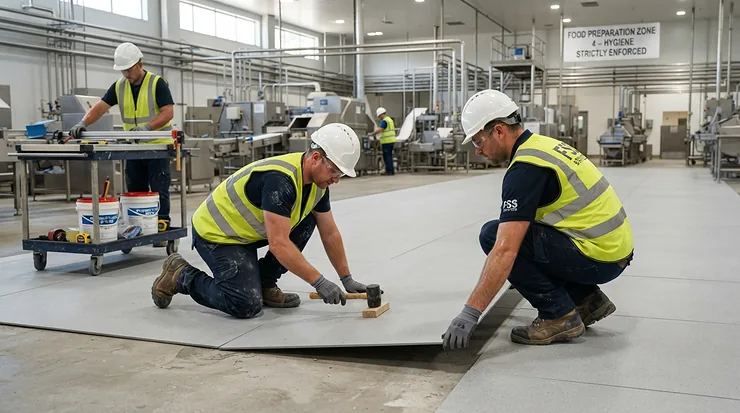
Every source I read puts most of the effort before the first roller stroke. Rust-Oleum’s sheet for the basement coating says to sweep, remove oil and grease, wash with a degreaser or household cleaner, rinse and let the floor dry completely. KILZ wants bare concrete cleaned and etched with a cleaner-etcher, then primed with a bonding primer. This Old House adds that concrete often needs etching, acid washing or power washing to bond, and suggests renting a floor maintainer to scrub the slab and cut down the labor. Buyers of Epoxy-Coat Epoxy Floor Kit (3-Gallon, Gray Base) describe an acid wash that ships inside it.
Old coatings change the job. Rust-Oleum’s sheet says to wire-brush loose paint, remove sealers by grinding or shot blasting, then scuff sand the whole surface. It also warns that scraping or sanding old paint can release lead dust, so a NIOSH-approved respirator and a HEPA vacuum belong in the plan for an older house.
Mixing windows differ a lot between products, so read the label rather than a forum. Rust-Oleum EpoxyShield Basement Floor Coating Kit asks for 3 minutes of mixing, a 15-minute induction period and a second mix, then gives 16 hours of pot life. ArmorGarage’s tile-and-wood system, a different two-part product, lists an epoxy work time of only 30 to 40 minutes. Rust-Oleum also tells users to wash tools at once with warm water and mild detergent, because dried product takes lacquer thinner to remove.
What a 120-square-foot kitchen costs: kit math versus a quote
For a hypothetical 120-square-foot kitchen, This Old House’s figures give a clear range. DIY materials at $2 to $5 per square foot come to about $240 to $600, while a professional installation at $3 to $12 per square foot comes to about $360 to $1,440. The same guide says premium topcoats add 20 to 30 percent. One Rust-Oleum EpoxyShield Basement Floor Coating Kit at around $100 to $110 works out to under a dollar per square foot, below the guide’s DIY floor, because those numbers assume thicker systems. Kit price is therefore the smallest cost on a kitchen job. Prep, lost days and a redo after a failed bond can cost more.
RenoQuotes argues that professional installation is usually the safer choice in kitchens, particularly when the slab needs repair, grinding, moisture testing or a decorative finish. If your slab shows cracks, flaking old paint or a damp patch, that advice outweighs any kit.
Where epoxy flooring for residential kitchens goes wrong
Heat comes first. Angi says extreme heat can leave epoxy soft and nearly tacky, and House Digest links bubbling and peeling to temperature swings, especially under the stove or near an exterior door. Impact comes next: House Digest warns of chips or cracks from a dropped pot or dragged furniture, and Angi notes that repairs are hard and often noticeable even when a professional does them.
Scratches and sun show up in owner reports. A Garage Journal member with a five-year-old floor said the first five feet yellowed from UV and that the surface scratched more easily than expected. An owner of a metallic epoxy floor on a Ford Raptor forum said the clear coat scuffs when a plastic gas can or a loaded trash can slides across it. Both reports come from garages, but a kitchen with a sunny door and a heavy trash bin invites the same wear. Both Angi and This Old House say a UV-resistant topcoat helps against yellowing at extra cost.
Prep failures are the quietest problem. An Anandtech forum poster discovered that the previous owner’s sealer would not let epoxy bond, which is exactly what the Rust-Oleum sheet warns against. Check the slab first, and think of an epoxy resin kitchen floor as a bonded layer that is only as sound as what it sticks to.
Straight answers on slip, tile, cure time, cost and yellowing
❓ Is an epoxy kitchen floor slippery?
✅ Glossy finishes can be, mainly when wet. House Digest advises caution near the sink and dishwasher, and This Old House says soap or oil spills make it hazardous. Mixing an aluminum oxide anti-skid additive into the final coat adds grip.
❓ Can I apply epoxy over existing kitchen tile or a wood floor?
✅ Generally not with the kits above. The Rust-Oleum and KILZ sheets cover concrete or masonry. Specialist bonding-primer systems exist for tile and wood, but one maker warns against continuously wet or hot areas, and a contractor guide calls wood subfloors a weak candidate. Ask the maker first.
❓ How long until I can use the kitchen after coating?
✅ Light foot traffic is possible after about 8 hours on Rust-Oleum's basement coating and normal use after 24. KILZ asks for 24 to 48 hours before heavy foot traffic. Angi says full cure can take 24 to 72 hours, sometimes a week.
❓ How much does an epoxy kitchen floor cost?
✅ This Old House puts DIY materials at $2 to $5 per square foot and professional installs at $3 to $12, with premium topcoats adding 20 to 30 percent. Kits for small rooms can run lower, while metallic systems cost more.
❓ Will an epoxy kitchen floor yellow or scratch?
✅ Both can happen. Angi notes some formulas yellow under direct UV, and a Garage Journal member reported yellowing in the first five feet of the floor and more scratching than expected after five years. Both Angi and This Old House say a UV-resistant topcoat helps.
How to choose among the four
An epoxy kitchen floor makes sense when three things line up: a bare, dry, sound concrete slab, a kitchen you can close for several days, and a willingness to live with a slick or textured surface. Run the water-bead test first, then match the coating to the room. A small galley on good concrete suits Rust-Oleum EpoxyShield Basement Floor Coating Kit. A larger open plan wants the thicker build of Epoxy-Coat Epoxy Floor Kit (3-Gallon, Gray Base). A pantry or laundry corner can live with KILZ 1-Part Epoxy Acrylic Concrete & Garage Floor Paint, and any gloss near the sink deserves Rust-Oleum 279847 EpoxyShield Anti-Skid Additive. If the floor is wood, sealed, damp or cracked, a contractor’s grind-and-coat quote or a different flooring is the honest alternative. Spotted one that fits your slab? Check current availability below.
Disclaimer: This post contains affiliate links. As an Amazon Associate, I earn from qualifying purchases made through these links, at no additional cost to you.
Splash a cup of water on your slab tonight: if it soaks in instead of beading, you already know the sealer question is settled.
At SmartCookLab, we are passionate about cooking and helping you find the best kitchen appliances and tools. Our team provides expert reviews, buying guides, and practical tips to enhance your cooking experience.
Home » Epoxy kitchen floor: Options for Different Budgets and Habits Can a coating sold for garages and basements really survive a kitchen? Sometimes, but only when the floor underneath
Home » Epoxy kitchen floor: Options for Different Budgets and Habits Can a coating sold for garages and basements really survive a kitchen? Sometimes, but only when the floor underneath
Home » Epoxy kitchen floor: Options for Different Budgets and Habits Can a coating sold for garages and basements really survive a kitchen? Sometimes, but only when the floor underneath