As an Amazon Associate we earn from qualifying purchases. Links in this article may be affiliate links. How we choose gear
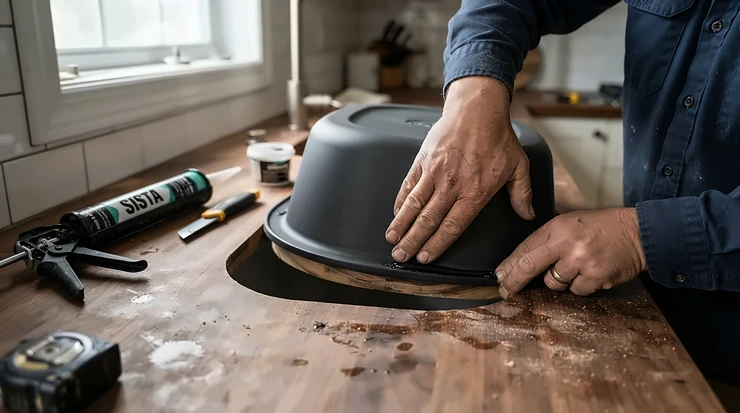
A sink is one of the few kitchen parts you can’t quietly swap once the countertop is in. Order one an inch too wide for the base cabinet, or a drop-in model when your plan calls for undermount, and the correction means new cutouts, extra bracing or a return of a 40-pound box. That is why composite kitchen sinks deserve a few minutes with a tape measure before any shopping starts.
We haven’t installed any of the sinks below. Everything here comes from manufacturer pages, retailer spec sheets and published buying guides, and we flag the places where those sources disagree. For 2027 shoppers, the picks are sorted by situation (small kitchen, big pots, two people at the sink, an old drop-in cutout) instead of one ranked winner, because a composite sink that suits one counter is wrong for another.
Three questions to settle before you open a product page
What does your countertop let you install?
Mounting style decides which sinks are even on the table. A drop-in sink rests on a rim over the cutout, and one retailer’s description of the Kraus Quarza line says its drop-in designs work with any countertop material, laminate and granite included. An undermount sink attaches beneath the counter for a flush edge. Dual-mount models, such as the Forteza, install either way.
Replacing an old drop-in is the easiest swap. Ruvati’s listing says its standard 33-by-22-inch epiGranite size fits most existing top-mount cutouts, but check any maker’s cutout template against the hole in your counter before cutting anything.
Can the cabinet carry it, and what will installation add?
Composite is dense. Angi puts an empty composite sink at roughly 40 to 50 pounds, and says installation often costs more than for other materials because the cabinet may need added bracing and support. Retailer spec sheets agree on the weight class: AJ Madison lists a 31-inch Kraus Quarza at 38.1 pounds, and one dealer shows 35 pounds for a 33-inch Elkay drop-in.
Width matters too. The 33-inch Blanco, Ruvati and Elkay listings below all call for a 36-inch minimum base cabinet, while the 25-inch Kraus lists 27 inches. Bob Vila says standard sink widths generally run from 24 to 32 inches, so a 33-inch model sits just beyond that range, which makes the cabinet measurement the first thing to confirm.
Price ranges overlap more than brand names suggest. Houzz puts granite composite at $250 to $550. Angi says composite sinks start around $300, with high-end composite or stainless close to $1,000 or more. House Digest splits it by type: top-mount granite composite from $150 to $375, undermount from $200 to $425, and quartz composite from $200 to $600, with installation running $216 to $628 according to Angi’s figures as that article relays them.
How do you actually use the sink?
Think about an ordinary Tuesday night. One deep bowl handles stockpots and sheet pans. Two bowls let one person wash while another rinses, at the cost of room in each. Color plays a part as well: House Digest reports that light granite composite stains more easily than dark, while wear shows more on darker quartz shades.
A garbage disposal adds another check. Kraus describes the rear drain on its Quarza line as compatible with all disposal adapters, and Ruvati’s drop-in epiGranite page says to use the drain flange that comes with the disposal.
Kinds of composite sink: granite, quartz and the resin-heavy blends
Nearly every composite sink for the kitchen is crushed stone bound with acrylic resin and molded under pressure. The differences are in the stone, the ratio and the label.
Granite composite is crushed granite and resin. Houzz describes roughly 80 percent granite and 20 percent acrylic, and says the material resists scratches, stains and chips while tolerating hot pots, with heat resistance up to 535°F. Bob Vila gives a different ratio, about 95 percent stone and 5 percent resin. Sources split on this, and the spec sheet for the model you pick is the better guide.
Quartz composite swaps the granite for crushed quartz. House Digest cites at least 70 percent quartz, and Elkay’s spec sheet describes its Quartz Classic sinks as molded with up to 80 percent natural quartz. The same article notes quartz comes in a narrower color range, mostly matte, and shows wear more on dark shades.
Solid-surface and other resin-heavy blends are a different product in the same aisle. Bob Vila warns that man-made solid-surface sinks can be damaged by high heat, and a Yahoo Life buyer’s guide cautions that some composite sinks suffer blemishes from melting resin. If heat matters to you, pick a sink with a published heat rating and read its warranty.
The labels add confusion. Kraus describes the Quarza line as made from 80 percent natural quartz, yet sells it as a granite composite sink; Build.com calls Elkay’s quartz formula the toughest granite composite available. Retail categories treat “granite” and “quartz” as near-synonyms, so read the material line rather than the product category.
One more disagreement: Houzz calls granite composite porous, saying mineral-rich water can dull the finish over time, while Kraus and Elkay listings describe non-porous surfaces. In a hard-water home, treat the cleaning routine as part of the purchase.
Five composite sinks worth a look, matched to the kitchen they suit
These five come from four makers and cover small kitchens, big single bowls, double bowls and drop-in swaps. Rankings of the best composite sinks usually crown one winner; here each pick answers a different set of constraints.
| Sink | Overall size (L × W) | Bowls | Mounting | Heat rating on listings |
|---|---|---|---|---|
| Kraus Quarza 25-Inch Dual Mount Single Bowl Sink | 25 × 22 in | One | Drop-in or undermount | Described as heat resistant; no figure |
| Kraus Forteza 33-Inch Single Bowl Granite Sink | 33 × 22 in | One | Top-mount or undermount | No figure given |
| Blanco Diamond Super Single Dual Mount Sink | 33½ × 22 in | One | Drop-in or undermount | 536°F |
| Ruvati epiGranite 33-Inch Double Bowl Sink | 33 × 22 in | Two | Drop-in or undermount | 536°F |
| Elkay Quartz Classic 33-Inch Drop-In Single Bowl Sink | 33 × 20⅞ in | One | Drop-in | 535°F |
Three of the five list a 36-inch minimum cabinet, and the Kraus Forteza 33-Inch Single Bowl Granite Sink is the same width, so the Kraus Quarza 25-Inch Dual Mount Single Bowl Sink is the only one for a genuinely small base. The Elkay Quartz Classic 33-Inch Drop-In Single Bowl Sink is about an inch shallower front to back than the 22-inch models, which helps in tight counters. Heat ratings are manufacturer claims, and they come from different material lines.
1. Kraus Quarza 25-Inch Dual Mount Single Bowl Sink — small footprint, full-depth bowl
Small kitchens are where a 33-inch sink stops being an option. This Quarza measures 25 by 22 inches with a bowl depth of about 9 inches on AJ Madison’s spec sheet, and it lists a 27-inch minimum base cabinet. It also makes sense as a second sink on a prep island or bar, in the same material as the main one.
Ferguson’s page describes 80 percent natural quartz bound with acrylic resin, and says the sink installs as a drop-in or an undermount. A rear-set drain frees up cabinet space below, and the sink comes with one pre-drilled faucet hole.
The bowl’s interior is roughly 21½ by 18 inches, so a half-size 18 × 13 sheet pan fits, while a full-size 26-inch pan will not lie flat. Kraus backs the sink with a limited lifetime residential warranty and only one year for commercial use, per Build.com.
2. Kraus Forteza 33-Inch Single Bowl Granite Sink — one wide bowl for big pans
Bob Vila’s editors named this their best granite-composite pick in a roundup of kitchen sinks. The sink measures 22 inches front to back, 33 inches wide and about 9.56 inches deep, comes in black or gray, and installs top-mount or undermount using a pre-drilled hole and four knock-out holes.
Two design details earn it a place in this lineup. The faucet hole sits off center, which Bob Vila says adds usable workspace in the bowl. The thick construction, according to the same write-up, reduces noise and banging while you wash. It also resists dirt, grime and scratches, and wipes clean easily.
Against that, Bob Vila’s editors note that some users report poor fit and installation difficulty, and at 33 inches the sink is wider than the 24-to-32-inch range the same article calls standard.
3. Blanco Diamond Super Single Dual Mount Sink — Silgranit and a published care routine
Blanco is the entry where the maker’s paperwork does the most work. The Diamond Super Single measures 33½ by 22 inches with a 9½-inch bowl, and listings describe it as 80 percent granite, rated to 536°F, with softly rounded drain grooves. A supplied template covers the cutout, which has a 5/8-inch corner radius, and the listing calls for a 36-inch cabinet.
What sets it apart is the guidance around it. Blanco’s US care page lays out a routine: dish soap and a soft sponge daily, a limescale-reducing cleaner weekly, and a deep clean once or twice a year with laundry detergent and hot water of about 140°F, left to sit for at least two hours. It also warns against steel wool and metal scrubbers.
The model number depends on color: 440195 is white, with siblings including 440194 (Anthracite), 440192 (Café), 441287 (Truffle) and 443109 (Volcano Gray). Zoro and QualityBath mark 440195 as discontinued, while other dealers still list it, and Zoro gives Germany as the country of origin.
4. Ruvati epiGranite 33-Inch Double Bowl Sink — separate wash and rinse sides
Two people at the sink is a different shopping problem. The RVG1344 is a dual-mount 33 × 22-inch epiGranite with a larger bowl of 15¼ by 18½ inches and a smaller one of 13 by 16, both about 9 inches deep, per Ruvati’s listing. Ruvati describes it as crafted in Italy from 80 percent crushed granite, and retailer pages add sound dampening, a basket strainer and a limited lifetime warranty.
Compliance is spelled out: Ferguson says it is cUPC certified and tested by IAPMO to US and Canadian plumbing standards. The heat rating on retailer pages is 536°F, and the listings give a 36-inch minimum cabinet.
Sources disagree on the split. Ferguson calls it 60/40, one retailer lists it as 55/45, and the bowl measurements point to something closer to even. Ruvati notes the divider rises nearly to the rim, so a big pot won’t straddle it, and it offers a low-divide alternative in the RVG1345.
5. Elkay Quartz Classic 33-Inch Drop-In Single Bowl Sink — built for drop-in replacements
Older kitchens often come with faucet holes that newer sinks don’t have. This Elkay is pre-scored for up to five faucet holes, and its mounting hardware fits countertops up to 1¾ inches thick, according to dealer pages. That suits a swap into an existing laminate or tile counter where the faucet setup stays put.
The ELGR13322 measures 33 by 20⅞ inches with a 9 7/16-inch bowl, weighs about 35 pounds on one dealer’s page, and comes in six finishes: black, dusk gray, graphite, greystone, matte black and white. Elkay’s spec sheet describes the material as up to 80 percent natural quartz with acrylic resins, and listings give a heat rating of 535°F and a 36-inch minimum cabinet.
Elkay’s Quartz Classic line carries a limited lifetime residential warranty on Build.com, and the same pages list it as not approved for commercial use.
Composite sink reviews: where the sources agree and where they split
No star counts appear in this article. What the published guides do agree on is more useful anyway.
Roundups of the best composite kitchen sinks tend to repeat the same strengths. Houzz highlights scratch and stain resistance, Bob Vila ranks granite composite among the most scratch-resistant sink materials, and Angi says composite resists dings and dents better than stainless steel and can be cleaned with simple dish soap. Weak spots show up too. Angi warns that the hard surface gives less than stainless, so dishes can break, and that composite sinks cost more and weigh more than stainless. House Digest adds that light colors stain more easily, resin can hold stains permanently, and chipping or cracking is still possible, if less likely.
The Forteza’s mixed signal is typical of the category: Bob Vila praises the build while noting user complaints about fit. That pattern suggests the sink itself is rarely the issue; the problems arrive from cabinet size and cutouts, which is why the three questions at the top come first.
Habits that wear a composite sink out early
Reaching for steel wool or scouring powder
Blanco says strong abrasives, metal scrubbers and steel wool scratch and dull the surface. Houzz makes the same point about abrasive powders and pads, noting they can dull the finish and make stains more likely. A nylon brush with soapy water is the safer routine.
Letting limescale sit
Blanco’s care page says most discoloration is stain stuck to limescale, so a weekly acid-based cleaner does more than hard scrubbing. House Digest advises mixing white vinegar and water 1:1 rather than using straight vinegar, while Blanco’s page mentions warm vinegar for stubborn stains. Follow your own maker’s guide, since formulas differ.
Treating the bowl like a bin
Blanco warns that acrylic paint left in the sink for more than 24 hours can leave permanent marks. Angi’s caution about hard surfaces applies too: a dropped plate hits composite harder than it would hit stainless.
Quick answers before you buy
Do composite kitchen sinks scratch or stain easily?
They resist both better than most materials, but not perfectly. Houzz says granite composite resists scratches and stains, yet warns against abrasives. House Digest says light colors show stains more and resins can hold them. Daily rinsing and limescale control keep most sinks looking even.
Can you put a hot pan in a composite sink?
Many makers publish ratings: 535°F for Elkay’s quartz line and Houzz’s granite composite, and 536°F for Blanco’s Silgranit and Ruvati’s epiGranite. Bob Vila warns that man-made solid-surface sinks can be damaged by high heat, so read the rating on your sink’s own spec sheet before treating it as a trivet.
Are composite sinks better than stainless steel?
It depends on what you value. Angi says composite resists dents, stains and scratches better and is easy to clean. Stainless costs less, weighs less and is gentler on dropped dishes. If your cabinet needs added bracing, installation can narrow the price gap.
How much do composite kitchen sinks cost?
Guides give overlapping ranges. Houzz lists $250 to $550 for granite composite, Angi says composite starts around $300, and House Digest gives $150 to $375 for top-mount granite and $200 to $600 for quartz, plus $216 to $628 for installation. Check the current price on Amazon.com for any model.
How to choose among these five
Start with the cabinet and the countertop, then pick the bowl layout. For a 25-inch opening, the Kraus Quarza 25-Inch Dual Mount Single Bowl Sink is the straightforward fit. For a standard 36-inch cabinet and big pans, the Kraus Forteza 33-Inch Single Bowl Granite Sink or the Blanco Diamond Super Single Dual Mount Sink gives you one wide bowl, with Blanco adding a published care routine on its US site. Two people at the sink point to the Ruvati epiGranite 33-Inch Double Bowl Sink, and an old drop-in cutout with several faucet holes points to the Elkay Quartz Classic 33-Inch Drop-In Single Bowl Sink.
Whichever way you lean, composite kitchen sinks reward careful measuring more than brand loyalty. Compare the exact model number and the cutout dimensions with your countertop before you order, since colors and mounting styles carry different numbers within one line.
Recommended for You
- 7 Best Composite Kitchen Sinks for Ultimate Durability and Style in 2025
- 7 Best Kitchen Sink White Options That Transform Your Space in 2025
- 10 Extraordinary Best Kitchen Sinks That Will Transform Your Cooking Space | Expert Guide 2025
Disclaimer: This post contains affiliate links. As an Amazon Associate, we earn from qualifying purchases made through these links, at no additional cost to you.
Measure the cabinet twice, then see what’s in stock on Amazon.com. 📏