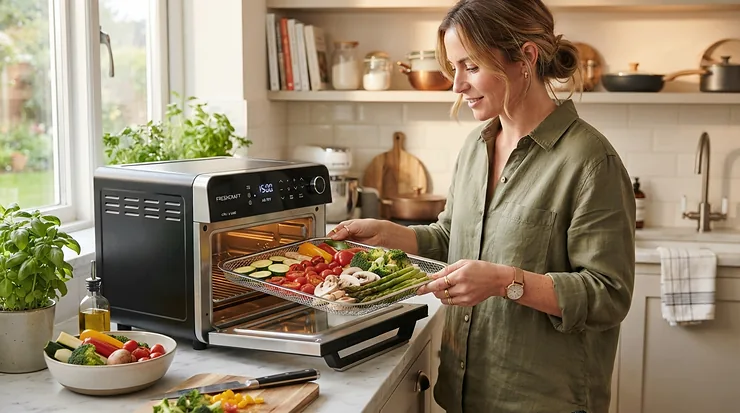
A 4.4-quart Philips 2000 Series and a 9.6-quart Philips 5000 Series with steam sit 5.2 quarts apart (our arithmetic), and the Walmart and Philips store pages cited below put them about $250 apart in price, around $100 against around $350. That spread is why philip air fryers reviews seem to contradict each other: a tester who praises a window and an easy-clean basket is describing a different machine from one who praises steam and two drawers. The brand on the box is spelled Philips, and this philip air fryers guide for 2027 covers the 2000, 3000 and 5000 Series lines that US retailers carry.
The test write-ups credit the line with good browning but differ on speed, noise and cleaning, and those three traits decide most purchases. One more fact affects warranty claims: a Philips manual for an older Airfryer names Versuni Holding B.V. as manufacturer and warrantor, with the Philips name used under trademark license.
Every performance claim below traces to a named write-up at Tom’s Guide, TechRadar, T3, RTINGS or Expert Reviews, a Philips product page or a retailer listing, and no unit was cooked on for this piece, so each remark about crispness or noise is credited to the person who made it.
How the Philips range splits into three numbered lines
The 2000 Series is the entry point: one basket, a viewing window and 13 presets, sold as the Philips 2000 Series Airfryer 4.4 Qt (NA221/00) and in a 6.6-quart size. The 3000 Series adds a bigger window basket and the first dual-basket model. The 5000 Series is where steam appears. For philip air fryers 2027 shopping, the useful split is by basket count and function rather than by release year.
Philips’ launch announcement for the single-basket 3000 Series describes 6.2-liter and 7.2-liter versions with 12 presets, 16 cooking methods and dishwasher-safe, nonstick parts. Philips’ US store pages for the dual models list a two-year warranty plus a 30-day money-back guarantee, while the older-Airfryer manual mentioned above gives one year, so the warranty period depends on the model.
The method: five steps from counter space to a short list
Run the steps in order, because each one removes models before the next begins.
Measure the counter and the space above it. Philips’ store page lists the dual 3000 Series at 15 inches deep, 17.4 wide and 12.3 high, and 17.3 pounds. Tom’s Guide lists the 6.6-quart 2000 Series with a window, and its 3000 Series single-basket review gives the 7.2-liter size as 13 by 17.5 by 12.25 inches and 13 pounds. The store page for the dual 5000 Series says 17.5 by 15 by 14 inches, and Expert Reviews warns that its steam can leave the wall behind it wet, which matters under wall cabinets.
Count plates, then check the basket shape. RTINGS calls the 4.5-quart NA220/00, the sibling of the NA221/00, enough for two to three people, and its dual NA350/00 has a 6.18-quart main basket and a 3.1-quart side basket. Tom’s Guide roasted a 2.9-pound chicken in the 6.6-quart 2000 Series, which took 38 minutes.
Decide whether two dishes must finish together. Sync timing is the dual-basket pitch, and T3 called it a standout. RTINGS still rates the Ninja Foodi DZ550 and DZ201 above the NA350/00 for most people and says the Ninjas cook faster, and Tom’s Guide found food took longer than in a typical air fryer. A household that mostly cooks one dish gains little from the second drawer.
Look at cleaning and coating before features. Tom’s Guide says the star-shaped base that improves airflow collects crumbs and grease, on the 2000 Series and on the dual 3000 Series alike. Tasting Table quotes Philips’ support page saying the pan and basket are PTFE coated inside a plastic housing, and a Philips coating page links peeling to incidental scratching and warns against metal scrubbers and hard brushes.
Read ratings with their source in mind. Philips’ US page for the dual 5000 Series shows 4.9 of 5 from 33 reviews, yet six of the ten reviews displayed are marked as collected as part of a promotion. Retailer pages are broader: Walmart shows 4.8 from 94 reviews for the 6.6-quart 2000 Series and 4.8 from 146 for the dual 3000 Series, and Staples shows 4.75 from 138 for the 4.4-quart model. High averages like these say owners are satisfied overall, but they say little about speed or noise, which is where independent tests earn their place when you read philip air fryers reviews.
Philip air fryers price: what the retailer pages show
Price climbs with basket size and extras. The bands below come from the Walmart, Staples, Target, Williams Sonoma, Philips store and test pages opened for this guide, so the current price on Amazon.com may differ.
Model
Baskets
Footprint listed
Price band
Main trade-off
Philips 2000 Series Airfryer 4.4 Qt (NA221/00)
One, 4.4 qt
Not listed on pages opened
Around $100
Room for two to three people
Philips 2000 Series Airfryer 6.6 Qt (NA231/00)
One, 6.6 qt
Not listed on pages opened
$95 to $130
67 dB in one test
Philips 3000 Series Airfryer with Window 7.6 Qt
One, 7.2 L
13 x 17.5 x 12.25 in, 13 lb
$150 to $200
Back of the basket browns faster
Philips 3000 Series Dual-Basket Airfryer 9.5 Qt (NA351/00)
Two, 6 L and 3 L
15 x 17.4 x 12.3 in, 17.3 lb
$170 to $250
Slower, bulky
Philips 5000 Series Dual-Basket Airfryer with Steam 9.6 Qt (NA555/00)
Two, 6.3 qt and 3.2 qt
17.5 x 15 x 14 in
Around $350
Steam in one drawer only
Moving from the 6.6-quart 2000 Series to the dual 3000 Series adds roughly $75 to $120 depending on the seller (our arithmetic from the bands), and the 5000 Series adds another $100 to $180 beyond that. The 4.4-quart model sits only about $30 below the 6.6-quart at Walmart, close enough that the extra capacity deserves a look. Philips’ launch announcement put the 7.2-liter single basket at around $150, which is the floor of the band shown for it now.
Cheap Philip air fryers: what the low price leaves out
The 2000 Series holds the cheap philip air fryers in the line, and the savings come from features rather than from a different kind of cooking: one basket, no sync timing, no steam, a smaller footprint. Tom’s Guide notes that the dual 3000 Series costs about the same as comparable Ninja and Instant dual models and more than Bella and Dash. Walmart also lists a restored, like-new dual 3000 Series at around $150, below the new band, though a restored unit should state its own warranty terms before you choose it.
What testers and owners report, and how to dodge the usual letdowns
Speed comes up first. RTINGS says the NA350/00’s large basket preheats slowly yet cooks at a decent pace, and Tom’s Guide found the dual 3000 Series slower than a typical air fryer. TechRadar and Expert Reviews both report that the 5000 Series timer starts with no preheat, so extend times by a few minutes and check early rather than trusting a preset.
Noise is the second theme. Tom’s Guide measured 67 dB on the 6.6-quart 2000 Series with a phone app, 2 dB above the Ultenic K10 it was comparing, and lists 65 dB as the dual 3000 Series spec while calling that model quite quiet. The beeps draw opposite complaints: T3 found the dual’s alert too quiet with no volume setting, Expert Reviews said the same of the 5000 Series’ end-of-cook tone, and Tom’s Guide called the single-basket 3000 Series’ halfway beep incessant until a tap silences it.
Coating wear and first-use smell appear in owner reports. Tasting Table’s October 2026 roundup of Reddit threads names Philips among the brands whose owners reported flaking, with owners of several brands describing damage within a month or so, and it quotes Philips’ support page saying parts may give off some smell during the first uses. Philips advises letting the unit cool, cleaning it and running it hot with nothing inside. On Target’s page for the 6.5-quart 2000 Series, one reviewer reported smoke and smell from the coating at first use and another said food stuck to the pan; both are single reports, and most reviewers there rated cleaning easy.
Fingerprints are a smaller annoyance. Tom’s Guide says the plastic exterior of the dual 3000 Series shows them fairly easily, and T3 says its matte body shows grease as well.
Recall history deserves a quick look too. Air fryer recalls in recent years covered Cosori, Insignia and PowerXL units, according to CPSC notices and news coverage, and none of the notices surfaced in searches for this guide named a Philips model. The CPSC recall page filters notices by date, hazard and category, and model numbers appear inside each notice, so checking a specific unit takes a few minutes.
The best Philip air fryers, matched to the steps above
Four models answer the decisions above, each with the trade-off that comes with it. The price bands come from the pages cited and shift between sellers.
Around $95 to $130 is the band for this one: Tom’s Guide cited about $96 on Amazon in early 2025, Williams Sonoma shows a limited-time deal near $100, and Walmart and Target sit at the top of the band.
Working with a 6.6-quart 2000 Series whose listing title reads NA230, Tom’s Guide’s tester cooked a 2.9-pound chicken to 176°F in 38 minutes total, finished jalapeño poppers in about 6 minutes against 20 in an oven, and roasted frozen fries in 20 minutes against 25 on the package. The verdict was Editor’s Choice, with the tester calling it “hands-down, my favorite air fryer to use.” The grill is dishwasher safe, though the concave star-shaped bottom collects grease and crumbs.
Walmart and Williams Sonoma list this size as NA231/00, and Philips support replies on Target’s page cite NA230/00, NA231/00 and NA221/09 for a single listing, so the suffix alone does not pin down the version.
Pros:
Window and light for watching food, with 13 modes, per Tom’s Guide
Roasted a whole chicken in the tester’s trial
Lowest price band of the four picks
Cons:
Measured at 67 dB, which the tester called a little loud
One basket, so no sync timing
Loudest of the picks in the tests cited
Walmart’s page shows 4.8 from 94 reviews for the 6.6-quart listing. See the current listing on Amazon.com.
Philips 2000 Series Airfryer 6.6 Qt (NA231/00)See current price, sizes and reviews on Amazon.
Items at the back of the basket browned faster than those at the front in Tom’s Guide’s April 2025 test, and that is the main quirk reported for this single-basket model. Everything else in that review was favorable. The tester said food browned evenly on both top and bottom, so flipping was unnecessary.
The review judged the step up from the 2000 Series worth the extra money. The basket is nonstick and dishwasher safe, but the raised ridges on the base need extra attention when washing, and the halfway shake beep was described as incessant until a tap turns it off. The HomeID app supplies recipes and the manual but does not control the machine.
Tom’s Guide tested a 7.2-liter version, the same capacity Walmart lists as 7.6 quarts, and neither page gives a model number for it. Philips announced around $150 for that size at launch and Walmart shows around $200, which sets the band at $150 to $200; Walmart’s page also shows 4.8 from 89 reviews.
Philips 3000 Series Airfryer with Window 7.6 QtSee current price, sizes and reviews on Amazon.
A weeknight with chicken in one drawer and vegetables in the other is the scenario this model is built around. Philips’ store page lists a 6-liter main drawer and a 3-liter side drawer, with 8 presets and a 140 to 400°F range. RTINGS measured 6.18 and 3.1 quarts on its NA350/00 unit.
Tom’s Guide gave it Editor’s Choice in December 2024. It was positive overall, and held back on speed, the base groove that makes cleaning harder, and presets of limited use. RTINGS scores the NA350/00 at 7.3 for air frying, 8.6 for capacity and 7.3 for speed. It also finds the Ninja Foodi DZ550 the better dual-basket for most people, while the Philips beats Beautiful’s 9-quart TriZone on fries and wings.
Pros:
Sync timing for two dishes, which T3 called a standout
Dishwasher-safe baskets, per Philips’ store page
Described as quite quiet by Tom’s Guide, with a 65 dB listed spec
Cons:
Slower than a typical air fryer in Tom’s Guide’s test
Heavy and wide at 17.3 pounds and 17.4 inches, per Philips’ store page
The base groove makes washing harder, and the plastic shell shows fingerprints
Philips’ store page lists a two-year warranty plus a 30-day money-back guarantee, and retail pages place the model between $170 and $250. Check current availability on Amazon.com.
Philips 3000 Series Dual-Basket Airfryer 9.5 Qt (NA351/00)See current price, sizes and reviews on Amazon.
Model numbers disagree for this one. Philips’ US product page lists NA555/00, Philips’ US store sells the same description as NA551/00, and TechRadar tested NA551/00 in its Australian form, noting that the UK model is NA555/09. Weight conflicts as well: the store page says 9 pounds 6 ounces, while a second TechRadar review lists 19.3 pounds.
Steam works only in the larger drawer, according to TechRadar. Its reviewer found steamed vegetables, fish and dumplings worked, drumsticks stayed moist in steamfry mode but needed five more minutes of air frying to crisp, and the 800 ml tank lasted no more than about an hour. The steam-clean cycle runs 15 minutes plus a 2-minute dry, and the tester still scrubbed the basket by hand. TechRadar scored it 4 of 5 for performance and value and 4.5 for design.
Expert Reviews adds that Philips advises running the descaling program after every 10 hours of cooking, that the icon controls are hard to read without explanation, and that the box holds only pictorial instructions. Philips’ store page lists the price at around $350, the same band Walmart shows, and when opened it showed the model as out of stock, so availability needs checking. TechRadar’s reviewer did not run the descaling cycle and saw no scale after three months.
Philips 5000 Series Dual-Basket Airfryer with Steam 9.6 Qt (NA555/00)See current price, sizes and reviews on Amazon.
Philip air fryers 2027: what is new, and how to buy without surprises
Versuni’s February 2026 announcement of a 5000 Series with Steam describes a single 7.2-liter basket with 21 cooking functions and an automatic steam clean, which is a different machine from the dual model above despite the shared series name.
To buy philip air fryers with the right cover, read the warranty on the product page itself: Philips’ US store lists two years plus a 30-day money-back guarantee on the dual 3000 and 5000 Series, while a Philips manual for an older Airfryer gives one year and names Versuni Holding B.V. as warrantor. Model suffixes also differ by retailer, as the 6.6-quart and dual 5000 Series entries show, so match the code on the unit’s label to the review you relied on.
Noise, coating, price and steam: short answers on Philips air fryers
Are Philips air fryers worth buying?
Testers rate several well: Tom's Guide gave Editor's Choice to the 2000 Series, the single-basket 3000 Series and the dual 3000 Series. RTINGS prefers Ninja dual-baskets over the Philips NA350/00, so value depends on whether you prioritize size, speed or cleaning.
How loud are Philips air fryers?
Tom's Guide measured 67 dB on the 6.6-quart 2000 Series with a phone app and lists 65 dB as the dual 3000 Series spec, calling it quite quiet. The beeps get a separate complaint: T3 found the dual's alert too quiet, with no volume setting.
Why does the coating on a Philips air fryer peel?
Philips' support page links peeling to incidental scratching and advises against metal scrubbers and hard brushes. Tasting Table's roundup of Reddit threads reports owners of several brands, Philips included, seeing flaking within weeks. Philips states its materials are food-safe.
How much do Philips air fryers cost?
On philip air fryers price, retailer pages show around $100 for the 4.4-quart, $95 to $130 for the 6.6-quart, $150 to $200 for the 7.6-quart, $170 to $250 for the dual 3000 Series and around $350 for the steam model. Check the current price on Amazon.com.
Does steam work in both drawers of the Philips 5000 Series?
No. TechRadar says steam and the steam-clean cycle work only in the larger drawer, and Philips' store page advises running steam clean in the large basket for 15 minutes after each use. TechRadar adds that the 800 ml tank lasts about an hour of cooking.
Choosing among Philips air fryers: size first, then speed and cleaning
Across the philip air fryers reviews above, one rule carries most of the weight: let the counter and the household set the size, then let speed, noise and cleaning pick the model. The Philips 2000 Series Airfryer 6.6 Qt is the sensible default for single-dish cooking, and the Philips 3000 Series Airfryer with Window 7.6 Qt suits a cook who wants one large, evenly browning basket. The Philips 3000 Series Dual-Basket Airfryer 9.5 Qt earns its footprint only when two dishes must finish together, and the Philips 5000 Series Dual-Basket Airfryer with Steam 9.6 Qt is for buyers who will use steam and accept the descaling routine. Whichever of the best philip air fryers you settle on, compare the exact Amazon.com listing with the capacity, version and warranty described here before you buy.
Disclaimer: This post contains affiliate links. As an Amazon Associate, we earn from qualifying purchases made through these links, at no additional cost to you.
Tape out the footprint on your counter first, and the right Philips will usually fit inside it.
SmartCookLab is an independent buying-guide site for cookware, pots, pans, range hoods and kitchen appliances. Our editorial team compares products using manufacturer specifications, independent tests from specialist kitchen media, owner reports and retailer listings. We do not claim to have tested the products ourselves; see How We Choose Gear for our method.