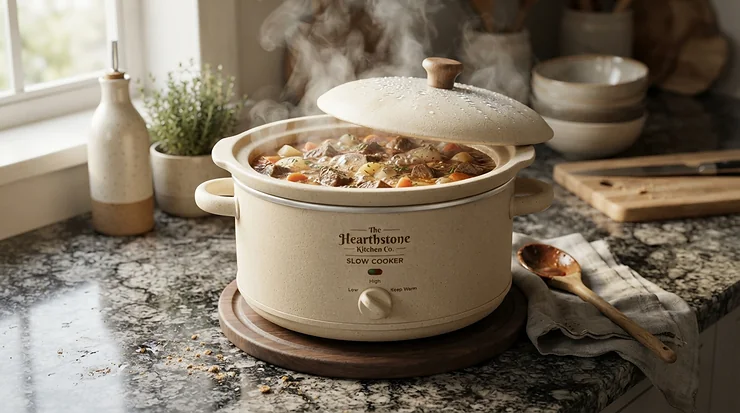
Why would two six-quart electric pressure cookers at similar prices handle the same bowl of beans so differently? In CNN Underscored’s tests, one cooker produced evenly cooked beans while another left them inconsistent, so the size on the box settles very little. For 2027, the differences that matter are pot material, lid and steam-release design, wattage against your wall circuit, and whether the plug matches your country’s voltage. The five electric pressure cookers below each answer a different kitchen, from a first-time buyer to a cook who wants fine control over pressure.
The findings rest on maker spec pages from Instant Pot, Cosori and Breville, published tests from Food Network and CNN Underscored, and university extension guides on safe use; nobody tested these cookers for this article, and Ninja’s own product page would not load, so that entry leans on a test plus retail listings. Prices appear as ranges drawn from those pages, and the current price on Amazon.com may differ.
Pot size, coating, wattage and lid: what separates one cooker from another
Size comes first. Mississippi State University Extension suggests a 4-quart cooker for singles or couples, calls the 6-quart the most popular family size, and keeps 8-quart models for bigger households or batch cooking. Four of the five cookers here are 6-quart. The Ninja Foodi 14-in-1 8-Quart XL is the outlier, and CNN Underscored measured it at about 15.4 by 14.2 by 14.25 inches and 25 pounds, the largest unit in its test.
Pot material is the second split. Instant Pot’s pages list stainless steel for the Instant Pot Duo 7-in-1 6-Quart (18/8, with a tri-ply base meant for searing) and the Instant Pot Pro 10-in-1 6-Quart. The Cosori 6-Quart Pressure Cooker has a nonstick-coated pot, a retail listing gives the Ninja a nonstick pot, and the Breville Fast Slow Pro uses a ceramic-coated bowl that Breville’s page calls free of PFOA and PTFE. Food Network credited the nonstick finish on a smaller Ninja it tested for easy cleanup.
Wattage is third, and it interacts with your kitchen. Listed power runs from 1,000 watts for the Duo to about 1,760 watts for the Ninja, according to retail listings. Dividing 1,760 by 120 volts gives roughly 14.7 amps (our arithmetic), nearly the whole capacity of a standard 15-amp circuit, so a toaster or kettle sharing that circuit is a reason to check the breaker.
Lid and steam release come fourth. Food Network found the Duo’s lid could be hard to lock and preferred the Pro’s easier one. Breville’s hinged lid pairs with automatic steam release that chooses quick, pulse or natural for you, per the maker’s page, while Cosori’s valve angles backward at 30 degrees and resets when the lid closes.
Electric pressure cookers reviews: where the testers agree and where they split
Two published tests carry most of the independent evidence, and they overlap more on price tiers than on the Duo. Food Network tested 14 multicookers and named the Instant Pot Duo best overall, praising fluffy rice, moist chicken and chickpeas soft enough for hummus. CNN Underscored crowned a different Instant Pot, found the Duo’s beans and risotto inconsistent and its stew vegetables slightly overcooked, and rated the cheaper Instant Pot Rio about equal to the Duo. The recipes differ between the two tests (rice, chicken and chickpeas against risotto, beans and stew), which may explain the split; each report is a single test, so treat it as one data point.
On the Breville Fast Slow Pro the two agree: both file it under splurge at around $300. Food Network found the rice nearest the bottom slightly overcooked, while CNN Underscored saw a slightly thicker stew broth than its top pick produced and noted the lack of a remote steam release. Both testers also flagged bulk in Ninja models: Food Network called its Ninja Foodi Pro 11-in-1 bulky and hard to store, and CNN Underscored’s 25-pound measurement came from the 8-quart.
Two lower-ranked models in CNN’s field show what to avoid: a Cuisinart whose rear-attached lid made opening feel risky, and a Zavor that rattled and had no automatic steam release.
Wear shows up first in the silicone ring. Instant Pot’s sealing-ring page says the ring is porous and can absorb odors and discolor, and it suggests a replacement every 6 to 12 months to avoid that.
Capacity, wattage and pot material across the five
Model
Size
Listed power
Inner pot
Warranty
Price range
Instant Pot Duo 7-in-1 6-Quart
6 qt
1,000 W
18/8 stainless, tri-ply base
1 year
Around $85 to $125
Instant Pot Pro 10-in-1 6-Quart
6 qt
1,200 W
Stainless steel
1 year
Around $150 to $190
Cosori 6-Quart Pressure Cooker
6 qt
1,100 W
Nonstick-coated
2 years plus 30-day return
Check the current price on Amazon.com
Ninja Foodi 14-in-1 8-Quart XL
8 qt
1,760 W (retail listings)
Nonstick (retail listing)
1 year (retail listings)
Around $290 to $330
Breville Fast Slow Pro
6 qt
1,100 W (retail listings)
Ceramic-coated
Not stated on Breville’s page; 1 year on a retailer listing
Around $300
In an electric pressure cooker 2027 shortlist, wattage, pot material and warranty vary far more than capacity does. Only the Cosori lists two years of coverage, and Instant Pot’s one-year warranty applies to the US and Canada only. The Breville Fast Slow Pro and the Ninja Foodi 14-in-1 8-Quart XL sit at roughly 2.5 to 3.5 times the Duo’s price range (our arithmetic, $300 against $85 to $125). Once the size is settled, check current availability below.
Which of the best electric pressure cookers fits your kitchen?
Each pick starts from a situation, because the cooker that suits a dorm shelf is not the one that suits a household of six.
Anyone watching the budget should start here. Food Network and CNN Underscored put the Instant Pot Duo 7-in-1 6-Quart between roughly $85 and $125 across Amazon and Walmart, the lowest range among the picks that carry a price here. Instant Pot’s page gives 1,000 watts, seven functions, 13 one-touch programs, an Easy-Release steam switch and UL and ULC listing.
Pros:
Named best overall by Food Network among 14 models, with fluffy rice and moist chicken
Stainless 18/8 pot with a tri-ply base, per Instant Pot’s page
Food Network cites the large library of recipes written for it
Cons:
No on/off button, and Food Network found the lid hard to lock
CNN Underscored found its beans and risotto inconsistent
Food Network also liked the simple interface and the yogurt function. A new cooker gets used more when recipes are easy to find, and here they are. The slimmer Instant Pot Rio, at around $100, matched the Duo’s results in CNN Underscored’s tests.
Instant Pot Duo 7-in-1 6-QuartSee current price, sizes and reviews on Amazon.
A cook who rotates through the same ten recipes will appreciate a cooker that stores its settings, and that is the pitch for the Instant Pot Pro 10-in-1 6-Quart. Instant Pot’s page lists 1,200 watts, a stainless steel pot, 10 functions, 28 one-touch programs and five customizable favorite buttons, with a manual steam release switch under a diffusing cover.
Food Network’s tester liked the easier lid and the start button, and docked the Pro for its price and for presets most people will never touch. The tester counted 27 presets where the maker’s page says 28, and the maker’s figure is the one to trust. CNN Underscored reported good results and a quieter steam release, and put the Pro at around $150 to $190 across retailers. It preferred the app-connected Pro Plus for about $20 more, though availability of that model varies by retailer.
Whether the extra presets pay off remains the open question, since Food Network expects most owners to use only a few.
Instant Pot Pro 10-in-1 6-QuartSee current price, sizes and reviews on Amazon.
Independent evidence is thin: neither Food Network’s nor CNN Underscored’s roundup tested the Cosori 6-Quart Pressure Cooker, so the case for it rests on the maker’s page. That page lists 1,100 watts, 13 functions, a stainless exterior with a nonstick-coated pot, and a hinged lid that can be removed and stored upright on the back of the cooker. The steam valve angles backward at 30 degrees and resets when the lid closes. Working pressure runs 5.1 to 8 psi on low and 9.4 to 12.3 psi on high.
The warranty is the standout: two years plus a 30-day money-back guarantee, double the one year Instant Pot gives. Sources disagree on the safety count. Retail listings advertise 12 safety features and a ceramic inner pot, while Cosori’s own FAQ describes a 9-point safety system and its specification text mentions only a nonstick coating, so trust the label on the box.
Check the current price on Amazon.com. Its high range tops out at 12.3 psi, close to the 12 psi ceiling Breville lists for its own cooker.
Cosori 6-Quart Pressure CookerSee current price, sizes and reviews on Amazon.
Households that want crisp skin and browned tops without a second appliance are the target. A SmartLid slides between pressure cooking and air-crisping on the Ninja Foodi 14-in-1 8-Quart XL, and retail listings give 14 functions, an 8-quart pot, a 5-quart crisping basket and 1,760 watts. CNN Underscored found it performed well, though not as well as its winners, and called it the largest and priciest cooker in the field: 15.4 by 14.2 by 14.25 inches, 25 pounds, and roughly $290 to $330.
Pros:
Pressure cooks and air-crisps under one lid, per retail listings
Performed well across CNN Underscored’s tests
Cons:
The largest and heaviest cooker in CNN Underscored’s field
Priced at the top of the five, alongside the Breville
Ninja sells this size as the OL601 and the OL701, and a Best Buy answer says the OL701 adds a thermometer probe, so confirm the model on the listing. At 1,760 watts the cooker also needs a circuit with room to spare, as the arithmetic earlier showed. The listings give the crisping basket 5 quarts of the pot’s 8, so crisped batches run smaller than pressure-cooked ones.
Ninja Foodi 14-in-1 8-Quart XLSee current price, sizes and reviews on Amazon.
Around $300 is where Food Network and CNN Underscored both place the Breville Fast Slow Pro, and both file it under splurge. Breville’s page lists a 6-quart ceramic-coated bowl, a pressure range of 1.5 to 12 psi across 8 levels, and hands-free steam release that selects quick, pulse or natural on its own. The box includes a steamer basket, a rack and a 41-recipe book.
Sources disagree on how finely pressure can be tuned. Breville’s page says 8 levels and also mentions 11 pressure-cook settings, while CNN Underscored describes adjustment in half-psi steps and 11 settings, so read the label before relying on either number. CNN also credited dual sensors, automatic altitude adjustment and a dishwasher-safe hinged lid, and marked it down for having no remote steam release.
Food Network’s tester found tender chickpeas and well-cooked chicken but rice slightly overcooked at the bottom of the pot. Breville’s page doesn’t state a warranty length; a Sur La Table listing gives one year.
Breville Fast Slow ProSee current price, sizes and reviews on Amazon.
Electric pressure cooker how to use: a first-day routine
University extension guides agree on the basics, and the order below follows them.
Run a water test. WVU Extension recommends an initial water-only run to learn the controls and confirm the cooker works. Instant Pot’s test-run sheet says pressurizing can take 5 to 15 minutes, and the float valve rises once enough steam has built up. Don’t press down on the lid.
Add liquid, and don’t overfill. Mississippi State Extension warns that overfilling causes uneven cooking, and its vegetable chart starts with 1 cup of water. A “burn” message, per WVU, means too little liquid or food stuck to the bottom of the pot.
Seal, set pressure and time. Choose the pressure level and minutes, and remember that the pressurizing minutes from step 1 come on top of the recipe time.
Pick the release method. Natural release lets the cooker cool until the float valve drops, which can take 10 to 40 minutes or longer. Quick release suits delicate foods, but WVU and Mississippi State both say to avoid it for oatmeal, beans and starchy soups, which can splatter.
Open away from the steam. Keep hands and face clear of the vent while releasing pressure and opening the lid.
One more caution: Mississippi State Extension warns that the delay timer can leave food in the 40°F to 140°F bacterial danger zone, so use it carefully with meat and dairy. The university’s guide to electric pressure cookers also lists cooking times by food.
Commercial electric cooker and steamer: where a home cooker stops
A home multicooker is not a commercial electric cooker and steamer, and the paperwork says so. Instant Pot’s warranty lists commercial use among the causes of damage it does not cover. A commercial pressure steamer, such as the Market Forge ST-E, is marked “intended for commercial use only, not for household use,” and its manual lists 9, 12 or 12.5 kW versions on 208 to 480 volts with a water supply, a drain and a 125-pound shipping weight.
For scale, 9 kW is about five times the Ninja’s 1.76 kW (our arithmetic). ENERGY STAR treats compartment steamers with three or more pans as their own category and lists pressure steamers as ineligible. Anyone cooking for customers, a stall or a catering job needs equipment built and certified for that work, not a 6-quart countertop model.
Electric pressure cooker in Pakistan: check the voltage before the brand
Voltage is the first filter for anyone shopping from or shipping to Pakistan. Instant Pot’s FAQ says its US and Canada models are built for 110 to 120 volt outlets only, and tells owners not to use them on other electrical systems even with adapters or converters. A Pakistani retailer’s voltage guide puts the national supply at about 230 volts, and a Malaysian Instant Pot distributor’s help page confirms that 220 to 240 volt versions are sold separately.
Every cooker above is a 120-volt US design as far as the pages show: Instant Pot lists 120 V, a Dillard’s listing gives Breville 110 to 120 V, and a spec-comparison site lists 120 V for the Ninja. Cosori’s page does not state voltage. Instant Pot’s warranty also covers only the United States and Canada. A cooker rated 220 to 240 volts and sold locally, with a local warranty, is the safer route, and the picks here are best read as a guide to features rather than a shopping list for Pakistan.
Canning, heavy oil and tired seals: three ways to misuse one
Canning comes first. Utah State University Extension says electric programmable pressure cookers should not be used for low-acid canning, notes a USDA warning against it, and reports that in its study many jars were under-processed, especially at higher altitudes. Its alternative is a stovetop pressure canner that follows USDA guidance.
Heavy fats are second. Instant Pot’s FAQ says cooking with more than a quarter cup of oil or fat, or with thick oil-based sauces, can cause injury or property damage and voids the warranty.
The third is the ring. Mississippi State Extension suggests keeping separate sealing rings for strong and mild foods, and Instant Pot sells a two-color pack for the same reason.
Size, canning, release time and voltage: quick answers
What size electric pressure cooker should I buy?
Mississippi State Extension calls the 6-quart the most popular family size, suggests 4-quart for singles or couples, and 8-quart for larger families or batch cooking. Larger models are wider and heavier, so measure the cabinet before ordering.
Can I use an electric pressure cooker for canning?
No. Utah State University Extension says electric programmable pressure cookers should not be used for low-acid canning, and its study found under-processed jars, especially at altitude. Use a stovetop pressure canner that follows USDA guidance for meats, beans and plain vegetables.
How long does natural release take?
WVU Extension says natural release can take 10 to 40 minutes or longer, depending on how much food is inside. Quick release is faster but unsuitable for oatmeal, beans and starchy soups, where foam and splatter are likely.
Can I use a US 120-volt cooker in Pakistan?
Instant Pot says its US and Canada models are for 110 to 120 volt outlets only, even with adapters or converters. Pakistan's supply is about 230 volts, so look for a 220 to 240 volt version sold locally with a local warranty.
Is a home electric pressure cooker the same as a commercial cooker and steamer?
No. Commercial pressure steamers are marked for commercial use only and draw 9 to 12.5 kilowatts on 208 to 480 volts, with plumbing. Instant Pot's warranty also excludes commercial use, so a home model is the wrong tool for a business kitchen.
Choosing among electric pressure cookers: a decision rule that holds up
For most households choosing among electric pressure cookers, the sensible order is size, then pot, then lid. Start with the Instant Pot Duo 7-in-1 6-Quart for a low entry price and a large recipe library, and accept a manual valve and a lid that can be fussy. Move to the Instant Pot Pro 10-in-1 6-Quart only if saved presets and quieter venting will really be used. Take the Cosori 6-Quart Pressure Cooker for a two-year warranty and a coated pot. Reserve the Ninja Foodi 14-in-1 8-Quart XL for kitchens with space and a strong circuit, and the Breville Fast Slow Pro for cooks who want to set pressure themselves.
Whatever you pick, run the water test, match the voltage to your wall and leave canning to a stovetop canner. Check current availability below for the size your counter can hold.
Disclaimer: This post contains affiliate links. As an Amazon Associate, we earn from qualifying purchases made through these links, at no additional cost to you.
Settle on the pot size first, then confirm today’s availability on Amazon.com
SmartCookLab is an independent buying-guide site for cookware, pots, pans, range hoods and kitchen appliances. Our editorial team compares products using manufacturer specifications, independent tests from specialist kitchen media, owner reports and retailer listings. We do not claim to have tested the products ourselves; see How We Choose Gear for our method.