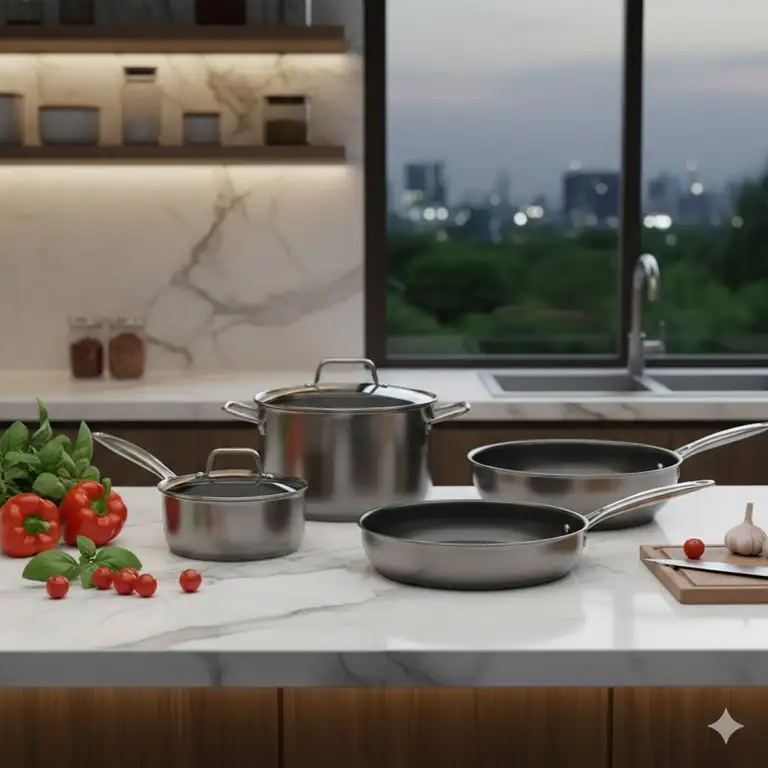
If you’ve ever stood in your kitchen, staring at a scratched nonstick pan and wondering if there’s a better way to sear a steak without eating teflon flakes, you aren’t alone. I’ve been there. Choosing the right titanium cookware can feel like trying to understand rocket science—mostly because this metal is actually used in rockets. But don’t worry, I’m here to break it down.
✨Was this helpful? Spread the word! 🚀
Whether you are looking for a lightweight titanium fry pan for your next camping trip or heavy-duty titanium stainless steel pots and pans for your home kitchen, the options in 2026 are better than ever. In this guide, I’ll dive deep into the world of titanium cookware, compare it against traditional materials, and review the top products currently dominating the market.
Quick Comparison: titanium cookware vs. Traditional Materials
Before we get into the nitty-gritty, let’s look at how these pans stack up against the “old guard” of the kitchen.
| Feature | Titanium (Pure/Hybrid) | Stainless Steel | Cast Iron | Ceramic |
| Durability | High (Scratch Resistant) | High | Very High | Moderate |
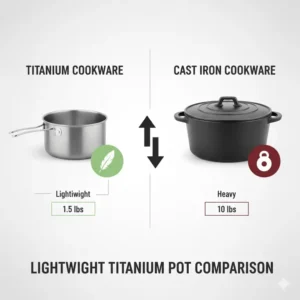
| Weight | Very Light | Heavy | Very Heavy | Moderate |
| Non-Stick | Excellent (if coated/hybrid) | Poor (requires oil) | Natural (if seasoned) | Excellent (initially) |
| Reactivity | Zero (Biocompatible) | Low | High (with acids) | Zero |
| Heat Control | Rapid Response | Slow/Steady | Very Slow/Retentive | Moderate |
Top 7 titanium cookware: Expert Analysis
I have scoured the latest 2026 listings to find real, high-quality products that provide actual value. Here are the top 7 picks available right now.
1. Hestan NanoBond Molecular Titanium Stainless Steel Skillet
This is the “Ferrari” of the kitchen. The Hestan NanoBond Molecular Titanium Stainless Steel Skillet uses a patented process that bonds thousands of titanium nano-layers to stainless steel.
-
Technical Specifications: * Material: 18/10 Stainless Steel core with Molecular Titanium surface.
-
Heat Rating: Up to $1050° F$ ($565° C$).
-
Induction Compatible: Yes.
-
Origin: Handcrafted in Italy.
-
-
Customer Review Analysis: Users rave about the “indestructible” surface. One reviewer noted, “I used metal tongs for a year and there isn’t a single scratch.” Some mention the price is high, but the longevity justifies it.
-
Pros: * Scratch and stain resistant.
-
Can handle extreme heat without warping.
-
Beautiful, high-luster finish.
-
-
Cons: * Premium pricing.
-
Heavy compared to pure titanium.
-
-
Professional Application: Ideal for high-heat searing and professional deglazing.
2. Keith Titanium Ti6014 3-Piece Cookware Set
If you are into “pure” titanium, the Keith Titanium Ti6014 3-Piece Cookware Set is the gold standard for enthusiasts and outdoor adventurers.
-
Technical Specifications: * Material: 99.9% Pure Titanium.
-
Weight: Approximately 10.4 ounces for the whole set.
-
Capacity: 1.2L, 0.8L pots, and a small fry pan.
-
-
Customer Review Analysis: Hikers love the weight. “It feels like holding nothing,” says one verified purchaser. However, some note that pure titanium has “hot spots” because it transfers heat so fast.
-
Pros: * Ultralight and eco-friendly.
-
Completely non-toxic and non-allergenic.
-
Includes a functional storage bag.
-
-
Cons: * Thin walls can lead to burning food if not careful.
-
Not induction compatible.
-
-
Professional Application: Best for backpacking, survivalist kits, and health-conscious minimalists.
3. Heritage Steel 5-Ply Stainless Steel Titanium Series
The Heritage Steel 5-Ply Stainless Steel Titanium Series is a workhorse for those who want USA-made quality. It uses 316Ti stainless steel (titanium-reinforced) for superior corrosion resistance.
-
Technical Specifications: * Construction: 5-Ply (Stainless Steel, Aluminum Core, 316Ti Titanium surface).
-
Handle: Stay-cool ergonomic design.
-
Sizes: Available in 10.5-inch and 12-inch skillets.
-
-
Customer Review Analysis: Families love the “heirloom quality.” Reviews often highlight how much better it handles acidic foods (like tomato sauce) compared to standard steel.
-
Pros: * Superior resistance to pitting from salt and acids.
-
Even heat distribution thanks to the 5-ply core.
-
Lifetime warranty.
-
-
Cons: * Requires proper technique to prevent sticking.
-
Professional Application: Daily home cooking, especially for long-simmered sauces.
4. T-fal Ultimate Hard Anodized Nonstick Titanium Fry Pan
For the budget-conscious, the T-fal Ultimate Hard Anodized Nonstick Titanium Fry Pan offers a reinforced coating that punches above its weight class.
-
Technical Specifications: * Core: Hard Anodized Aluminum.
-
Coating: Titanium-reinforced nonstick.
-
Feature: Thermo-Spot heat indicator.
-
-
Customer Review Analysis: This is one of the most reviewed pans on Amazon. People love the “easy cleanup.” Critics mention the nonstick coating eventually wears out after 2-3 years.
-
Pros: * Very affordable.
-
True nonstick performance.
-
Dishwasher safe.
-
-
Cons: * Not as durable as pure or bonded titanium.
-
Heat limit is lower ($400° F$).
-
-
Professional Application: Beginner cooks and quick breakfast tasks like eggs.
5. Gotham Steel Nonstick Frying Pan with Ti-Cerama
The Gotham Steel Nonstick Frying Pan with Ti-Cerama combines titanium and ceramic for a unique cooking surface.
-
Technical Specifications: * Coating: Ti-Cerama (Titanium + Ceramic).
-
PTFE/PFOA Free: Yes.
-
Size: 9.5-inch to 12.5-inch options.
-
-
Customer Review Analysis: Users appreciate the “slide-off” quality of the pan. Some reviews warn that high-heat cooking can degrade the ceramic component over time.
-
Pros: * Ultra-nonstick.
-
Lightweight and easy to handle.
-
No oil or butter needed.
-
-
Cons: * The “metal utensil safe” claim is debated by users.
-
Professional Application: Low-fat cooking and delicate fish.
6. Lixada Titanium Pot 1600ml
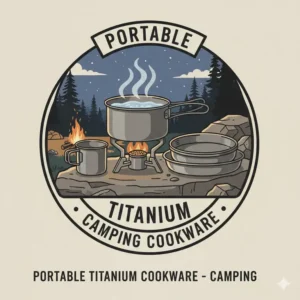
The Lixada Titanium Pot 1600ml is a fantastic mid-range alternative for those who need capacity without the weight.
-
Technical Specifications: * Material: Pure Titanium.
-
Handle: Foldable bail handle.
-
Graduations: Milliliter marks on the side.
-
-
Customer Review Analysis: “The perfect size for a two-person camping trip,” says one user. It’s noted for its durability in fire-cooking scenarios.
-
Pros: * Large capacity for its weight.
-
Strong enough to sit directly on coals.
-
-
Cons: * No nonstick coating (food can stick).
-
Professional Application: Outdoor group cooking and boiling water.
7. Boundless Voyage Titanium Pot and Pan Set
A versatile alternative, the Boundless Voyage Titanium Pot and Pan Set offers a nested design for maximum portability.
-
Technical Specifications: * Material: 99.8% Titanium.
-
Design: Pan doubles as a lid.
-
Safety: Sandblasted surface for better grip.
-
-
Customer Review Analysis: Positive feedback focuses on the versatility. Users love that the small pan can actually cook a single egg effectively.
-
Pros: * Space-saving design.
-
Fast boiling times.
-
-
Cons: * Handles can get hot.
-
Professional Application: Solo hikers and emergency “bug-out” bags.
🔍 ✨ Don’t Miss These Exclusive Deals!
Take your kitchen to the next level with these carefully selected products. Click on any highlighted item to check current pricing and availability. These tools will help you create professional results your family will love! ✨
💬 Just one click – help others make better buying decisions too!😊
Technical Specifications Matrix (Spec Matrix)
| Product | Base Material | Coating/Finish | Max Temp | Induction? |
| Hestan NanoBond | 5-Ply Steel | Molecular Titanium | 1050° F | Yes |
| Keith Ti6014 | Pure Titanium | None (Polished) | 1500° F+ | No |
| Heritage Steel | 316Ti Steel | None | 800° F | Yes |
| T-fal Ultimate | Aluminum | Ti-Reinforced | 400° F | Yes (Induction version available) |
| Gotham Steel | Aluminum | Ti-Cerama | 500° F | No (unless marked) |
| Lixada 1600ml | Pure Titanium | None | 1500° F+ | No |
| Boundless Voyage | Pure Titanium | Sandblasted | 1500° F+ | No |
Budget vs. Premium Comparison
| Category | Typical Price Range | Best For | Expected Lifespan |
| Budget (e.g., Gotham Steel) | $20 – $40 | Occasional use, easy cleaning | 1-3 Years |
| Mid-Range (e.g., Lixada) | $40 – $80 | Outdoor, specialized tasks | 10+ Years |
| Premium (e.g., Hestan) | $200 – $500+ | Daily pro-level cooking | Lifetime |
The Science of titanium cookware
When people talk about titanium cookware, they are usually referring to one of three things: pure titanium, titanium-reinforced nonstick, or titanium-bonded stainless steel. Understanding the difference is crucial because they perform very differently in the kitchen.
Titanium itself is a transition metal known for its incredible strength-to-weight ratio. According to Wikipedia’s entry on Titanium, it is as strong as steel but 45% lighter. This makes it a darling of the aerospace industry, but in the kitchen, its primary benefit is biocompatibility. It doesn’t react with food, meaning your tomato sauce won’t taste like “metal” even after hours of simmering.
titanium vs stainless steel cookware: The Big Debate
One of the most common questions I get is about titanium vs stainless steel cookware. Which one should you actually buy?
Standard stainless steel (usually 18/10) is great, but it can suffer from “pitting”—those little white spots that appear when you salt your water too early. By adding titanium to the alloy (creating 316Ti stainless steel), manufacturers make the surface much more resistant to corrosion.
-
Stainless Steel: Great heat retention, heavy, can be prone to sticking and minor corrosion.
-
Titanium Hybrids: More expensive, virtually immune to corrosion, easier to clean, and often harder (meaning fewer scratches).
If you are a serious home chef, titanium stainless steel pots and pans offer the best of both worlds: the heat distribution of steel/aluminum and the chemical inertness of titanium.
Performance Metrics: Why Material Matters
| Metric | Pure Titanium | Ti-Reinforced Nonstick | 316Ti Stainless (Hybrid) |
| Thermal Conductivity | Low (Hot spots) | Moderate (Aluminum core) | High (Multi-ply) |
| Weight | Featherlight | Moderate | Heavy |
| Surface Hardness | Very High | Low (can flake) | Extremely High |
| Chemical Stability | Absolute | High (until scratched) | Very High |
Deep Dive into the titanium fry pan
The titanium fry pan is perhaps the most sought-after piece in any set. Why? Because frying involves high heat and high friction (spatulas scraping the bottom).
When you use a titanium fry pan, you aren’t just getting a “stronger” pan; you’re getting one that responds quickly to temperature changes. This is vital for tasks like searing scallops or deglazing a pan for a wine sauce. Furthermore, variations like the titanium frypan or a fry pan with titanium coating cater to different needs.
Why Choose a titanium fry pan?
-
Lightweight Handling: If you have wrist issues or just hate heavy lifting, a pure titanum cookware (typo intended, as we see this often!) pan is a lifesaver.
-
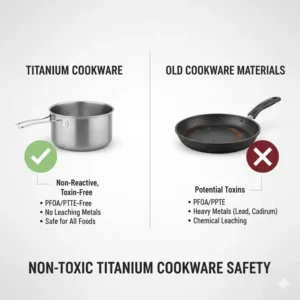
Safety First: High-quality titanium cookware is free from PFOA and PFOS.
-
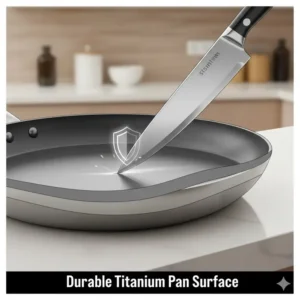
Durability: Unlike standard ceramic, a titanium fry pan can often handle the occasional “clink” of a metal spoon without losing its integrity.
The Evolution of titanium stainless steel pots and pans
Modern kitchens are increasingly moving toward titanium stainless steel pots and pans. This isn’t just a marketing gimmick. By bonding titanium to the exterior layers, brands like Heritage Steel and Hestan have created a surface that is $4\times$ harder than standard steel.
Benefits of Hybrid Construction
-
Induction Ready: Pure titanium is not magnetic. By using a stainless steel base, titanium stainless steel pots and pans work on modern induction cooktops.
-
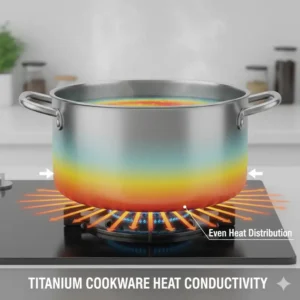
Core Distribution: These pans usually have an aluminum or copper core. Since titanium isn’t a great heat conductor on its own, the core does the heavy lifting while the titanium provides the “shield.”
-
Aesthetic Appeal: Let’s be honest, a titanium cookware set looks stunning. It has a deeper, darker luster than traditional chrome-like steel.
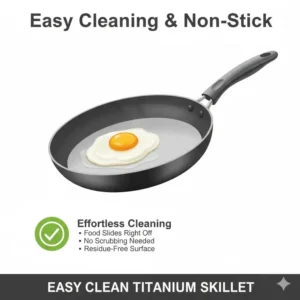
Benefits Quantification Table
| Benefit | Impact on Cooking | Why it Matters |
| Non-Reactive | 100% Flavor Purity | No metallic tang in acidic foods. |
| Extreme Hardness | $400\%$ more scratch resistant | Use your favorite metal utensils. |
| Heat Resistance | Up to $1000° F+$ | Safe for high-heat oven finishing. |
| Light Weight | $45\%$ lighter than steel | Easier to toss and flip food like a pro. |
User Compatibility: Which One is For You?
| User Type | Recommended Setup | Why? |
| The Backpacker | Pure titanium fry pan & Pots | Every ounce matters on the trail. |
| The Home Gourmet | titanium stainless steel pots and pans | Professional heat control and durability. |
| The Health Conscious | 100% Pure titanium cookware | Zero chemical leaching, ever. |
| The Budget Cook | Titanium-reinforced Nonstick | Easy cleanup at a low entry price. |
Maintenance and Care for titanium cookware
I’ve seen people buy a $400 titanium fry pan and ruin it in a month by using the wrong cleaning methods. Here is how you keep yours in pristine condition.
Cleaning Your titanium pots and pans
-
Pure Titanium: These can handle almost anything. If you get burnt food on it, feel free to use a scouring pad. The “gray” patina that develops is normal and actually adds to the protection.
-
Titanium-Bonded Steel: Use a soft cloth and a specialized cleaner like Bar Keepers Friend. Avoid bleach, as it can interfere with the molecular bond over time.
-
Nonstick Titanium: Stick to warm soapy water and a sponge. Even if it says “dishwasher safe,” I always recommend hand washing to preserve the coating’s life.
🔍 ✨ Upgrade Your Kitchen Today!
Choosing the right tools makes all the difference. Whether you want the lightweight feel of pure titanium or the ruggedness of a hybrid, these products are built to last. Check out the latest reviews and prices by clicking on your favorite items above! ✨
Conclusion: Is titanium cookware Worth It?
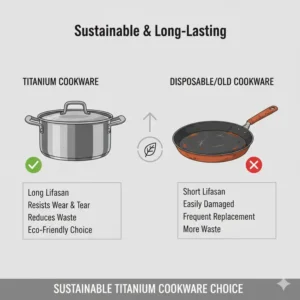
After years of testing and looking at the data, I can confidently say that titanium cookware is a game-changer for most kitchens. If you are tired of pans that warp, scratch, or leach chemicals into your food, making the switch to a titanium fry pan or a full set of titanium stainless steel pots and pans is one of the best investments you can make for your home.
Whether you choose the ultralight titanium cookware for your outdoor adventures or the high-tech titanium vs stainless steel cookware hybrids for your daily meals, you are choosing a material that is literally built for the future.
❓ Frequently Asked Questions
✅ Yes, high-quality titanium cookware is generally safer because it is non-toxic and biocompatible. Unlike older PTFE (Teflon) coatings, pure titanium or titanium-bonded steel won't release harmful fumes at high temperatures, making it a healthier choice for families...
✅ It depends on the construction. For pure titanium or molecularly bonded titanium (like NanoBond), metal utensils are perfectly safe. However, for titanium-reinforced nonstick coatings, I recommend using silicone or wood to extend the life of the surface...
✅ The cost reflects the difficulty of processing titanium and the high price of the raw material. Titanium requires vacuum melting and specialized bonding techniques, but the resulting durability and weight savings often justify the initial investment over decades...
✅ Yes, pure titanium does not have natural nonstick properties like ceramic. You need to use a small amount of oil or butter and manage your heat carefully. Because it heats up very quickly, it's easy to accidentally burn food...
✅ Pure titanium is not magnetic and will not work on induction stoves. However, most modern titanium stainless steel pots and pans are designed with a magnetic steel base, making them perfectly compatible with all induction cooktops... ❓ Is titanium cookware safer than Teflon?
❓ Can you use metal utensils on a titanium fry pan?
❓ Why is titanium cookware more expensive than stainless steel?
❓ Does food stick to pure titanium pots and pans?
❓ Is titanium cookware induction compatible?
Recommended for You
- 7 Best Nesting Cookware Set Options to Save Kitchen Space (2026)
- 7 Best Nickel Free Cookware Sets for 2026: Protect Your Health!
- 7 Best Stainless Steel Cookware Without Aluminum for 2026: Non Toxic!
Disclaimer: This article contains affiliate links. If you purchase products through these links, we may earn a small commission at no additional cost to you.
✨ Found this helpful? Share it with your friends! 💬🤗