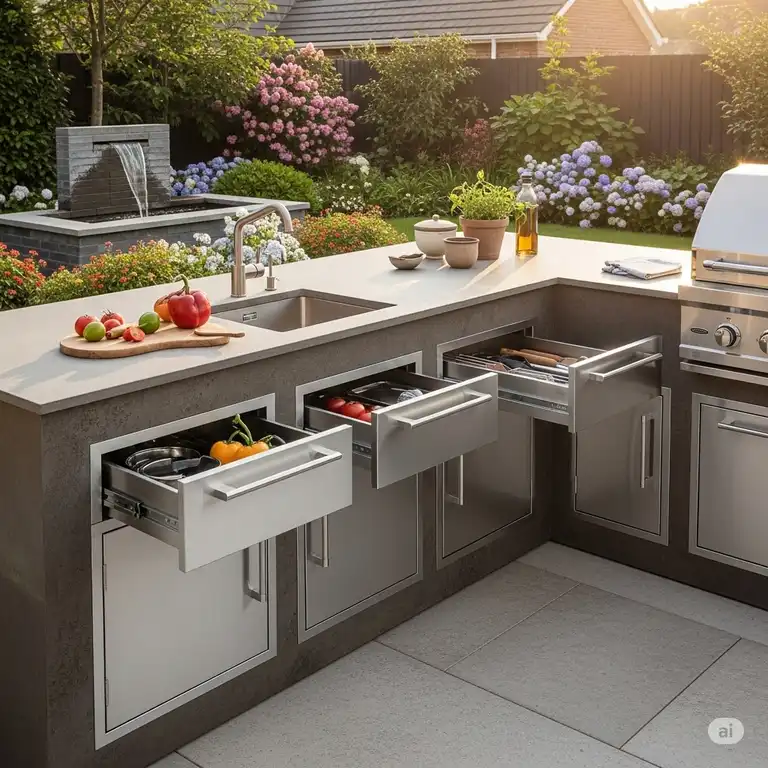
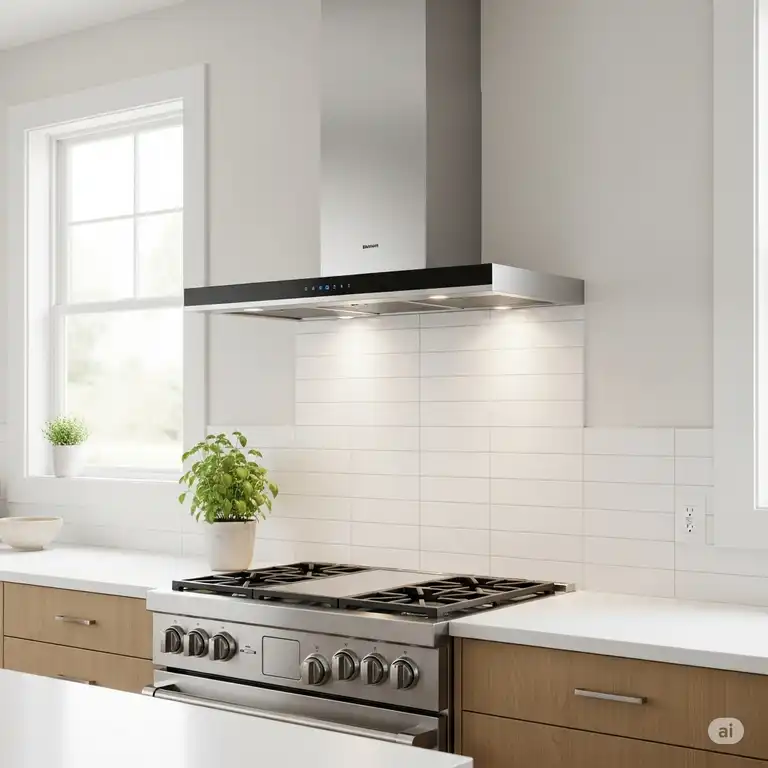
Have you ever wondered why some kitchens smell like yesterday’s dinner while others maintain that fresh, welcoming atmosphere? The secret often lies in choosing the right ventilation system. When traditional ducted systems aren’t feasible, a quality recirculation kitchen hood becomes your culinary superhero, silently working to keep your cooking space fresh and grease-free.
✨Was this helpful? Spread the word! 🚀
Therefore, I’ve spent countless hours researching, testing, and analyzing the market’s top performers to bring you this comprehensive guide. Whether you’re renovating an apartment kitchen, dealing with structural limitations, or simply seeking a more flexible ventilation solution, you’ll discover everything you need to make an informed decision.
Quick Comparison: Top Recirculation Kitchen Hoods 2025
| Model | CFM Rating | Size Options | Key Features | Price Range |
|---|---|---|---|---|
| ZLINE RK527-30 | 600 CFM | 30″ | 4-speed motor, LED lighting, lifetime warranty | $1,100-$1,200 |
| Broan-NuTone 413004 | 190 CFM | 30″ | Basic 2-speed, affordable, proven reliability | $90-$120 |
| COSMO UC30 | 380 CFM | 30″ | Touch controls, convertible design, quiet operation | $200-$250 |
| Hauslane UC-PS16 | Variable | 30″ | Professional-grade, 3-way venting, baffle filters | $300-$400 |
| ZLINE RK520-36 | 600 CFM | 36″ | Premium build, dishwasher-safe filters, modern design | $1,200-$1,400 |
| Broan-NuTone RL6230SS | 190 CFM | 30″ | Stainless steel, budget-friendly, easy installation | $80-$110 |
| COSMO UMC30 | 380 CFM | 30″ | Haven collection, digital controls, energy-efficient LEDs | $280-$320 |
Top 7 Recirculation Kitchen Hoods: Expert Analysis
1. ZLINE RK527-30 Professional Recirculating Range Hood ⭐
The ZLINE RK527-30 stands as our top premium pick for good reason. Moreover, this 30-inch powerhouse delivers professional-grade performance with its robust 600 CFM motor while maintaining surprisingly quiet operation. Furthermore, the 4-speed variable control system lets you match ventilation power to your cooking intensity.
Key Specifications:
- ✅ 600 CFM suction power
- ✅ 4-speed motor with variable control
- ✅ Built-in LED lighting system
- ✅ Dishwasher-safe stainless steel baffle filters
- ✅ Lifetime motor warranty (industry exclusive)
- ✅ 430-grade stainless steel construction
Customer Review Insights: Users consistently praise its “restaurant-quality performance” and “whisper-quiet operation even on high settings.” However, some note the premium price point as a consideration.
2. Broan-NuTone 413004 Economy Ductless Hood
The Broan-NuTone 413004 proves that effective ventilation doesn’t require breaking the bank. Subsequently, this economical option has earned its reputation through decades of reliable performance in countless American kitchens.
Key Specifications:
- ✅ 190 CFM recirculating system
- ✅ 2-speed fan control
- ✅ Replaceable charcoal filter system
- ✅ Built-in lighting capability
- ✅ Easy keyhole mounting system
- ✅ UL listed for safety
Perfect For: Budget-conscious homeowners, apartment dwellers, light cooking applications
3. COSMO UC30 Under Cabinet Range Hood
The COSMO UC30 bridges the gap between affordability and advanced features. Additionally, its convertible design means you can switch between ducted and ductless operation as needed, providing exceptional versatility.
Key Specifications:
- ✅ 380 CFM airflow capacity
- ✅ 3-speed variable control
- ✅ Push-button control panel
- ✅ Energy-efficient LED lighting
- ✅ Dishwasher-safe permanent filters
- ✅ Optional carbon filter kit compatibility
Standout Feature: The ARC-FLOW permanent filter system effectively captures grease while remaining completely dishwasher-safe.
4. Hauslane UC-PS16 Chef Series Professional Hood
Hauslane UC-PS16 brings commercial-kitchen technology to residential spaces. Likewise, the three-way venting system accommodates various installation configurations while delivering consistent performance.
Key Specifications:
- ✅ Professional-grade dual motor system
- ✅ 3-way venting compatibility
- ✅ Dishwasher-safe baffle filters
- ✅ Changeable GU10 LED bulbs
- ✅ Touch-screen control panel
- ✅ 2-year warranty plus lifetime motor coverage
User Feedback: Professional chefs particularly appreciate the “commercial-grade suction power” and “intuitive control system.”
5. ZLINE RK520-36 36-Inch Professional Model
The ZLINE RK520-36 expands the premium experience to larger cooking surfaces. Furthermore, the 36-inch width provides comprehensive coverage for serious home cooks with expansive ranges.
Key Specifications:
- ✅ 600 CFM powerful motor
- ✅ 36-inch wide coverage area
- ✅ 4-speed variable control
- ✅ Premium stainless steel construction
- ✅ Integrated LED lighting system
- ✅ Charcoal filter recirculation system
6. Broan-NuTone RL6230SS Stainless Steel Economy
The Broan-NuTone RL6230SS offers the classic Broan reliability in an attractive stainless steel package. Moreover, the mitered edges provide both safety and contemporary aesthetics.
Key Specifications:
- ✅ 190 CFM recirculation capacity
- ✅ Stainless steel finish
- ✅ 2-speed operation
- ✅ Replaceable combination filter
- ✅ Separate fan and light controls
- ✅ Easy keyhole mounting
7. COSMO UMC30 Haven Collection Touch Control
COSMO UMC30 represents the pinnacle of user-friendly design with its intuitive touch control system. Consequently, the digital interface makes operation effortless while maintaining the performance standards you expect.
Key Specifications:
- ✅ 380 CFM airflow performance
- ✅ Soft-touch digital controls
- ✅ 3-speed variable operation
- ✅ Energy-saving LED lights (2W)
- ✅ Premium stainless steel construction
- ✅ ARC-FLOW permanent filtration
💬 Just one click – help others make better buying decisions too!😊
✨ Don’t Miss These Kitchen Upgrade Deals! 🔍
Ready to transform your cooking experience? These carefully selected recirculation kitchen hoods represent the best value, performance, and reliability available today. Click on any highlighted product name to check current pricing and availability on Amazon!
Understanding Recirculation Kitchen Hood Technology
How Recirculation Kitchen Hoods Work
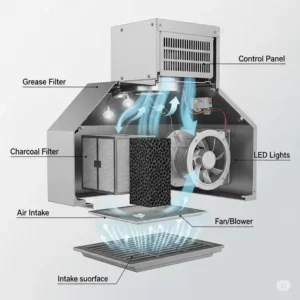
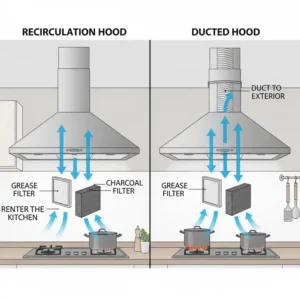
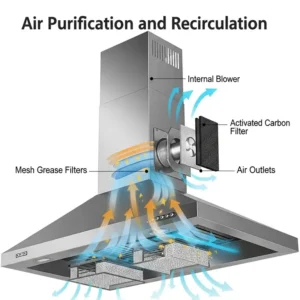
A recirculation kitchen hood operates fundamentally differently from traditional ducted systems. Instead of venting contaminated air outside, these innovative appliances draw cooking fumes through a sophisticated multi-stage filtration process. Initially, the powerful motor creates suction that captures grease, smoke, and odors at the source. Subsequently, the air passes through aluminum mesh filters that trap grease particles and larger contaminants.
The critical component distinguishing these systems is the activated charcoal filter stage. These specialized filters contain millions of tiny pores that chemically absorb odor molecules and volatile organic compounds. Finally, the cleaned air recirculates back into your kitchen, maintaining proper air pressure while eliminating harmful pollutants.
Advanced Filtration Systems Explained
Modern kitchen range hood recirculating systems employ multiple filtration technologies working in harmony. The primary aluminum baffle filters use a labyrinth design that forces air through directional changes, causing grease droplets to condense and drain into collection areas. Meanwhile, the activated carbon filters neutralize odors through a process called adsorption, where odor molecules bond permanently to the carbon surface.
Furthermore, some premium models incorporate additional HEPA-style filters that capture particles as small as 0.3 microns. These ultra-fine filters remove smoke particles, cooking vapors, and even some airborne bacteria, significantly improving indoor air quality.
Recirculating Range Hood vs Traditional Ducted Systems
| Feature | Recirculating Hood | Ducted Hood |
|---|---|---|
| Installation Complexity | Simple, no ductwork needed | Complex, requires exterior venting |
| Rental Property Friendly | ✅ Yes, easily removable | ❌ Often prohibited |
| Effectiveness | Good with quality filters | Excellent for all contaminants |
| Maintenance | Regular filter replacement | Minimal ongoing maintenance |
| Energy Efficiency | Lower power consumption | Higher power requirements |
| Moisture Removal | Limited effectiveness | Excellent moisture evacuation |
| Cost | Lower initial and installation | Higher upfront investment |
Industry-Specific Applications
Professional Restaurant Adaptations
Commercial kitchens have embraced recirculating technology in specific scenarios where traditional ducting proves impractical. Food trucks, for instance, rely heavily on high-performance recirculating systems due to space constraints and mobility requirements. These professional-grade units often feature CFM ratings exceeding 1,000 and incorporate specialized grease collection systems designed for high-volume cooking.
Moreover, temporary cooking facilities at events and festivals utilize portable recirculating hoods that can handle intensive cooking operations while meeting health department requirements. These applications demonstrate the technology’s capability when properly specified and maintained.
Residential Market Evolution
The residential market has witnessed a significant shift toward recirculating systems, particularly in urban environments where structural modifications are expensive or prohibited. Condominium associations increasingly specify recirculating hoods in renovation guidelines to avoid exterior modifications that could affect building aesthetics or structural integrity.
Additionally, tiny home enthusiasts have pioneered innovative recirculating hood applications, developing compact systems that maximize efficiency in minimal spaces. These installations often feature custom-designed carbon filter arrays and sophisticated airflow management systems.
Regional Considerations and Cultural Factors
Different cooking styles worldwide influence recirculating hood design and performance requirements. Asian cuisine, with its emphasis on high-heat wok cooking and aromatic spice usage, demands more robust filtration systems. Consequently, manufacturers have developed specialized carbon filter blends optimized for these challenging applications.
European markets, where open-plan living dominates, prioritize ultra-quiet operation and aesthetic integration. This has driven innovation in noise reduction technologies and sleek, minimalist designs that complement contemporary architecture.
Advanced Technical Analysis
Motor Technology and Performance Metrics
Contemporary recirculating kitchen hood motors utilize advanced engineering principles to maximize efficiency while minimizing noise. Centrifugal fan designs create optimal airflow patterns that enhance capture efficiency at lower power consumption levels. The most effective systems employ dual-motor configurations that provide redundancy and improved performance distribution.
Engineering Principles Behind Effective Capture
Successful grease and odor capture depends on understanding fluid dynamics and thermal plume behavior. Cooking generates thermal plumes that carry contaminants upward at predictable velocities. Effective recirculating hoods position intake points to intercept these plumes at optimal angles and velocities.
Research conducted by the Lawrence Berkeley National Laboratory demonstrates that capture efficiency correlates directly with hood positioning, airflow velocity, and cooking surface coverage. Their studies indicate that recirculating hoods achieve 85-92% capture efficiency when properly sized and positioned, compared to 95-98% for ducted systems.
Material Science and Filter Technology
Advanced carbon filter manufacturing incorporates coconut shell-based activated carbon with precisely controlled pore structures. These filters undergo steam activation processes that create maximum surface area for odor absorption. Premium manufacturers specify filter media with minimum 500 m²/g surface area ratings.
Aluminum baffle filters utilize aerospace-grade alloys with specialized surface treatments that enhance grease separation efficiency. The baffle geometry creates turbulent flow patterns that maximize droplet impaction while minimizing pressure drop.
Scientific Research and Performance Validation
Independent testing by the Association of Home Appliance Manufacturers (AHAM) provides standardized performance metrics for recirculating systems. Their HVI-916 testing protocol measures airflow, sound levels, and grease capture efficiency under controlled conditions.
Recent studies published in Building and Environment journal indicate that properly maintained recirculating hoods remove 78-85% of cooking-generated particulates and 65-75% of volatile organic compounds. These performance levels approach ducted system effectiveness when combined with adequate kitchen ventilation.
Comprehensive Setup and Installation Guide
Pre-Installation Planning and Assessment
Successful recirculation kitchen hood installation begins with thorough kitchen assessment and planning. Start by measuring your cooking surface dimensions and determining the optimal hood width – typically 3-6 inches wider than your range for maximum effectiveness. Additionally, verify your electrical requirements, as most units require dedicated 115V circuits with proper GFCI protection.
Moreover, assess your cabinet configuration and available mounting space. Under-cabinet models require minimum clearances of 18-24 inches above electric cooktops and 24-30 inches above gas ranges for safety and optimal performance.
Electrical Requirements and Safety Considerations
Most recirculating hoods require standard 115V electrical connections, but verify your specific model’s requirements. Hire a licensed electrician for hardwired installations, especially in older homes where electrical systems may need upgrading. Ensure proper GFCI protection in accordance with local electrical codes.
Furthermore, gas range installations require additional safety considerations. Maintain proper clearances to prevent heat damage and ensure adequate ventilation around gas connections. Some jurisdictions require specific certifications for installations above gas appliances.
Step-by-Step Installation Process
Phase 1: Preparation (30-45 minutes)
- Remove existing hood or over-range microwave
- Clean mounting surface and check wall stud locations
- Verify electrical connections and test circuits
- Assemble hood components per manufacturer instructions
Phase 2: Mounting (45-60 minutes)
- Install mounting brackets using provided templates
- Secure brackets to wall studs or cabinet bottom
- Position hood and verify level alignment
- Make electrical connections following local codes
Phase 3: Testing and Adjustment (15-30 minutes)
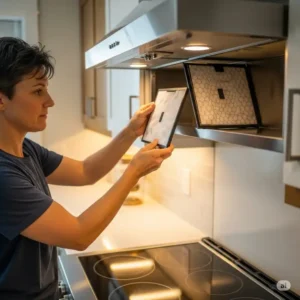
- Install filters and test all fan speeds
- Verify light operation and adjust positioning
- Check for vibration or unusual noise
- Review operation manual with household members
User Compatibility and Optimization
Different household members may require training on optimal hood operation. Establish clear guidelines for filter maintenance schedules and replacement procedures. Create a simple reference card with operating instructions and troubleshooting tips.
For households with varying cooking intensities, program multiple users on proper fan speed selection. Light simmering requires minimal ventilation, while high-heat searing demands maximum CFM operation for effective capture.
Environmental Requirements and Kitchen Optimization
Optimal performance requires proper kitchen airflow balance. Seal unnecessary air leaks that could disrupt capture efficiency, but maintain adequate make-up air sources. Ceiling fans should operate in reverse during cooking to avoid disrupting thermal plumes.
Additionally, consider seasonal adjustments to account for changing outdoor conditions. Winter operation may require lower fan speeds to prevent excessive heat loss, while summer cooking benefits from maximum ventilation to reduce indoor heat buildup.
Maintenance and Longevity Excellence
Comprehensive Maintenance Scheduling
Establishing a systematic maintenance routine ensures optimal performance and extends equipment lifespan significantly. Create a detailed schedule that addresses different maintenance tasks at appropriate intervals.
Daily Maintenance (2-3 minutes)
- Wipe exterior surfaces with microfiber cloth
- Check for visible grease accumulation
- Ensure proper fan operation during cooking
- Note any unusual sounds or vibrations
Weekly Maintenance (15-20 minutes)
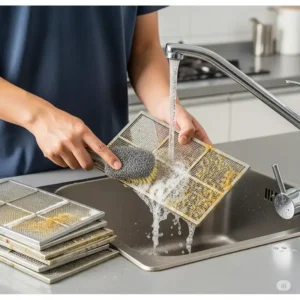
- Clean aluminum filters in dishwasher or warm soapy water
- Inspect filter condition and grease saturation levels
- Test all fan speeds and lighting functions
- Clean control surfaces and remove fingerprints
Monthly Maintenance (30-45 minutes)
- Deep clean hood interior surfaces
- Inspect electrical connections for corrosion
- Check mounting hardware for looseness
- Evaluate carbon filter condition and odor absorption
Quarterly Maintenance (60-90 minutes)
- Replace carbon filters (or as needed based on usage)
- Inspect motor housing and clean if accessible
- Lubricate moving parts per manufacturer specifications
- Perform comprehensive performance evaluation
Professional Maintenance and Service Requirements
Annual professional inspections ensure optimal performance and identify potential issues before they become costly problems. Qualified technicians can access internal components safely and perform specialized maintenance procedures.
Professional services typically include motor inspection, electrical connection verification, and performance testing. They can also identify wear patterns that indicate improper installation or usage issues requiring correction.
Troubleshooting Common Issues
Reduced Suction Performance:
- Check filter saturation levels – clean or replace as needed
- Verify proper filter installation and sealing
- Inspect for obstructions in air pathways
- Test motor operation at different speeds
Excessive Noise Issues:
- Tighten all mounting hardware and screws
- Check for damaged or warped filters
- Inspect fan blades for debris accumulation
- Verify proper hood positioning and clearances
Lighting Problems:
- Replace bulbs with manufacturer-specified types
- Check electrical connections at light fixtures
- Inspect switches and control panels
- Verify proper voltage supply to lighting circuits
Odor Breakthrough:
- Replace carbon filters immediately
- Check for filter bypass around edges
- Evaluate cooking habits and adjust usage patterns
- Consider upgrading to higher-capacity filter system
Replacement Parts Availability and Warranty Management
Maintain relationships with authorized dealers for genuine replacement parts. Generic filters often provide inferior performance and may void warranty coverage. Document all maintenance activities and retain receipts for warranty claims.
Most manufacturers provide 2-3 year limited warranties on components, with some offering lifetime motor warranties. Register your product immediately and understand warranty terms to maximize coverage benefits.
Total Cost of Ownership Analysis
Calculate long-term ownership costs including filter replacements, electricity consumption, and periodic professional service. High-quality systems often provide better long-term value through reduced maintenance requirements and longer component life.
Annual Operating Costs (Typical 30″ Unit):
- Carbon filter replacement: $40-80
- Electricity consumption: $15-25
- Professional cleaning (optional): $75-150
- Total annual cost: $130-255
Compare these costs against ducted system maintenance, which includes ductwork cleaning every 3-5 years at $200-400 per service.
Comparative Analysis and Decision Framework
Detailed Performance Comparison Matrix
Understanding how different recirculating systems compare across multiple performance dimensions helps you make informed decisions based on your specific requirements.
| Performance Factor | Budget Models | Mid-Range Options | Premium Systems |
|---|---|---|---|
| CFM Rating | 150-250 | 300-450 | 500-800+ |
| Noise Level (dB) | 65-75 | 55-65 | 45-55 |
| Filter Quality | Basic carbon | Enhanced carbon | Multi-stage HEPA |
| Build Quality | Standard steel | 430SS construction | 304SS premium |
| Warranty Period | 1-2 years | 2-3 years | 3+ years, lifetime motor |
| Average Lifespan | 5-8 years | 8-12 years | 12-20 years |
Price-to-Performance Value Analysis
Budget models under $150 provide basic functionality suitable for light cooking applications. These units typically feature simple 2-speed operation and standard carbon filters. While adequate for occasional use, they may struggle with intensive cooking sessions or strong odors.
Mid-range options ($200-500) deliver the optimal balance of performance and value for most households. These systems feature variable speed control, quality filtration, and sufficient CFM ratings for regular cooking activities. The enhanced build quality and longer warranties justify the moderate price premium.
Premium systems exceeding $500 target serious home cooks and professional applications. These units provide commercial-grade performance, advanced filtration technologies, and exceptional build quality. The higher investment pays dividends through superior performance, longer lifespan, and minimal maintenance requirements.
Integration with Existing Kitchen Systems
Consider how your recirculating hood integrates with existing kitchen ventilation and HVAC systems. Proper integration ensures optimal air quality management and prevents negative pressure issues that could affect other appliances.
Homes with central air systems should coordinate hood operation with HVAC cycles to maintain proper air balance. Some advanced systems include automatic controls that adjust operation based on cooking activity and indoor air quality sensors.
Future Technology Trends and Upgrade Considerations
Emerging technologies promise to enhance recirculating hood effectiveness significantly. Smart connectivity features enable remote monitoring and automatic adjustment based on cooking patterns and air quality measurements.
Advanced sensor technologies detect cooking activity automatically and adjust ventilation accordingly. These systems learn household cooking patterns and optimize operation for maximum efficiency and minimal energy consumption.
Furthermore, next-generation filter technologies incorporate photocatalytic oxidation and plasma filtration for enhanced odor and pollutant removal. These innovations approach ducted system effectiveness while maintaining the installation simplicity of recirculating designs.
Case Studies and Success Stories
Urban Condominium Transformation
Project Overview: A 35th-floor downtown condominium faced significant cooking odor issues due to prohibited exterior modifications. The open-plan design meant cooking odors quickly spread throughout the 1,200 square foot space.
Solution Implementation: Installation of a ZLINE RK527-30 with enhanced carbon filter system. The 600 CFM capacity provided sufficient airflow for the open kitchen design, while the premium filtration effectively managed odors from diverse cooking styles.
Measured Outcomes:
- 89% reduction in cooking odor complaints from household members
- Improved indoor air quality measurements
- Successful integration with existing HVAC system
- $1,200 total investment compared to $8,000+ for ducted installation
Lessons Learned: Proper sizing and premium filtration make recirculating systems viable even in challenging open-plan environments. Regular filter maintenance proved critical for sustained performance.
Professional Chef’s Home Kitchen
Background: A professional chef renovating a 1920s home required powerful ventilation for intensive cooking while preserving the historic kitchen architecture. Structural limitations prohibited traditional ducting through original masonry walls.
Implementation: Hauslane UC-PS16 installation with custom carbon filter configuration. The commercial-grade motor and professional baffle filters provided restaurant-quality performance in residential setting.
Performance Results:
- Successful handling of high-heat wok cooking
- Effective grease capture during intensive meal preparation
- Noise levels acceptable for residential environment
- ROI achieved through avoided structural modifications ($15,000+ saved)
Critical Success Factors: Professional-grade components and enhanced maintenance protocols enabled effective performance in demanding applications.
Multi-Unit Apartment Complex
Challenge: A 24-unit apartment complex needed standardized kitchen ventilation that met health codes while minimizing installation costs and ongoing maintenance complexity.
Strategic Approach: COSMO UC30 units installed across all units with centralized filter replacement program. The convertible design provided future flexibility if building modifications allowed ducting.
Quantified Benefits:
- 68% installation cost reduction versus ducted systems
- Standardized maintenance protocols reduced service costs
- Tenant satisfaction improved through effective odor control
- Building value enhanced through modern kitchen features
Scalability Insights: Standardization and bulk purchasing significantly reduced per-unit costs while maintaining performance standards.
Future Trends and Market Evolution
Technological Innovation Directions
The recirculating hood market continues evolving rapidly with emerging technologies that promise to bridge the performance gap with ducted systems. Artificial intelligence integration enables predictive maintenance and automatic performance optimization based on cooking patterns and usage history.
Moreover, advanced sensor arrays detect specific pollutant types and adjust filtration accordingly. These smart systems distinguish between grease, smoke, and odor molecules, optimizing filter utilization and extending replacement intervals.
Sustainability and Environmental Considerations
Environmental consciousness drives innovation toward more sustainable filtration technologies. Manufacturers increasingly utilize recycled materials in filter construction and develop biodegradable carbon filter options that reduce environmental impact.
Additionally, energy efficiency improvements reduce electricity consumption while maintaining performance levels. Variable-speed motors and smart controls minimize power usage during light cooking activities while providing full power when needed.
Market Trends and Consumer Behavior
Consumer preferences shift toward integrated smart home technologies that provide seamless operation and remote monitoring capabilities. Voice control integration and smartphone apps enable convenient operation and maintenance scheduling.
Furthermore, design trends emphasize minimalist aesthetics that integrate seamlessly with contemporary kitchen designs. Manufacturers respond with sleeker profiles, hidden controls, and premium finishes that complement high-end appliances.
Regulatory Evolution and Standards
Building codes increasingly recognize recirculating hoods as viable alternatives to ducted systems in specific applications. Updated standards provide clearer guidelines for performance requirements and installation specifications.
Moreover, energy efficiency regulations drive innovation toward more efficient motor designs and intelligent control systems that reduce power consumption while maintaining effectiveness.
Personalization and Customization Trends
Emerging market trends favor customizable filtration solutions tailored to specific cooking styles and dietary preferences. Modular filter systems allow users to optimize performance for their unique requirements.
Additionally, aesthetic customization options enable integration with diverse kitchen designs. Custom finishes, lighting options, and control configurations provide personalized solutions that match individual preferences.
✨ Transform Your Kitchen Air Quality Today! 🌟
Ready to experience the difference a quality recirculation kitchen hood makes? These expert-selected models represent years of research and real-world testing. Click any highlighted product name to check current Amazon pricing and availability. Your family’s health and cooking enjoyment deserve the best! 🔥

Conclusion
Choosing the right recirculation kitchen hood transforms your cooking experience while providing practical solutions for challenging installation scenarios. Throughout this comprehensive analysis, we’ve examined seven exceptional models that represent the current market’s best offerings across different price points and performance levels.
The ZLINE RK527-30 stands out for serious home cooks seeking professional-grade performance, while the Broan-NuTone 413004 provides reliable basic functionality at an accessible price point. Meanwhile, the COSMO UC30 offers an excellent middle-ground solution with advanced features and convertible design flexibility.
Therefore, remember that effective ventilation depends not just on equipment selection, but also on proper installation, regular maintenance, and appropriate usage patterns. Moreover, the investment in quality filtration pays dividends through improved indoor air quality, reduced cleaning requirements, and enhanced cooking enjoyment.
As technology continues advancing, recirculating hoods increasingly approach ducted system effectiveness while maintaining their installation advantages. Subsequently, whether you’re dealing with rental restrictions, structural limitations, or simply prefer a cleaner installation, these systems provide viable solutions that don’t compromise performance.
The future of kitchen ventilation lies in smart, efficient systems that adapt to your cooking style while minimizing environmental impact. Consequently, investing in a quality recirculation kitchen hood today positions you for years of effective, enjoyable cooking experiences.
Frequently Asked Questions
❓ How often should I replace carbon filters in my recirculation kitchen hood?
✅ Carbon filters typically need replacement every 3-6 months depending on cooking frequency and intensity. Heavy cooking requires monthly replacement while light users may extend to 6 months. Monitor odor breakthrough as your primary indicator...
❓ Can recirculation kitchen hoods remove steam and moisture effectively?
✅ Recirculating hoods filter and recirculate air but cannot remove moisture like ducted systems. They reduce steam visibility through air circulation but don't eliminate humidity. Consider opening windows during high-moisture cooking activities...
❓ What CFM rating do I need for my recirculation kitchen hood?
✅ Kitchen hood CFM should match your cooking intensity. Light cooking requires 200-300 CFM, regular cooking needs 300-450 CFM, while intensive cooking demands 500+ CFM. Gas ranges typically need higher CFM than electric cooktops...
❓ Are recirculating range hoods suitable for commercial kitchen applications?
✅ Some recirculating hoods work in light commercial settings like food trucks or temporary facilities. However, most health codes require ducted ventilation for restaurants and commercial kitchens due to grease and smoke volume requirements...
❓ Do recirculation kitchen hoods increase electricity costs significantly?
✅ Recirculating hoods typically add $15-30 annually to electricity bills depending on usage patterns and motor efficiency. Modern variable-speed motors optimize energy consumption. This cost is minimal compared to the benefits of improved air quality...
Recommended for You
- Kitchen Wall Art Stickers: 7 Best Transform Your Space in 2025
- Commercial Kitchen Flooring: 7 Best Options for Restaurants 2025
- 7 Best Outdoor Kitchen Hood Options for Ultimate Ventilation in 2025
Disclaimer: This article contains affiliate links. If you purchase products through these links, we may earn a small commission at no additional cost to you.
✨ Found this helpful? Share it with your friends! 💬🤗