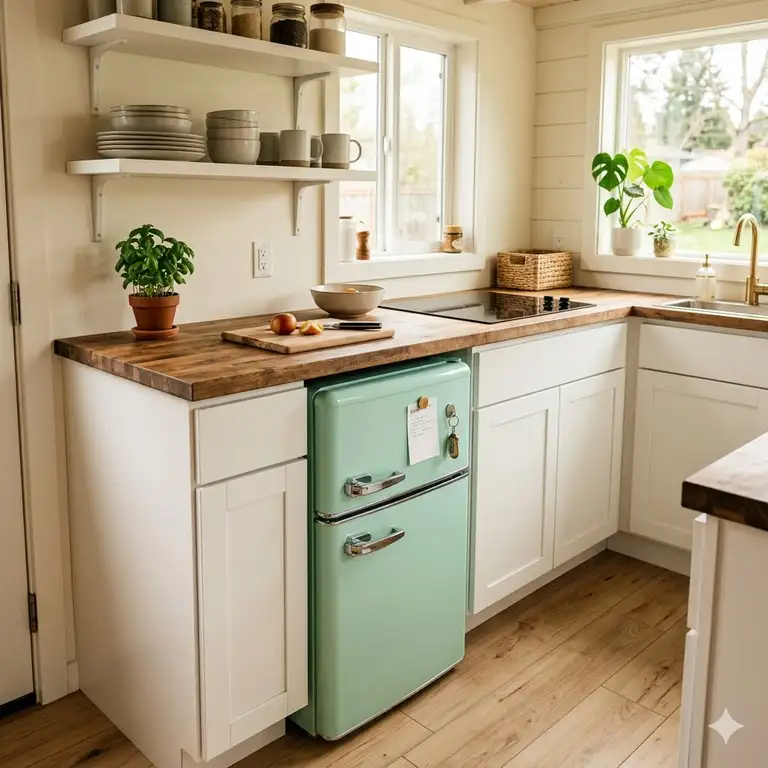
So, you’ve finally done it. You’ve ditched the mortgage, embraced the minimalism, and moved into a space that’s likely smaller than your childhood bedroom. Living in a tiny home is a dream, but let’s be real—the logistics can be a bit of a puzzle. Specifically, the kitchen. When every square inch of counter space is a hard-won victory, choosing a tiny house fridge isn’t just a shopping trip; it’s a strategic maneuver. I’ve spent a lot of time looking at how people maximize these small dwellings, and if there’s one thing I’ve learned, it’s that your refrigerator is the heart of the home, even if that heart is only 3 cubic feet.
✨Was this helpful? Spread the word! 🚀
In 2026, the technology behind the tiny house refrigerator has leaped forward. We aren’t just looking at “dorm fridges” anymore. We’re looking at high-efficiency, whisper-quiet machines that can run on solar power or tuck neatly under a custom-built walnut bench. Whether you are building a DIY shed-to-home or buying a luxury mobile estate, finding the right tiny house fridge requires balancing power consumption, dimensions, and—most importantly—how much ice cream you can actually fit inside.
Before we dive into the nitty-gritty of compressor types and BTU ratings, let’s look at how a specialized tiny home fridge stacks up against the massive stainless steel beasts you see in suburban mansions.
Table 1: Tiny House Fridge vs. Traditional Full-Sized Refrigerator
| Feature | Tiny House Refrigerator | Traditional Refrigerator |
| Average Capacity | 1.5 to 10 cubic feet | 18 to 30 cubic feet |
| Power Draw | 50W – 150W (Optimized) | 300W – 800W |
| Footprint | Approx. 2-4 sq. ft. | Approx. 9-12 sq. ft. |
| Weight | 30 – 120 lbs | 200 – 400 lbs |
| Off-Grid Capability | High (12V/Gas options) | Low (Requires heavy inverter) |
| Cooling Method | Compressor, Absorption, or Peltier | Primarily Compressor |
Quick Comparison: Top 7 tiny house fridge Models for 2026
If you are in a rush to get your kitchen sorted, here is a snapshot of the best units currently dominating the market in 2026. These have been vetted for reliability, efficiency, and real-world performance in small living environments.
Table 2: Top 7 Product Quick Comparison
| Product Name | Type | Capacity | Best For |
| Black+Decker BCRK17B | Compact | 1.7 Cu. Ft. | Ultra-minimalists |
| Midea WHD-113WSS1 | Double Door | 3.1 Cu. Ft. | Small families |
| SMAD 3-Way Refrigerator | Absorption | 1.4 Cu. Ft. | Off-grid living |
| BougeRV 12V Portable Fridge | Portable | 30 Quart | Mobile tiny homes |
| RCA RFR322 | Compact | 3.2 Cu. Ft. | Style & Color variety |
| Galanz GLR31TRDEER | Retro | 3.1 Cu. Ft. | Aesthetic enthusiasts |
| Avanti RA7316PST | Apartment Size | 7.4 Cu. Ft. | High-volume storage |
Top 7 tiny house fridge Options: Expert Analysis
Choosing the right tiny house fridge involves more than just measuring the width of your cabinet. You need to understand the cooling mechanism and how it interacts with your home’s electrical system. Below is a deep dive into the top contenders for 2026.
1. Black+Decker BCRK17B Compact Refrigerator
This is the “old faithful” of the tiny home world. The Black+Decker BCRK17B is a square-back design that fits almost anywhere. It’s incredibly popular for those who don’t need a massive freezer and want to keep their energy bill low.
-
Technical Specifications: 1.7 Cubic Feet capacity, adjustable thermostat, reversible door, and a dedicated ice cube tray. Dimensions: 17.5 x 18.5 x 19.7 inches.
-
Customer Review Analysis: Users frequently praise its silence. In a tiny house, a loud compressor can feel like a jet engine. Most reviews highlight that it reaches target temperatures within two hours. Some users noted that the freezer section is only good for ice, not long-term frozen food storage.
-
Warranty: 1-year parts and labor; 2-year compressor warranty.
-
Professional Applications: Perfect for office-based tiny dwellings or as a secondary beverage cooler in a larger tiny home refrigerator setup.
-
Pros:
-
Ultra-compact footprint.
-
Energy Star certified.
-
Flat back design allows for flush installation.
-
-
Cons:
-
Very small freezer.
-
Manual defrost required.
-
2. Midea WHD-113WSS1 Double Door Compact Fridge
If you actually cook and need to keep frozen veggies or meat, the Midea WHD-113WSS1 is a game changer. It features a separate freezer door, which is a luxury in the tiny house fridge category.
-
Technical Specifications: 3.1 Cubic Feet, separate freezer compartment, adjustable legs, and interior lighting. Dimensions: 18.5 x 19.4 x 33 inches.
-
Customer Review Analysis: Reviewers love the “real fridge” feel. The separate freezer prevents the main compartment from getting too cold. A common point of feedback is the need for 5 inches of clearance for the door to swing fully open.
-
Warranty: 1-year limited warranty.
-
Professional Applications: Best for permanent tiny home residents who meal prep.
-
Pros:
-
Separate freezer keeps ice cream solid.
-
Quiet operation (approx. 42 dB).
-
Fruit and vegetable crisper drawer included.
-
-
Cons:
-
Heavier than single-door models.
-
Requires more vertical space.
-
3. SMAD 3-Way Refrigerator (Propane/AC/DC)
For the true off-grid pioneer, the SMAD 3-Way Refrigerator is a masterpiece of versatility. It doesn’t use a compressor; instead, it uses an absorption system that can run on electricity or propane.
-
Technical Specifications: 1.4 Cubic Feet, 3-way power (110V AC, 12V DC, or LPG), no moving parts (silent). Dimensions: 15.8 x 15.8 x 25 inches.
-
Customer Review Analysis: Customers are obsessed with the silence. Since there is no compressor, it makes zero noise. However, users warn that it must be perfectly level to function correctly, which can be tricky in a tiny home on wheels.
-
Warranty: 1-year manufacturer warranty.
-
Professional Applications: Remote cabins, off-grid schoolies, and solar-powered tiny homes.
-
Pros:
-
Completely silent.
-
Runs on gas if your solar batteries are low.
-
No vibration.
-
-
Cons:
-
Cooling takes longer than compressor models.
-
Requires proper venting for propane use.
-
4. BougeRV 12V Portable Fridge (30 Quart)
Sometimes the best fridge for tiny home living isn’t a “fridge” in the traditional sense. The BougeRV 12V Portable Fridge is a chest-style cooler that uses a high-efficiency compressor.
-
Technical Specifications: 28-liter capacity, 12V/24V DC or 110V-240V AC power, -4°F to 50°F range. Dimensions: 22.6 x 12.6 x 13.8 inches.
-
Customer Review Analysis: Users highlight the incredible efficiency. It draws very little power, making it ideal for 200W-400W solar setups. The chest design is also praised for “keeping the cold in” when the lid is opened.
-
Warranty: 2-year warranty on the compressor and 1-year on other parts.
-
Professional Applications: Mobile tiny homes, van conversions, and outdoor kitchens.
-
Pros:
-
Extremely energy efficient.
-
Can act as either a fridge or a freezer.
-
Highly durable for travel.
-
-
Cons:
-
Chest style means you have to dig for items at the bottom.
-
Small capacity for full-time living.
-
5. RCA RFR322 Single Door Fridge with Freezer
The RCA RFR322 is the quintessential budget-friendly tiny home refrigerator. It comes in a variety of colors, allowing you to add a pop of personality to your kitchen.
-
Technical Specifications: 3.2 Cubic Feet, built-in can dispenser, adjustable thermostat, and reversible door. Dimensions: 17.5 x 18.5 x 31.5 inches.
-
Customer Review Analysis: Most buyers mention the “bang for your buck.” It offers a lot of space for a low price point. Some reviews mention that the back can get warm, so it needs decent ventilation.
-
Warranty: 1-year limited warranty.
-
Professional Applications: Guest tiny houses or “ADUs” (Accessory Dwelling Units).
-
Pros:
-
Very affordable.
-
Available in purple, red, blue, and black.
-
Includes a can rack in the door.
-
-
Cons:
-
Shelves are not very adjustable.
-
Compressor click is audible.
-
6. Galanz GLR31TRDEER Retro Compact Refrigerator
For those following the 2026 trend of “Modern Nostalgia,” the Galanz GLR31TRDEER offers a stunning 1950s aesthetic with modern cooling technology.
-
Technical Specifications: 3.1 Cubic Feet, dual door, retro chrome handle, glass shelves. Dimensions: 19.17 x 23.31 x 35.16 inches.
-
Customer Review Analysis: People buy this for the looks, but stay for the performance. It’s frequently cited as the most “Instagrammable” fridge. Reviews mention that it feels sturdier than cheaper plastic models.
-
Warranty: 1-year warranty.
-
Professional Applications: Boutique tiny home rentals and high-end tiny home refrigerator designs.
-
Pros:
-
Beautiful retro design.
-
Solid build quality.
-
Clear glass shelves make it easy to see food.
-
-
Cons:
-
Slightly larger footprint.
-
Premium price for the design.
-
7. Avanti RA7316PST 2-Door Apartment Size Refrigerator
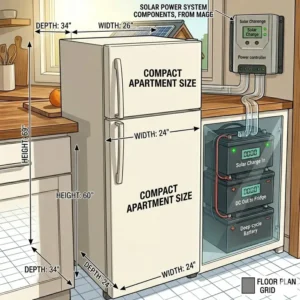
If you are living in a “giant” tiny house (say, 400 square feet), you might want a “large” tiny home fridge. The Avanti RA7316PST provides nearly double the space of standard compacts.
-
Technical Specifications: 7.4 Cubic Feet, top-mounted freezer, glass shelves, door storage for 2-liter bottles. Dimensions: 21.5 x 23 x 56 inches.
-
Customer Review Analysis: Families living in tiny homes swear by this. It’s narrow enough to fit in tight galleys but tall enough to hold a week’s worth of groceries.
-
Warranty: 1-year limited warranty.
-
Professional Applications: Large-scale tiny houses and park models.
-
Pros:
-
Massive storage compared to other small units.
-
Modern stainless steel finish.
-
Energy efficient for its size.
-
-
Cons:
-
Too tall for many under-counter installations.
-
Heavier (over 90 lbs).
-
✨ Upgrade Your Tiny Living Experience Today!
🔍 Ready to finalize your tiny house kitchen? Don’t settle for lukewarm drinks or spoiled milk. Click on any of the products above to check the latest 2026 pricing and availability on Amazon. Your perfect tiny house fridge is just a click away! 🏠❄️
💬 Just one click – help others make better buying decisions too!😊
Deep Dive: The Science of the tiny home fridge
When I first started researching appliances for small spaces, I thought a fridge was just a fridge. I was wrong. The physics of cooling changes when you are dealing with confined spaces. In a standard home, a refrigerator has plenty of “breathing room.” In a tiny house, your fridge might be squeezed between a compost toilet and a loft ladder.
Cooling Technology: Compressor vs. Absorption
Most tiny home refrigerator units use a Compressor. This is the same tech in your big house fridge. It’s efficient and cools down fast. However, it makes a “humming” sound.
Absorption fridges, like the SMAD mentioned earlier, use a heat source (like a propane flame or electric element) to move a chemical coolant. These are silent. If you are a light sleeper and your bed is three feet from the kitchen, this matters.
Table 3: Cooling Technology Comparison
| Feature | Compressor Fridge | Absorption Fridge |
| Noise Level | Low Hum (35-45 dB) | Silent (0 dB) |
| Cooling Speed | Fast (1-2 hours) | Slow (6-12 hours) |
| Power Sensitivity | Sensitive to voltage drops | Can run on LPG/Propane |
| Leveling | Not strictly necessary | MUST be level to work |
| Efficiency | High | Medium to Low |
The 12V Revolution
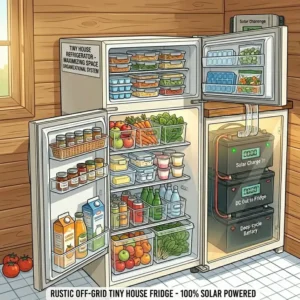
In 2026, the tiny home fridge market is moving heavily toward 12V DC power. Why? Because most tiny homes use solar panels. Converting solar energy (DC) into wall outlet power (AC) through an inverter causes about a 10-15% energy loss. Running a fridge directly on 12V DC is much more efficient. If you are planning to live off-grid, searching specifically for a 12V tiny house refrigerator will save you a fortune in battery costs.
According to the U.S. Department of Energy, refrigeration accounts for about 3% of the average home’s energy use, but in a tiny house, that percentage can skyrocket to 30% if you aren’t using an efficient model.
Key Benefits of a Specialized tiny house refrigerator
You might be tempted to just grab a cheap $99 dorm fridge from a big-box store. Resist the urge! A dedicated tiny house refrigerator is designed for a different lifestyle.
-
Variable Speed Compressors: Modern tiny house fridges often use digital inverters. Instead of being “all on” or “all off,” they ramp up and down, saving massive amounts of power.
-
Superior Insulation: Because they are smaller, manufacturers often use high-density foam or Vacuum Insulation Panels (VIPs) to keep the cold in without making the walls too thick.
-
Vibration Resistance: If your tiny house is on wheels, a standard fridge’s internal components might rattle loose after 500 miles on the highway. A mobile-optimized tiny home fridge is built to handle the road.
Table 4: Benefits of Specialized Tiny House Fridges vs. Dorm Fridges
| Benefit | Tiny House Specific | Standard Dorm Fridge |
| Energy Usage | 0.5 – 1.0 kWh/day | 1.5 – 2.5 kWh/day |
| Durability | High (Vibration resistant) | Low (Static use only) |
| Interior Layout | Optimized for full meals | Optimized for sodas/snacks |
| Climate Class | T (Tropical) – works in heat | N (Normal) – struggles in heat |
Installation and Maintenance for your tiny home refrigerator
I’ve seen many people buy the perfect fridge only to have it die six months later. Why? Ventilation. A refrigerator doesn’t “create cold”; it “removes heat.” That heat has to go somewhere. If you build your tiny house fridge into a tight cabinet without any airflow, the heat builds up, the compressor works overtime, and eventually, it burns out.
Pro Tips for Installation:
-
The 2-Inch Rule: Always leave at least 2 inches of space on the sides and 4 inches at the back for airflow.
-
Vent it Out: If possible, install a small vent in your cabinetry that leads to the main living area or outside.
-
Leveling is Key: Use a bubble level. An unlevel fridge causes the coolant to pool incorrectly, which can lead to permanent damage.
Table 5: Installation Requirements Matrix
| Fridge Type | Side Clearance | Rear Clearance | Top Clearance |
| Compact Compressor | 1 inch | 2 inches | 2 inches |
| Absorption (Gas) | 2 inches | 4 inches (Critical) | 6 inches |
| Chest Style | 1 inch | 1 inch | Open (for lid) |
| Apartment Size | 2 inches | 3 inches | 4 inches |
The Maintenance Checklist
Maintaining your tiny house refrigerator is easier than a large one, but it’s still necessary.
-
Defrosting: Most small fridges are manual defrost. When the ice on the back wall gets thicker than a pencil, it’s time to melt it. Thick ice acts as an insulator, making the fridge work harder.
-
Coil Cleaning: Every six months, pull the fridge out and vacuum the dust off the coils. Dust is the enemy of efficiency.
Analyzing the tiny house fridge Market: Budget vs. Premium
How much should you spend? In 2026, the price range for a tiny house fridge is wider than ever. You can find basic units for $200, while high-end marine-grade units can top $2,000.
Table 6: Budget vs. Premium Features
| Feature | Budget ($200 – $450) | Premium ($500 – $1,500+) |
| Cooling Tech | Basic Compressor | Digital Inverter / 3-Way |
| Shell Material | Painted Steel/Plastic | Stainless Steel / Marine Grade |
| Noise Level | 45+ dB | Under 38 dB |
| Control | Analog Dial | Digital LCD Touchscreen |
| Warranty | 1 Year | 2-5 Years |
If you are a weekend warrior, a budget RCA or Black+Decker is perfect. But if you are living the “Tiny Life” full-time, I strongly recommend investing in a premium tiny home refrigerator. The energy savings alone will pay for the difference over three years.
Buyer’s Guide: How to Choose Your tiny home fridge
When you are scrolling through Amazon, it’s easy to get overwhelmed. Here is my personal framework for choosing a tiny house fridge:
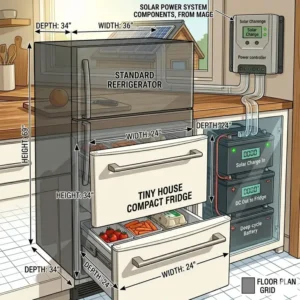
1. Measure Your “Max Dimensions”
In a tiny house, the fridge usually has to fit into a specific “niche.” Don’t just measure the hole; measure the path to the hole! I once knew someone who bought a beautiful tiny home fridge that couldn’t fit through the front door of their tiny house. Measure twice, buy once.
2. Calculate Your Power Budget
Are you plugged into a 50-amp RV hookup, or are you running on four lithium batteries?
-
Shore Power: Any 110V AC fridge works.
-
Solar Power: Look for a 12V DC tiny house refrigerator.
-
Propane: Look for a “3-way” absorption model.
3. Consider Your Diet
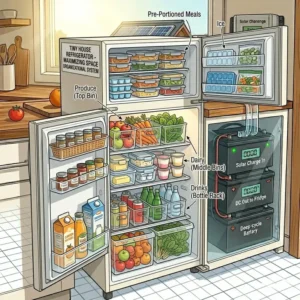
Do you eat out a lot, or are you a home chef? If you love fresh greens, you need a model with a dedicated crisper drawer. If you live on frozen pizza, a single-door model with a tiny “ice box” will lead to a very sad, soggy pizza experience.
4. Noise Tolerance
In a 200-square-foot house, you are never more than 10 feet from your fridge. If you are sensitive to noise, look at the decibel (dB) ratings. Anything under 40 dB is considered “whisper quiet.”
Table 7: Noise Level Reference for Tiny Living
| Sound Level | Description | Suitability for Tiny Homes |
| 30 dB | Whisper | Perfect (Hardly noticeable) |
| 40 dB | Library Quiet | Good (Noticeable only at night) |
| 50 dB | Rainfall | Fair (Might be annoying during sleep) |
| 60 dB | Normal Conversation | Poor (Will feel intrusive) |
Table 8: Performance Metrics by Climate
| Fridge Model | Cold Performance (32°F ambient) | Hot Performance (95°F ambient) |
| Compressor Units | Excellent | Excellent |
| Absorption Units | Good | Poor (Struggles to stay cold) |
| Thermoelectric | Poor | Very Poor |
Advanced Considerations: Aesthetics and Integration
Let’s talk about style for a moment. In 2026, the “clunky white box” look is out. Tiny house owners are treating their appliances like furniture.
Custom Panels
Some high-end tiny home fridge models allow for “panel-ready” installation. This means you can attach a piece of wood to the front of the fridge that matches your cabinets. When the door is closed, the fridge completely disappears. This is a fantastic trick to make a tiny kitchen feel much larger and more cohesive.
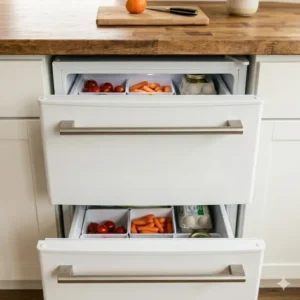
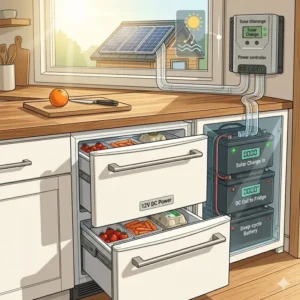
Drawer Fridges
One of the hottest trends in 2026 is the refrigerator drawer. Instead of a door that swings out (and hits your shins), you have a drawer that slides out. These are incredibly space-efficient because they can be installed under a counter or even under a bed. While they are more expensive, the ergonomic benefits in a tiny house are huge.
Table 9: Space-Saving Comparison
| Design Style | Space Impact | Ease of Access | Aesthetic Value |
| Standard Swing Door | High (Needs swing room) | High | Standard |
| Chest Style | Low (Top opening) | Medium (Must dig) | Low (Looks like a cooler) |
| Drawer Style | Minimal | Very High | Premium |
Table 10: Warranty and Support Comparison
| Brand | Warranty Period | Support Reputation | Parts Availability |
| Black+Decker | 1 Year | Excellent | Very High |
| Midea | 1 Year | Good | High |
| SMAD | 1 Year | Moderate | Moderate |
| BougeRV | 2 Years | Excellent | High |
| Galanz | 1 Year | Good | High |
✨ Take the Leap into Tiny Living!
🔍 Ready to make the move? Your kitchen is the heart of your home, and the right tiny house fridge is the heart of your kitchen. Check out our top picks on Amazon now and take advantage of the latest 2026 deals. Your minimalist dream is waiting! 🏠✨
Conclusion: Finding Your Perfect tiny house fridge
At the end of the day, your choice of a tiny house fridge comes down to how you live. If you are a digital nomad constantly on the move, a rugged 12V portable fridge like the BougeRV is your best friend. If you are building a permanent sanctuary in the woods and want a kitchen that looks like a magazine spread, the Galanz Retro or the Avanti apartment-sized unit will serve you best.
Don’t forget to prioritize energy efficiency. In 2026, we are more conscious than ever about our carbon footprint and our utility bills. A fridge that saves you 1 kWh per day might not sound like much, but over the course of a year, that’s 365 kWh—roughly enough to power the rest of your tiny home for a month!
Living small doesn’t mean living with less quality. It means choosing items that work twice as hard in half the space. Your tiny house refrigerator is more than just a box for your milk; it’s a vital component of your freedom. Take the time to choose the one that fits your space, your power, and your soul.
FAQs
✅ For off-grid setups, a 12V DC compressor fridge is the gold standard. These units bypass the energy loss of inverters, drawing significantly less power from your solar battery bank. Brands like BougeRV and Dometic lead this category for 2026...
✅ You can, but it's not ideal. Standard dorm fridges are often poorly insulated and use cheaper, louder compressors. They consume more power than specialized tiny home refrigerator models and aren't designed to handle the vibrations of a mobile home...
✅ Airflow is key. Because spaces are small, odors linger. Keep an open box of baking soda inside and ensure the defrost drain isn't clogged. Cleaning the door seals every month prevents mold growth in humid tiny house environments...
✅ It depends on your power source. A 3-way fridge is better if you rely heavily on propane and want total silence. However, compressor fridges cool faster and are much more efficient when running on electricity or solar power...
✅ A single person usually thrives with 2.5-3.5 cubic feet. For couples, 4-7 cubic feet is recommended. If you shop at farmers' markets once a week, lean toward the larger end of the spectrum to accommodate fresh produce... ❓ What is the most energy-efficient tiny house fridge for off-grid living?
❓ Can I use a standard dorm fridge in my tiny house?
❓ How do I stop my tiny house refrigerator from smelling?
❓ Is a 3-way fridge better than a compressor fridge?
❓ How much space do I really need in a tiny house fridge?
Recommended for You
- Wolfgang Puck Cookware Review: 7 Best Sets and Pans Tested for 2026
- Cookware Sets With Removable Handles: 7 Best Space-Saving Sets for 2026
- 7 Best Nesting Cookware Set Options to Save Kitchen Space (2026)
Disclaimer: This article contains affiliate links. If you purchase products through these links, we may earn a small commission at no additional cost to you.
✨ Found this helpful? Share it with your friends! 💬🤗